1. A Psychologist Who Went Undercover to Study 'How People Get Persuaded'
Robert Cialdini is a social psychologist. To study how people get persuaded, he did something ruthless—he spent three years going undercover inside the training sessions of professional persuaders: car salesmen, insurance agents, fundraisers, and even phone scammers. He wanted to see from the inside what techniques actually make people hand over their money.
In 1984, he wrote up his findings in Influence. The book distilled six principles of persuasion, sold millions of copies over 40 years, and became a classic in marketing, negotiation, and psychology.
But I didn't read this book to learn how to persuade others. I read it to figure out how the market persuades me. Because these six principles explain almost perfectly—why bubbles form, why retail investors chase rallies, why a single KOL can move an entire sector.
This book is the academic prototype of Munger's "lollapalooza effect" (the stacking of multiple psychological biases). Munger himself recommended it strongly.
2. Of the Six Principles, the Three Most Lethal for Investors
Cialdini's six principles are: reciprocity, commitment & consistency, social proof, liking, authority, and scarcity. I'll pick the three most lethal for investing.
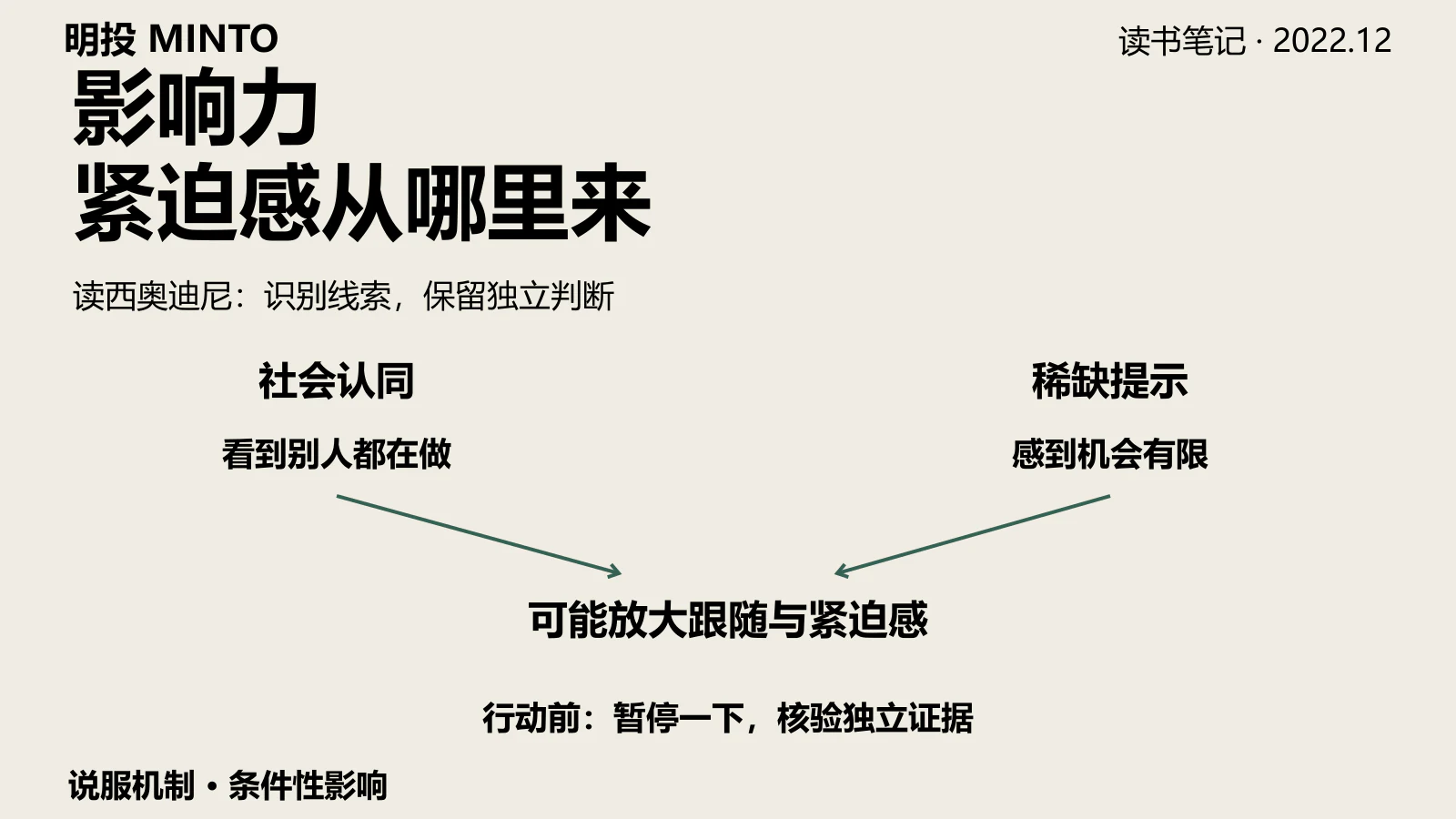
First, social proof. When people are uncertain, they look at what others are doing to decide what to do. The more uncertain, the more they rely on others.
This is the engine of market bubbles. When a stock shoots up, you're not sure whether to buy—then you see "everyone is buying," the social proof button is pressed, and you buy along. You buy because 'everyone else is buying,' not because the company is good. The 2021 meme stocks, the crypto mania, the 2000 dot-com bubble—all of it is social proof at its most extreme.
Second, scarcity. "The fewer the opportunities, the more valuable they are" and "miss it and it's gone." FOMO is essentially the scarcity principle in action.
The financial world is full of scarcity language—"last chance to get in," "this wave won't come again for a decade," "limited allocation." These phrases hit your scarcity button and make you act impulsively before you've thought it through. Real opportunities never shout 'last chance'; the ones that do are usually asking you to catch a falling knife.
Third, commitment & consistency. Once people make a commitment (especially a public one), they feel intense pressure to be consistent.
This is extremely dangerous in investing—once you go public with a bullish call (posting on social media, telling a friend, recommending in a group chat), you are hijacked by the consistency principle. Even if the fundamentals deteriorate, you'll subconsciously defend your call, ignore contrary evidence, and hold on until it hurts. Going public is the fastest way to lose your rational grip. That's one reason I never publicly call specific stocks.
3. Why Understanding This Protects You
Cialdini's core point is that these six principles are automatic reactions. They were useful shortcuts in our evolutionary past (following the crowd was usually safer; scarce things were usually more valuable), so they got wired into the brain. The problem is that modern persuaders (and markets) have learned to trigger these buttons artificially.
The key insight is—you can't turn off these buttons, but you can recognize the moment they are being pressed.
Cialdini says that when you feel a sudden urge to "act now," that's often a signal that some button has been pressed. That feeling of urgency is itself an alarm.
I have a personal rule—any investment opportunity that makes me feel 'I must act now or I'll miss it' gets a mandatory 48-hour wait. Because urgency is almost always scarcity or social proof at work, and a truly rational opportunity will survive the wait. If an opportunity disappears in 48 hours, it probably wasn't an opportunity in the first place.
4. Where I Disagree with Cialdini
1. This book teaches defense, but it also teaches offense.
Cialdini wrote it to help people defend against manipulation. But the reality is that more people use it as a textbook for manipulation. Marketers, pyramid schemers, scammers, and financial charlatans all use these six principles. A book that tried to protect ordinary people has become a tool kit for hurting them. The irony is not lost on Cialdini himself.
2. It portrays people too mechanically.
Cialdini describes people as machines that react when a button is pressed. But people are not that simple—the same scarcity pitch makes one person buy impulsively and another shrug. The difference lies in the degree of awareness and past experience. The book doesn't explain well why some people are more resistant to manipulation. It treats people as passive reactors, underestimating the role of awareness and training.
3. He didn't explore how these principles amplify at the group level.
Cialdini studied one-on-one persuasion (salesperson to customer). But markets are many-to-many—when social proof meets social media, it amplifies exponentially. One person sees others buying and follows; when millions see on social media that "everyone is buying," that social proof self-reinforces into frenzy. The jump from individual persuasion to crowd mania requires Soros (reflexivity) and Shiller (narratives) to complete the picture.
4. Digital-age manipulation is far more sophisticated than what he described.
The book was written in 1984, about face-to-face sales. Today's manipulation is algorithm-driven—recommendation algorithms, filter bubbles, instant feedback loops, gamification. These are orders of magnitude more precise and scalable than any 1980s salesman. A single app today can manipulate you with a power a thousand times greater than the best salesman of 1984. The principles still hold, but the intensity of manipulation he described is severely outdated—the real world is far more dangerous.
5. Cialdini vs. Munger: The Same Truth, Two Uses
Munger's "Human Misjudgment Psychology" and Cialdini's six principles talk about largely the same things. But their usage differs.
Cialdini takes the social psychologist's view—he focuses on "how others manipulate you," teaching you to defend against external persuasion.
Munger takes the investor's view—he focuses on "how you manipulate yourself," teaching you to defend against internal biases.
One defends outward (don't get conned by others), the other defends inward (don't con yourself).
But in investing, the two are connected—the market's manipulation (social proof, scarcity) works exactly through your internal biases (herding, loss aversion). External buttons and internal weaknesses are two sides of the same coin.
My own posture—use Cialdini to detect when the market is pressing my buttons; use Munger to detect when my own weaknesses are responding. Together, the two perspectives give you a complete defense against the market's emotional harvesting.
6. Final Thoughts
What struck me most about this book isn't the manipulation techniques—it's a fundamental fact: these six buttons were installed before you were born. They are products of evolution, not choices you made. You cannot uninstall them.
That means—as long as you're human, you will be influenced by market sentiment, no matter how smart or experienced you are. The difference isn't "whether you get influenced" but "whether you can detect the moment you're being influenced."
The biggest takeaway from reading this book is a habit of constant self-monitoring—when I feel "I must buy now," "everyone is making money except me," "this is the last chance," I stop and ask: Is this my judgment, or is my button being pressed?
Most of the time, it's the button.
And that moment of pause—not a smarter analysis, just a simple brake—is often the only difference between a rational investor and an emotional retail target.
Cialdini spent three years undercover to write a book that shows you where those buttons are.
The rest is whether you can recognize them the instant they're pressed.
That's a lifetime practice.
专注投资分析、市场洞察与资产配置。不追短期波动,只理解真正驱动长期回报的东西。