跳到正文 · Skip to content
内容
关于与合作
订阅与会员
★ 查看会员权益
外观与设置
外观
主题色
版本 · 深色 / 减动搜索⌘K
草稿预览·这篇还没发布,不会出现在列表和 RSS 里。review 完后把 frontmatter 的 draft: true 改为 false 即可。

The Fate of Tech Companies Lies in a Law Called 'Gene'

Wu Jun articulates a brutal law: the gene a company forms in its golden age is both the reason for its rise and the destiny of its decline.

2024.02.207 min原创
The Fate of Tech Companies Lies in a Law Called 'Gene'

1. A Tech Company Rise-and-Fall History Written by an Engineer

Wu Jun is a unique author—an early Google researcher, NLP expert, who later became a venture capitalist and wrote a series of bestselling popular science and business books. In 2011, he published The Wave, a history of the rise and fall of Silicon Valley tech companies.

The most valuable part of this book is not the company stories it tells (AT&T, IBM, Apple, Microsoft, Google), but the several laws Wu distilled from these stories—especially his insight into "gene determinism."

As someone who both understands technology and has done investing, Wu has a unique perspective on tech companies— he can see both the essence of technology and the logic of business. This allows him to explain phenomena that pure tech experts or pure business experts cannot.

For an investor focused on tech stocks, this book provides a practical framework for understanding "why tech companies rise and why they fall."

2. The Core Insight: A Company's "Gene Determinism"

Wu's most famous idea is the "gene determinism" of tech companies—

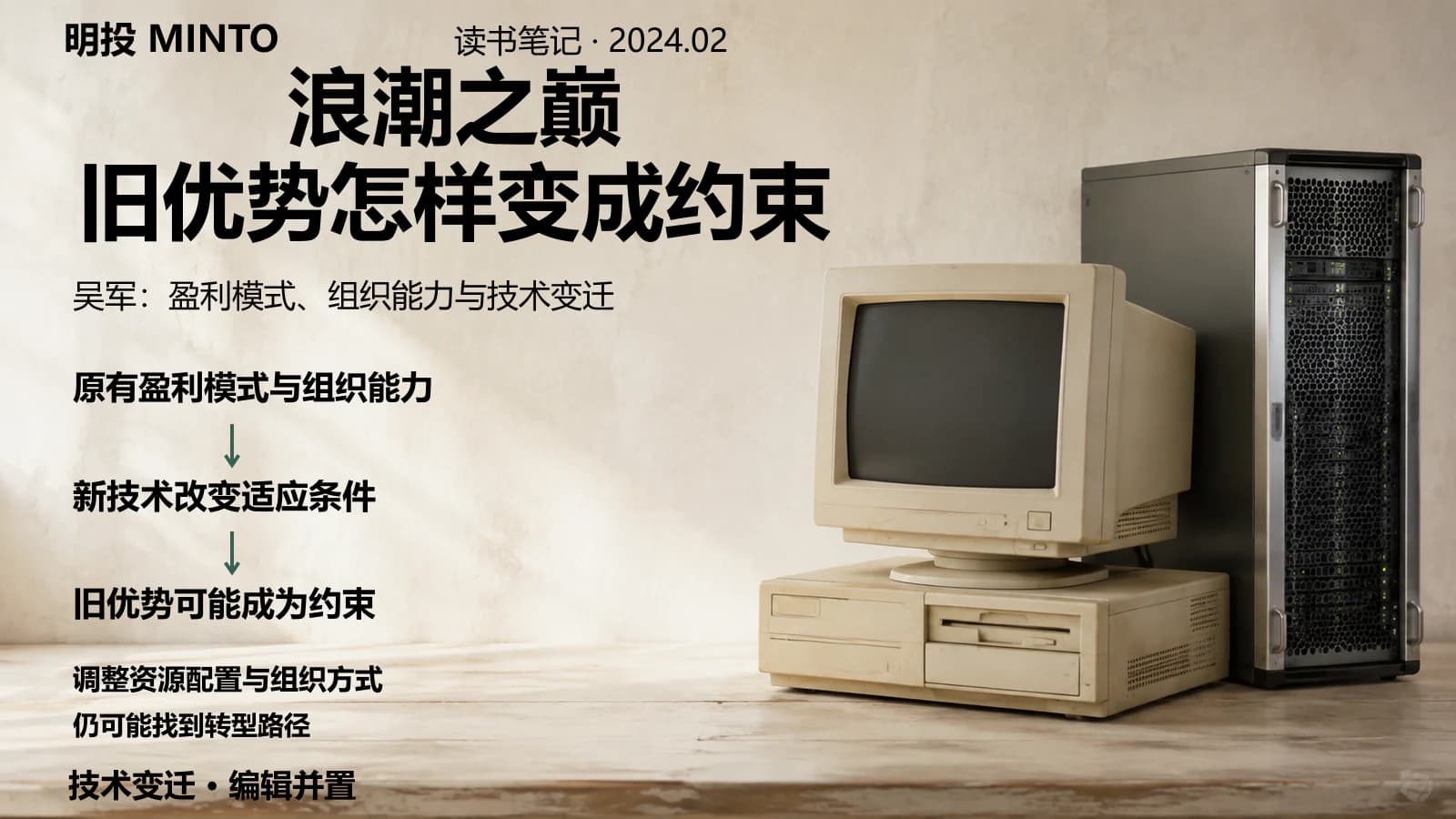
A company, during its golden age of rise, forms a unique "gene" (culture, organization, profit model, core competency). This gene makes it extremely successful in that era. But the same gene makes it extremely difficult to transform in the next era.

The classic example is Microsoft—its gene is "selling software licenses + Windows/Office desktop hegemony." This gene made it dominate the PC era. But the same gene caused it to fail almost completely in the mobile era (Windows Phone disaster)—because the "sell licenses" gene couldn't adapt to the mobile era's "free + service" model. (Note: Microsoft later successfully transformed under Nadella's cloud leadership, which is an extremely rare case of "changing the gene.")

Wu's insight is— companies are like organisms; their genes are locked in during their golden age, and this set of genes is both the reason for their success and their destiny of being unable to adapt to the next era.

This echoes Christensen (The Innovator's Dilemma), Grove (Strategic Inflection Points), and West (companies die)—but Wu uses the "gene" metaphor, giving it a particularly vivid, Eastern expression.

3. Practical Tools for Investors

Wu's framework offers several practical tools for tech stock investors:

First, to judge whether a company can transform, first see if its "gene" conflicts with the new era. If the gene (profit model, organizational culture) that a company relies on for current success fundamentally conflicts with a new trend (like AI), then transformation is extremely difficult, even if the company has money, talent, and technology. Google's search advertising gene fundamentally conflicts with the new model of "AI directly giving answers, no need to click links"—this is why Google is so anxious in the AI era, despite having the strongest technology.

Second, the "70-20-10" attention rule. Wu observes that successful tech companies should allocate most resources (70%) to core business, 20% to related expansions, and 10% to disruptive new directions. A company that never invests in "disrupting itself" will be disrupted externally; a company that randomly invests in the future while its core business is still stable will lose focus. When looking at a tech company's capital allocation (remember that piece on Buffett), this ratio is a useful reference.

Third, "Moore's Law" and "gene continuity" determine industry structure. Wu emphasizes that in tech, the speed of technological progress (exponential progress a la Moore's Law) determines the pace of industry churn. The faster the change, the easier it is for an incumbent's "gene advantage" to become a "gene burden." This is why leadership changes in hard tech happen much faster than in traditional industries—the exponential progress of technology constantly turns old genes into old burdens.

4. Where I Differ from Wu Jun

First, "gene determinism" is too fatalistic.

Wu's "gene determinism" is insightful, but it's too fatalistic— it almost implies that companies cannot change their genes, so decline is inevitable. But reality has counterexamples— Microsoft successfully changed its genes under Nadella (from selling software to selling cloud services), Amazon constantly disrupts its own genes, Apple transformed from a computer company to a consumer electronics + services company. These prove— genes can be changed, though extremely difficult. Wu underestimates the possibility of "exceptional leadership + special mechanisms" breaking through gene destiny. This book was written in 2011, before Microsoft's subsequent comeback, so "gene determinism" appears more absolute than it actually is.

Second, its judgments have a "hindsight" component.

Wu's company rise-and-fall stories are mostly already happened—he explains "why IBM declined, why Google rose." These ex-post explanations are brilliant, but explaining everything post-hoc with "gene" borders on circular reasoning—success means "its genes were good," failure means "its genes couldn't adapt to the new era." The real test is pre-hoc prediction, and the "gene theory's" predictive power is far weaker than its explanatory power. This is a common flaw in almost all "law-like" business books.

Third, it's biased towards "large company perspective," weak on explaining "new species."

Wu's framework excels at explaining "why existing large companies decline." But it's weak at explaining "why new species (startups) suddenly rise." Tesla, Nvidia (before AI), OpenAI—these companies' rises don't fit the "gene" framework well, because they are new, without the baggage of old genes. Wu's perspective is useful for judging "who will decline," but of limited help for discovering "who will rise." And the latter is precisely where the biggest investment opportunities lie.

Fourth, its timeliness issue (written in 2011).

This book was written in the early mobile internet era, and its judgments of that era are accurate. But it completely lacks the AI variable. Looking at tech company rise-and-fall today, AI is the overwhelming new variable—it is rewriting the "gene fitness" of all companies. Wu's 2011 framework remains useful (the logic of gene determinism hasn't changed), but specific judgments need to be re-evaluated through the new prism of AI. For example—which companies' genes are fit for the AI era, and which fundamentally conflict with AI—this is something a 2011 book cannot answer.

5. Wu Jun vs. Christensen: East and West "Disruption" Theories

Wu's "gene determinism" and Christensen's "Innovator's Dilemma" talk about almost the same thing— why successful large companies get disrupted—but with different styles and perspectives.

Christensen is the Western academic school—he uses rigorous case studies, precise mechanisms (entering from low end, moving upmarket), to build an analyzable theoretical framework.

Wu is the Eastern practice school—he uses the vivid biological metaphor of "gene," plus his first-hand observations as a Google insider + investor, to give a more intuitive, grounded explanation.

Christensen tells you the 'mechanism' of disruption (how it happens); Wu tells you the 'sense of destiny' of disruption (why it's almost inevitable).

Combined, they give tech stock investors a complete judgment framework— use Christensen to identify 'where and by what mechanism disruption is brewing' (external low-end entry); use Wu to judge 'whether this company's genes can adapt' (internal gene conflict).

A company facing disruption (Christensen), if its genes fundamentally conflict with the new trend (Wu), will likely decline, even if it is currently strong. Conversely, if a company has a rare ability to "change its genes" (like Microsoft, Amazon), it may break the destiny. Judging the long-term fate of tech stocks is essentially judging these two things—what disruption it faces, and whether its genes can adapt.

6. Final Thoughts

My biggest takeaway from reading this book is a sense of the "lifecycle" of tech companies— there is no permanent crest of the wave.

The book's title "The Wave" itself is full of a sense of destiny— every great tech company once stood at the crest of its era's wave. But waves pass, new waves come, and companies standing on the crest of the old wave mostly cannot board the new wave.

AT&T stood at the crest of the telephone era, IBM at the crest of the mainframe era, Microsoft at the crest of the PC era, Google at the crest of the search era... each was an invincible titan, and each faced fundamental challenges in the next wave.

This is a profound reminder for investors— don't fall in love with any company, not even the greatest ones today. Today's Mag 7 stand at the forefront of the AI wave, but Wu would remind you— whether they can board the next wave after AI depends on whether their genes can evolve again, and this is historically extremely rare.

But this book also offers a glimmer of hope— a few companies (Microsoft, Amazon) prove that genes can be changed. These rare "self-revolutionaries" are truly worth holding for the long term. Judging which companies have this "ability to change genes" (usually requiring extremely strong leadership, decentralized culture, mechanisms willing to self-disrupt—remember West's 'act like a city, not a machine') is the highest-level and most valuable judgment in tech stock investing.

Wu, through the history of Silicon Valley's rise and fall, tells you a simple and brutal truth— the crest of the wave is temporary; those that can cross multiple waves are extremely rare.

And the art of investing is to identify these rare few before the market fully recognizes them.

Minto
明投 Minto
投资分析 · 长期主义者
你读完了 · Colophon

The Fate of Tech Companies Lies in a Law Called 'Gene'

7
分钟
2024/02
期号
2024
年份
真正稀缺的,是一个不慌不忙的人。
明投 · MintoInvest Wisely
— From This Series
喜欢这篇?这类 读书笔记 的深度拆解会持续发到你邮箱。
无广告 · 随时退订
— Enjoyed the read?
如果这篇文章对你有用,把它分享给一个朋友,就是对我最好的支持。

口碑是独立创作者最稀缺的燃料。

— Discussion

说说你的想法

评论基于 GitHub Discussions(Giscus)。登录后即可留言、点赞、互相讨论。

评论还在准备中。

想说什么可以直接发我邮件,比在评论区更容易认真回复。

mingtaohuang617@gmail.com →
支持沉浸式阅读