Five numbers up front · Q1 revenue $81.6B, +85% YoY, data center $75.2B (+92%) · Networking +199%, gross margin back to 74.9%, quarterly free cash flow $48.6B · GAAP net income $58.3B, of which $15.9B is unrealized gains from investments in its own customers (non-operating) · World's largest market cap at $4.72T, yet forward P/E only ~22x · New $80B buyback + dividend raised 25x to $0.25
There's a counterintuitive fact in the market: Nvidia is the world's most valuable company (roughly $4.72 trillion), but its forward P/E is only about 22x — below its own five-year average and below many AI peers growing slower. A company still growing at 85% has had its valuation compressed into the "reasonable" zone. This piece aims to unpack whether that 22x is actually cheap, or if the market is pricing in a cyclical peak in advance.
The world's largest company is still growing at 85%
Let's start with how strong this machine is. In Q1 FY2027 (quarter ended April 2026), revenue came in at $81.6B, up 85% YoY; data center accounted for $75.2B (+92%), and within that networking (NVLink, , Spectrum-X) hit $14.8B, up 199% — effectively growing into a second leg. Gross margin returned to 74.9% (after a one-time H20 impairment dragged it to 60.5% a year ago), operating margin 66%, and quarterly free cash flow $48.6B.
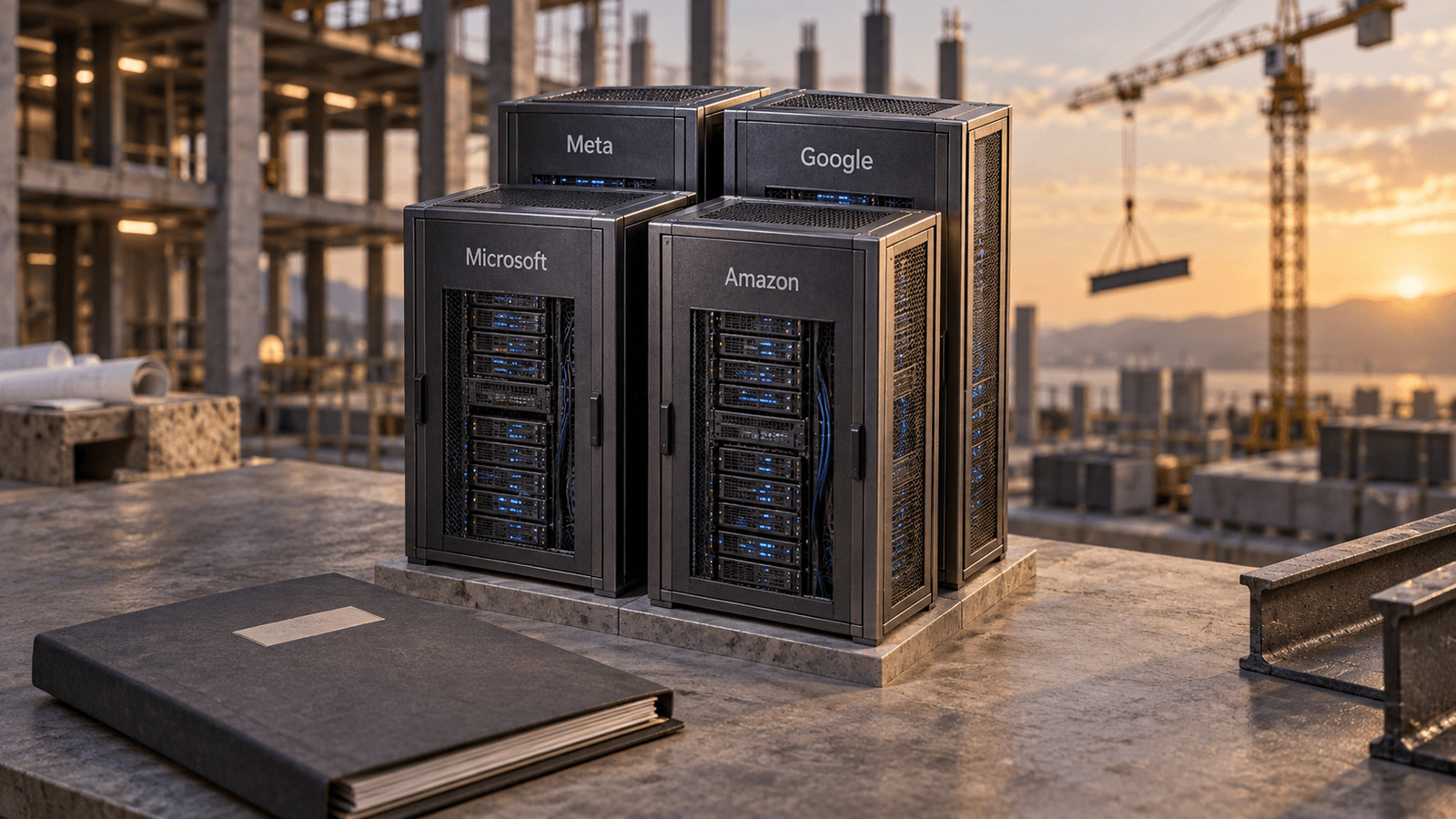
It doesn't just sell a single chip; it sells a complete "AI factory": GPUs (Blackwell, and soon Vera Rubin), CPUs, networking, plus over a decade of CUDA software ecosystem. The next-generation Rubin platform is scheduled to ramp in the second half of this fiscal year, and the company's combined Blackwell+Rubin visibility stands at $500B (covering 2025 through 2026). On the demand side, hyperscaler CapEx keeps getting revised up.
My view: Unlike AI names like PLTR or Nebius that are "expensive on valuation," Nvidia's problem has never been high multiples — it's that it remains fundamentally a cyclical stock. The current fundamentals are unimpeachable; the real question is how much longer this AI CapEx cycle can run.
| Segment (Q1 FY27) | Revenue | YoY |
|---|---|---|
| Data Center – Compute | $60.4B | +77% |
| Data Center – Networking | $14.8B | +199% |
| Edge Computing | $6.4B | +29% |
| Total | $81.6B | +85% |
Table 1 NVIDIA segment revenue (source: NVDA Q1 FY2027 8-K, quarter ended 2026-04-26).
GAAP net income beat non-GAAP — because Nvidia is investing in its customers
There's an anomaly in the earnings that needs explaining: GAAP net income of $58.3B actually exceeded non-GAAP of $45.5B. The reason is GAAP includes $15.9B of equity investment revaluation gains — from Nvidia's stakes in CoreWeave, Nebius, OpenAI and others — a non-operating, non-cash one-time item. For operating earnings, focus on non-GAAP net income of $45.5B, or $1.87 per share.
The other side of the same coin is more interesting. This quarter, Nvidia's non-public strategic investments jumped from $22B to $43B — it's heavily investing in its own customers, who then turn around and buy more chips. This is the "circular financing" the market keeps debating.
Key insight gap: Circular financing is a double-edged sword. Bulls see it as an ecosystem flywheel: Nvidia uses its profits to fund compute buyers and grows the pie. Bears see it as a risk: part of demand is being manufactured by its own cash, and if AI CapEx cools, writedowns and demand contraction could feed on each other. This line is as important as data center growth when assessing Nvidia.
Why the world's most expensive company isn't expensive on valuation
Now back to that 22x. Nvidia's forward P/E is ~22x, enterprise value to FY27 revenue ~12x — for a company with 75% gross margin, 66% operating margin, and still growing 50%+, that's not high. For context, its own five-year average P/E is around 70x, and even the trailing P/E is only about 29x.
Why? Because the market is giving it a "cyclical discount" rather than a "growth premium." Investors fear that AI CapEx will peak like all semiconductor cycles, so they compress the valuation in advance. In other words, the 22x already bakes in some fear of a cyclical top. That's a very different situation from the sky-high multiples of PLTR or Nebius, which are paying many years of perfection upfront.
Let's cross-check with free cash flow: Nvidia's quarterly FCF of $48.6B annualizes to roughly $200B. Using that as a base, with gradually declining growth and an 11% WACC, a rough intrinsic value per share lands at around $190–220, close to and slightly above the current price of $193. In other words, the current price doesn't overextend cash flows; there's a margin of safety in the valuation.
Cheap only if this cycle doesn't peak
Let's lay out three scenarios (target prices are modeling constructs, not guidance):
| Scenario | Probability | Key Assumptions | Target Price | vs $193 |
|---|---|---|---|---|
| Bull | 35% | AI CapEx super-cycle continues, Rubin ramps smoothly | $300 | +56% |
| Base | 45% | Solid growth but decelerating, P/E holds | $230 | +19% |
| Bear | 20% | CapEx peaks + custom ASIC erosion, EPS flatlines, de-rate | $150 | −22% |
| Weighted | 100% | 0.35×300 + 0.45×230 + 0.20×150 | $238 | +24% |
Table 2 Three-scenario pricing (modeling construct, not company disclosure).
The weighted target price of $238 implies ~24% upside, and the downside scenario is only −22% — the risk/reward is more symmetrical than PLTR or Nebius. The core variable isn't whether valuation is rich, but the slope of the AI CapEx cycle: as long as cloud giants keep spending, Nvidia is core; once they collectively enter an absorption phase, the semiconductor cycle won't spare the world's largest company.
What I'd do at $193
A few perspectives based on portfolio situations, not recommendations.
Not holding: Valuation is relatively reasonable. Could start a small position at current levels, add on pullbacks to $160–175; as a core AI holding, allocate up to 5–8% of portfolio.
Already holding with low cost basis: Mostly hold for long-term upside; sell covered calls at $260–280 on a small portion to collect premium.
Hedging cycle risk: It's still a high-beta cyclical stock. Buy protective puts at $160 or use a collar to hedge against a systemic drawdown from an AI CapEx peak.
My view: Among this group of AI names, Nvidia offers the best match between fundamentals and valuation — the largest market cap in the world, yet only ~22x forward P/E. I'd hold it as a core AI position, not a beta play. The risk isn't "expensive" but "cyclical" — so I'm willing to own it, but I'd use options to hedge against the day that CapEx peaks.
Data and sources
· NVIDIA Q1 FY2027 8-K (period ended 2026-04-26, SEC EDGAR) — revenue/segment/margins/net income/FCF/balance sheet/equity investment income/guidance
· NVIDIA FY2026 earnings and CFO commentary (data center $193.7B, Blackwell/Rubin $500B visibility, H20/China stance)
· Q2 FY27 guidance ($91B revenue, 75% gross margin, China data center modeled at zero); $80B buyback + 25x dividend increase
· Valuation: GuruFocus / FinanceCharts / MacroTrends (forward/trailing P/E); market cap and price from public data (as of 2026-06-29)
This article is compiled based on NVIDIA corporate earnings, SEC filings, CFO commentary, and public reports. Company-disclosed data are directly cited; forward/trailing P/E, EV/revenue multiples, FY27/FY28 EPS estimates, three-scenario target prices, DCF cash flow path and WACC are calculated based on public data; the one-time equity investment revaluation gain ($15.9B) has been separated and explained. Published June 29, 2026, market data as of close June 29, 2026. This is not an offer or solicitation for any securities transaction. The market has risks. Invest with caution.

On investment analysis, market insight, and asset allocation — not chasing short-term noise, but understanding what truly drives long-term returns.