跳到正文 · Skip to content
内容
关于与合作
订阅与会员
★ 查看会员权益
外观与设置
外观
主题色
版本 · 深色 / 减动搜索⌘K
草稿预览·这篇还没发布,不会出现在列表和 RSS 里。review 完后把 frontmatter 的 draft: true 改为 false 即可。

The Hardest Thing in Investing: Thinking for Yourself — Wang Xiaobo and the Silent Majority

Wang Xiaobo said he belonged to the silent majority — not because he had no opinions, but because he refused to use other people's words to say things he didn't believe.

2025.06.187 min原创
The Hardest Thing in Investing: Thinking for Yourself — Wang Xiaobo and the Silent Majority
读书笔记MINTOVIEW2025.06.18

一个用幽默对抗愚蠢的作家

Wang Xiaobo (1952–1997) was one of the most unusual writers in contemporary China. He died almost unknown, only to be widely read and loved after his death. His collection of essays, The Silent Majority, has been a kind of "primer on independent thinking" for countless young Chinese.

What made him special was his stance: he used humor, irony, and a nearly stubborn rationality to fight against all forms of stupidity, herd mentality, and the coercion of grand narratives. What he hated most was "replacing independent thought with a ready-made, correct set of words."

Why should a US equities investor read Wang Xiaobo? Because investing is, at its core, a game of independent thinking against groupthink (remember Le Bon, Shiller, Cialdini). And Wang Xiaobo is the Chinese writer who explains "how to think independently and avoid being swept up by crowds and narratives" better — and more entertainingly — than anyone else.

He's not writing about investing. But what he writes about — how to keep a clear, uncoerced mind — is precisely the scarcest skill an investor can have.

"沉默的大多数":拒绝用别人的话说自己不信的事

Wang Xiaobo said he belonged to the "silent majority." But his silence wasn't about having no opinion or being cowardly. It was a refusal: a refusal to use that ready-made, correct, universally repeated language to say things he didn't actually believe.

In an environment where everyone is loudly echoing some "correct narrative," Wang chose silence. Not because he had nothing to say, but because he didn't want to join that chorus of performing with correct platitudes.

This has a deep parallel for investors. Markets are full of "correct choruses." At any given moment, everyone is repeating the same narrative ("AI changes everything," "this time is different," "you'll miss out"). Joining that chorus feels safe, conformist, not lonely.

But Wang would remind you: when everyone is saying the same thing, that thing itself is suspect. Real independent thinking often means silent solitude, or solitary opposition.

The essence of contrarian investing is exactly Wang Xiaobo's "silent majority" — not being swept along by the mainstream narrative chorus, reserving your own judgment, even if it means being alone. When everyone is singing in greed, can you silently stay alert? When everyone is singing in fear, can you alone see the opportunity? This ability to "not sing along" is the real source of alpha.

对投资者的三个清醒

First, beware the coercion of "grand narratives." Wang was most wary of all kinds of grand narratives — big stories that claim to hold ultimate truth and demand everyone's submission. He said, once you accept a grand narrative, you hand over your right to independent judgment. In investing, grand narratives are everywhere: "new era," "paradigm shift," "permanent bull market." Wang would remind you: the more grand the narrative, the more it makes everyone's blood boil, the more you should stay coolly skeptical (remember Shiller — the peak of a narrative is the most dangerous).

Second, "being fun" is a form of resistance. Wang highly valued "fun" and "the joy of intelligence." He believed that keeping an interesting, curious, independent mind was itself a resistance to stupidity and herd mentality. In investing, this means: maintain genuine curiosity about the world (not driven by anxiety), treat investing as an intellectual game of understanding the world (not gambling), and use the pleasure of independent thinking to resist the pull of group emotion. An investor driven by anxiety and greed will be ruled by emotions; one driven by "the joy of understanding" is more likely to stay clear-headed.

Third, honestly face your own ignorance. Wang repeatedly stressed the value of "I don't know" — admitting ignorance is the beginning of wisdom (consistent with Confucius's "to know what you know and what you don't know" and Socrates's "I know that I know nothing"). He despised those who "know everything and have a ready answer for everything." In investing, this means: honestly admit "I don't know where the market will go tomorrow," "I don't understand this industry," "I could be wrong." This honest ignorance is far safer than false omniscience.

我跟王小波不同的地方

First, "independent thinking" can itself become another form of stubbornness.

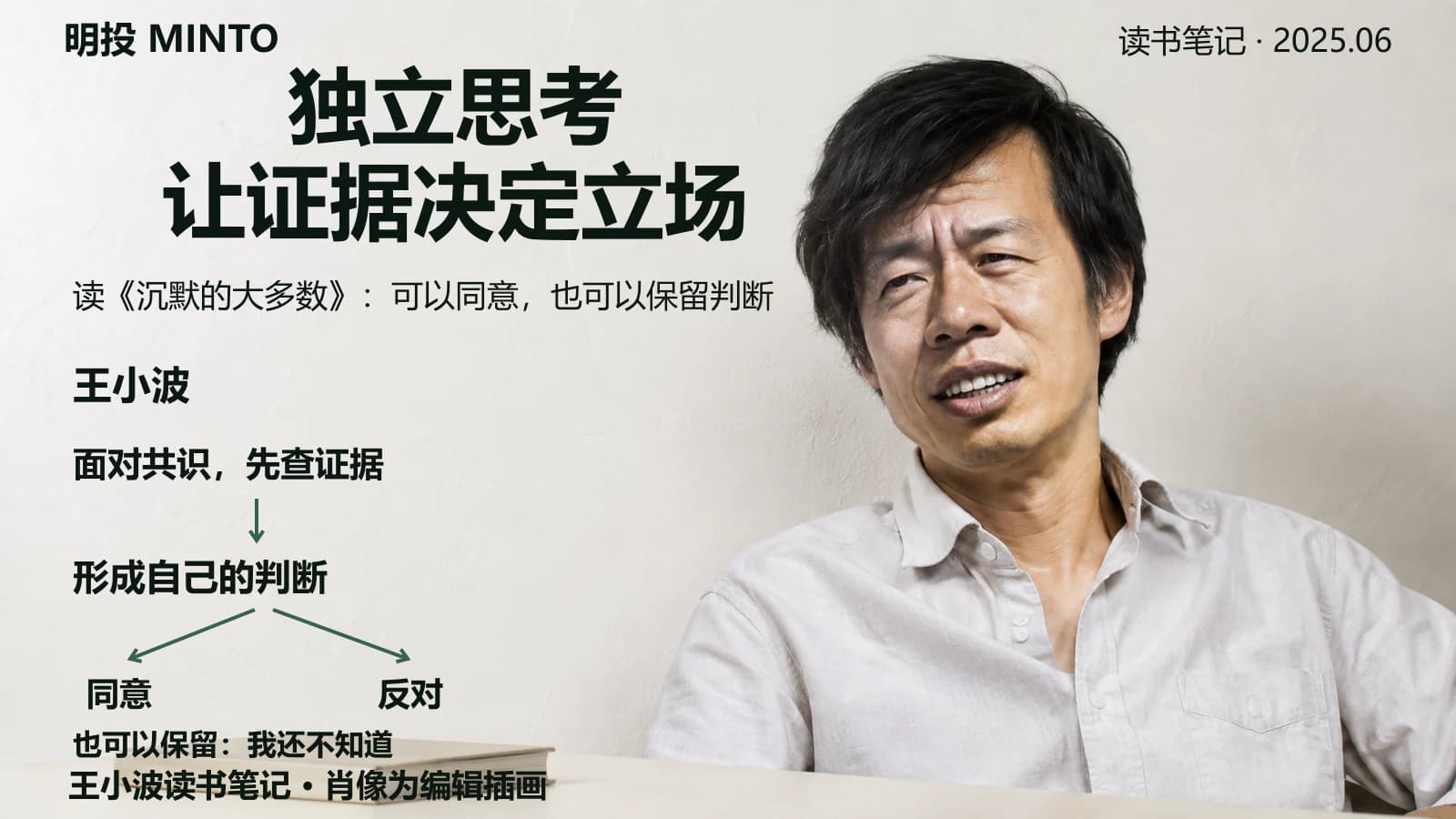
Wang championed independent thinking and opposed blind following. But "independent thinking" itself can become a kind of stubbornness — deliberately opposing everything mainstream just to "not be like the crowd" is actually not independent (it's being hostage to "anti-mainstream"). True independence is not "if everyone believes it, I oppose it," but "based on evidence and reason, agree when appropriate, oppose when appropriate." In investing, some mainstream consensus is correct (e.g., long-term index holding), and blindly being contrarian can be a mistake. Wang's "independence" needs to pair with "evidence-based" thinking, otherwise it can become opposition for opposition's sake.

Second, his rationalism sometimes underestimates emotion and intuition.

Wang was a staunch rationalist, valuing logic, science, and a clear mind. But he sometimes underestimated the positive value of emotion, intuition, and the irrational. In investing (and in life), pure rationality isn't enough — sometimes, intuition born of experience, empathy for human nature, or even a kind of "irrational persistence" is correct. Wang's rationalism is a precious antidote (against blind following), but it shouldn't be pushed to the extreme of denying all things irrational.

Third, his essays are strong on critique, weak on construction.

Wang's essays excel at criticism — exposing stupidity, satirizing herd mentality, puncturing grand narratives. But they are relatively weaker on construction — he tells you "what not to do" but less often "what to do." This is a feature (and limitation) of the essay genre. In investing, having a critical eye (seeing through baloney) is not enough; you also need a constructive framework (building your own judgment and methodology). Wang gives you clear eyes, but you still need to build your own ability to act.

Fourth, his context is specific; direct transfer is risky.

Wang's essays were strongly targeted at a particular era and environment — he was fighting the specific "stupidity" and "coercion" of his time. Moving his specific opinions directly into investing requires caution. His stance (independent, clear-headed, fun, honest about ignorance) is universal and worth learning; but some of his specific judgments are context-dependent and cannot be copied. Read him for his spirit, not his conclusions.

王小波 vs 加缪:两种清醒的活法

Wang Xiaobo and Albert Camus (author of The Myth of Sisyphus) share a curious affinity — both chose, in an "absurd" world, to live "clearly, with dignity, and with a certain sense of humor."

Camus's clarity is philosophical and tragic — facing the absurdity of the universe, he rebels with clear-eyed awareness. Wang Xiaobo's clarity is earthy and humorous — facing the stupidity and coercion of the mundane world, he resists with amusement.

Camus gives you a philosophical stance toward the absurd; Wang gives you practical wisdom for dealing with stupidity.

But what they share is this: in a world of absurdity and stupidity you cannot change, keeping a clear, independent, dignified mind is itself the highest form of resistance and freedom.

For investors, the combined lesson is: the market is a world full of collective stupidity, narrative coercion, and emotional contagion (absurd). You can't change it. But you can choose to participate in it clearly, independently, and without being swept up by the chorus. This "clear independence" is both Camus's rebellion and Wang Xiaobo's "silent majority," and it's the real source of alpha.

写在最后

The biggest takeaway I have from reading Wang Xiaobo is not any specific opinion. It's a stance: in a world where everyone is singing along, having the courage and the solitude to think for yourself.

Investing, in the end, is a lonely game. If you think and act like most people, you get the same (mediocre) results as most people. Alpha comes only from judgments that are "different from consensus and correct." And that requires exactly the skill Wang Xiaobo embodies: not being swept along by the chorus, reserving your own judgment, even if it means being silent or opposed.

This skill is extremely scarce. Because humans are social animals — "being the same as everyone else" feels safe; "being independent and alone" feels anxious (remember Le Bon — the group makes people shed their independence). The vast majority would rather be "wrong with the crowd" than "right alone" — because the former has company, and the latter is lonely.

Wang Xiaobo spent his life proving that keeping an independent mind, though lonely, is a person's most precious dignity and greatest freedom.

For investors, this "dignity of independence" is precisely the most valuable skill. Because the market always punishes the herd and rewards those who remain clear-eyed in group euphoria and rational in group panic — those lonely independent thinkers.

Wang Xiaobo had a line that I take as a motto for both investing and life: "All human suffering is essentially anger at one's own incompetence."

The pain in investing — chasing highs, panic selling, regret over missing out — is essentially anger at your own inability to think independently, control emotions, and stay clear-headed.

And the antidote isn't in any investment secret. It's in what Wang kept saying: be an independent, clear-headed, fun, honest-in-your-ignorance person.

Easy to know, hard to do. But it might be the most fundamental lesson for both investing and life.

Minto
明投 Minto
投资分析 · 长期主义者

专注投资分析、市场洞察与资产配置。不追短期波动,只理解真正驱动长期回报的东西。

你读完了 · Colophon

The Hardest Thing in Investing: Thinking for Yourself — Wang Xiaobo and the Silent Majority

7
分钟
2025/06
期号
2025
年份
真正稀缺的,是一个不慌不忙的人。
明投 · MintoInvest Wisely
— From This Series
喜欢这篇?这类 读书笔记 的深度拆解会持续发到你邮箱。
无广告 · 随时退订
— Enjoyed the read?
如果这篇文章对你有用,把它分享给一个朋友,就是对我最好的支持。

口碑是独立创作者最稀缺的燃料。

— Discussion

说说你的想法

评论基于 GitHub Discussions(Giscus)。登录后即可留言、点赞、互相讨论。

评论还在准备中。

想说什么可以直接发我邮件,比在评论区更容易认真回复。

mingtaohuang617@gmail.com →
支持沉浸式阅读