跳到正文 · Skip to content
内容
关于与合作
订阅与会员
★ 查看会员权益
外观与设置
外观
主题色
版本 · 深色 / 减动搜索⌘K
草稿预览·这篇还没发布,不会出现在列表和 RSS 里。review 完后把 frontmatter 的 draft: true 改为 false 即可。

Wang Yangming's Sharpest Insight for Investors: If You Know But Can't Do, You Don't Really Know

Wang Yangming said, if you know but can't do, you don't really know – this one insight kills the self-comfort of 90% of investors.

2024.07.1510 min原创
Wang Yangming's Sharpest Insight for Investors: If You Know But Can't Do, You Don't Really Know
读书笔记MINTOVIEW2024.07.15

1. A 500-Year-Old Guide to Self-Cultivation for Investors

Instructions for Practical Living is a collection of Wang Yangming's (1472–1529) dialogues, compiled by his disciples. It's not a treatise penned by Wang himself—it's a live record of his conversations with students, Q&A sessions, and debates. So it reads like dialogue, not academic prose.

500 years later. This book ranks just below the Analects and Mencius in the Chinese philosophical canon. It founded the "School of Mind" (Yangmingism), influencing figures like Zeng Guofan, Liang Qichao, Sun Yat-sen, Mao Zedong, and in Japan, the Meiji Restoration generation—Kazuo Inamori and Eiichi Shibusawa both called themselves Wang's students.

But I'm rereading it not as philosophy, but as a guide to self-cultivation for investors.

Why? Because the book's recurring themes—the unity of knowledge and action (zhi xing he yi), extending innate knowledge (zhi liangzhi), and refinement through real-world practice (shi shang mo lian)—all answer one question: How do you turn "knowing" into "doing"?

And that's exactly where most investors get stuck for life.

2. The Sharpest Line: If You Know But Can't Do, You Don't Know

Wang Yangming's most famous concept: "the unity of knowledge and action."

These four characters have been quoted for 500 years, but the most widely understood version is almost always wrong.

Most people take it to mean: "knowledge and action should be unified"—you should both understand the principle and act on it. That interpretation is mild, almost feel-good.

But Wang's real meaning is far harsher: "To know but not act is simply not to know." If you "know" but "can't do it," at a deep level you don't really know. You think you know, but your "knowing" is counterfeit.

This one line kills 90% of investors' self-comfort.

Most investors say, "I know I should hold long-term, but I can't," "I know not to chase and panic-sell, but I can't," "I know I should control position size, but I can't," "I know I need to simplify, but I can't."

Wang Yangming told you 500 years ago: These "but I can't" are all excuses. You can't do it because you haven't truly known it. Real knowing automatically translates into action; conversely, the "knowing" you can't act on is just a slogan you've heard, read, or memorized—it hasn't entered your cognitive system.

When I first truly understood this line, I felt offended. Because the story I kept telling myself—"I know but can't do it"—is worthless in Wang's framework. I had to admit: I didn't really know.

That offense is the book's greatest gift.

3. The Second Sharpest Line: Refinement Through Real-World Practice

Wang emphasizes a concept: refinement through real-world practice (shi shang mo lian). It means real learning doesn't happen in books—it happens in events. If you don't practice through concrete situations, reading endlessly does nothing.

His example: a person can talk brilliantly in a study, but if they've never faced real crisis, real loss, real humiliation, their "cultivation" is fake. The moment something happens, their true colors show.

This applies perfectly to investing. Most investors' "investment cultivation" has never been tested by events. They're patient in a bull market, disciplined on risk in peaceful times, humble when nothing's wrong—but when a real drawdown comes, real losses hit, real panic sets in, they immediately turn impatient, greedy, self-doubting.

Wang would say: You stayed calm watching others get blown out in the 2020 circuit-breaker crash—that wasn't calm, that was you having no position. When the stock you own drops 40% in a week, that's when you see your real cultivation.

Refinement through real-world practice. Investment knowledge that hasn't been tested by events will completely fail in your first real crisis.

My own litmus test is simple: look back at my actual behavior during the most painful drawdowns—March 2020, October 2022, August 2024. Did I say one thing and do another? Was I calm when planning but panicked when executing? Did I only see what I "should" have done in hindsight, but couldn't do it in the moment?

If yes, then my "knowing" hasn't truly become "doing." I need more refinement.

4. The Most Underrated Line: Extending Innate Knowledge

The core of Wang Yangming's School of Mind is extending innate knowledge (zhi liangzhi)—returning to the "innate good conscience" within you and following its guidance.

Modern readers underestimate this term because "conscience" in Chinese has been reduced to "moral sense." But Wang's "innate knowledge" goes far beyond morality—he means the clearest, most direct, least distorted judgment deep inside you, untouched by desires and thoughts.

This judgment exists in everyone, but it's buried under layers: others' opinions, social norms, your own fear and greed, past failures and successes. "Extending innate knowledge" means peeling all that away and returning to that original judgment.

This is incredibly useful for investors.

Most investment mistakes are not "wrong judgments"—they are "you knew inside it was wrong, but you did it anyway."

You knew the stock was ridiculously overvalued, but everyone around you was buying, so you bought—not a judgment error, you didn't listen to innate knowledge. You knew you should reduce position, but your paper gains made you reluctant to sell—not a judgment error, you didn't listen. You knew you no longer understood this stock, but you'd held it for three years and didn't want to admit being wrong—not a judgment error, you didn't listen.

Wang would say: "Innate knowledge" knows, but you suppressed it. Your real problem isn't lack of clarity—it's lack of courage to hear what your inner voice says.

This is embarrassing for me. Because when I review my worst trades, ~80% fall into this category of "innate knowledge knew all along but I suppressed it"—not not knowing, but not listening.

"Extending innate knowledge" is the practice of learning to listen. That's the hardest and most crucial part of Yangmingism after 500 years.

5. Where I Diverge from Yangmingism

By the third reading, I found several real disagreements.

First, his concept of "innate knowledge" risks circular reasoning.

Wang says "extend innate knowledge"—return to your inner conscience. But how do you know you're returning to true innate knowledge and not something else (self-deception, selfish desire, bias, instinct)?

Wang's answer: "Innate knowledge naturally knows." If you're doing something wrong, you'll feel uneasy.

But psychologically, this doesn't hold. Countless studies show humans can rationalize, suppress, and get accustomed to feelings of unease. A habitual liar loses the "unease" about lying—that person, by Wang's standard, would think they are "extending innate knowledge" when they're actually self-justifying.

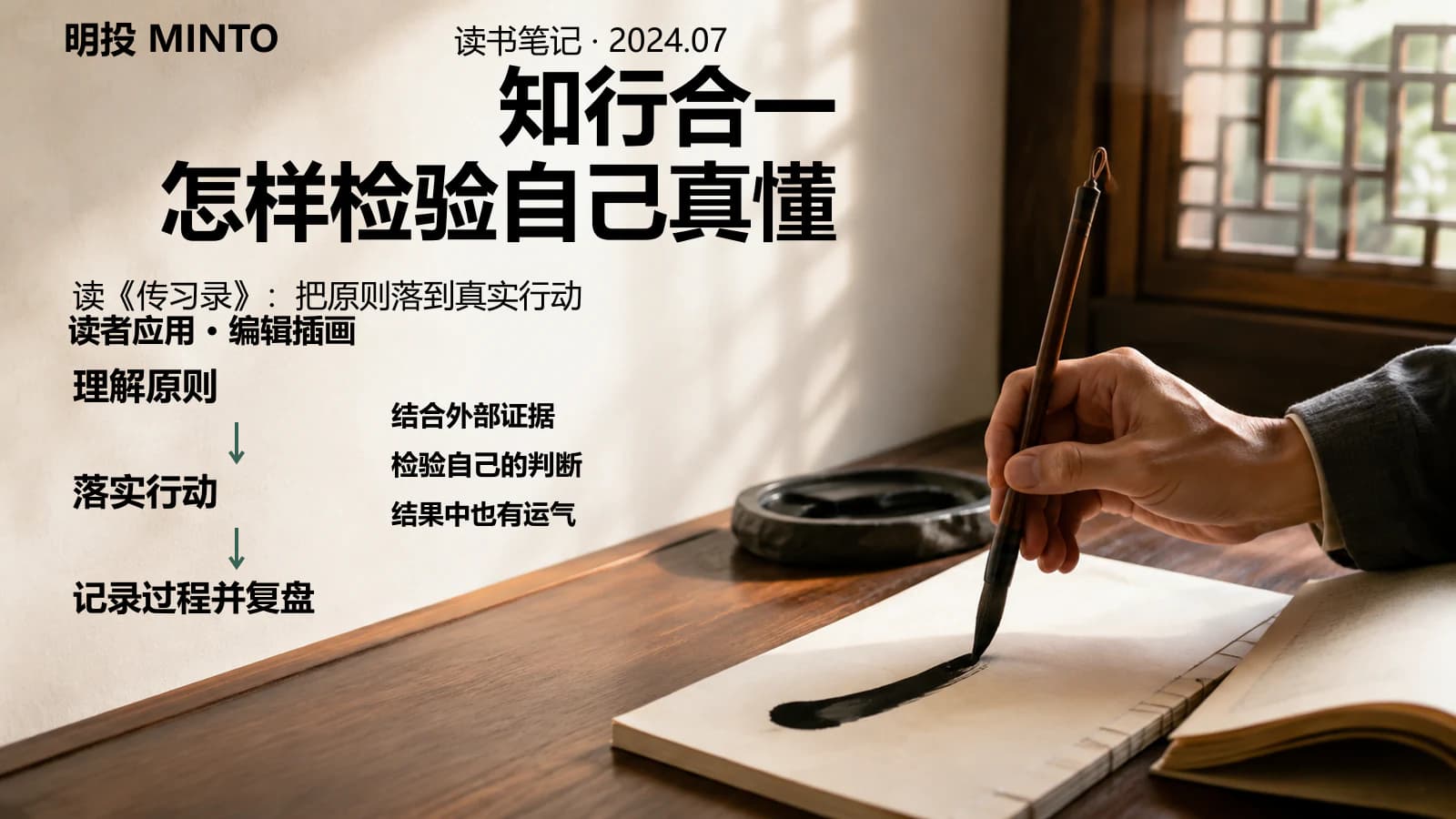
My correction: "Innate knowledge" shouldn't be purely internal—it needs an external verification mechanism. Talk to people with different perspectives, write down your decisions and wait for time to validate them, revisit your past judgments. If you only listen to your inner voice, you're likely hearing what you want to hear.

Second, his "refinement through practice" has a "hindsight bias" danger.

Wang emphasizes testing cognition through outcomes. But outcomes contain massive randomness—you can be right by luck and wrong despite good judgment.

Using outcomes alone to judge cognition is problematic in highly random fields like investing. Howard Marks discusses this in The Most Important Thing—investment performance has huge luck components; short-term results can't judge cognitive level.

In Wang's era—being an official, fighting wars, teaching—these domains had relatively low randomness, so "outcome" was a cleaner signal of "cognition." But investing is different. You need a process-oriented rather than outcome-oriented reflection framework, which Yangmingism doesn't directly provide.

Third, his "School of Mind" is weak on systemic problems.

Wang's entire methodology is "look inward"—solve problems by cultivating yourself. This is extremely effective for individual-level problems (impulse, greed, self-deception).

But for systemic problems (market structure, institutional game theory, regulatory cycles, macro cycles)—"look inward" is useless. These can't be solved by personal cultivation; they require analysis, research, game theory.

In Wang's time, almost every problem could be answered by "self-cultivation." But an investor in 2025 faces a world where many questions can't be answered by cultivation—no matter how composed you are, you can't predict the Fed's next move; no matter how stable your mindset, you can't resist the flow of ETF money.

My correction: Yangmingism handles the "inner," economics and finance handle the "outer." Both are needed, neither is sufficient.

Fourth, his emphasis on "action" can mislead passive investors.

Wang's "unity of knowledge and action" stresses turning knowledge into doing. That's right for many fields requiring active decisions. But for long-term passive holders, sometimes "inaction" is the highest cultivation.

Buffett's most profitable positions are held for 20+ years on average. During those 20 years, his "action" was "not moving." If you interpret Wang's teaching literally, you might overact—and destroy long-term compounding.

In investing, "action" is often not "doing" but "not doing." Wang's language doesn't clearly address this—he almost defaults "action" to "doing." Readers need to translate: "doing when you should, and not doing when you should not—both are manifestations of the unity of knowledge and action."

6. Yangmingism vs. Zhuxi's Rationalism: The Most Important Internal Split in Chinese Philosophy

To read Wang, you can't avoid his opposition to Zhu Xi. This is the most important internal split in Chinese philosophy.

Zhu Xi (Rationalism) said: Truth lies in the external world. You study external things one by one through investigating things and extending knowledge (ge wu zhi zhi), gradually approaching truth. First "know," then "act."

Wang Yangming (School of Mind) said: Truth lies within you. The external world is just a mirror reflecting your mind. You don't need to exhaust the world—you just need to return to your innate knowledge. "Knowing" is "doing," "doing" is "knowing."

These two postures correspond to completely different investment approaches.

Zhu Xi-style investor: Diligently research every company, every industry, every macro indicator. First understand the world, then place a trade. This is the stance of Buffett, Charlie Munger, Howard Marks.

Wang Yangming-style investor: Look inward at your own biases, desires, fears. First understand yourself, then place a trade. This is the state that a few seasoned investors eventually reach—technical skills are already sufficient, the real bottleneck is mentality.

My own stance: Study Zhu Xi when young, study Wang Yangming when middle-aged. In early stages, you need to first understand the world—that's the foundation. In later stages, your bottleneck is not external but internal—that's when you need Yangmingism.

You can't swap the two stages. Learning Wang when young leads to mysticism—just looking inward without research. Sticking with Zhu Xi when old leads to paralysis—always needing "a little more research."

7. The Three Most Practical Yangming Lessons for Investors

If I could take only three rules from this book, they would be:

First, ask yourself beforehand: Do I truly know this, or have I just heard it?

If you "can't do it," you likely "don't know." Admit that, and you can truly practice instead of comforting yourself with "I know but can't do it."

Second, ask yourself in the moment: What is the most direct judgment inside me?

The vast majority of wrong trades aren't because you didn't see clearly—they're because you knew inside but didn't want to listen. Translate "innate knowledge" into "the most direct, unrationalized sentence inside me"—and then truly listen.

Third, ask yourself after the fact: Was this result my skill or luck?

Don't use outcomes to directly confirm cognition. Good outcomes may be wrong judgment + luck; bad outcomes may be correct judgment + black swan. The core of refinement through practice is not "it's right if I won," but "honest review regardless of win or loss."

8. In Closing

Wang Yangming died in 1529 in Jiangxi, at age 57. His last words: "This heart is bright—what more is there to say?"

Countless people have quoted this line, but what strikes me most is not its tragic grandeur—it's its certitude.

A man who spent his life pursuing "extending innate knowledge" could say "this heart is bright" at death. It means he truly lived the way he wanted to.

Most people never accomplish that in a lifetime.

Investing is ultimately a lifelong cultivation. You'll make money, lose money, see people come and go, go through many cycles. But in the end, the real question isn't how much you made—it's: Can you look at your lifetime of trade records on your deathbed and say, "This heart is bright"?

If you can, you've truly unified knowledge and action.

If you can't, no matter how much you've made, you're still on the road.

Wang Yangming told us this across 500 years. The most valuable part of this book is that it sets that standard clearly.

May we all move slowly in that direction.

Minto
明投 Minto
投资分析 · 长期主义者

专注投资分析、市场洞察与资产配置。不追短期波动,只理解真正驱动长期回报的东西。

你读完了 · Colophon

Wang Yangming's Sharpest Insight for Investors: If You Know But Can't Do, You Don't Really Know

10
分钟
2024/07
期号
2024
年份
真正稀缺的,是一个不慌不忙的人。
明投 · MintoInvest Wisely
— From This Series
喜欢这篇?这类 读书笔记 的深度拆解会持续发到你邮箱。
无广告 · 随时退订
— Enjoyed the read?
如果这篇文章对你有用,把它分享给一个朋友,就是对我最好的支持。

口碑是独立创作者最稀缺的燃料。

— Discussion

说说你的想法

评论基于 GitHub Discussions(Giscus)。登录后即可留言、点赞、互相讨论。

评论还在准备中。

想说什么可以直接发我邮件,比在评论区更容易认真回复。

mingtaohuang617@gmail.com →
支持沉浸式阅读