One: A Harvard Scholar’s History of China’s Transformation
Ezra Vogel was a leading East Asia expert at Harvard. In 2011, he published Deng Xiaoping and the Transformation of China—a dense study of how Deng led China from the ruins of the Cultural Revolution to reform and opening-up.
Why should a US equity investor read this? Because — it’s the best case study on ‘how a giant system successfully transforms itself.’
China’s economic rise from 1978 to today is the largest and fastest economic transformation in human history — hundreds of millions lifted out of poverty, a near-bankrupt planned economy becomes the world’s second-largest economy. Understanding how that transformation was decided offers deep lessons for understanding how any system—a country, a company, an organization—can successfully change.
And Vogel’s core portrayal is this: the transformation that changed the lives of over a billion people was not driven by grand theory or radical revolution, but by a series of pragmatic, incremental, ‘no-debate’ decisions made by a pragmatist.
Two: Insight One — Pragmatism Over Ideology
Deng Xiaoping’s most famous line: ‘It doesn’t matter if a cat is black or white, as long as it catches mice.’
That one sentence sums up his entire method: pragmatism above ideology. Don’t get stuck on whether an approach is ‘socialist or capitalist’ (ideology); just ask ‘does it solve the real problem? Does it make people better off?’ (practical results).
In a country torn for decades by ideological debates, Deng used the phrase ‘no debate’ to bypass endless theoretical squabbling and go straight to doing things that produced results.
This has a clear parallel for investors: the best investors are also pragmatists, not ideological believers.
Investment is full of ‘ideologies’ — value vs. growth, technical vs. fundamental, active vs. passive, long vs. short. Many investors bind themselves to a ‘school’ and make decisions based on identity rather than results. But a Deng-style investor says: whatever method, as long as it makes money consistently while controlling risk, it’s good. Value when value works, growth when growth works; active when active beats passive; passive when that’s efficient. Don’t be captured by any single school’s ideology—just look at actual outcomes. That pragmatic flexibility is the key to navigating different market environments.
Three: Insight Two — Gradual Reform vs. Shock Therapy
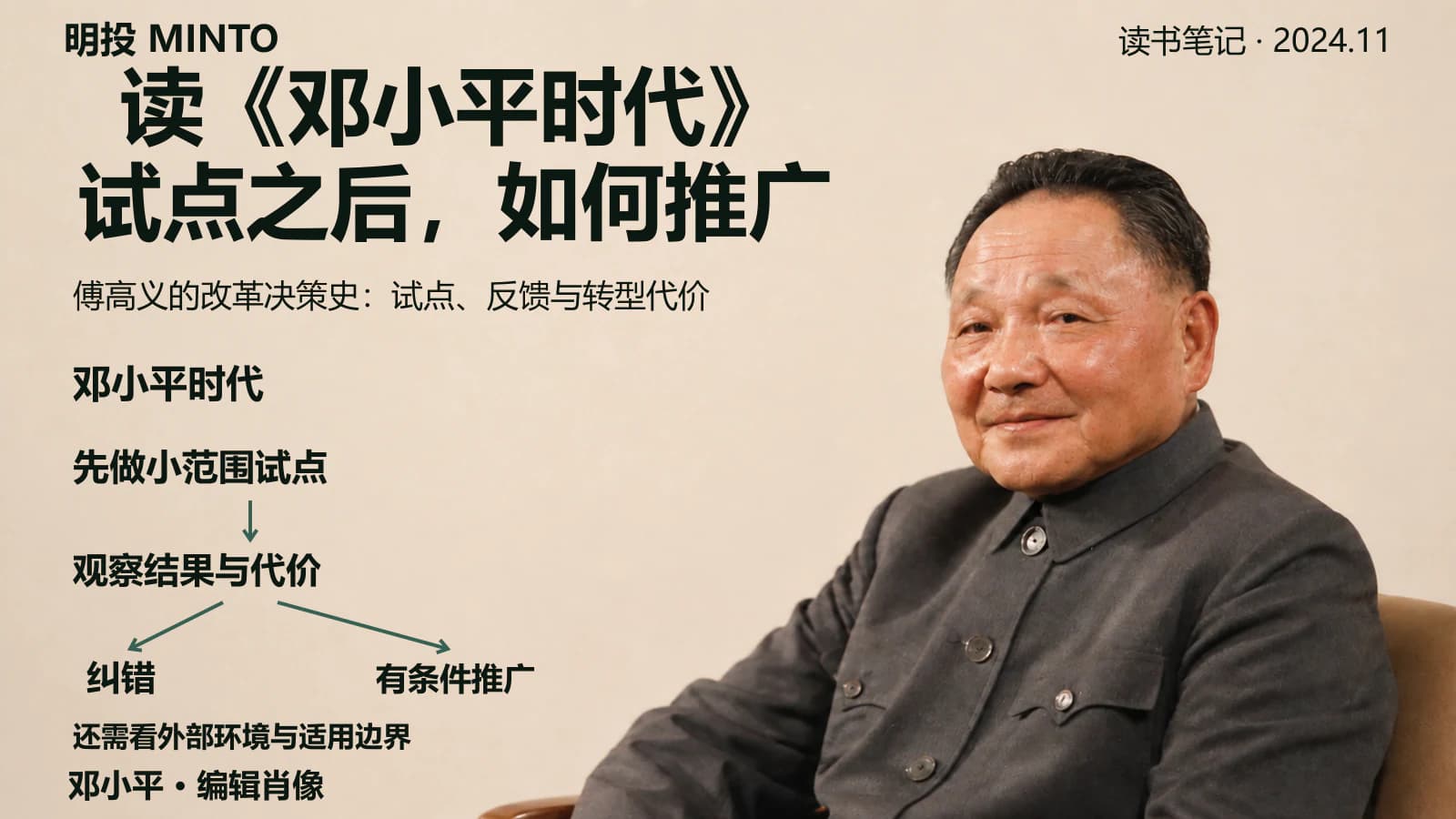
The most important feature of Deng’s reforms was gradualism—‘crossing the river by feeling the stones.’
He rejected a radical, one-shot ‘shock therapy’ (like Russia after the Soviet collapse). Instead, he tested first in small areas (Shenzhen SEZ, rural household contracting), verified effectiveness, then gradually scaled up. If wrong, fix it; if right, expand.
That gradualism allowed China to avoid the Soviet-style collapse — the USSR’s radical reforms led to economic implosion and national disintegration, while China’s gradual reforms achieved a smooth transformation. Same starting point (planned economy), different methods, vastly different outcomes.
The lesson for investors (and anyone making big changes): for major transformations, incremental trial-and-error is often safer than a radical bet.
In investing, this means: when you want to change strategy, enter a new field, or adjust a portfolio, start with a small position. Test your thesis. Then scale up gradually (echoing Taleb’s small-bet trial-and-error, Kelly’s ‘modular growth’). Don’t go all-in on an unproven call. ‘Crossing the river by feeling the stones’ means you lose little when wrong, and have room to add when right. This is an extremely robust, anti-fragile way to act.
Four: My Disagreements with Vogel
First, the book has an ‘authorized biography’ inclination to defend its subject.
Vogel is broadly sympathetic to Deng. His narrative focuses on ‘how Deng successfully drove the transformation.’ But that lens downplays the costs and dark sides — the corruption that emerged, the dramatic rise in inequality, the sacrifices of certain groups, and some highly controversial decisions. Vogel does mention them, but the overall ‘successful transformation’ narrative makes these costs seem secondary. The reminder for readers: behind every ‘great transformation,’ there are costs and victims hidden by the narrative.
Second, ‘pragmatism’ has its own limits and dangers.
Deng’s pragmatism (‘black cat, white cat’) was extremely effective, but it came at a price: pure pragmatism can lack long-term value anchors and red lines. ‘Just look at results’ if taken to an extreme can slide into ‘the ends justify any means.’ A pure pragmatist, in the process of doing whatever works, may sacrifice principles that should not be sacrificed (think of Inamori’s ‘what is right as a person’ boundary). Pragmatism is a powerful tool, but it needs some value floor to constrain it, or it becomes dangerous. Vogel doesn’t adequately explore this tension.
Third, it underestimates the role of luck and the times.
Vogel attributes China’s successful transformation largely to Deng’s leadership and decisions. But the transformation’s success also depended hugely on era and external factors — the dividend of globalization, inflow of Western capital and technology, demographic dividend, a relatively peaceful international environment. The same pragmatic decisions, without those external conditions, might have had a completely different result (again, that recurring issue of ‘underestimating the era dividend’). Attributing success mainly to one person is a tilt toward the ‘great man theory of history.’
Fourth, the book freezes at a particular point, missing later complex evolutions.
The book focuses on reforms from 1978 through the 1990s. But the model Deng pioneered has evolved over subsequent decades (growth slowing, debt accumulation, difficulty of model transformation—remember Lan Xiaohuan’s The Ground Under Our Feet?). That is outside the book’s scope. A successful start to transformation does not guarantee continued success. When you read this book, remember: it tells you how the transformation started, not how it sustains. And the latter is precisely the key to judging China’s (and any transforming system’s) long-term prospects.
Five: [object Object] vs. [object Object]: Two Layers of Transformation
These two books illuminate China’s economic transformation from two levels.
Vogel gives the top-level decision history — how Deng, as the central figure, used pragmatism and gradualism to kick-start the whole transformation. Lan Xiaohuan gives the bottom-level operating mechanism — how the economic model (land finance, local competition) actually runs.
Vogel tells ‘how the transformation began’; Lan tells ‘how the machine of transformation works.’
Together, they offer investors a complete picture for understanding ‘the China variable’ — use Vogel to understand the transformation’s origin and method (pragmatism, incremental trial-and-error), use Lan to understand its mechanics and current dilemmas (land finance, debt, the challenge of model transformation).
For an investor whose core allocation is in US equities, the biggest value of these two books (as I wrote in the Ground Under Our Feet note) is to help you more soberly understand ‘the world’s largest variable’ — its strengths (efficient transformation ability, ability to concentrate resources) and its unpredictability (policy-driven, path dependence) are two sides of the same mechanism. Understanding it is not about investing in it; it’s about factoring it into judgments on global macro, supply chains, commodities, and tech competition.
Six: Final Thoughts
My biggest takeaway from this book is not a specific judgment about China, but a methodology for ‘how to successfully drive a major shift’ — pragmatism + incremental trial-and-error.
This methodology transcends countries and politics; it applies to any major change — a company turnaround, a career shift, a portfolio restructuring.
Pragmatism — don’t be captured by ideology (schools, dogmas, past success formulas). Just look at what actually solves problems and produces results. Change when change is needed; don’t agonize over ‘is this consistent with my usual style.’
Incremental trial-and-error — for big changes, test in a small area first; verify effectiveness before gradually scaling. Lose little when wrong, add more when right. No all-in bets on untested ideas.
These two principles are how Deng restarted a civilization’s engine. They are also the most robust action framework for anyone, any organization, any investor facing major uncertain change.
Deng had a line that I keep as a motto when confronting big changes: ‘Cross the river by feeling the stones.’
Not because there was no direction (he knew he wanted to move toward a market economy), but because he acknowledged: in a complex, unpredictable system, no one can see the entire path in advance. You can only try step by step, adjusting as you go.
This posture is at once humble (admitting you can’t see the full picture), determined (keep moving forward), and robust (each step probes the ground first).
It echoes Mitchell’s ‘complex systems are unpredictable,’ Taleb’s ‘small-bet trial-and-error,’ and Kelly’s ‘gradual growth’ — in a world you cannot fully see, the smartest way to act is not to bet big on a grand vision, but to cross the river by feeling the stones, step by step, correctable, moving forward.
A man who changed the lives of a billion people this way leaves this lesson for everyone making big decisions.
Including every investor, moving forward step by step in an uncertain market.