1. The Mathematician Who Beat the Casino First, Then Wall Street
Ed Thorp is one of the 20th century's most legendary figures. He started as a math professor, then did two nearly impossible things:
First, he invented card counting for blackjack, mathematically proving that the casino's game could be beaten. His book Beat the Dealer forced casinos worldwide to change their rules.
Second, he took the same approach to Wall Street, founding one of the earliest quantitative hedge funds. For 20 consecutive years, he had almost no losing years, compounding at about 20% annually—and sailed through the 1987 crash and the 1998 LTCM crisis unscathed.
In 2017, an 80-something Thorp published his autobiography, A Man for All Markets. The most valuable part isn't the legend—it's that he spent his life proving that markets are not fully efficient, and the way to beat them is learnable—if you use math, not feelings.
2. The Core Tool: The Kelly Criterion
At the heart of Thorp's methodology is the Kelly Criterion—a mathematical formula that tells you how much to bet each time.
Most people obsess over what to bet (which stock to pick). Thorp obsessed over how much to bet (position sizing). He believed the latter is far more important.
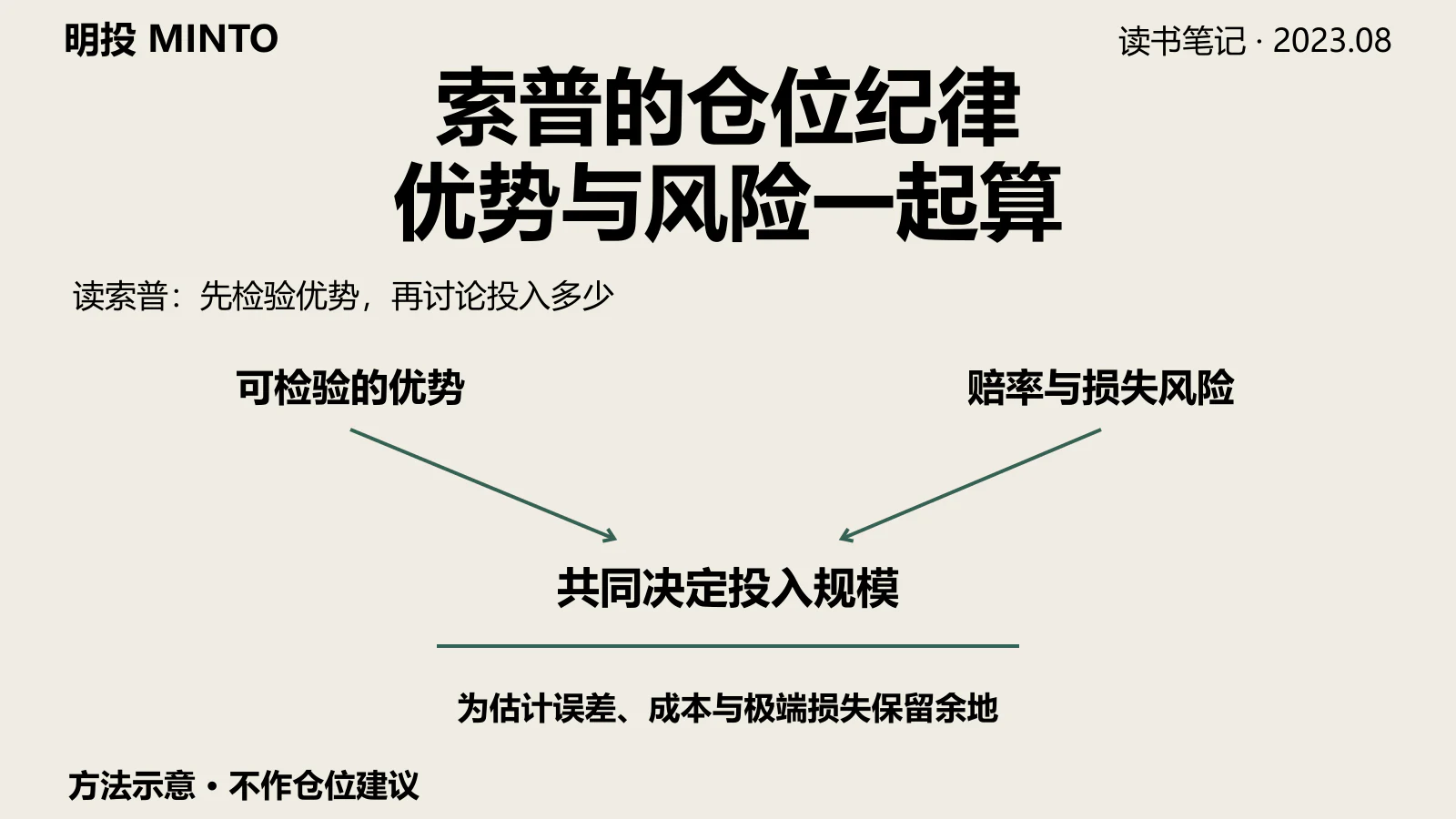
The core idea: your bet size should be proportional to your edge, and inversely proportional to risk. Big edge → bet more. Small edge → bet less. No edge → don't bet.
It sounds simple, but it solves the most fatal problem in investing—position management.
Most people blow up not because they picked the wrong stock, but because they bet too much on the wrong thing, or too little on the right thing. Thorp used the Kelly Criterion to turn "how much to bet" from gut feeling into calculation.
The most practical lesson I took from Thorp: "How sure am I?" must translate into "How much do I bet?" If you say "I really like this company" but can't tell if your conviction is 60% or 90%, you can't decide whether to put 5% or 20% of your portfolio in it. The Kelly Criterion forces you to turn vague "like" into precise "edge + position".
3. Second Insight: Market Inefficiency Is Real, but Hard
Thorp proved with real money that markets have systematic, exploitable inefficiencies. His convertible arbitrage, statistical arbitrage, and warrant pricing all repeatedly made money where the market mispriced things.
This directly refuted the strong version of the efficient market hypothesis. If markets were fully efficient, Thorp's nearly loss-free 20-year record would be impossible.
But Thorp also proved the flip side: exploiting inefficiencies is incredibly hard. It requires top-tier math, early computers, rigid discipline, and extreme cost control. Ordinary people think they can copy Thorp, but they lack all his tools.
That's the duality of Thorp's story: markets can be beaten, but the person who can beat them needs conditions 99.9% of people don't have. So for most people, Malkiel's "buy the index" is still right; only those with genuine mathematical edge should try to do what Thorp did.
4. Where I Diverge from Thorp
First, the Kelly Criterion is nearly impossible to use precisely in reality.
The Kelly formula requires you to know the true win probability and the true odds. In blackjack, those are precisely calculable. But in stock investing, you never know a trade's true probability—you only have subjective estimates. Plugging wrong probabilities into Kelly leads to catastrophic over-betting. That's why almost everyone uses "fractional Kelly" (half or a quarter of the suggested position) as a margin of safety. Thorp did this too, but the book doesn't emphasize it enough.
Second, his method relies on "repeatable statistical edge," which is rare in investing.
Thorp's arbitrage worked because it could be repeated at high frequency—the same edge, thousands of times, letting the law of large numbers ensure you win. But most stock investing is low-frequency and non-repeatable—you might buy only a few dozen big positions in a lifetime, a tiny sample where the law of large numbers barely applies. Thorp's mathematical edge essentially breaks down in low-frequency decisions.
Third, his success had a strong "era tailwind."
Thorp did his arbitrage in the 1970s–1990s, when markets were far less efficient, computers were scarce, and quantitative strategies were a blue ocean. Today's quant world is a red ocean—Renaissance, Two Sigma, Citadel run on computing power and data thousands of times stronger than Thorp's. The inefficiencies Thorp harvested are mostly already eaten by machines. An ordinary person trying to replicate them has almost no room.
Fourth, he's not fully honest about luck.
Thorp repeatedly emphasizes math, edge, and discipline. All true. But he lived through 1970–2010, arguably the best decades in American capital markets history. If he'd been born in a country with a long bear market, the same mathematical genius would have gotten a completely different outcome. His methodology is worth learning, but that his success had a contingent component—he says too little about it.
5. Thorp vs. Buffett: Two Market Beaters, Completely Different Methods
Thorp and Buffett are the two most successful "market beaters" of the 20th century, but their methods are almost opposites.
Buffett relies on depth + concentration + long term—understand a few great companies, bet big, hold for decades. He earns money from "business growth."
Thorp relies on breadth + diversification + high frequency—find many tiny statistical edges, small positions, quick entries and exits. He earns money from "pricing errors."
Both are right, but they exploit different market weaknesses. Buffett exploits the market's underestimation of long-term value; Thorp exploits the market's short-term mispricings.
Fun fact: they were friends and admired each other. Buffett even recommended Thorp early on. Both understood: there's no single right way to beat the market, but you need a real edge that others don't have.
My own stance: I don't have Thorp's math, so I learn from Buffett; but I use Thorp's position-sizing discipline (the Kelly mindset) to manage Buffett-style concentrated holdings. Taking half from each.
6. In Closing
Thorp is now in his 90s, healthy, reportedly still investing. His life spans mathematics, gambling, hedge funds, and personal investing—he won in almost every arena.
But what moved me most in this book isn't how much money he made. It's his mindset. Thorp accumulated hundreds of millions of dollars, but lives simply, never flaunts it, and devotes huge energy to family and health. He ends the book with: "The real value of wealth is that it lets you freely control your own time."
That line carries special weight from someone who used math to beat both the casino and Wall Street. He proved you can win, then told you what really matters after you win.
The biggest takeaway for me from this book isn't the Kelly Criterion. It's this posture—use the most rational method to win, then live the most unpretentious life.
Most people get it exactly backwards—they use the most emotional methods to gamble, then use the winnings to show off.
Thorp did the reverse. That's what's more worth learning than his wealth.

On investment analysis, market insight, and asset allocation — not chasing short-term noise, but understanding what truly drives long-term returns.