A Man Who Spent Decades Defying Mainstream Economics
Richard Thaler won the Nobel Prize in Economics in 2017. In 2015, he wrote a semi-autobiographical book, Misbehaving, about how he spent decades fighting the entire mainstream economics establishment.
Mainstream economics rests on a core assumption—people are rational (economists call this "Econ," a theoretical creature that calculates precisely and optimizes forever). What Thaler did, over decades, was prove again and again that real people (he calls them "Humans") are nothing like that.
Real people stick with losing propositions because of sunk costs; they treat the same money differently because of mental accounting; they overvalue what they already own because of the endowment effect; they make decisions they know are bad because they lack self-control.
Thaler's contribution was turning these "irrationalities of people" from anecdotes into systematic, predictable, and modelable science. This book is both an introduction to behavioral economics and a history of academic struggle—how a non-mainstream scholar slowly turned his "heresy" into the mainstream.
Three Concepts That Directly Affect Investment
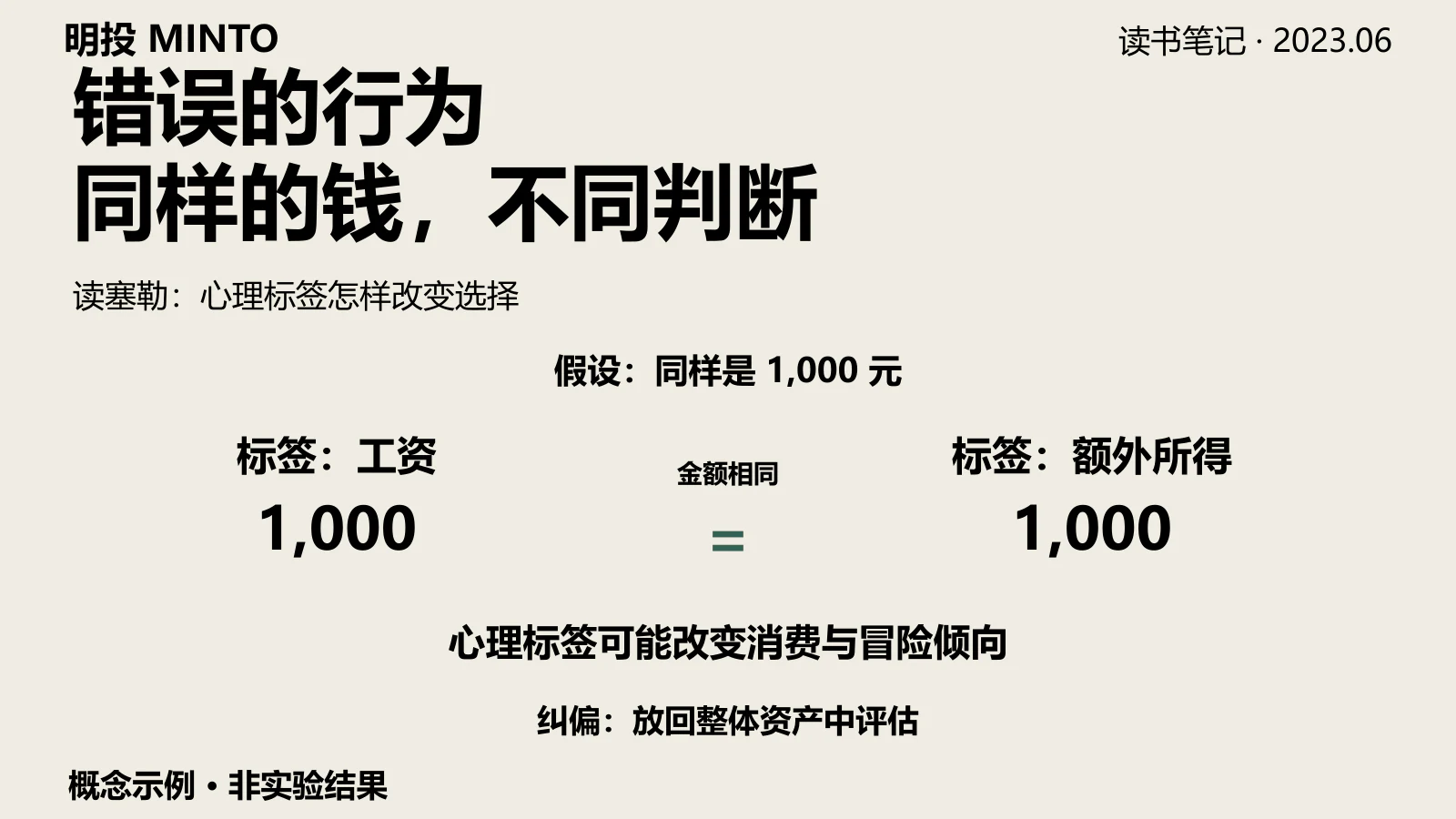
First, mental accounting. People compartmentalize money into different "mental accounts" and treat them differently. The same $10,000 is hoarded if it's salary, but squandered if it's a lottery win. "Principal" is guarded, but "profits earned" are risked (the so-called "house money" effect).
This is extremely dangerous in investing—many people use "already-earned profits" to make high-risk bets, thinking, "If I lose it, it's just money I made, so I won't feel the pain." But the market doesn't recognize your mental accounts. The money you earned is just as real as your principal. Treating profits as "play money" is the fastest way to lose them.
Second, the endowment effect. People overvalue what they already own. Once you buy a stock, you subconsciously think it's "worth more," pay more attention to information that supports it, and ignore information against it. Holding it distorts your judgment.
My way of fighting this: regularly ask myself, "If I didn't own this stock today, would I buy it at this price?" If the answer is no, then my only reason for holding is the endowment effect, and I should sell.
Third, the sunk cost fallacy. Costs already incurred and unrecoverable should not influence future decisions. But people can't help it: "I'm already down 50%—if I sell, I lock in the loss. I'll just wait." This is letting sunk costs (money already lost) hijack future decisions. The right question isn't "How much have I lost?" but "From now on, is holding this better than switching to something else?"
The Most Valuable Practice: Nudge
Thaler didn't just diagnose irrationality; he did something more important—design mechanisms to counteract it. He called them "nudges."
The most famous example is retirement savings. Everyone knows they should save for retirement, but because of procrastination and lack of self-control, most people don't save enough. Thaler designed a mechanism—"Save More Tomorrow": let employees pre-commit to "automatically increase the savings rate every time I get a raise."
What's clever about this design? It bypasses human weaknesses—no need to cut consumption now (no pain), and future raises automatically divert part of the money to savings (invisible). As a result, employees using this mechanism tripled their savings rates.
The lesson for investors: Don't rely on willpower to fight your weaknesses; rely on mechanisms. Instead of "trying hard" to dollar-cost average every month, set up automatic investing—let savings happen without you feeling it. Instead of "trying hard" to avoid overtrading, hand your account password to a process, set a trading cooldown. Willpower is a finite resource; mechanisms don't get tired.
Where I Part Ways with Thaler
First, "nudges" in investing might be weaponized against you.
Thaler's nudges aim to help people make better decisions. But the same behavioral science is used by brokers, exchanges, and crypto platforms to make you trade more, get addicted deeper. "Zero commissions," instant feedback, flashing red and green, push notifications—these are reverse nudges pushing you toward overtrading. The tools Thaler invented are used more often in finance to hurt investors than to help them. This dark side is too lightly treated in his book.
Second, behavioral economics risks over-explanation.
There are hundreds of "biases" in behavioral economics. Almost any behavior can be explained by some bias. But a theory that can explain everything has suspect predictive power. Sometimes behavior isn't a bias; it's a rational choice based on information or preferences we don't see. Attributing all "seemingly irrational" behavior to biases is itself a kind of arrogance.
Third, his treatment of group behavior is weak.
Thaler primarily studies individual decisions. But markets are groups. How individual biases aggregate into bubbles and stampedes in groups is almost untouched by Thaler. For that, you need the tools of Shiller (narratives) and Soros (reflexivity). Knowing individual behavioral economics alone is not enough to understand market-level irrationality.
Fourth, the ethical boundary of "nudges" is blurred.
If you can design mechanisms to "make people make better decisions," who defines "better"? Where is the line between nudge and manipulation? Thaler acknowledges the question but doesn't go deep enough. Once you accept that you can influence others' choices by designing the environment, you open a dangerous door—it can be used for good (saving) or evil (getting you to gamble). This ethical tension is what behavioral economics must face most squarely.
Thaler vs. Kahneman: Diagnostician vs. Engineer
Thaler and Kahneman are the twin peaks of behavioral economics, but with very different temperaments.
Kahneman is a pessimistic diagnostician—he proves that human irrationality is deep-rooted and nearly impossible to overcome through willpower. Reading Kahneman, you feel despair about humanity.
Thaler is an optimistic engineer—he acknowledges irrationality, but believes clever design can help flawed people achieve better outcomes. Reading Thaler, you see hope.
Kahneman tells you how sick you are; Thaler tells you how to live better with the sickness.
For investors, both postures are indispensable—use Kahneman to maintain a sober skepticism about yourself; use Thaler to design systems that protect you. Only Kahneman's clarity leads to paralysis; only Thaler's optimism leads to recklessness.
Final Thoughts
Thaler had a cameo in the 2015 film The Big Short—he and singer Selena Gomez sit at a poker table explaining the "hot hand fallacy." A Nobel economist, explaining behavioral finance to the public in the most accessible way. That image is pure Thaler—his life's work was to bring "why people make stupid mistakes" from the ivory tower to ordinary people.
My biggest takeaway from this book isn't the names of the biases; it's Thaler's fundamental stance—accept that people are flawed, then figure out how to do good work within that constraint.
Most investment advice implicitly assumes, "You should be more rational, more disciplined, less emotional." But Thaler would say—that's unrealistic. You won't become a rational machine. So don't try to eliminate your irrationality; design a system that works even when you're irrational.
This stance is deeply pragmatic. It doesn't ask you to be a better person; it asks you to make smarter arrangements.
Automatic investing, trading cooldowns, decision checklists, treating profits and principal as the same pot of money—these "mechanisms" are far more effective than any "I will be more disciplined" resolution.
Because willpower gets tired. Mechanisms don't.
That's the most practical gift Thaler left for every ordinary investor.

On investment analysis, market insight, and asset allocation — not chasing short-term noise, but understanding what truly drives long-term returns.