跳到正文 · Skip to content
内容
关于与合作
订阅与会员
★ 查看会员权益
外观与设置
外观
主题色
版本 · 深色 / 减动搜索⌘K
草稿预览·这篇还没发布,不会出现在列表和 RSS 里。review 完后把 frontmatter 的 draft: true 改为 false 即可。

Can Forecasting Be Learned? The Truth About Superforecasters

Taleb says forecasting is useless; Tetlock says it can be trained. Both are right — it depends on what you're predicting.

2023.09.306 min原创
Can Forecasting Be Learned? The Truth About Superforecasters
读书笔记MINTOVIEW2023.09.30

One: The Man Who Spent 20 Years Proving "Experts Are Terrible"

Philip Tetlock is a political psychologist. He did something that pissed off the entire "expert industry" — he spent 20 years tracking nearly 30,000 predictions from 284 experts, and proved that the accuracy of expert predictions is about the same as flipping a coin.

His famous conclusion — "the average expert's predictive ability is about the same as a dart-throwing chimpanzee." (Chimpanzees again.) And the more famous, the more TV appearances an expert has, the worse their predictions — because they're chasing "a compelling story," not accuracy.

But Tetlock didn't stop at this cynical conclusion. He then launched an even more important study — the Good Judgment Project. He wanted to know: since most people predict poorly, what do the few who predict well have in common? Can these skills be learned?

In 2015, he wrote the answer in Superforecasting. His conclusion — yes, it can be learned. Forecasting ability is not a gift, but a set of trainable habits.

This book directly challenges Taleb's "forecasting is useless" stance. Both are right, but they apply to different domains — this is the most important thing to think through about this book.

Two: Habits of Superforecasters

Tetlock found that top forecasters (superforecasters) share certain thinking habits:

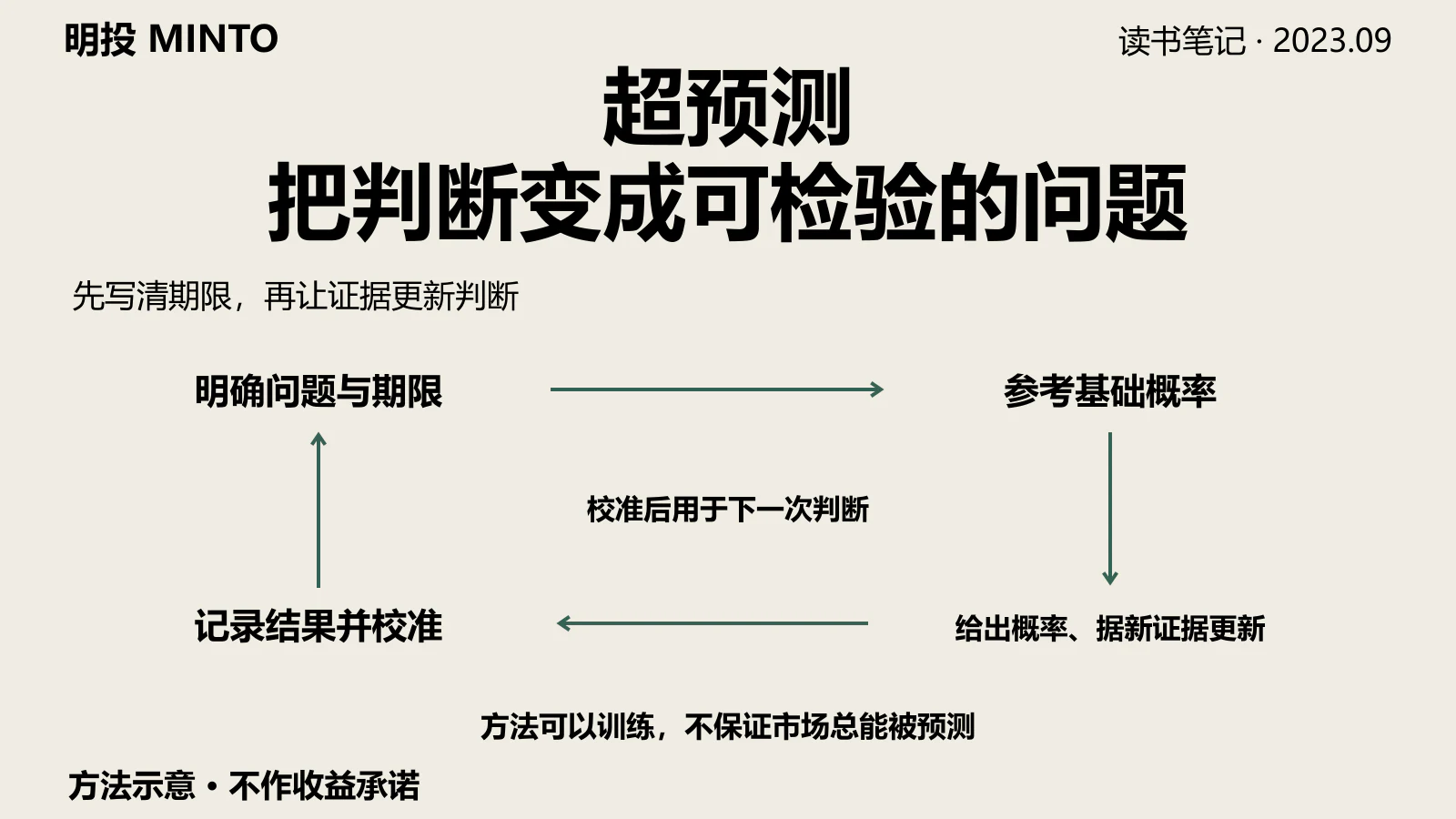
First, probabilistic thinking. Ordinary people say "will" or "won't"; superforecasters say "about 70% probability." They quantify their judgment into probabilities, not binary yes/no. More impressively, they distinguish between 70% and 75% — that level of precision seems pedantic to ordinary people but is exactly the core of forecasting ability.

Second, frequent updating. Superforecasters don't cling to their judgments. When new information arrives, they immediately make small adjustments — from 70% to 65%, then to 68%. They treat forecasting as a continuous updating process, not a one-and-done conclusion. This is Bayesian thinking at its core.

Third, decomposition. Facing a big question ("Will this company succeed next year?"), they break it into smaller sub-questions (revenue growth, gross margin, competitive landscape, management), estimate each, then combine. Turn the unknowable big question into relatively knowable smaller questions.

Fourth, outside view first. Look at "historical base rates of similar situations" (what percentage of companies like this have succeeded historically), then look at this company's unique aspects. Anchor on the statistical baseline first, then adjust for the specific case — don't get misled by a compelling story.

These habits can be learned by anyone. Tetlock proved that trained ordinary people can predict more accurately than CIA analysts with classified intelligence.

Three: Implications for Investors — Turn "Bullish" into Probability

The most direct takeaway for investors is — turn vague judgments into precise probabilities.

Most investors judge in binary, fuzzy terms — "I'm bullish on this company" or "this stock will go up." But is "bullish" 60% bullish or 90% bullish? That difference determines whether you should allocate 5% or 20% of your portfolio (remember Thorp's Kelly criterion).

The superforecaster approach forces you to be honest — you say "it will go up" — what's the probability? How much up? Over what time frame? Once forced to quantify, you'll find many "strongly bullish" views don't hold up — you can't name a specific probability because your judgment was vague in the first place.

One concrete thing I do — for every major position decision, I write down a falsifiable probability forecast: "I estimate the probability that this company's revenue growth exceeds 25% over the next two years is X%." Then I come back and audit. This habit revealed that my calibration is poor — events I assigned 80% probability happen only about 60% of the time. This calibration exercise improves judgment more than any investing book.

Four: Where I Disagree with Tetlock

First, his method works in domains with "repeatable, rapid feedback" but partially fails in investing.

Superforecaster training depends on quick, clear feedback — predict "will X happen within 6 months," and six months later you know if you were right and can calibrate. But many important judgments in investing are long-cycle, fuzzy feedback — you judge a company's competitive position 10 years out, and only know the answer a decade later, and even then you can't separate judgment from luck. The slower and fuzzier the feedback, the less Tetlock's training method works.

Second, he underestimates how "extreme events" break forecasting.

Tetlock's superforecasters excel at "routine problems" — roughly knowable, with historical baselines. But Taleb would say — what determines your fate are extreme events with no historical baseline, and those are exactly what even superforecasters cannot predict. Tetlock's method can make you more accurate on 90% of routine questions, but the 10% extreme events can wipe out all your routine gains. The real disagreement between him and Taleb isn't "can we predict," but "which predictions matter".

Third, "calibration" can give a false sense of precision.

Quantifying a judgment as "73%" feels scientific and precise. But if the underlying information is garbage, precise probabilities are just dressing up garbage judgment in a lab coat. GIGO — garbage in, garbage out. Tetlock doesn't emphasize enough that quantification cannot compensate for information quality.

Fourth, his sample is mainly geopolitical predictions — migrating to finance carries risks.

The Good Judgment Project mainly predicted geopolitical events (elections, conflicts, policy). These differ fundamentally from financial markets — financial markets are reflexive (Soros), meaning your prediction and actions change the object being predicted. In geopolitics, predicting an election doesn't change the outcome; but in markets, if many people predict something, that prediction itself pushes it to happen or not happen. Tetlock's method is more reliable in non-reflexive domains.

Five: Tetlock vs. Taleb — Can vs. Cannot Predict

This book and Taleb's work represent the most fundamental debate about "forecasting." The two have publicly clashed.

Tetlock says — forecasting can be trained; ordinary people can significantly improve accuracy through practice. Taleb says — the important things (extreme events) cannot be predicted, and practice only improves prediction of "routine trivia," which is irrelevant.

Who's right? My take — they're arguing about different things.

Tetlock is right about: on knowable, baseline-available, medium-term routine questions, forecasting ability can be trained. This is useful in investing — judging a company's operations next quarter, predicting a mid-term industry trend.

Taleb is right about: on unknowable, no-baseline, tail-end extreme events, forecasting is futile — only structural strategies can defend against them. This is also right in investing — trying to predict "when the next financial crisis will hit" is pointless.

My own stance — use Tetlock's method to improve routine judgments, use Taleb's structure to guard against extremes. The former helps you win the day-to-day, the latter prevents extremes from wiping you out. They address different problems; there's no contradiction.

Six: Final Thoughts

This book's most anti-cancer-of-culture point is — it proves that top forecasters' advantage comes not from IQ, not from information, not from education, but from a thinking style: humble, flexible, willing to update, quantifying judgments, not captured by their own positions.

Tetlock borrows an ancient metaphor — the hedgehog and the fox (from philosopher Isaiah Berlin). The hedgehog knows one big thing and explains everything with a single grand theory; the fox knows many small things and flexibly approaches problems from multiple angles.

Research found — foxes predict far better than hedgehogs. And the experts who appear on TV are almost all hedgehogs (because hedgehogs' stories are more compelling, confident, and shareable).

This is a sharp reminder for investors — the most confident, famous, big-narrative-spouting "experts" are precisely the worst predictors. The ones who predict well often speak hesitantly, loaded with qualifiers, constantly revising themselves — and they don't go on TV, because they don't sound "catchy."

My biggest takeaway from this book is learning to be wary of confident predictions and respectful of humble probabilities.

In the financial world, this habit can help you dodge 90% of the BS. Because those who BS you are almost always supremely confident hedgehogs.

And the ones worth listening to are mostly stammering foxes.

Minto
明投 Minto
投资分析 · 长期主义者

专注投资分析、市场洞察与资产配置。不追短期波动,只理解真正驱动长期回报的东西。

你读完了 · Colophon

Can Forecasting Be Learned? The Truth About Superforecasters

6
分钟
2023/09
期号
2023
年份
真正稀缺的,是一个不慌不忙的人。
明投 · MintoInvest Wisely
— From This Series
喜欢这篇?这类 读书笔记 的深度拆解会持续发到你邮箱。
无广告 · 随时退订
— Enjoyed the read?
如果这篇文章对你有用,把它分享给一个朋友,就是对我最好的支持。

口碑是独立创作者最稀缺的燃料。

— Discussion

说说你的想法

评论基于 GitHub Discussions(Giscus)。登录后即可留言、点赞、互相讨论。

评论还在准备中。

想说什么可以直接发我邮件,比在评论区更容易认真回复。

mingtaohuang617@gmail.com →
支持沉浸式阅读