跳到正文 · Skip to content
内容
关于与合作
订阅与会员
★ 查看会员权益
外观与设置
外观
主题色
版本 · 深色 / 减动搜索⌘K
草稿预览·这篇还没发布,不会出现在列表和 RSS 里。review 完后把 frontmatter 的 draft: true 改为 false 即可。

The Market Has No Truth, Only Refined Biases: Soros on Reflexivity

Soros says the market is always wrong — but the way it's wrong changes the direction of its error. Understand that, and you understand bubbles.

2023.11.086 min原创
The Market Has No Truth, Only Refined Biases: Soros on Reflexivity

一本几乎没人读懂的传奇之书

In 1987, George Soros published The Alchemy of Finance.

This book has a strange status — it's widely revered, but hardly anyone claims to have truly understood it. Even Soros's longtime partner, Stanley Druckenmiller, said he found it a tough read. Soros himself admits he's not a great writer.

But the book is worth the struggle, because it contains one of the 20th century's most profound market theories — reflexivity. This is the underlying logic behind Soros's decades of consistently beating the market (including his USD 1 billion short against the pound in 1992).

If you've already read Shiller on "narratives" and Taleb on "uncertainty," then Soros's "reflexivity" is the sharpest tool in that lineage — it explains why markets self-reinforce toward extremes, and then suddenly collapse.

反身性:市场和现实互相改变

Mainstream economics assumes markets reflect reality. Company fundamentals are the "cause," stock prices are the "effect." Prices oscillate around fundamentals.

Soros says — wrong. Markets and reality feed back into each other.

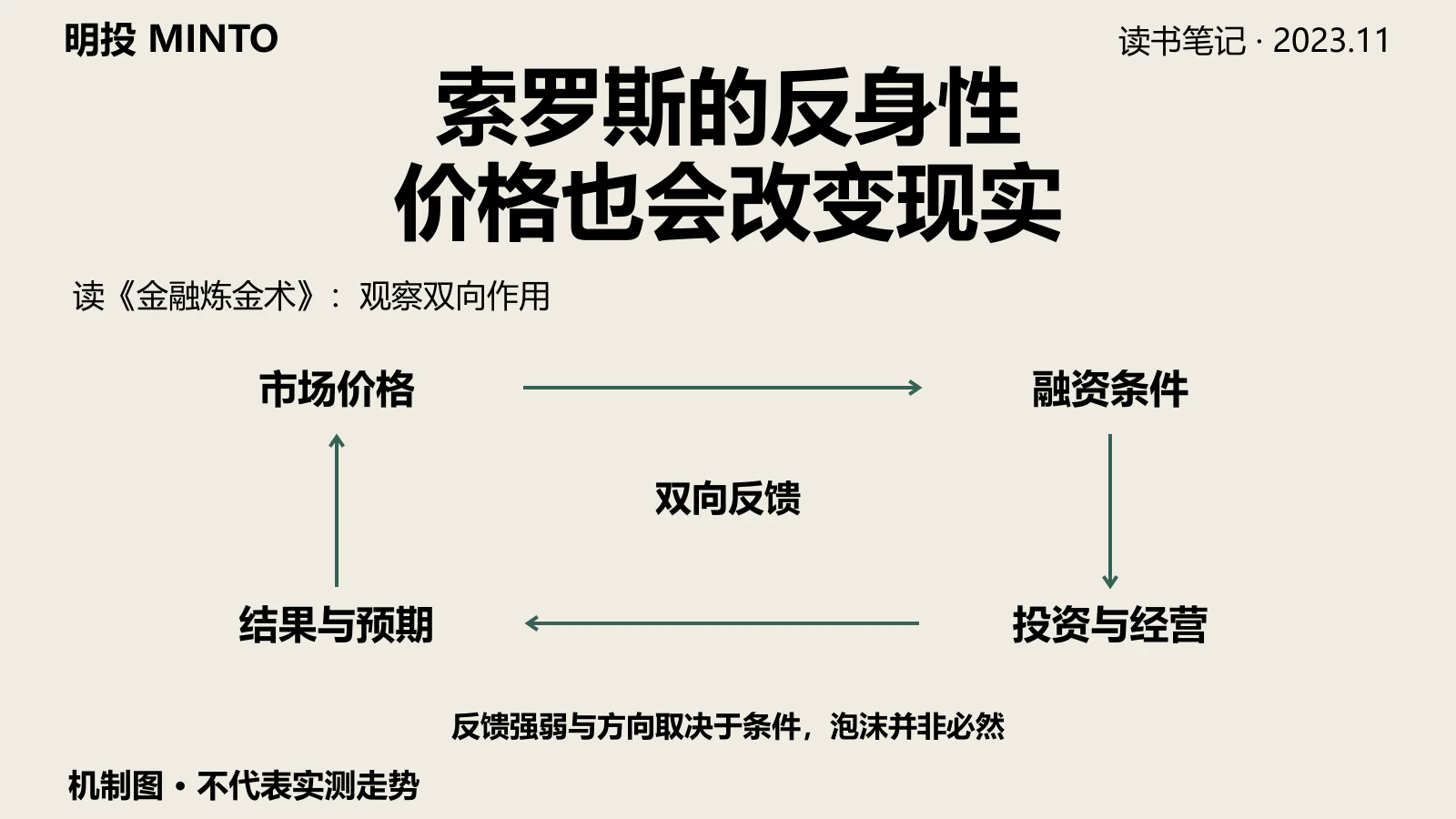
His logic: participants' perceptions change the market itself, and the changed market then alters participants' perceptions. It's a loop, not a one-way mirror.

Example. A company's stock rises → it can raise capital more cheaply → it actually expands faster, fundamentals improve → which pushes the stock even higher. The stock's rise "creates" the fundamentals it was supposed to reflect.

This is reflexivity — expectations change reality, reality changes expectations, cycle repeats until it goes too far and breaks.

This completely upends the "price oscillates around value" picture. Soros says — often, price creates value, rather than reflecting it. That's the mechanism of a bubble.

繁荣-崩溃模型:泡沫的完整生命周期

Soros uses reflexivity to lay out a full bubble model, roughly eight stages:

  1. An unrecognized trend begins
  2. The trend is recognized; self-reinforcement begins
  3. Market undergoes a test (a pullback), but the trend holds
  4. Conviction strengthens; trend accelerates; price detaches from fundamentals
  5. The moment of truth — reality can no longer support expectations
  6. Twilight — people still believe, but enthusiasm fades
  7. Tipping point — trend reverses
  8. Collapse accelerates; negative self-reinforcement

The most useful part of this model is stage 3 — "successful test" . Soros says a bubble will inevitably experience a pullback midway; if it survives, it only strengthens conviction, accelerating the trend. "It went down and came back up" is itself the most dangerous signal of a bubble, not the safest.

Many assets in 2021 (meme stocks, crypto, SPACs) went through this full cycle — the Q1 2021 pullback was absorbed by "buy the dip," reinforcing belief, then total collapse in 2022.

Whenever I look at a strong trend, I use Soros's model to locate where we are — What stage? Has the "successful test" passed? Can fundamentals still support expectations? This tells me more about bubble positioning than just looking at valuations.

我跟索罗斯不同的地方

First, reflexivity is strong after the fact, weak before.

Reflexivity is a beautiful explanatory framework — after any bubble bursts, you can use it to tell a compelling story. But beforehand, it gives you almost no clue about "which day is the turning point." Soros himself admits he knew the bubble would pop, but he often got the timing wrong. A framework that's perfect in hindsight but fuzzy in foresight has limited practical value.

Second, his method relies heavily on personal talent and is nearly impossible to teach.

Soros reportedly traded based largely on "body signals" — he knew his position was wrong when his back hurt. This almost mystical intuition, combined with the reflexivity framework, made him successful. But this system cannot be replicated. Druckenmiller worked with him for years and still couldn't fully learn it. A method that can't be taught has diminished value for readers.

Third, he's not honest enough about his own position within reflexivity.

Soros uses reflexivity to explain markets, but as a massive capital player, he himself is part of the reflexivity loop — when he shorted the pound, he wasn't just "predicting" it would fall; his action of shorting "created" the decline. A player of his caliber can exploit reflexivity; retail investors cannot, because ordinary people can't "change reality." Soros rarely discusses this asymmetry.

Fourth, his philosophical packaging is excessive.

Soros has always wanted to be seen as a philosopher (he studied under Popper), so this book is wrapped in thick philosophical jargon — "fallibility," "imperfect understanding," etc. These philosophical discussions make the book extremely hard to read and dilute the core insight (reflexivity). A good insight doesn't need this much packaging. It's the biggest obstacle to reading this book.

索罗斯 vs 巴菲特:市场观的终极对立

Soros and Buffett represent the most fundamental divergence in views of the market.

Buffett believes in intrinsic value — a company has an objective value independent of market sentiment; your job is to estimate it and buy when price is below value. Market sentiment is noise.

Soros believes in reflexivity — there is no independent "intrinsic value"; value itself is constantly reshaped by market sentiment. Market sentiment is not noise; it's part of value.

This is a clash of two worldviews — objective value vs. subjective construction.

Who's right? My take — Buffett is right on stable companies; Soros is right on trending assets.

A company selling soda has relatively stable intrinsic value; Buffett works. An asset driven by technological change / narrative (AI, crypto, platform stocks) has its value repeatedly reshaped by expectations; Soros works better.

My own stance — core positions use Buffett (find companies with objective value), but when gauging the overall market position, use Soros (see how far reflexivity has gone). Two worldviews, corresponding to two layers of the market.

关于「反身性」的滥用

Final section — "reflexivity" is becoming a universal post-hoc excuse.

Any asset goes up: someone says "reflexivity is self-reinforcing." Any asset goes down: someone says "reflexivity is reversing." Using a framework that always fits after the fact to explain everything explains nothing.

To truly use reflexivity well, you need pre-hoc judgment: Is the current trend reflexivity-driven? Which stage of self-reinforcement? How wide is the gap between fundamentals and expectations? — These are hard, falsifiable, specific judgments. Using the word "reflexivity" as a label after the fact is lazy.

Soros himself was never lazy — he used reflexivity to make pre-hoc, real-money bets that could lose. His readers, however, often use it only for post-hoc, zero-cost explanations. That's the greatest disservice to Soros.

写在最后

Soros is now in his 90s. He made tens of billions of dollars over his lifetime and has given most of it to his Open Society Foundations.

What I admire most about this book is not reflexivity theory itself, but Soros's attitude toward himself — he always assumes he is wrong. His entire philosophy rests on the premise that "human understanding of the world is inevitably incomplete and flawed." When he trades, his first question isn't "how do I win?" but "what if I'm wrong?"

This posture of "always assuming I'm wrong" is the fundamental reason he survived in markets for 60 years. Not because he was right more often than others, but because he admitted his mistakes faster.

One quote I keep copying — "It's not whether you're right or wrong that's important, but how much money you make when you're right and how much you lose when you're wrong."

That sentence is more practical than reflexivity theory. It applies to every investor, whether or not you can read The Alchemy of Finance.

And The Alchemy of Finance itself — worth the struggle, but be prepared to struggle. It's a great but difficult book. Both things are true.

Minto
明投 Minto
投资分析 · 长期主义者
你读完了 · Colophon

The Market Has No Truth, Only Refined Biases: Soros on Reflexivity

6
分钟
2023/11
期号
2023
年份
真正稀缺的,是一个不慌不忙的人。
明投 · MintoInvest Wisely
— From This Series
喜欢这篇?这类 读书笔记 的深度拆解会持续发到你邮箱。
无广告 · 随时退订
— Enjoyed the read?
如果这篇文章对你有用,把它分享给一个朋友,就是对我最好的支持。

口碑是独立创作者最稀缺的燃料。

— Discussion

说说你的想法

评论基于 GitHub Discussions(Giscus)。登录后即可留言、点赞、互相讨论。

评论还在准备中。

想说什么可以直接发我邮件,比在评论区更容易认真回复。

mingtaohuang617@gmail.com →
支持沉浸式阅读