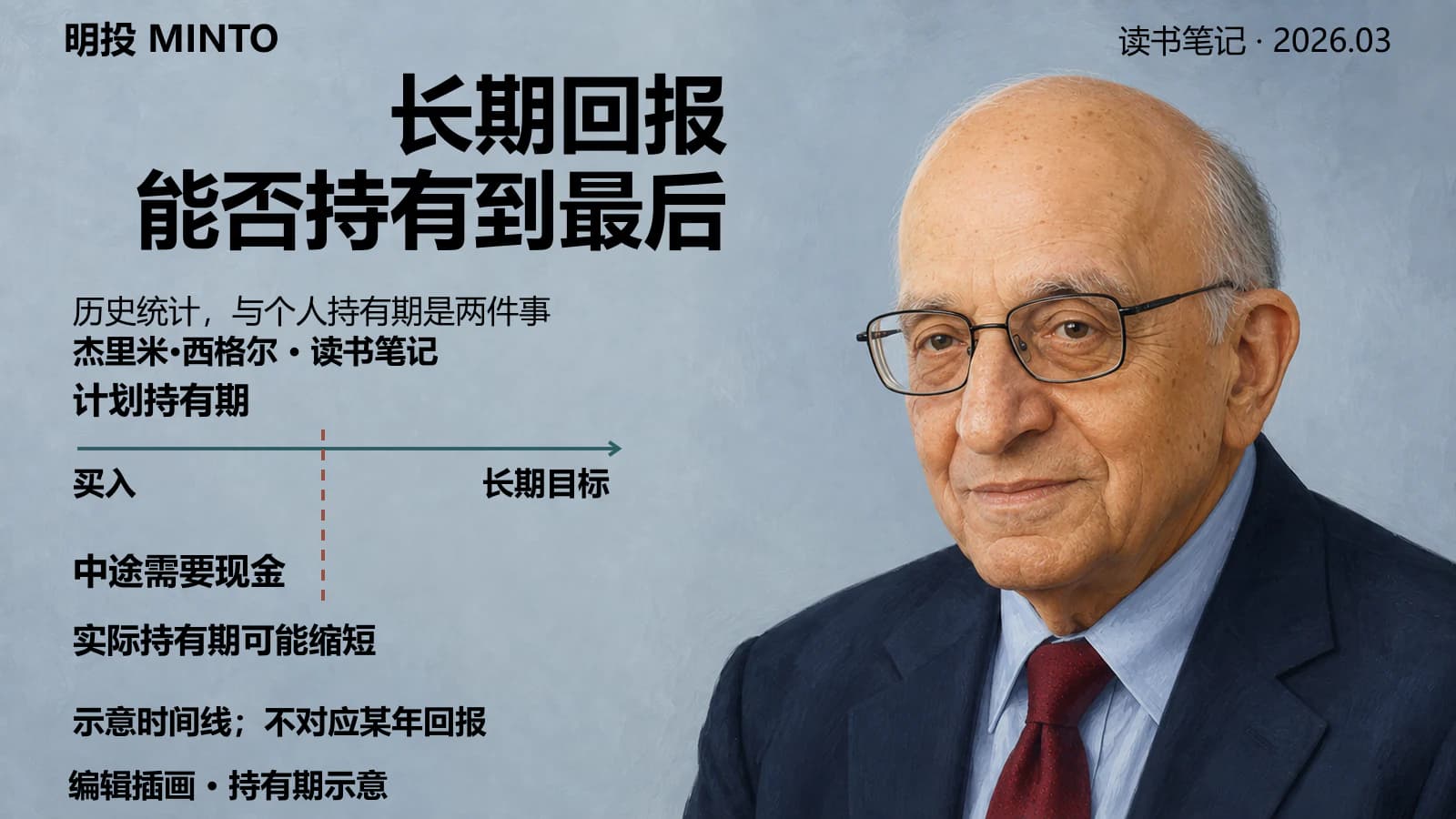
One: A Book That Uses 200 Years of Data as Evidence
Jeremy Siegel is a finance professor at Wharton, University of Pennsylvania. In 1994, he published Stocks for the Long Run. What makes the book special is the time span it dares to use — 200 years — a length that most finance books shy away from.
From 1802 to 1992 (updated to the 2020s in later editions), the real (inflation-adjusted) returns for U.S. markets:
- Stocks: ~6.6%-6.9% annualized
- Long-term government bonds: ~3.5% annualized
- Short-term government bonds: ~2.7% annualized
- Gold: ~0.5% annualized
- U.S. dollar cash: -1.4% annualized (eaten by inflation)
If you had put $1 into each of these five assets in 1802, by 2020 that dollar in stocks would have become roughly $2 million, in bonds a few thousand, and in cash just a few cents.
Siegel's core conclusion is so simple it sounds almost like common sense: Over a sufficiently long horizon, stocks always win.
But the real value of this book doesn't lie in that conclusion. It lies in the complexity hidden behind those three words: 'sufficiently long.'
Two: First Truth — Stocks Win Because They Absorb Inflation
Why do stocks outperform over the long run? Siegel's answer is different from what most people think.
It's not because companies earn a lot — it's because companies themselves are inflation absorbers.
When a company raises prices, expands capacity, makes acquisitions, or buys back shares, it is essentially absorbing inflation. Its revenue rises with inflation, its costs partially rise with inflation, and its profits ultimately rise with inflation.
Bonds can't do that — a 10-year fixed-rate bond sees its real returns eaten away as inflation rises. Cash can't do that — it's the sacrificial lamb of inflation. Gold appears to hedge inflation, but over 200 years its real return was only 0.5%, basically keeping pace with inflation.
Only stocks are themselves a compounding machine of 'inflation + real growth.'
This is why the 'cash + bond' portfolio that many conservative investors rely on looks stable but actually delivers extremely low real returns — they mistake 'low volatility' for 'low risk.' In reality, inflation is the biggest, most insidious risk.
The 2021-2023 period provided a perfect real-world test. U.S. CPI rose about 18% cumulatively. Cash holders lost >15% in real purchasing power; long-bond holders lost >30% in real terms. But holders of S&P 500 ETFs, even after the 2022 drawdown, saw their total real purchasing power positive when they came back in 2024. In the crucible of inflation, stocks are the only long-term survivor.
What Siegel taught me is not 'stocks are best,' but 'not holding stocks is itself a form of ongoing loss.'
Three: Second Truth — Stocks' 'Stability' Requires a 20- to 30-Year Window to Appear
But the most honest part of Siegel's book is where he admits something — stocks win long-term, but the medium term can be excruciating.
- In 1929, stocks fell 89% from the peak, and it took 25 years to get back to breakeven.
- From 1966 to 1982, the S&P 500 had near-zero nominal returns (real losses of >60% after inflation).
- From 2000 to 2013, the S&P 500 had near-zero real returns.
- The Nikkei from 1989 to 2024 — 35 years — only just returned to its nominal starting point.
Holding stocks long-term always wins, but only if you really do hold long-term.
Siegel calculated from historical data:
- Holding period of 1 year: probability stocks underperform bonds ~35%
- Holding period of 5 years: ~25%
- Holding period of 10 years: ~15%
- Holding period of 20 years: ~0%
- Holding period of 30 years: virtually 0%
The true 'stocks always win' requires a 20- to 30-year holding period to emerge.
That's the biggest trap for individual investors — they say they are 'long-term investors,' but their actual holding period is often 6 to 18 months.
I've reflected on my own trading records: positions I've held for more than 5 years are extremely rare. The vast majority of positions get shaken out within 1 to 3 years by some 'volatility' or 'opportunity cost.'
Long-term holding is not a willingness; it's a capability. The core of that capability is the ability to endure 10 years of mediocre returns in the middle.
Four: Third Truth — Starting Valuation Determines Everything
Siegel's data also reveals another uncomfortable truth — long-term returns depend heavily on the valuation at which you buy.
Backtest results:
- Buying when CAPE < 10: future 20-year real annualized return ~11%
- Buying when CAPE 10-15: ~8%
- Buying when CAPE 15-20: ~5%
- Buying when CAPE > 25: ~2%-3%
That difference between 11% and 3%, compounded over 20 years, is an 8x gap.
This means — 'Holding stocks long-term always wins' is a statistical fact, but 'winning big or winning small' is almost entirely determined by the valuation at which you buy.
At the start of 2020, the S&P 500 CAPE was 30. In early 2026, it's still near 35. Based on historical data, at this valuation level, the real return over the next 20 years will likely be significantly below the historical average of 6.6%.
I take two things from this:
- Don't be fooled by the slogan 'stocks win long-term.' That conclusion only holds when you buy at reasonable valuations.
- Cross-regional allocation is especially valuable when valuation gaps are wide. When the U.S. CAPE is 35, European CAPE is 18, and emerging market CAPE is 12, a global equity allocation is far smarter than going all-in on the U.S. — especially in an environment where U.S. valuations are at the 90th percentile historically.
Five: Where I Differ from Siegel
By my fourth reading of this book, I began to develop some real disagreements.
First, his 'stocks always win long-term' conclusion is heavily contaminated by 'American exceptionalism.'
Siegel uses almost exclusively U.S. data. But the U.S. over the past 200 years has been the most special capital market on earth — it experienced one civil war, two world wars, one Great Depression, but it never experienced foreign invasion, a complete shutdown of its equity market, or a wholesale restructuring of its monetary system. That's an almost unique run of luck in the last 200 years.
If you run the same backtest elsewhere:
- Germany 1900-2000: real stock return ~3% (two world wars)
- Japan 1900-2000: ~4% (collapse + long deflation)
- Argentina 1900-2000: ~0% (hyperinflation + multiple defaults)
'Stocks always win long-term' is really 'in markets that haven't suffered catastrophic political events, stocks always win long-term.' This is a conclusion heavily contaminated by survivorship bias.
Siegel occasionally acknowledges this in the book, but his posture remains 'the U.S. will continue to be the U.S.' That has been true for the past 200 years, but the inference 'what was true for the past 200 years will also be true for the next 100' is itself an example of the extrapolation bias that Siegel himself warns against.
Second, his 'stocks always beat bonds' conclusion was broken during the low-interest-rate era.
Siegel's conclusion is built on the assumption that 'bonds yield ~3.5% long-term.' But during 2009-2021, the U.S. 10-year Treasury yield was persistently below 2%. During that period, the actual long-term bond return was much lower than what Siegel's model assumes.
More dangerous: if we experience a 'persistently high inflation + high interest rate' environment over the next 30 years, the relative advantage between stocks and bonds will reshuffle — stocks' 'inflation absorption' advantage is no longer exclusive because bonds also offer higher coupons; meanwhile, stock valuations get compressed by high rates. Siegel's model implicitly assumes a relatively stable macro environment — an assumption that is questionable in 2026.
Third, he barely discusses the risk of being forced to sell during the holding period.
Siegel's backtest assumes the investor can hold for 20-30 years. But in reality, most people encounter one or more 'forced sell' moments in a 20-30 year window — job loss, medical bills, family crisis, children's education, buying a house.
At those moments, your return isn't '20-year stock annualized 6.6%' but a function of 'when I am forced to sell.' Someone who retired in the second half of 2007 and had to withdraw from their pension got a return that has nothing to do with Siegel's statistics.
What truly determines your return is not 200 years of data, but the state of the market on the day you sell. Siegel's statistics cannot answer that — they assume you can hold the full 20 years, but in real life, most people cannot.
Fourth, his simplification of 'stocks' ignores internal divergence.
Siegel says 'stocks' outperform long-term, but he uses the broad market index. The composition within the index changes dramatically — almost none of the companies in the 1900 Dow are still around today; fewer than half of the companies in the 1980 Dow are still in the index.
This means 'holding stocks' is not the same as 'holding the companies from 1980.' The index's return is actually the return of 'constantly eliminating losers and adding winners.' If you picked 30 stocks in 1980 and held them static, your return in 2026 would be far below the index's statistical return — because the index has a built-in 'death elimination mechanism' that your portfolio lacks.
For investors in the ETF era, this is actually good news — by buying VTI / VOO, you automatically enjoy that elimination mechanism. But for investors who say 'I'll pick 10 stocks and hold them for 30 years,' this is a seriously underestimated risk.
Six: Siegel vs. Bogle — Internal Tensions Within the Passive Investing Camp
Siegel and Jack Bogle (founder of Vanguard) are often seen as both belonging to the 'passive investing school,' but their core arguments are fundamentally different.
Bogle's argument: active managers cannot beat the market, so buy the index. His evidence comes from fund industry statistics — 80% of active funds underperform their benchmark over 10 years.
Siegel's argument: stocks outperform other assets over the long run, so you should hold stocks. His evidence comes from 200 years of cross-asset return data.
The two arguments answer different questions. Bogle answers 'how to choose within stocks'; Siegel answers 'how to choose between asset classes.' But they are often merged into the same faith of 'buy the index + hold forever.'
What I've learned is — these two arguments have different strengths.
Bogle's argument (index beats active) held extremely well in U.S. stocks from 2000 to 2020, but has significant counterexamples in emerging markets and certain niche sectors (small-cap growth, mid-cap value).
Siegel's argument (stocks beat other assets) holds in 'U.S. + no political catastrophe' context, but is weaker elsewhere.
So the combined strategy 'buy the index + hold long-term' is truly reliable only when both conditions hold simultaneously: 'U.S. large-cap index + no major political rupture.' If either condition wobbles, the strategy's probability of success drops.
Seven: Three Takeaways for Individual Investors
If I could take only three things from this book, they would be:
-
Not holding stocks is a form of ongoing loss — inflation constantly eats your cash and bonds; only stocks can fight it long-term. But this premise requires being in a market that hasn't yet suffered a political rupture.
-
'Long-term' is 20-30 years, not 2-3 years — most people say they are long-term investors but cannot actually execute it. True long-term holding requires enduring mid-term slumps, requires the right mindset, requires cash flow, requires a financial structure that won't force liquidation.
-
Starting valuation determines return level — don't go all-in when CAPE is extremely high. Wait patiently for a normalization window, or look for valuation gaps between different markets. In 2026, with U.S. CAPE at 35, this point matters especially.
These three things are not glamorous. But they determine where you will be 20 years from now.
Eight: The Overconfidence in 'Stocks Always Win'
In this final section, I want to argue against some of Siegel's readers — 'stocks always win' has been deified to the point of losing its original meaning.
Whenever I see someone citing Siegel to say 'stocks always win long-term' and using that to support a 'all-in S&P 500, never sell' strategy, I grow wary.
Because that strategy has been spectacularly successful in U.S. stocks over the past 30 years, but it leaves zero room for the possibility that 'the next 30 years could be different from the past 30.'
History is not destiny; statistical returns are not promises. Japanese investors in 1990 used the same logic to go all-in on the Nikkei; 35 years later, they just got their money back. They didn't violate Siegel's method — they violated the 'failure to realize that the era they lived in was different from the past.'
Siegel's data tells you what happened in the U.S. past; it does not tell you that the U.S. future will be the same. Mistaking the past for a promise of the future is the easiest illusion a 200-year backtest can create.
Nine: A Final Note
Stocks for the Long Run doesn't offer the kind of 'read it today, apply it tomorrow' concrete methods. Its value is of a different kind — it uses 200 years of data to lock certain repeatedly debated questions into facts.
What I admire most about this book is that it doesn't hedge. Siegel doesn't tell stories or narratives or individual stocks; he just shows you the data.
But good data does not equal good predictions. 200 years of data can tell you the past, but cannot tell you the future. Siegel himself acknowledges this, but his readers often forget.
What 200 years of data tells us is not 'stocks are best,' but 'time is most expensive.'
Good assets are good because they allow time to work for you. Bad assets are bad because they let time work against you.
Understand this, and your entire perspective on asset allocation changes.
Every investor must ultimately answer one question: In the next 20 years, do I want time on my side, or against me?
If the answer is the former, this book is worth reading. But after reading, remember — time is on your side only if the market doesn't experience something you haven't prepared for. Leaving room for that possibility — a tail-end contingency — is what it truly means to have understood this book.
Siegel himself lived in an era remarkably friendly to his method. You and I may not be so lucky. That humble acknowledgment is the one thing that the 200 years of data didn't say explicitly, but is the most valuable takeaway.
专注投资分析、市场洞察与资产配置。不追短期波动,只理解真正驱动长期回报的东西。