跳到正文 · Skip to content
内容
关于与合作
订阅与会员
★ 查看会员权益
外观与设置
外观
主题色
版本 · 深色 / 减动搜索⌘K
草稿预览·这篇还没发布,不会出现在列表和 RSS 里。review 完后把 frontmatter 的 draft: true 改为 false 即可。

First Machine Age Freed Muscles, the Second Is Replacing Brains

Brynjolfsson says we're standing at a watershed—machines are starting to do the 'thinking' for the first time, and we're not ready for the consequences.

2025.09.226 min原创
First Machine Age Freed Muscles, the Second Is Replacing Brains
读书笔记MINTOVIEW2025.09.22

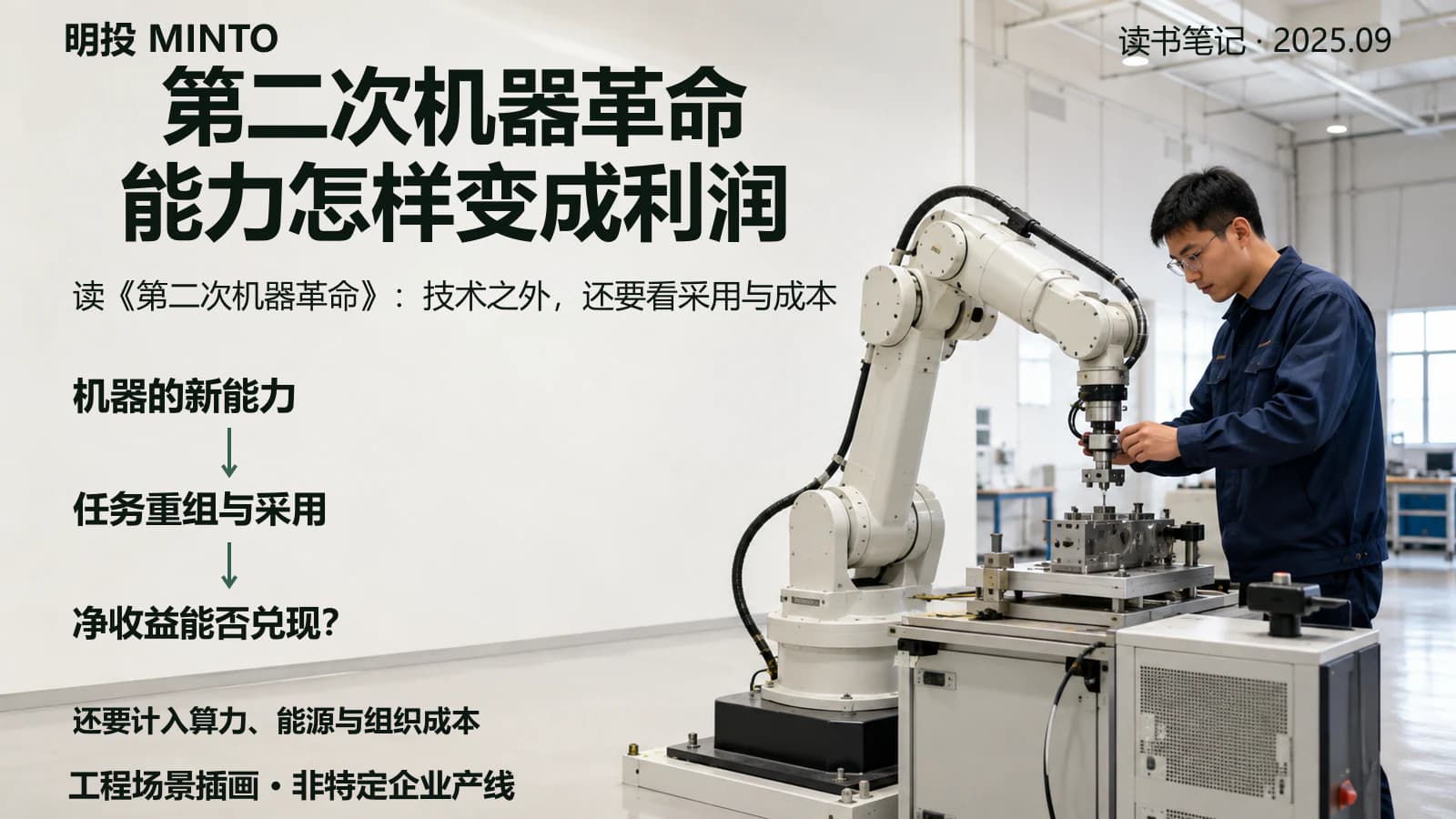
一本预言了 AI 冲击的书

In 2014, MIT economists Erik Brynjolfsson and Andrew McAfee published The Second Machine Age.

The book's core thesis—which seemed a bit ahead of its time in 2014—has become almost reality in the AI-driven 2025:

The first machine age (the Industrial Revolution) used machines to replace and amplify human 'muscle.' Steam engines, electricity, internal combustion—they did the physical labor, freeing our bodies.

The second machine age uses machines to replace and amplify the human 'brain.' Computers, AI, machine learning—they do cognitive work, and they're taking over mental labor.

The authors predicted back in 2014 that we're at the inflection point of the second machine age, and this revolution will be deeper, faster, and more disruptive than the first. Because this time, it's not muscle being replaced—it's brainpower, the last bastion of human uniqueness.

Eleven years later, watching ChatGPT write code, articles, and analyses—this book predicted almost exactly what's happening.

三个对投资极重要的判断

First: 'nonrivalry' and 'zero marginal cost' will reshape the economy. The authors emphasize that digital products have a revolutionary property—the cost of copying is near zero, and a single product can be used by an infinite number of people simultaneously (economists call this 'nonrivalry'). Once an AI model is trained, serving the first user and the one hundred millionth costs almost the same. This creates unprecedented economies of scale and winner-take-most dynamics. That's why AI-era leaders can have such insane margins and market caps—their products can serve the world at zero incremental cost.

Second: 'winner-take-all' will worsen inequality. When replication costs zero and network effects dominate, markets concentrate among a tiny set of winners. The authors predicted that the second machine age will generate enormous wealth, but it will be highly concentrated among the few who 'own the machines (capital) and top skills,' while the many doing automatable cognitive work will be left behind. This echoes Piketty's r > g—AI will supercharge returns on 'capital' and 'top human capital,' while stalling returns on 'ordinary labor.' For investors, this is a cold but crucial judgment: position yourself on the side that 'owns the AI capital.'

Third: the boundary between 'what machines are good at' and 'what humans are good at' is redrawing. The authors propose 'racing with machines' vs. 'collaborating with machines.' Competing with AI in areas it does well is futile; real value lies in doing what AI still doesn't do well (creativity, complex judgment, human connection, asking good questions), and in 'human + AI' collaboration. For investors, this points to a framework—which companies/jobs will be replaced by AI (short thesis), and which will be amplified by AI (long thesis).

对 2025 美股的直接映射

This book's 2014 predictions are playing out precisely in 2025 US stocks:

Nvidia's rise—It supplies the 'engine' (compute) of the second machine age. Just like the companies that sold steam engines and electricity in the first machine age, the compute seller sits at the top of the food chain.

Mag 7 concentration—'Zero marginal cost + network effects + winner-take-all' is making the largest tech companies even larger. The book's 2014 prophecy is today's reality: 7 companies make up a third of the S&P 500 market cap.

Productivity paradox—The authors also discuss a puzzle: technology advances rapidly, but overall productivity statistics grow slowly (the 'Solow Paradox'). This puzzle persists in the AI era—AI looks powerful, but it hasn't yet shown up meaningfully in macro productivity data. This is a key investment question—will AI's productivity dividend ever materialize in corporate profits, and when? If it does, current valuations are justified; if it doesn't, current AI valuations are a bubble.

我跟两位作者不同的地方

First: their 'optimistic timeline' for AI deviates from reality.

In 2014, the authors were too optimistic about some AI capabilities (e.g., the timing of autonomous driving) and underestimated others (e.g., the sudden explosion of generative AI—they didn't anticipate ChatGPT's impact in 2022). Technology prediction timelines are almost always wrong—the direction of the big trend is right, but 'when and in what form' is almost always surprising. Investors beware: betting on an 'optimistic timeline' often kills you by being 'too early.'

Second: their judgment on 'job displacement' needs updating.

In 2014, the authors worried AI would replace a lot of 'routine cognitive work' (data entry, basic analysis). But 2025 reality is more nuanced—generative AI is hitting 'high-end creative and knowledge work' (writing, programming, design, law), while some 'low-end physical + flexible' jobs (caregiving, repair) are harder to replace. The direction of AI displacement deviates from 2014 expectations. This reminds investors—the judgment of 'which jobs/industries will be disrupted by AI' needs constant updating, not old frameworks.

Third: they underestimated AI's cost and energy consumption.

The authors emphasized 'zero marginal cost' for digital products. But generative AI partly breaks that assumption—training and inference for large models require enormous compute and energy; marginal cost is not zero. Every AI conversation consumes real electricity and compute cost. That's why AI capex is so staggering and why energy has become a bottleneck for AI. 'Zero marginal cost' holds for traditional software, but needs a discount for AI. This is extremely important for assessing the real profitability of AI companies.

Fourth: their treatment of 'AI risks' is too light.

The book's tone is optimistic—the second machine age will create enormous prosperity. But it under-discusses systemic risks (manipulation, loss of control, disinformation, power concentration). In 2025, we're increasingly aware that AI is not just a productivity tool—it's also an unprecedented tool for manipulation and centralization of power. A complete judgment needs to add vigilance about AI's dark side on top of the authors' 'prosperity narrative.'

《第二次机器革命》 vs KK《必然》:两种 AI 未来观

This book and Kevin Kelly's The Inevitable both predict an AI-driven future, but from different angles.

KK is a technology philosopher's perspective—he uses big concepts like 'cognifying' (making everything intelligent) to paint a grand picture of AI permeating everything. He gives you direction and excitement.

Brynjolfsson is an economist's perspective—he focuses on AI's concrete impact on the economy, employment, inequality, and productivity. He gives you cool-headed economic analysis.

KK tells you 'AI will make everything intelligent'; Brynjolfsson tells you 'what this means for jobs, wealth distribution, and corporate profits.'

Combined, they're most useful for investors—use KK to grasp the big direction of AI permeation (cognifying is inevitable), and use Brynjolfsson to judge the economic consequences of that direction (who makes money, who loses jobs, where profits flow, whether valuations are rational).

The most critical investment question lies precisely on Brynjolfsson's side—will AI's productivity dividend actually materialize in corporate profits? When? In what form? The answer determines whether 2025's AI valuations are rational or bubble. KK makes you believe AI is important, but Brynjolfsson reminds you—important doesn't mean immediately profitable (remember the Solow Paradox).

写在最后

My biggest takeaway from this book is a long-cycle framework—we're in the early stages of a transformation that might be bigger than the Industrial Revolution.

The first machine age took over a century to fully unfold (from steam to electrification), with huge booms and painful bumps (unemployment, social upheaval, inequality). The authors argue that the second machine age will be faster and more intense, with both the boom and the pain amplified.

For investors, this implies several long-term judgments:

First, stand on the side of 'the machine (capital).' Whether it's compute (Nvidia), platforms (Mag 7), or companies amplified by AI, over the long run, those who 'own and control the machines' will benefit. This echoes Piketty—in the AI era, being on the 'capital side' is more important than ever.

Second, be wary of the side 'being replaced by the machine.' Companies whose core business can be efficiently replaced by AI (pure manual content, basic cognitive services) face structural pressure long-term.

Third, stay humble about timelines. The direction of AI's impact is certain, but 'when it materializes into profits' is highly uncertain. To bet on a certain direction with an uncertain timeline, you need a Taleb-like posture—long-term bullish, but don't wager in a way that kills you by being 'too early.'

Brynjolfsson has a line in the book that keeps coming back to me—'Technology is an amplifier. It amplifies good, but it also amplifies bad; it amplifies prosperity, but it also amplifies inequality.'

The second machine age is amplifying everything.

And as an investor, what you can do—is stand on the side of the 'good and prosperity' being amplified (owning and controlling AI capital), while staying awake to the 'risk and inequality' it amplifies.

That is this book's most important long-term compass for an investor living in the age of AI.

Minto
明投 Minto
投资分析 · 长期主义者

专注投资分析、市场洞察与资产配置。不追短期波动,只理解真正驱动长期回报的东西。

你读完了 · Colophon

First Machine Age Freed Muscles, the Second Is Replacing Brains

6
分钟
2025/09
期号
2025
年份
真正稀缺的,是一个不慌不忙的人。
明投 · MintoInvest Wisely
— From This Series
喜欢这篇?这类 读书笔记 的深度拆解会持续发到你邮箱。
无广告 · 随时退订
— Enjoyed the read?
如果这篇文章对你有用,把它分享给一个朋友,就是对我最好的支持。

口碑是独立创作者最稀缺的燃料。

— Discussion

说说你的想法

评论基于 GitHub Discussions(Giscus)。登录后即可留言、点赞、互相讨论。

评论还在准备中。

想说什么可以直接发我邮件,比在评论区更容易认真回复。

mingtaohuang617@gmail.com →
支持沉浸式阅读