一个被低估了半个世纪的经济学家
Joseph Schumpeter is one of the 20th century's most profound yet underappreciated economists. His 1942 book Capitalism, Socialism and Democracy was overshadowed by Keynes at the time, but today—especially in a technology-driven era—his insights seem increasingly prophetic.
Schumpeter's most famous concept is creative destruction. The term is overused today, but its original meaning is profound:
The essence of capitalism is not the textbook idea of "competing on price within a given product," but rather the relentless replacement of old products, technologies, and business models with entirely new ones.
Schumpeter called this the "perennial gale of creative destruction" —the fundamental fact of capitalism. The real threat to any business is never "a competitor lowering its price," but "a completely new thing that makes your entire industry obsolete."
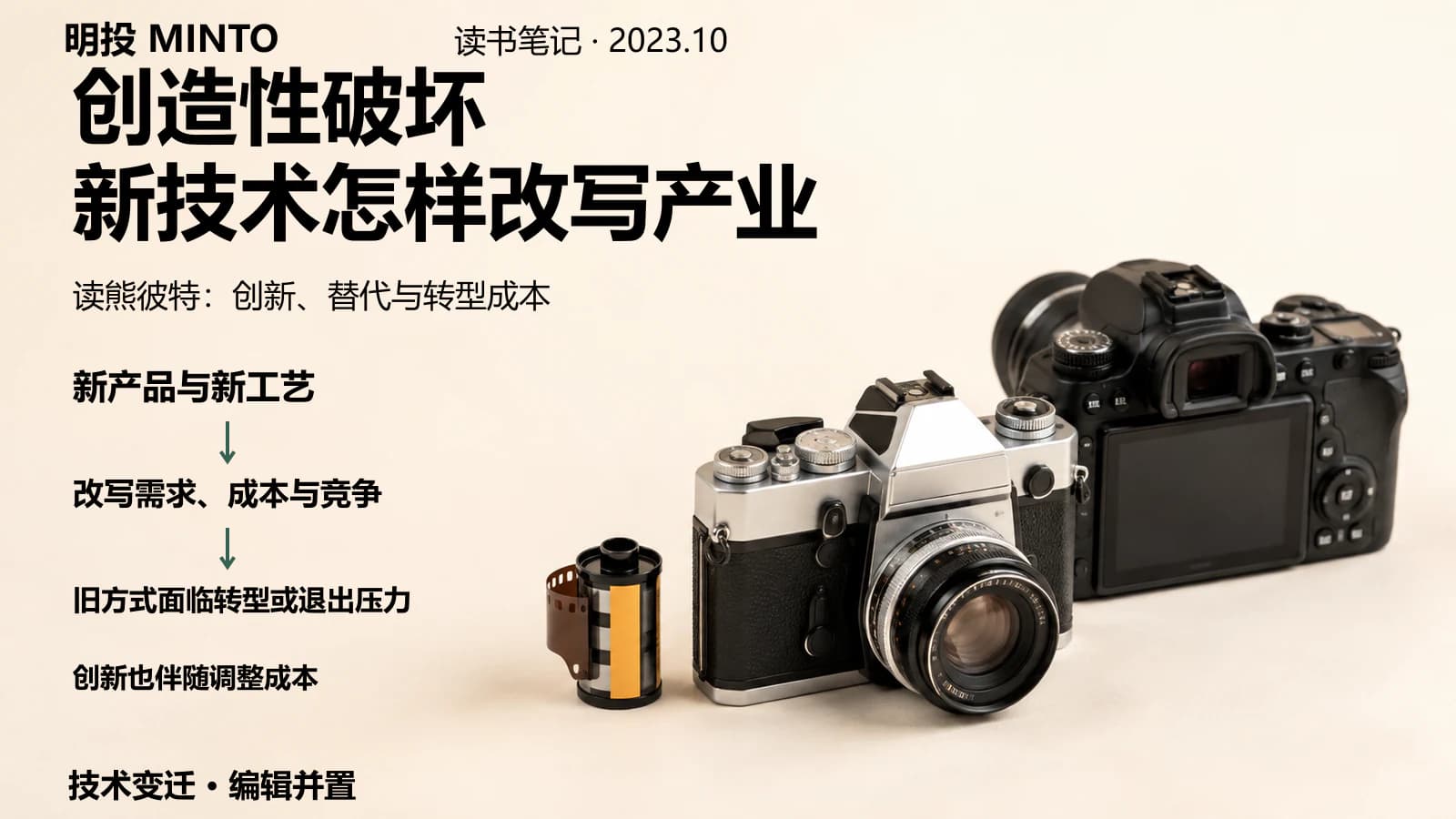
This insight precisely predicted today's tech world—Netflix destroyed Blockbuster, digital destroyed Kodak, smartphones destroyed countless industries, and AI is destroying the next batch.
创造性破坏:竞争的真正形态
Schumpeter's most important contribution to investors is his redefinition of "competition."
Traditional economics sees competition as "price competition"—the same product, whoever sells it cheaper wins. But Schumpeter said the competition that truly matters is the competition of creative destruction:
The competition that really counts is not price competition among existing products, but competition from new commodities, new technologies, new sources of supply, new types of organization—competition that strikes not at the margins of the profits of existing firms, but at their foundations and their very lives.
The implication for investors is disruptive: When evaluating a company's risk, don't focus mainly on "price competition from rivals." Ask instead: "Could an entirely new thing render this business irrelevant?"
Kodak wasn't beaten by another film company; it was beaten by "digital." Nokia wasn't beaten by another feature phone company; it was beaten by "smartphones." Taxis weren't beaten by cheaper taxis; they were beaten by Uber.
The most dangerous competition comes from outside your industry. This is Schumpeter's deepest warning for investors.
对科技股投资的直接启示
Schumpeter's framework is almost tailor-made for today's tech stock investing.
First, moats are temporary. Schumpeter would say that any moat is merely a temporary state until the next creative destruction arrives. Kodak had the deepest moat (global monopoly in film), Nokia had one (world's #1 in phones)—both were destroyed by creative destruction. This sharply contrasts with Buffett's "permanent moat." Schumpeter would argue that in technology, there are no permanent moats, only moats not yet disrupted.
Second, monopoly profits are the reward for innovation, but also the target for the next innovator. A company innovates, achieves monopoly, earns excess profits. But those excess profits attract the next wave of innovators to attack it. High profits are a signal—they tell every potential disruptor, "There's meat here." So the higher a company's profits and the stronger its position, the more it becomes the target of the next creative destruction.
Third, the real investing question is: "Which side of creative destruction is this company on?" Every creative destruction has destroyers and destroyed. The core judgment is: Is the company you own the one holding the hammer (the destroyer) or the one being hammered (the destroyed)? Netflix vs. Blockbuster, Amazon vs. traditional retail, Nvidia vs. traditional chips—each pair represents two sides of creative destruction. If you pick the wrong side, no moat can save you.
When I look at any tech company, I ask a Schumpeterian question: "Is it the subject or the object of creative destruction right now?" Is it destroying others, or are others destroying it? This judgment is more fundamental than looking at P/E or moats.
我跟熊彼特不同的地方
First, his pessimistic prediction about capitalism was wrong (at least so far).
The book's most famous prediction is that capitalism will die of its own success. Schumpeter believed creative destruction would dismantle traditional social structures, intellectuals would oppose capitalism, bureaucratization of large firms would kill entrepreneurship, and eventually capitalism would evolve into socialism. This prediction has clearly not come true (80+ years later). Not only has capitalism not died, but it has been rejuvenated by technological revolutions. Schumpeter underestimated capitalism's capacity for self-renewal.
Second, creative destruction is not unconditionally good.
Schumpeter portrays creative destruction as almost neutral or even positive—old things die, new things are better. But he underestimated the human cost of destruction. Every creative destruction causes mass unemployment, community decay, and wealth destruction. Auto workers in Detroit, small-town stores destroyed by Amazon, white-collar workers displaced by AI—their suffering is real. Schumpeter, from the height of "economic progress," couldn't see the ground-level pain. A complete view must account for these costs (this is what Acemoglu cares about: who benefits and who loses).
Third, "creative destruction" does not apply in some industries.
Schumpeter treated creative destruction as a universal law. But in some industries, stability and continuity matter more than destruction—consumer staples (Coke is still Coke), toll infrastructure (pipelines are still pipelines), certain brands (luxury goods derive value from being unchanged). In these areas, Buffett's "permanent moat" is more accurate than Schumpeter's "creative destruction." Schumpeter's framework is truth in technology, but misleading in slow-changing sectors.
Fourth, he underestimated that big companies can also innovate.
Schumpeter believed innovation primarily comes from entrepreneurs challenging the existing order; big companies, ossified by bureaucracy, lose their innovative edge. But the 21st century proves that some big companies are extremely powerful innovators. Apple, Amazon, Google, Nvidia are giants, yet they continuously engage in creative destruction (including of themselves). Schumpeter didn't foresee the possibility of "big companies maintaining innovation through internal mechanisms." This is crucial for investing—it means some giants are not passive targets of creative destruction, but active destroyers.
熊彼特 vs 巴菲特:护城河是永久还是暂时
Schumpeter and Buffett represent two fundamental views on moats.
Buffett believes in the permanent moat—some companies have durable competitive advantages you can hold forever. Coke, See's Candies, railroads, insurance.
Schumpeter believes there are no permanent moats—any advantage is merely a temporary state until the next creative destruction arrives. Everything will eventually be disrupted.
Who is right? My judgment: it depends on the "speed of change" in the industry.
In slow-changing industries (consumer staples, infrastructure, brands), Buffett is right—moats can last decades, creative destruction comes slowly.
In fast-changing industries (technology, software, internet), Schumpeter is right—moats can be overturned in a few years, creative destruction is the norm.
And the reality of 2025 is that AI is turning more and more "slow-changing industries" into "fast-changing industries." Once-stable SaaS, media, education, even healthcare are being accelerated disrupted by AI. This means Schumpeter's framework is expanding its scope in 2025, while Buffett's is shrinking.
My own stance: For slow-changing core positions, use Buffett (seek permanent moats). For fast-changing tech positions, use Schumpeter (always ask: is it the destroyer or the destroyed?). And be alert: AI is shrinking the safe zone of "slow-changing" every day.
写在最后
Schumpeter was a legendary figure—as a young man, he aspired to become "the greatest lover in Vienna, the best horseman in Austria, and the greatest economist in the world." He later said he achieved two of the three (he didn't say which). Behind this arrogance was a mind that saw the world very deeply.
My biggest takeaway from reading this book is a sustained sense of crisis—no company is safe, no moat is permanent, no business model can escape the perennial gale of creative destruction.
This sense of crisis is healthy for investors. It prevents you from treating any company as a holy grail you can hold with closed eyes forever. It makes you ask, before every heavy bet: Where will the next gale of creative destruction come from? And on which side will this company stand in that storm?
Schumpeter had a line that I think is the most profound summary of capitalism: "The perennial gale of creative destruction is the fundamental fact of capitalism."
This storm never stops. Today it's called AI; ten years ago, mobile internet; twenty years ago, e-commerce; a hundred years ago, electricity and cars. The names change, the storm is always there.
As an investor, you cannot stop the storm. What you can do is always stand on the side of the one holding the hammer, not the one being hammered.
That is the most important lesson Schumpeter wrote 80 years ago—a lesson every company is validating today.
专注投资分析、市场洞察与资产配置。不追短期波动,只理解真正驱动长期回报的东西。