跳到正文 · Skip to content
内容
关于与合作
订阅与会员
★ 查看会员权益
外观与设置
外观
主题色
版本 · 深色 / 减动搜索⌘K
草稿预览·这篇还没发布,不会出现在列表和 RSS 里。review 完后把 frontmatter 的 draft: true 改为 false 即可。

The Five Most Expensive Words in Financial History: 'This Time Is Different'

Reinhart and Rogoff combed through 800 years of data to prove one thing: before every crisis, people believed this time was different. And every time, they were wrong.

2023.04.146 min原创
The Five Most Expensive Words in Financial History: 'This Time Is Different'

1. A Book That Humiliates Human Memory with Data

In 2009, economists Carmen Reinhart and Kenneth Rogoff published This Time Is Different: Eight Centuries of Financial Folly.

The title itself is a bitter irony — "This time is different" is the phrase people love to utter before every financial crisis. Every time a bubble inflates to its peak, a new rationale emerges explaining why the old rules don't apply: new technology, new monetary policy, new economic paradigm. And then, every time, the crisis arrives just the same.

What the authors did was brutally painstaking and overwhelmingly persuasive — they compiled financial data from 66 countries spanning nearly 800 years, covering sovereign defaults, banking crises, inflationary crises, and currency collapses. Then they proved: these crises recur with astonishing regularity, and their precursors are strikingly similar.

The book's timing was dramatic — 2009, still in the aftershocks of the global financial crisis. It became essential reading for understanding crises.

2. Recurring Warning Signs of Crises

From 800 years of data, the authors distilled the most common signals before crises:

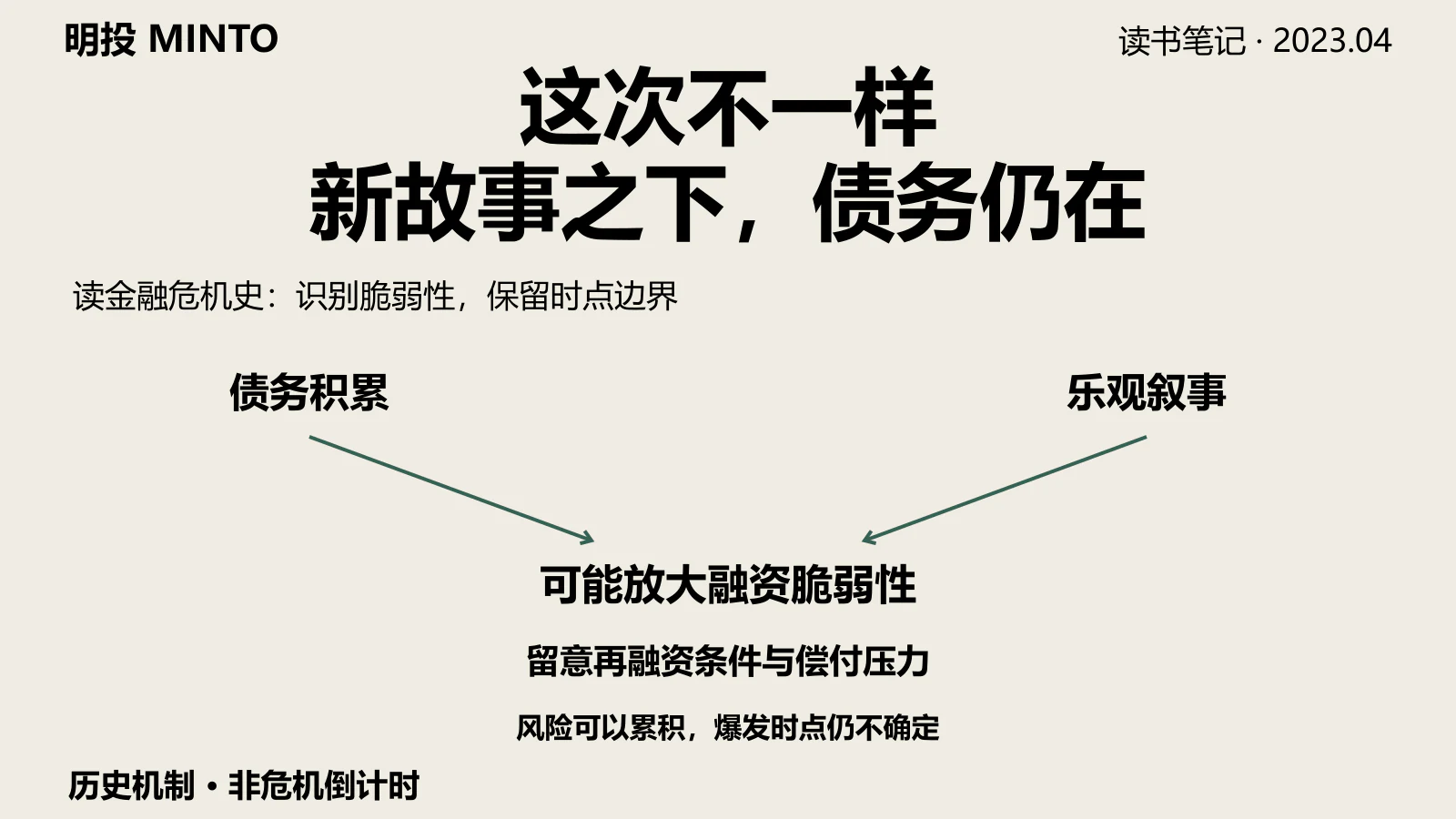
First, rapid debt accumulation. Almost every crisis is preceded by a period of rapid expansion in debt — government, private, or both. Debt itself isn't the problem; the pace of debt growth is.

Second, asset price bubbles. Real estate or equities often surge far beyond fundamental support before a crisis.

Third, widening current account deficits. A country's increasing reliance on foreign borrowing to sustain consumption and investment signals accumulating fragility.

Fourth, financial liberalization + deregulation. Almost every crisis follows a period of "financial innovation" and deregulation — new instruments, new leverage, new ways to bypass existing risk constraints.

The most famous finding concerns government debt: they argued that when government debt exceeds 90% of GDP, economic growth slows significantly. (Note: This specific 90% figure was later challenged due to an Excel calculation error, which I'll discuss below.)

3. The Most Profound Insight: Sovereign Default Is the Norm, Not the Exception

The most paradigm-shifting finding in this book is that sovereign default is the historical norm, not the exception.

Today we take for granted that "governments don't default." But 800 years of data show — almost every major country has defaulted multiple times. Spain defaulted more than a dozen times between the 16th and 19th centuries; default was routine in France, Germany, Greece, and Argentina. The belief that "government debt is safe" is itself a historical anomaly, not a constant.

This has profound implications for investors — the concept of a "risk-free asset" does not exist on an 800-year time scale. We treat US Treasuries as "risk-free" today, but that's built on the limited historical sample of the US never having defaulted. Over longer horizons, no sovereign debt is truly risk-free.

This isn't an argument to short Treasuries. It's a reminder — when your entire portfolio is built on the assumption that something is absolutely safe, you've embedded fragility. History over eight centuries repeatedly proves: the things thought to be "absolutely safe" are precisely the most dangerous in a crisis.

4. Where I Differ from the Authors

First, the famous "90% debt threshold" was later shown to have a calculation error.

One of the book's most influential conclusions — that debt/GDP above 90% drags on growth — was challenged in 2013 when a graduate student discovered an Excel spreadsheet error and data selection issues. After corrections, the statistical significance of the 90% threshold weakened substantially. This incident became a famous case in economics. It reminds us: even the most authoritative data research can be wrong. Don't treat any specific number as gospel. The broad direction (that debt accumulation is dangerous) still stands, but the precise "90%" figure shouldn't be worshipped.

Second, "This time is different" can sometimes be true.

The book's core mission is to mock the hubris of "this time is different." But there's a danger — it can turn readers into permanent pessimists who sneer at any genuine structural change. The internet really did change the economy. AI could be genuinely different. If you use "'this time is different' is always wrong" to dismiss every change, you'll miss true paradigm shifts. The key is distinguishing between "narrative this-time-is-different" (bubble excuse) and "structural this-time-is-different" (real transformation) — and this book offers almost no guidance on how to tell them apart.

Third, it's excellent at ex-post crisis identification, but poor at ex-ante timing.

This book perfectly explains every crisis that has already happened. But like all such research — clear in hindsight, fuzzy in foresight. It can tell you "debt is accumulating, risk is rising," but it cannot tell you "which year the crisis will erupt." And a bubble can persist in a state of "obviously unsustainable" for years. Knowing risk is accumulating is different from knowing when it will break — this book cannot help with the latter.

Fourth, it underestimates central bank intervention capabilities.

The book was written in 2009, based on historical samples where central bank intervention was relatively limited. But post-2008, the scale and tools of central bank intervention (QE, negative rates, unlimited easing) far exceed anything in history. This unprecedented intervention capacity may allow modern crises to take shapes never seen before — such as "zombification" (crisis averted but with prolonged economic stagnation, like Japan). The authors' historical sample lacks these modern interventions, so their model may underestimate the possibility of crises being "indefinitely postponed."

5. [object Object] vs. Shiller: Data vs. Narrative

Reinhart and Rogoff's book and Robert Shiller's Irrational Exuberance offer complementary lenses for understanding crises.

Reinhart and Rogoff are the data school — they use 800 years of hard data to show that crises have statistical patterns. Shiller is the narrative school — he shows that crises are driven by collective narratives.

Both are essentially describing two sides of the same coin — "This time is different" is both a data phenomenon (debt and valuations deviating from historical means) and a narrative phenomenon (collective belief in a new story).

The data school tells you how big the risk is (how far valuations and debt deviate from normal). The narrative school tells you why people don't see it (they are seduced by a compelling story).

My own stance — use the data school to measure how far we are from normal, and the narrative school to judge how long the deviation can persist. Data gives you space; narrative gives you time. Both together allow you to fully position a bubble.

6. Final Thoughts

The most sobering takeaway from this book isn't any specific crisis case — it's the revelation of humanity's collective amnesia.

Every generation has to personally experience a crisis to learn the lesson. By the time they age and a new generation takes over, the lesson is forgotten. Financial crises recur not because humans aren't smart enough, but because memory cannot be inherited.

Those who lived through the Great Depression of 1929 remained vigilant about debt and speculation for life. But when they pass away, the new generation that never experienced it will once again believe "this time is different," pile on debt, and march toward crisis.

For individual investors, this is a sharp reminder — the moment you need to be most vigilant is precisely when "everyone thinks the old rules no longer apply." When the market is flooded with voices saying "this time is different, traditional valuation methods are obsolete, a new paradigm has arrived," 800 years of history tell you: chances are, this time is the same.

In the AI narrative of 2025, the "this time is different" chorus is getting louder — "AI will permanently jump all companies' profit margins," "traditional valuation methods don't apply to the AI era."

These claims may contain partial truth. But whenever I hear "this time is different," I recall the title of this book — the five most expensive words in financial history.

Not because they are always wrong, but because those who say them almost never prepare for their cost.

Minto
明投 Minto
投资分析 · 长期主义者
你读完了 · Colophon

The Five Most Expensive Words in Financial History: 'This Time Is Different'

6
分钟
2023/04
期号
2023
年份
真正稀缺的,是一个不慌不忙的人。
明投 · MintoInvest Wisely
— From This Series
喜欢这篇?这类 读书笔记 的深度拆解会持续发到你邮箱。
无广告 · 随时退订
— Enjoyed the read?
如果这篇文章对你有用,把它分享给一个朋友,就是对我最好的支持。

口碑是独立创作者最稀缺的燃料。

— Discussion

说说你的想法

评论基于 GitHub Discussions(Giscus)。登录后即可留言、点赞、互相讨论。

评论还在准备中。

想说什么可以直接发我邮件,比在评论区更容易认真回复。

mingtaohuang617@gmail.com →
支持沉浸式阅读