1. A 20th Century Biography Written by an 85-Year-Old
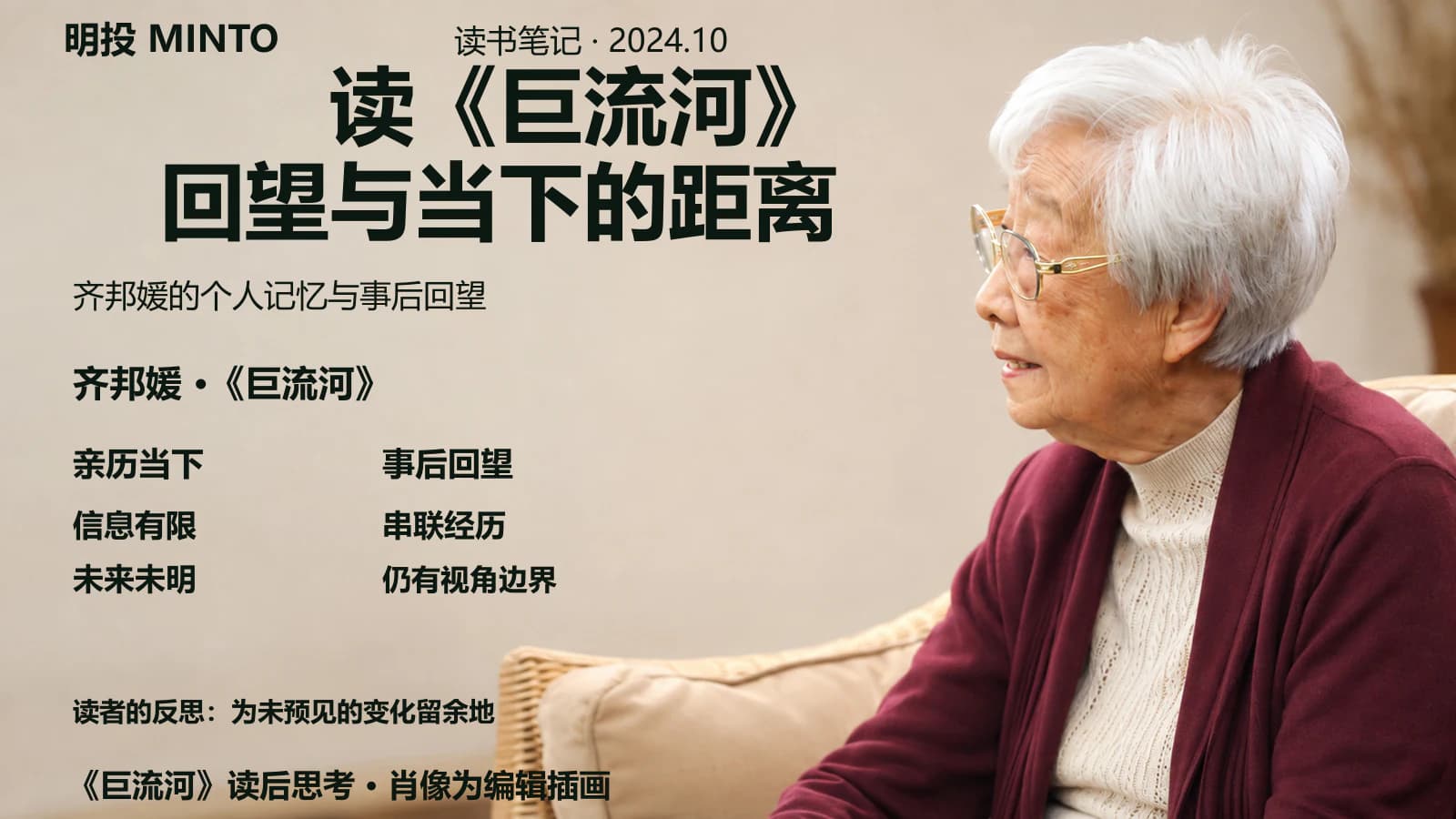
In 2009, 84-year-old Qi Bangyuan (qí bāng yuán) published Ju Liu He (The Giant River). The book is over 600 pages thick, covering her life from her birth in Liaoning in 1924 to the completion of the manuscript in Taiwan in 2009—one person living 85 years, witnessing China’s 20th century.
Qi was a professor of foreign languages at National Taiwan University, a key figure in translating Taiwanese literature into English. Her father, Qi Shiying, was a core figure in the resistance against Japan in the Northeast, associated with Zhang Xueliang, involved in the Xi'an Incident, and a member of the Kuomintang Central Committee. Her family’s trajectory itself is a microcosm of China in the first half of the 20th century.
But this is not a “power memoir.” It’s the attempt of an ordinary, sensitive person who lived very seriously to take a look at a span of history through a lifetime.
Reading it, I kept coming back to one thing—what Qi saw looking back at the 20th century at age 84 is completely different from what she saw when she was living through it at 24. This perspective of “only after time passes can you see clearly” is the rarest asset for investors—because we are almost always in the “present moment,” unable to see the shape of a trend.
2. The Passage That Shook Me Most: 1947, Age 18
In 1947, Qi went from Chongqing to Nanjing, studying in the Department of Foreign Languages at National Central University. She was 18. In the book she writes: “We thought the worst days were over. The eight-year War of Resistance had been won. China had returned to peace. Our generation could finally study, fall in love, and plan for the future.”
In reality, that year was when the Chinese Civil War was accelerating. Three years later, she fled with her family to Taiwan, never returning to the mainland.
When I read this passage, I had to close the book repeatedly. Because it is the quintessential example of a person being completely wrong about the future. In 1947, Qi thought it was a beginning. In fact, it was an ending. When you are standing at an inflection point, you cannot see it as an inflection point.
This is extremely important for investing—every inflection point is clear in hindsight and blurry in the moment. The American investor in September 1929, the Japanese investor in December 1989, the Nasdaq holder in February 2000, the Lehman employee in June 2008—none of them knew what time point they were standing on.
When I look at the U.S. stock market in 2025, I dare not claim I see clearly. Qi Bangyuan’s 1947 tells me: what you think is “the worst is over” might actually be “the worst is just beginning.” This humility is something an 18-year-old Qi could not have had, but an 85-year-old Qi taught us through her retrospect.
3. The Most Investable Metaphor: 1949’s “Belongings You Can’t Take”
In 1949, Qi’s family evacuated from Nanjing to Taiwan. In the book she describes in detail the mood of that time—everyone in the family was packing, but no one could figure out “what to take, what can be taken.”
Her father, Qi Shiying, insisted on taking several large boxes of books, abandoning gold, silver, and valuables. Relatives mocked him: “What’s the use of taking books?”—what could books get you in a chaotic era?
But when Qi recalled this at age 84, she wrote—those books later became the spiritual pillar of her father’s remaining years in Taiwan; later they became the seeds of her own academic life; and still later, the material for this book she wrote.
“The belongings you can’t take are actually the ones you really can take”—this is the deepest line in the book.
This is profoundly illuminating for asset allocation. In times of great upheaval, people always think “gold is hard currency, real estate is hard assets”—but what truly survives the long arc of history are “intangible assets”—skills, knowledge, relationships, cultural capital.
In my own asset allocation, I’ve started taking this seriously in the past two years—besides financial wealth, how many “cannot-be-taken-but-can-compound” assets do I have?—professional expertise, writing accumulation, network of contacts, books read, trained ways of thinking. None of these will appear on any balance sheet, but they are what truly transcend cycles.
This is something only an 84-year-old Qi could say. She proved it with her life.
4. On Long Cycles: The Greatest Value of This Book
The 20th century Qi lived through included—the War of Resistance, the Chinese Civil War, martial law in Taiwan, the economic takeoff, the lifting of martial law, cross-strait détente, and Taiwan Strait tensions. This is a complete sample of nearly every possible political and economic cycle.
She has a passage in the book that I’ve copied over and over—“In my life I have seen too many moments when ‘it can’t get worse’—and then it got worse; and too many moments when ‘it can’t get better’—and then it suddenly collapsed. Every time I thought I saw clearly, later I found out I hadn’t.”
The implications of this are too deep.
It tells us: the judgment “it can’t get any more X” is almost always wrong in a long cycle. Whether X is “down” or “up,” whether it’s “good” or “bad.” When you say “it can’t get any more X,” you are probably at an inflection point.
This is an extremely cautionary tale for U.S. stock investors in 2025. The U.S. stock market has been running at the 90th percentile of historical valuation for three years—many investors (including myself) have repeatedly felt “it can’t go any higher.” Every time we said “it can’t go higher,” it went up another 15%.
Qi would tell you—nothing is “impossible to X further.” Markets, like history, are far more resilient than you think, and far more fragile than you think. Both properties are true.
5. A Few Reservations About This Book
I have enormous respect for Qi Bangyuan. But as a reader, I also have some reservations.
First, her assessment of her father is overly sentimental.
Her father Qi Shiying was an important figure in the Kuomintang, involved in key decisions during the War of Resistance and the Civil War. But in her book, Qi writes almost exclusively about “father’s ideals,” rarely about “father’s failures.” For the reasons the Kuomintang lost the mainland, she basically explains it through “era” and “external factors,” touching hardly at all on the party’s own corruption and mistakes.
This is a common limitation of memoirs—it’s almost impossible for a family member to be completely honest about a family member. Readers must be aware that Ju Liu He is a version written by a daughter who deeply loved her father, not by a historian.
Second, she makes almost no evaluation of Taiwanese politics.
Qi arrived in Taiwan in 1949 and experienced military dictatorship, democratic transition, cross-strait openness, and party turnovers—she was present for all of it. But the book’s evaluation of these political changes is extremely restrained, almost a posture of “describing facts but not making judgments.”
I understand—she lived in Taiwan with many complex attachments, and public expression requires caution. But as a reader, this “no judgment” makes certain chapters less substantial.
Third, she shows almost no empathy for the “mainland perspective.”
Qi’s viewpoint is that of an “outside-province person” who retreated to Taiwan after 1949. This perspective has a deep sense of tragedy about the Kuomintang’s loss of the mainland, but gives almost equal attention to the fate of the hundreds of millions who remained on the mainland after 1949.
This is not her fault—she writes about the life she lived, and her life was indeed in Taiwan. But mainland readers of this book should be aware that this is a specific perspective, not a panoramic one.
Fourth, her narrative rhythm weakens in the second half.
The first half of the book (childhood to 1949) is extremely vivid; the second half (her academic career in Taiwan) clearly slows down. The most dramatic parts are written best, but the relatively stable parts sometimes lapse into a chronicle. This is a common problem for an 84-year-old writing a thick book—uneven energy distribution.
6. This Book vs. [object Object]: The Difference Between Two “River” Narratives
After finishing Ju Liu He, I naturally thought of Ken Follett’s Fall of Giants—also a thick book spanning the 20th century, using family stories to tell macro history.
An interesting comparison is the “degree of writer involvement” between the two.
Fall of Giants is a novelist “designing” history—he uses fictional characters to hit every historical node he deems important. Each family happens to be at a key moment, making a key choice. It reads as very dramatic, but with a sense of being designed.
Ju Liu He is a firsthand experiencer “recalling” history—her family happens to be at some historical nodes, but more often she is pushed by history, watching others make choices, just an observer. It reads without dramatic flair, but with a sense of authenticity.
What I learned from this is: when you look at a review of the 20th century, whether you are looking at a “firsthand experiencer” or a “designer,” the “historical laws” you derive are completely different. The eyewitness perspective is full of chance, misjudgment, and passiveness; the designer’s perspective is full of patterns, rhythm, and inevitability.
For investors, the “firsthand experiencer” perspective is more real—because we ourselves are firsthand experiencers of history, not designers. Our judgments about the market will, for the most part, be proven overconfident by time. Qi Bangyuan’s “thought” in 1947 is the best lesson.
7. Why Investors Should Read [object Object]
Many people think memoirs have nothing to do with investing. I disagree.
The true value of Ju Liu He for investors is not that it tells you what happened in which year, but that it teaches you how to survive a long cycle.
Specifically, it teaches three things:
First, the real texture of a “long cycle.” The “30-year bull market” in textbooks is a number. In The Giant River, “30 years” is the entire young adulthood of Qi Bangyuan, from age 24 to 54—getting married, having children, doing scholarship, reading, writing, teaching, being pushed by the times. 30 years is not a number; it is a person’s entire life. Understanding this gives you a completely different feeling about the phrase “long-term investing.”
Second, the normality of being “out of control.” Almost none of the major turning points in Qi’s life were chosen by her—born in wartime, forced into exile, coming to a strange Taiwan, marrying someone she didn’t like, her fate decided by others. The essence of long cycles is being out of control—most of your judgments about the world will be proven wrong by time. When an investor acknowledges this, they are less arrogant.
Third, the importance of a “value anchor.” Through all the upheavals, two things never changed for Qi: her love of literature and her sense of responsibility to family. These two anchors kept her from collapsing or losing her way over 85 years. For investors, what keeps you from collapsing or losing your way in a long cycle is also certain “things that will not waver”—perhaps your methodology, your source of cash flow, your family support, your core competency. Without an anchor, you cannot survive a single major drawdown.
8. In Closing
Qi Bangyuan passed away in 2024 at the age of 100.
In her last interview, she said: “I’ve lived 100 years, seen too many people come and go. The most important thing I’ve learned is: slow down, really slow down.”
“Slowness” is the deepest keyword of this book.
Her family took a lifetime to flow from the Giant River in Liaoning to Taiwan; she took 84 years to write this experience into a book; the book took 30 years to truly complete. Nothing she cherished most was accomplished quickly.
This is completely contrary to the rhythm of our era—we want everything fast: information fast, investing fast, living fast. But Qi tells us through 100 years that what truly endures is always a product of slowness.
I read this book in my 30s. I hope that when I am 84, I can write a similar book—recording the 21st century I lived through, all the “I thought” and “later I knew.”
This is not a plan. It is a hope.
But Qi Bangyuan’s existence makes me believe this hope is possible—as long as you are willing to be slow, willing to be honest, willing to keep writing.
That is the gift Ju Liu He leaves for an ordinary reader.

On investment analysis, market insight, and asset allocation — not chasing short-term noise, but understanding what truly drives long-term returns.