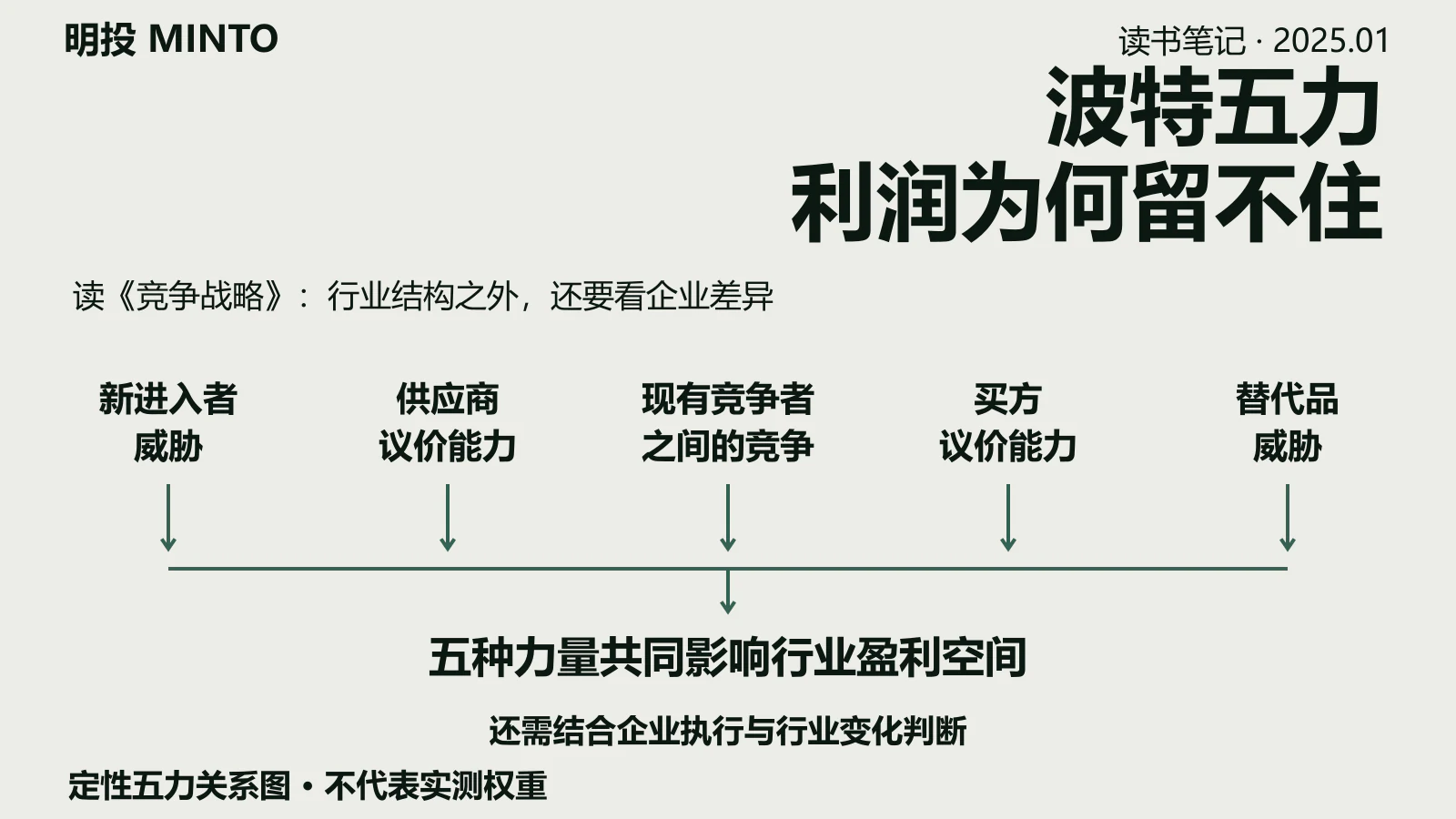
1. The Man Who Turned Strategy from Art into Science
In 1980, Harvard Business School professor Michael Porter published Competitive Strategy. The book did something no one had done before—it turned "corporate strategy" from an art reliant on intuition and experience into a set of analyzable, framable methods.
Porter's most famous contribution is the Five Forces model. It answers a fundamental question—why do some industries (like software or luxury goods) naturally make money, while others (like airlines or restaurants) naturally don't?
Porter's answer—a company's profitability depends mostly not on how good the company itself is, but on the "structure" of the industry it operates in. The same brilliant management team, placed in a good industry, will rake in profits; placed in a bad industry, they'll barely scrape by.
For investors, this is an enormously important insight—pick the industry before you pick the company. A good company in a bad industry often underperforms a mediocre company in a great industry.
2. The Five Forces: What Determines Whether an Industry Is Profitable
Porter's Five Forces model breaks "industry attractiveness" into five forces:
First, the intensity of rivalry among existing competitors. Do players in this industry fight price wars (airlines, LCD panels) or compete with relative restraint (Coca-Cola vs. Pepsi)? The fiercer the rivalry, the thinner the margins.
Second, the threat of new entrants. How easy is it to enter this industry? If anyone can start a business (e.g., opening a restaurant), profits get diluted by a constant stream of new players. If entry barriers are extremely high (chip fabrication, requiring tens of billions in capital), incumbents can sustain high margins.
Third, the threat of substitutes. Is there something else that could replace your product? (Remember Schumpeter's creative destruction.)
Fourth, the bargaining power of suppliers. Can your upstream suppliers strangle you? If a key component has only one supplier (like ASML for lithography machines), that supplier can grab most of the profit.
Fifth, the bargaining power of buyers. Can your customers squeeze your prices? If your customers are highly concentrated and have many alternatives, they can pinch your margins to near zero.
The combined force of these five determines an industry's "average profit margin." Industries where all five forces are benign — for example, a software platform with strong network effects and high entry barriers — are money-printing machines. Industries where all five are fierce — like airlines (intense rivalry, many substitutes, powerful suppliers, price-sensitive customers) — are long-term value destroyers.
3. A Practical Tool for Investors: Look at Industry Structure First
The most useful thing Porter gives investors is a simple analytical sequence: look at the industry first, then the company.
Warren Buffett famously said something that is essentially Porter's Five Forces in everyday language—"When a management with a reputation for brilliance tackles a business with a reputation for bad economics, it is the reputation of the business that remains." Meaning: industry structure (the Five Forces) matters more than management ability for long-term returns.
Using Porter's framework, I ask four questions about any company:
First, how high are the entry barriers in this industry? In low-barrier industries (restaurants, apparel, general manufacturing), even a great company struggles to sustain high profits — new entrants keep flooding in. In high-barrier industries (chip equipment, operating systems, payment networks), incumbents can collect rents for years.
Second, does it have pricing power over its suppliers and customers? A company squeezed between a powerful upstream (suppliers) and a powerful downstream (customers) will have thin margins. A company that can dictate terms to both sides (like Apple, which is strong with both suppliers and consumers) will have fat margins.
Third, how big is the threat of substitutes? This directly connects to Schumpeter and Christensen — could something entirely new make its whole business obsolete?
Fourth, is competition in this industry "rational" or "suicidal"? Some industries have an unspoken truce on pricing (oligopolistic mutual restraint), while others see price wars at first sight (commodity products). The former (like the cola duopoly) can profit together; the latter (like flat-panel displays or solar) collectively destroy value.
These four questions help you decide — before you even look at specific financial data — whether the arena this company plays in is worth being in at all.
4. Where I Disagree with Porter
First, the Five Forces model needs a patch for the network-effects era.
Porter's model was forged in the industrial economy of 1980. But the digital age has a sixth force that Porter didn't fully incorporate—network effects and platform dynamics. A platform with strong network effects (WeChat, Visa, Windows) has a moat that comes not from any of Porter's five forces, but from a self-reinforcing loop of "more users = more value." Porter's Five Forces is a "static" analysis of industry structure; platform economics is a "dynamic" winner-take-all game. Using pure Five Forces on Facebook or Google would seriously underestimate their moats. That's why Kevin Kelly's New Rules for the New Economy needed to supplement Porter.
Second, it's too defensive; it underestimates "creating new industries."
Porter's Five Forces, at its core, teaches you to find a good position to defend within an existing industry. But the biggest value creation often comes not from "staking a claim in a good industry," but from "creating an entirely new industry" (Tesla for electric vehicles, Nvidia for AI computing). Porter's framework is good at analyzing existing industries, not at understanding creation from scratch. This is what the later "Blue Ocean Strategy" aimed to supplement. For investors, this means: Porter helps you avoid bad industries, but finding the next great company requires a view beyond Porter.
Third, industry boundaries are blurring, making the Five Forces harder to define.
Porter assumes industries have clear boundaries. But today, those boundaries are dissolving fast—Amazon is simultaneously retail, cloud computing, advertising, logistics, and media; Apple is simultaneously hardware, software, services, and finance. When a company straddles multiple industries and constantly enters new ones, "analyzing the Five Forces of its industry" loses meaning. Porter's framework works in an era of clear industry lines; it struggles in an era of borderless giants.
Fourth, it's structurally deterministic; it underestimates execution and culture.
Porter emphasizes that industry structure determines profitability. But within the same industry, companies vary enormously—in retail, Costco is worlds apart from countless failed retailers; in restaurants, McDonald's vs. the thousands of small shops that shut down. These gaps come from execution, culture, and management, not from industry structure. Porter's framework can make you think "industry determines everything," but in reality, company-level differences within a given industry are equally massive. Both levels matter; Porter overweights the former.
5. Porter vs. Buffett: The Academic Edition and the Practical Edition of the Moat
Porter's "Five Forces" and Warren Buffett's "economic moat" are essentially the same thing expressed two ways.
Porter is the academic edition—he systematically analyzes, using the Five Forces, what kind of industry structure protects profits. Buffett is the practical edition—he uses the intuitive metaphor of a "moat" to judge whether a company's competitive advantage can persist.
Porter gives you the framework; Buffett gives you the intuition. Interestingly, Buffett's concept of the "moat" is in some ways just a popularization of Porter's Five Forces—a company with a wide moat is essentially one where all five forces work in its favor (high entry barriers, strong bargaining power, weak substitute threats, moderate competition).
My own approach—use Porter's Five Forces to systematically "dissect" the source of a moat (exactly which of the five forces is it strong against?), and use Buffett's intuition to judge how long that moat will last. Porter tells you what the moat is made of; Buffett (and Schumpeter) remind you that moats can be filled in.
6. Closing Thoughts
Porter is now in his 70s and remains the most influential scholar in the field of strategic management. The Five Forces, now over 40 years old, is still a required course in every MBA program and a foundational tool for every strategy consultant.
My biggest takeaway from reading this book is a simple but profound sequence—look at the industry first, then at the company.
Most ordinary investors get it backwards—they fall in love with a company first (its product, its story, its CEO) and only then look at its industry. But Porter tells you—if the industry structure is bad (low entry barriers, price wars, squeezed by suppliers and customers), even a great company will struggle to consistently make money.
That's why some industries, no matter how carefully you pick, are hard to find long-term winners in (airlines, where even Buffett got burned multiple times); while other industries are almost buy-and-hold winners blindfolded (tobacco in the past, certain software platforms today). It's not because the latter companies are better; it's because the structure of the industries they're in naturally protects profits.
There's a line from Porter I keep coming back to—"The essence of strategy is choosing what not to do."
For a company, that means focus; for an investor, it means—first, choose not to touch those industries with inherently bad structures, no matter how compelling the story the company tells.
Avoid the bad industries, and you've avoided most of the value destruction.
That's the first lesson Porter, with his cool-headed framework, teaches every investor.

On investment analysis, market insight, and asset allocation — not chasing short-term noise, but understanding what truly drives long-term returns.