1. An economics doorstop that accidentally became a global bestseller
In 2013, French economist Thomas Piketty published Capital in the Twenty-First Century. It's a 700-page economics monograph full of data and charts.
By all logic, such a book would be read only by economists. But it unexpectedly became a global phenomenon, hitting the top of the New York Times bestseller list and sparking debate from the White House to street corners. An academic tome about "wealth inequality" struck the collective anxiety of a world still reeling from the 2008 crisis.
What Piketty did was similar to Reinhart — he used massive long-term historical data (he traced wealth distribution across 200+ years and 20+ countries) to answer a fundamental question: Why does wealth become increasingly concentrated in a few hands? Is this a temporary malfunction of capitalism, or its inherent law?
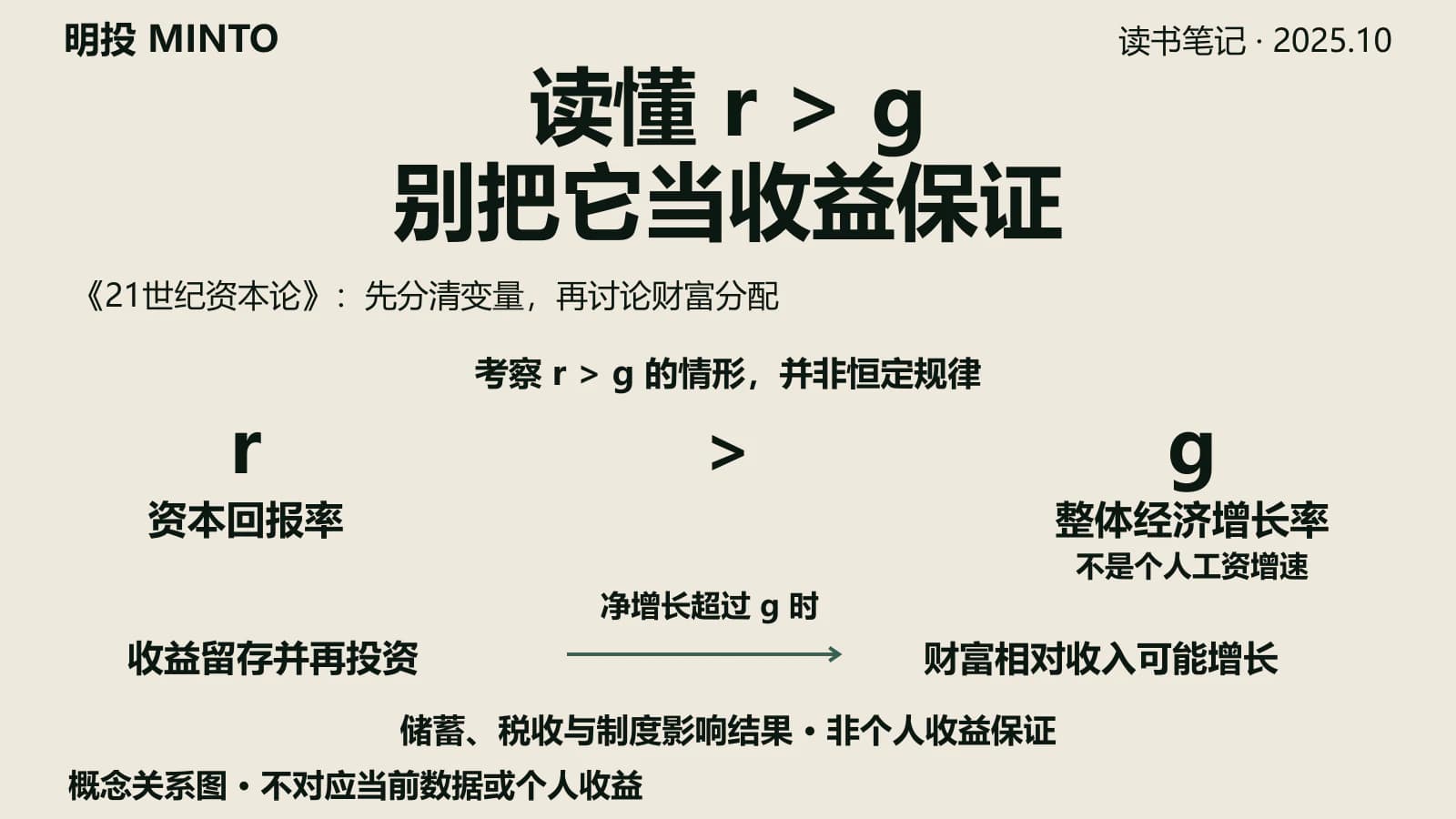
His answer, condensed into a simple inequality — r > g.
2. r > g: One inequality that explains wealth concentration
Piketty's core argument is — when the rate of return on capital (r) is persistently higher than the economic growth rate (g), wealth inevitably becomes more concentrated over time.
The logic is straightforward: g is the speed at which the entire economy (and thus ordinary people's wage growth) expands; r is the speed at which those who already own capital (stocks, real estate, businesses) see their wealth grow.
If r > g — people who already have money see their wealth grow faster than the economy as a whole, faster than those who rely on wages. Over time, the gap widens. The rich get richer, not because they work harder, but because the inherent growth rate of capital itself systematically outstrips the growth rate of labor income.
Piketty's data shows — for most of history, r has indeed been greater than g (r about 4-5%, g about 1-2%). The only exception was the mid-20th century (two world wars plus the Great Depression destroyed massive amounts of capital, combined with post-war high growth) — an anomalous period when inequality temporarily shrank. And we mistakenly took that anomaly as the norm.
In the 21st century, r > g is returning, so inequality is returning to 19th-century levels.
3. The most practical takeaway for ordinary investors: You must become part of "capital"
Piketty's book sparked a great debate about taxation and redistribution. But for the ordinary investor, it has a more direct, colder insight:
If r is persistently greater than g, you can never catch up to people who own capital by relying on your salary alone. Your only escape is to become someone who owns capital yourself.
This sounds like a "misuse" of Piketty — he wrote the book to criticize inequality and call for taxes. But as an ordinary person, you cannot change the macro law of r > g. You can only adapt to it. And the only way to adapt is — convert your labor income into capital as early and as much as possible.
Specifically: Don't just rely on your salary. Consistently channel part of it into equity (stocks, index funds, real estate, your own business). Because as long as r > g holds, your capital portion will grow faster than your wage portion. Over time, your capital income becomes increasingly important, and your wage income becomes increasingly secondary.
This is why Buffett, Bogle, and virtually every investing classic says the same thing — start owning assets early, then let compounding (i.e., r) work for you. Piketty, from a critical angle, provides the most powerful argument for "why you must invest": because if you don't invest, you're forever standing on the side of g, and g always loses to r.
4. Where I disagree with Piketty
First, r > g is a historical regularity, not a law of physics.
Piketty presents r > g as nearly inevitable. But it is not immutable. Technological revolutions, creative destruction, and the rise of emerging markets can all temporarily make g exceed r, or devalue old capital (Kodak's and Nokia's shareholders saw their wealth evaporate). Capital does not automatically grow forever — wrong capital gets destroyed. Piketty treats "capital" as a homogeneous, self-augmenting whole and underestimates that "specific capital can be zeroed out by creative destruction."
Second, he underestimates "human capital."
In Piketty's framework, "capital" mainly means financial and physical capital. But in the 21st century, the most important capital is increasingly human capital — skills, knowledge, creativity. A top engineer, doctor, or creator can generate "labor income" that far exceeds many people's "capital income." In the age of AI, the return on scarce skills may rival, or even surpass, the return on capital. Piketty's r/g binary misses this group of "high human capital" individuals who are neither pure labor nor pure capital.
Third, his policy prescription (global wealth tax) is nearly impossible.
Piketty's solution is a globally coordinated progressive wealth tax. But this is politically almost impossible — capital is mobile; if any single country imposes heavy taxes, capital flows elsewhere. His diagnosis is profound, but his prescription is utopian. This book is a masterpiece as an "analysis of the problem," but a fantasy as a "solution."
Fourth, his data and methodology have faced serious academic scrutiny.
Institutions like the Financial Times have challenged Piketty's data processing — certain wealth concentration trends may have been amplified by his data choices. This does not negate his core conclusion, but it reminds us: any study that "proves a grand law with data" requires caution about how data was selected and processed. Like Reinhart's Excel error, this is a common ailment of data-driven economics.
5. Piketty vs. Acemoglu: Two explanations of inequality
Both Piketty and Acemoglu (in Why Nations Fail) care about wealth distribution, but their explanations differ completely.
Piketty says — inequality is an intrinsic mathematical law of capitalism (r > g), largely independent of the quality of institutions, and must be countered through redistribution (taxes).
Acemoglu says — inequality is mainly caused by institutions, with extractive institutions allowing a small elite to capture everything while inclusive institutions distribute wealth more broadly.
One attributes it to economic law, the other to political institutions.
Who is right? My take — both are right, but at different levels. r > g explains "why capital tends to concentrate" (the economic mechanism). Institutions explain "to what degree it concentrates, and who gets to be on the capital side" (the political mechanism). Inclusive institutions cannot eliminate r > g, but they can allow more ordinary people to become "capital owners" (through open capital markets, education, entrepreneurship).
For the ordinary investor, the combined insight is — you must both exploit r > g (own assets early) and cherish the institutions that let you own assets (open capital markets). The reason America is the easiest place for ordinary people to "become capital" is precisely its most inclusive capital market institutions — anyone can buy a piece of the entire market at very low cost.
6. Final thoughts
Piketty wrote this book from a leftist political stance — he wanted to expose and combat inequality. But ironically, the most useful reading of this book may be a right-leaning, individualistic one: since r > g is a law, and since you can't catch the rich by relying on your salary, your only move as an individual is to get on the side of capital as early as possible.
This is not to say we should ignore inequality. It is to say — before you can change the macro law, you must survive within it. And the only way to survive is to own capital.
My biggest takeaway from this book is that it provides the hardest-core argument for "why you must invest" — not because investing will make you rich quickly, but because not investing will leave you systematically behind. In a world where r is persistently greater than g, owning assets is not a choice; it's a necessity.
Keeping your salary in a savings account (which can't even keep up with g) is betting against the historical trend. Converting your salary into equity (sharing in r) is going with the flow.
Piketty wanted to use r > g to criticize capitalism. But for an ordinary person, its most practical meaning is just one sentence:
The sooner you become "capital," the more time is on your side.
That is the most un-leftist lesson this leftist economic magnum opus leaves for every ordinary investor.

On investment analysis, market insight, and asset allocation — not chasing short-term noise, but understanding what truly drives long-term returns.