跳到正文 · Skip to content
内容
关于与合作
订阅与会员
★ 查看会员权益
设置
主题色
版本 · 深色 / 减动搜索⌘K
草稿预览·这篇还没发布,不会出现在列表和 RSS 里。review 完后把 frontmatter 的 draft: true 改为 false 即可。

The Three Layers of Moat: From Product to Network to Culture

A moat isn't one thing—it's a hierarchy. The deeper the layer, the more expensive, but also the more durable.

2026.04.114 min原创
The Three Layers of Moat: From Product to Network to Culture

Why We Need to Rethink the Moat

Buffett popularized the term "moat" in investing, but after two decades, most people still think of it as a metaphor: better product, lower cost, stronger brand. All true, but none answer the core question—are there layers among moats? Why do some moats get breached in a decade while others hold for fifty years?

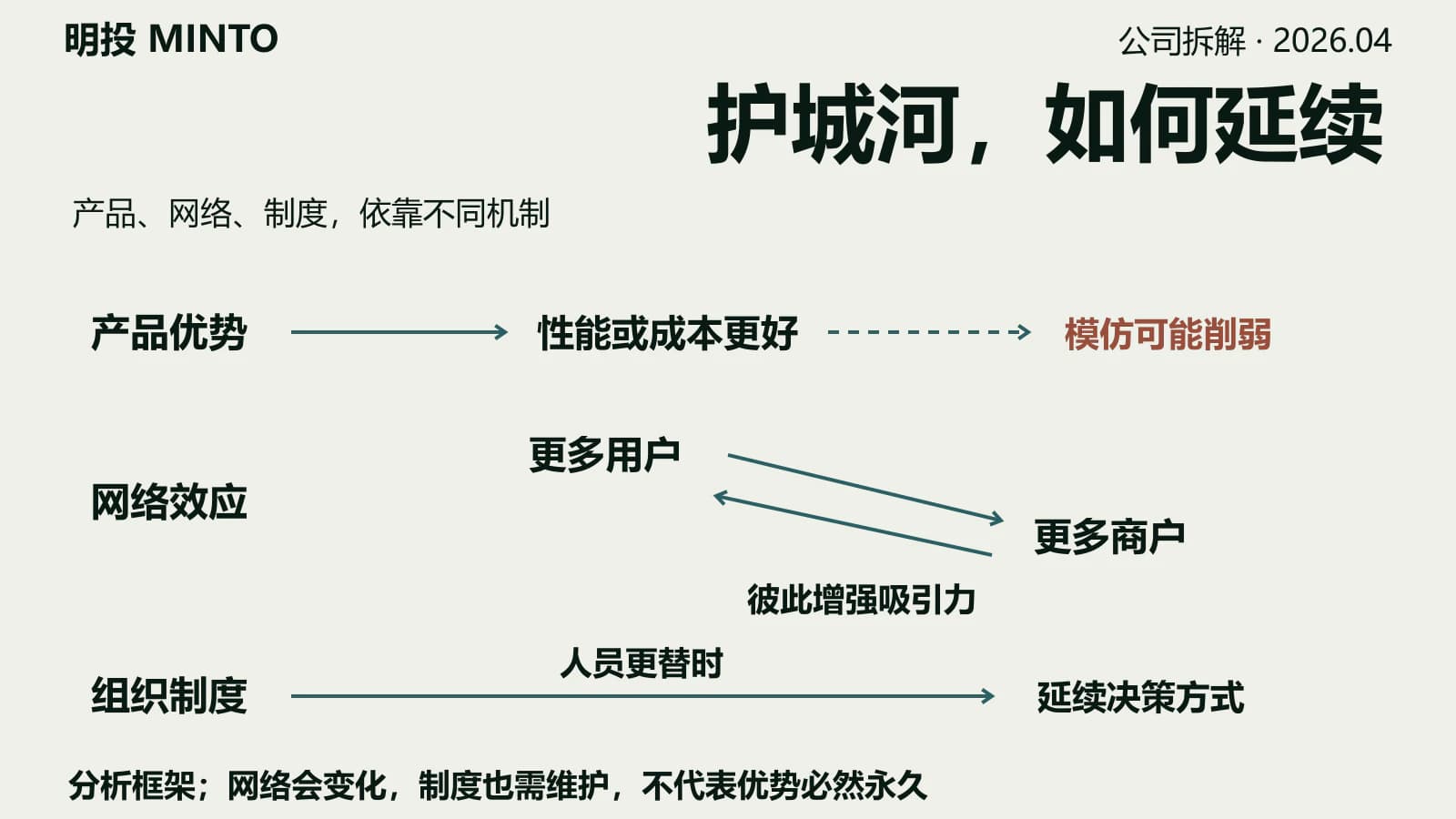
My view: a moat isn't a "thing"—it's a "hierarchy." From shallow to deep, there are three layers: product, network, and culture. They aren't parallel; they're nested. A shallow moat can exist alone, but a deep moat usually contains the shallower ones. Understanding this structure lets you judge whether a company is "expensive"—because the deeper the layer, the more valuation premium it deserves.

Let's use three real cases to trace how these layers evolve.

Layer 1: Product Moat

The product moat is the easiest to understand—my product is better, cheaper, or more unique. Its advantage is visibility: you can see it in user reviews, market share, and gross margins.

But it's also the easiest to breach. Products can be studied, reverse-engineered, and copied—given enough money and talent, catching up is just a matter of time. Smartphones are a classic case: ten years ago, the iPhone's industrial design, screen, and camera were generations ahead, but today's flagship Android phones have reached 90 points on hardware.

Apple's real moat today is no longer the iPhone itself—it's the ecosystem built by App Store + iCloud + iMessage. That's Layer 2.

Judgment criterion: If a company's moat only reaches the product layer, you should value it on a "five-year" horizon, not a "twenty-year" one. Five years is a reasonable timeframe for a product cycle to be disrupted.

Layer 2: Network Moat

The network moat is built on the positive feedback loop of "more users = more value." WeChat, Alipay, Visa, LinkedIn, Taobao—all are examples.

What makes the network moat formidable is asymmetry: once a company occupies the position, a later entrant can hardly reverse it by having a "better product." The user's switching cost isn't just the few seconds to open a new app—it's rebuilding the entire social graph, payment habits, and merchant network. Google+ was better than Facebook in some features, but it failed—not because the product was bad, but because people are where people are.

But network moats aren't permanent either. They depend on a premise: the core interaction pattern of users doesn't change. Once that pattern shifts—from PC to mobile, from text to video, from apps to AI assistants—the existing network effect can loosen overnight. Yahoo's portal network effect failed in the search era; Facebook's feed network effect lost ground to TikTok's algorithmic distribution.

Judgment criterion: To see if a network company's moat is still solid, ask whether its "core interaction pattern" will be rewritten by new technology in the next five years. If yes, discount the valuation.

Layer 3: Culture Moat

The culture moat is the hardest to see and the hardest to replicate. It's an "organizational operating system"—from hiring, decision-making, incentives, to crisis management, all infused with an internalized pattern. It's not written in annual reports, but it shows up in every critical choice.

Typical examples: Berkshire Hathaway, Costco, early Walmart, Toyota Production System, ASML. You can copy their business model, but you can't copy their people and systems. Costco's "SKU control + membership fee revenue structure" has been studied for thirty years, yet only one Costco in the world produces those numbers—because behind it is a whole culture of "trust customers, trust employees, don't chase quarterly profits."

The culture moat is invisible yet omnipresent. Its power lies in being "counter-human": when the industry chases growth, it chooses to protect margins; when the capital market expects M&A, it chooses buybacks; when the CEO retires, the successor seamlessly continues the strategy. This "self-similarity" is the result of institutional sedimentation, not individual will.

Judgment criterion: To know if a company has a culture moat, don't ask the CEO—ask an employee who left five years ago. If their descriptions are strikingly consistent, the company has it.

Three Layers Combined: The Rare Species of Ultra-Long-Term Compounding

When a company simultaneously possesses all three layers—product, network, and culture—it enters the "ultra-long-term compounding" zone. Over a twenty-year horizon, such companies create extraordinary returns in a "boring" way.

I can count fewer than twenty global companies that clearly have all three layers. Their common trait: they never look cheap on valuation, but when you look back ten years later, you were always buying at the bottom.

That's why I increasingly believe in a simple principle: instead of finding a cheap good company, spend a bit more to buy a great one. Because time is on the side of great companies—products can be disrupted, networks can be rewritten, but culture, as long as it persists, will keep generating new moats.

A moat is not a state—it's a capability.

Minto
明投 Minto
投资分析 · 长期主义者
你读完了 · Colophon

The Three Layers of Moat: From Product to Network to Culture

4
分钟
2026/04
期号
2026
年份
真正稀缺的,是一个不慌不忙的人。
明投 · MintoInvest Wisely
— From This Series
喜欢这篇?这类 公司拆解 的深度拆解会持续发到你邮箱。
无广告 · 随时退订
— Enjoyed the read?
如果这篇文章对你有用,把它分享给一个朋友,就是对我最好的支持。

口碑是独立创作者最稀缺的燃料。

— Discussion

说说你的想法

评论基于 GitHub Discussions(Giscus)。登录后即可留言、点赞、互相讨论。

评论还在准备中。

想说什么可以直接发我邮件,比在评论区更容易认真回复。

mingtaohuang617@gmail.com →
支持沉浸式阅读