I. A Book Never Meant to Be Read by Others
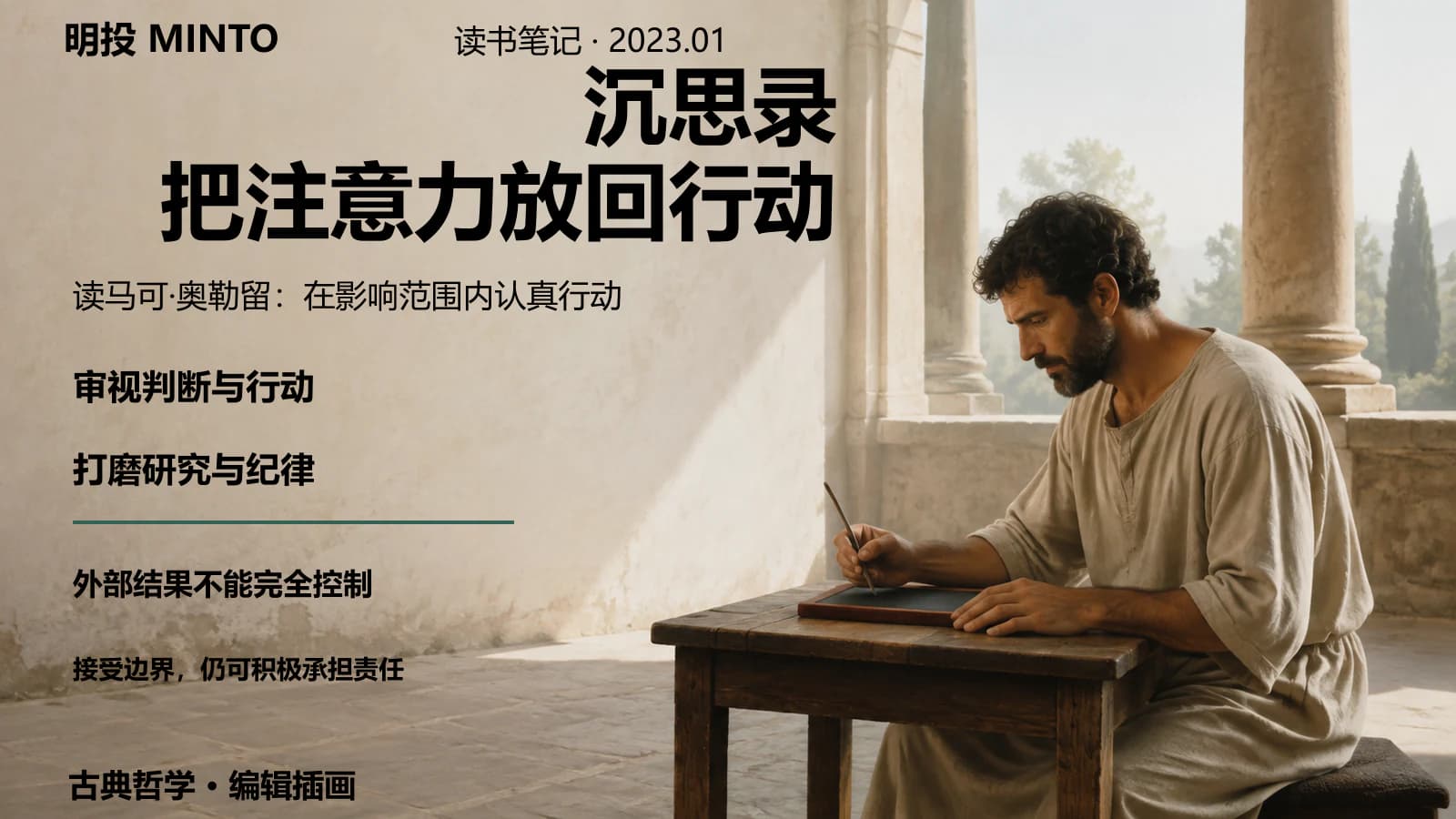
Meditations was written by Marcus Aurelius, Roman emperor (AD 121–180). But he never intended to publish it—it's a private notebook he wrote to himself while on military campaigns, in his tent. Its original title was literally "To Himself."
That's what makes Meditations so remarkable—it's not a sermon for readers, it's a man holding the most power in the world, alone at night, talking to himself. A ruler who could do anything, yet each day he wrote not about how to expand power, but about how to control his own mind, how to face death, how not to be ruled by emotion and desire.
Marcus Aurelius was the most famous practitioner of Stoicism. The core of Stoic philosophy is brutally simple—distinguish between "what you can control" and "what you cannot," then devote yourself entirely to the former, and calmly accept the latter.
This 2,000-year-old philosophy has, surprisingly, become one of the most practical psychological tools for navigating today's investment world—a world full of volatility and anxiety.
II. The Core of Stoicism: The Dichotomy of Control
Stoicism's most central principle is the "dichotomy of control"—
Some things are within your control (your judgments, your choices, your actions, your attitude), and some things are not (others' behavior, external events, outcomes, the market). Wisdom is putting all your energy into what you can control, and calmly accepting what you cannot.
For investors, this principle is almost tailor-made as an antidote.
How the market moves is entirely outside your control (it's a complex system, unpredictable—remember Mitchell). But the quality of your research, your decision-making discipline, your position sizing, your attitude toward volatility—these are entirely within your control.
The suffering of most investors comes precisely from misplaced energy—they worry about "what will the market do tomorrow" (uncontrollable), while neglecting "is my decision process rigorous" (controllable). They lose sleep over unrealized losses (uncontrollable outcome), but don't do their homework before hitting the order (controllable process).
Marcus Aurelius would say—anxiety over what you can't control wastes the only thing you truly own: your inner peace. Redirect that energy into honing the decision quality you can control—that's the most direct prescription Stoicism offers investors.
III. Three Principles Directly Useful for Investors
First, "Focus on process, not outcome." Stoicism says you can control your actions (process), not the result (outcome). An archer can control his aim and release (process), but once the arrow leaves the bow, factors like wind and target movement determine whether it hits (outcome). Wisdom is taking responsibility for perfecting the process, while calmly accepting an imperfect outcome. This aligns perfectly with the "process-oriented" thinking of Marks, Taleb, and Camus—single investment outcomes contain luck; what you control is decision quality.
Second, "Premeditate the worst case" (negative visualization). Stoics have an exercise—actively imagine losing everything you have (wealth, status, health, life). This isn't pessimism; it's to: 1) reduce fear of loss (you've already rehearsed it); 2) increase gratitude for the present. For investors, this means—before buying, seriously imagine: "If this investment loses half or goes to zero, what would I do?" If you can't bear it, don't buy so much. This is Taleb's "prepare for the worst" but given a psychological practice by Stoics.
Third, "This moment is all you have." Marcus Aurelius repeatedly reminds himself—the past is gone, the future hasn't come, all you truly possess is the present. Regretting past losses and fearing future uncertainty are both wastes of your only real asset: the present. For investors, this means—don't be held hostage by sunk costs (past losses), don't be paralyzed by fear of the future. Focus on: "Based on current information, what is the most rational decision right now?"
IV. Where I Disagree with Stoicism
First, "Accept what you can't control" can slide into passive fatalism.
Stoic "calm acceptance of the uncontrollable" is a powerful psychological tool. But it carries a risk—taken too far, it can become "I can't control it anyway, so I'll just give up"—a passive fatalism. In investing, "the market is uncontrollable" is true, but that doesn't mean "thorough research is useless." Good research can't control outcomes, but it can increase the probability of success. Stoic "acceptance" must be paired with "doing everything you can within your control"; otherwise, it becomes an excuse for inaction. Marcus Aurelius himself was extremely diligent (he governed the empire until his death), but his philosophy is easily misinterpreted as passive.
Second, its tension with "aggressive ambition."
Stoicism emphasizes inner calm and indifference to external things. But investing (and entrepreneurship, and career) requires a kind of ambition—actively seeking opportunities, taking risks, pursuing growth. Purely Stoic indifference can dull that ambition. A person completely indifferent to gain and loss might also lose the motivation to seize opportunities. Stoicism is great for "fighting anxiety and facing losses," but it offers little for "actively pursuing and seizing opportunities." Investors need to find balance between Stoic calm and ambitious drive.
Third, the boundary of the "dichotomy of control" is often blurry.
Stoicism says to separate "controllable" and "uncontrollable." But in reality, the line is often blurry. The market is uncontrollable, but my actions can subtly influence it (especially with large sums); others' behavior is uncontrollable, but I can influence them. Many things are "partially controllable." Reducing the world to a binary "fully controllable" vs. "fully uncontrollable" oversimplifies. Real wisdom is judging "how much I can influence vs. how much I cannot"—degrees, not a black-and-white split.
Fourth, it's a philosophy of "the individual's inner life" but lacks dimensions of "system" and "collaboration."
Stoicism is a highly individual practice—it focuses on "how I manage my own mind." But it almost never discusses "how to collaborate with others," "how to change systems," or "how to build relationships." A pure Stoic might have immense inner strength, but be powerless in situations requiring cooperation, external change, or dependence on others (investing requires external feedback, teams, systems). It solves "inside" but not "outside" (consistent with my critique of Wang Yangming).
V. Stoicism vs. Camus: Two Postures When Facing the Uncontrollable
Stoicism (Marcus Aurelius) and Camus (The Myth of Sisyphus) both answer "how to face a world you cannot control," but with different postures.
Stoicism's posture is acceptance and harmony—distinguish controllable from uncontrollable, calmly accept the uncontrollable, and live in harmony with the cosmos's order. It assumes the universe has a rational order (logos), and wisdom is flowing with it.
Camus's posture is rebellion and lucidity—the world is absurd, without inherent meaning, yet man must live lucidly and rebelliously. It doesn't assume any cosmic order; instead, it emphasizes the world's silence and absurdity.
Stoicism says "accept the order of the cosmos"; Camus says "resist lucidly in the chaos of the cosmos."
For investors, both postures are useful—use Stoicism to accept the uncontrollable parts of the market (don't worry about them), use Camus to maintain a lucid engagement even when outcomes are uncertain (don't passively give up). Stoicism gives you calm; Camus gives you the lucidity to persist.
My own posture—for losses and volatility, use Stoicism (accept the uncontrollable, stay calm); for participation and effort, use Camus (knowing results are uncontrollable, still make every bet seriously and lucidly). Combined, I'm neither anxious nor passive.
VI. Final Thoughts
My biggest takeaway from reading Meditations isn't any specific investing technique—it's a shift in psychological center.
Investing's greatest enemy has never been the market; it's your own emotions—greed, fear, anxiety, regret, envy. These emotions make you act impulsively when you need calm, waver when you need conviction, freeze when you need action.
Stoicism is one of the oldest and most effective tools for fighting these emotions. It teaches you—center your inner self away from being jerked around by external events (market ups and downs), and root it in what you can control (your judgment, discipline, attitude).
When the market crashes, a person ruled by emotion panics and sells; a Stoic thinks—the market's decline is outside my control. What I can control is: "Based on current information, what is the rational decision?" This shift in center—from external to internal, from outcome to process, from worrying about the future to focusing on the present—is the real steadiness that lets you navigate market turbulence.
Marcus Aurelius has a line I've adopted as my investing motto—"You have power over your mind—not outside events. Realize this, and you will find strength."
You can't control the market. But you can control your mind.
And in this endless game of investing (remember Sisyphus), only those who can control their minds will make it to the end.
A Roman emperor, 2,000 years ago, in his tent, wrote this truth to himself.
Two millennia later, it's still the best tool for fighting market anxiety.
That's what makes a classic—it's not about a particular era's market, but about the eternal, unchanging human heart.
专注投资分析、市场洞察与资产配置。不追短期波动,只理解真正驱动长期回报的东西。