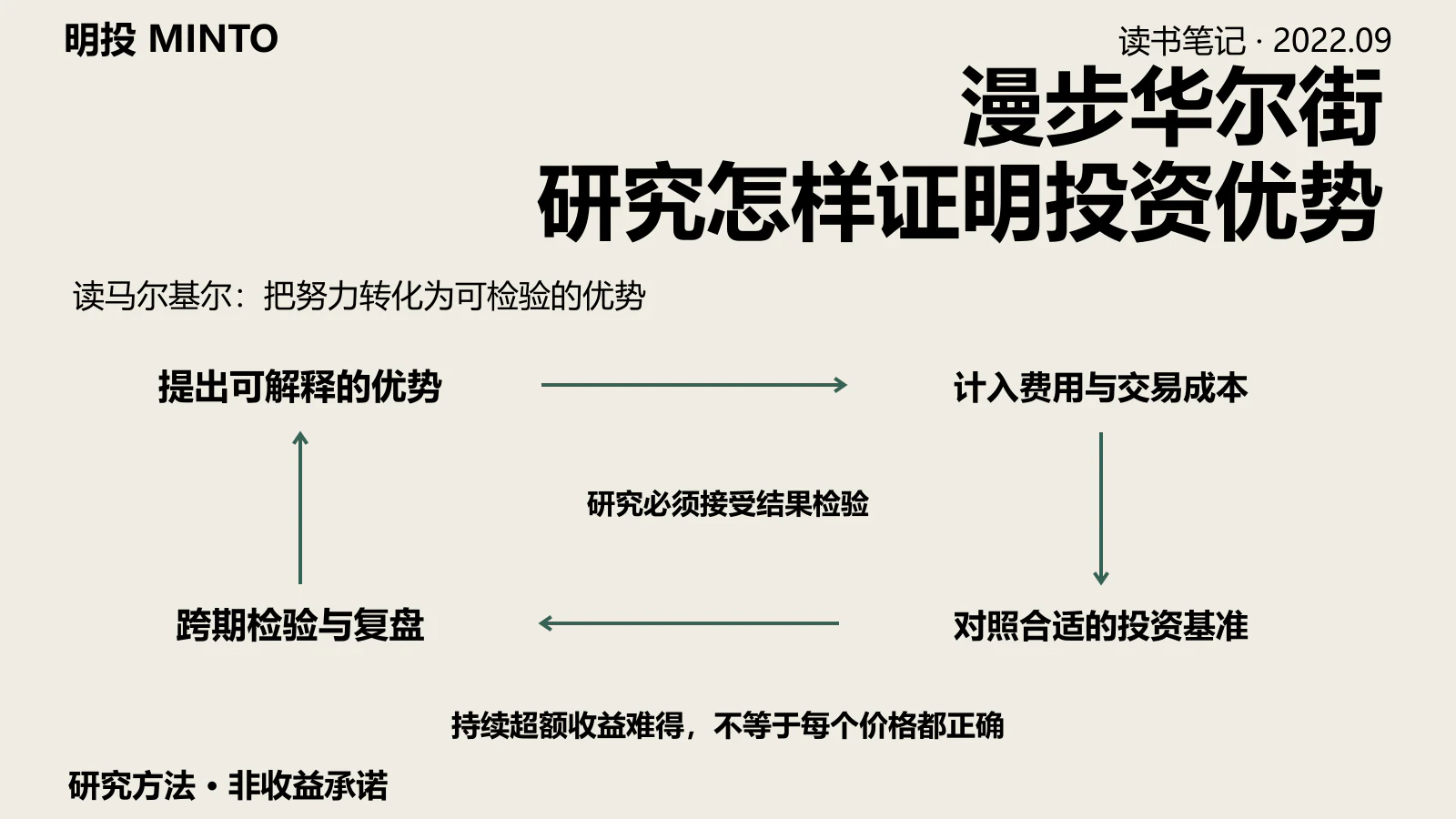
Section 1: A Book That Challenges Every Active Investor
In 1973, Princeton economist Burton Malkiel published A Random Walk Down Wall Street. By 2026 it’s reached its 13th edition, selling millions of copies – the most famous popular exposition of the Efficient Market Hypothesis (EMH).
Its core thesis is aggressively provocative: stock price movements are essentially a random walk, no one can consistently predict them; therefore, most active stock-picking, technical analysis, and market timing are futile; the best strategy for ordinary investors is to buy an index fund and then do nothing.
Malkiel has a famously incendiary line: “A blindfolded monkey throwing darts at a newspaper’s financial pages could select a portfolio that would perform just as well as one carefully selected by the experts.”
That line is an insult to the entire Wall Street. The more awkward truth: it’s largely correct. Decades of data repeatedly show that over 80% of actively managed funds underperform their benchmark indices over the long term.
As someone who spends significant time doing investment research, I have to answer this book head-on: If markets are really efficient, what’s the point of all my research?
Section 2: Three Versions of the Efficient Market Hypothesis
Malkiel presents three gradations of EMH:
Weak form – Stock prices already reflect all historical price information. So technical analysis (looking at candlestick charts, moving averages, patterns) is useless.
Semi-strong form – Prices reflect all publicly available information. So fundamental analysis (reading financial statements, news) also can’t generate excess returns, because information is priced in as soon as it’s public.
Strong form – Prices reflect all information, including insider information. So even insider trading can’t make money.
The vast majority of evidence supports weak-form efficiency (technical analysis is indeed essentially useless). Semi-strong has partial support but also counterexamples. Strong form is almost certainly wrong (insider trading clearly can make money – that’s why it’s illegal).
This taxonomy matters – it tells you that “market efficiency” is not black-and-white, but a matter of degree. The effectiveness of technical analysis is near zero. The effectiveness of fundamental analysis is declining but not zero. Informational advantages still exist in certain corners.
Section 3: Why This Book Must Be Taken Seriously
Many active investors dismiss this book with a sneer – “If markets are efficient, explain Warren Buffett.”
That’s a lazy rebuttal. The existence of people like Buffett does not refute the statistical mass of EMH. Among ten thousand active investors, a few will outperform over the long term – indistinguishable from “a few lucky ones produced by randomness.” EMH doesn’t say “no one can outperform”; it says “very few can consistently outperform, and you probably aren’t one of them.”
For the vast majority, that’s true. Ordinary investors who spend time stock-picking, timing, chasing hot trends will almost certainly earn lower long-term returns than just blindly buying an index. That’s not an insult – it’s a statistical fact.
My own attitude: First admit that EMH holds for 95% of people and 95% of situations, then ask: where is the remaining 5% inefficiency? If you can’t find that 5%, you should buy the index. If you can clearly articulate where the market is mispricing, why others don’t see it, and what your edge is – then you’re entitled to do active investing.
EMH is not about giving up; it’s about being honest.
Section 4: Where Malkiel and I Differ
First, he conflates “difficult” with “impossible.”
Malkiel’s data proves active investing is “very hard to beat,” but he often pushes that conclusion to “impossible.” That’s an overreach. Markets are not perfectly efficient – in corners where retail sentiment is extreme, liquidity dries up, or information diffuses unevenly, obvious mispricings keep appearing. Hard does not equal impossible.
Second, EMH clearly fails at extreme moments.
Malkiel’s random walk assumption holds roughly in calm periods. But at bubble tops (2000, 2021) and crash bottoms (2008, March 2020), markets are clearly inefficient – emotions drive prices away from fundamentals. Shiller’s CAPE data directly rebuts “markets are always efficient.” Malkiel’s framework has weak explanatory power for these extremes.
Third, he underestimates that “indexing itself creates inefficiency.”
Ironically, the index investing Malkiel promotes, if everyone did it, would itself create new inefficiencies – when vast sums blindly buy the index, component stock pricing detaches from fundamentals (passive money doesn’t look at quality, just follows weights). In the 2020s, the Mag 7’s rising share of index weights is partly driven by passive flows. EMH’s victory is destroying EMH’s premise.
Fourth, his treatment of the time dimension is insufficient.
EMH mainly addresses short-term pricing efficiency. But markets may be efficient in the short term while systematically wrong over the long term – for example, persistently undervaluing companies that “slowly get better” and overvaluing “storytelling” companies. Malkiel’s framework has almost no tools for this kind of “long-term inefficiency.”
Section 5: Malkiel vs. Graham – Two Fundamental Views of the Market
This book and Graham’s value investing represent the most fundamental opposition about markets.
Malkiel says: Markets are efficient – price is value, so you can’t buy cheap. Graham says: Markets are an emotional “Mr. Market” – price often deviates from value, so you can buy cheap.
Who’s right? Both are right, but in different contexts.
For broad market indices, large mature companies, and heavily covered stocks – markets are close to efficient, Malkiel is right, you’ll struggle to find bargains. For small caps, obscure stocks, crisis moments, and emotional extremes – markets are clearly inefficient, Graham is right, opportunities exist.
My own stance: Core holdings follow Malkiel (acknowledge efficiency, buy the index), satellite holdings follow Graham (look for mispriced corners). This isn’t contradiction; it’s layering. For most people, the Malkiel portion should be 80%.
Section 6: The Over-Deification of Index Investing
One final note – “blindly buying the index” is becoming a new superstition.
Malkiel’s index investing advice was spectacularly effective in the past 50 years of US markets. But it has two implicit premises that readers often forget: First, the US market has trended upward long-term; second, you’re not buying at an extreme valuation.
If the next 30 years see the US market stall like Japan’s Nikkei post-1990, “blindly buy and hold the index” would be a disaster. If you lump-sum buy the index at CAPE 35, your next decade’s returns will probably be poor.
“Buy the index” does not equal “don’t think.” You still need to think: which market’s index, at what valuation, and at what pacing. Treating index investing as “completely brainless” misreads Malkiel – he never said “valuation doesn’t matter.”
Section 7: Final Thoughts
Malkiel is now in his 90s and still updating this book. For over 50 years, his core thesis has barely changed – and most of it has been validated.
As someone who actively does investment research, my feelings reading this book are mixed: It largely negates the value of what I do. But I’m grateful for it. Because it forces me to ask myself an honest question every day:
Does my research really generate alpha? Or am I just soothing myself with “effort,” while my results are no better than a blindfolded monkey?
That question hurts, but it keeps me honest. It makes me cap my active investing to corners where I genuinely have an edge, and faithfully put the rest into the index.
Acknowledging that markets are mostly efficient is the starting point for a mature investor, not the finish line. Malkiel spent 50 years telling us this.
Uncomfortable to hear – but worth hearing.
专注投资分析、市场洞察与资产配置。不追短期波动,只理解真正驱动长期回报的东西。