跳到正文 · Skip to content
内容
关于与合作
订阅与会员
★ 查看会员权益
外观与设置
外观
主题色
版本 · 深色 / 减动搜索⌘K
草稿预览·这篇还没发布,不会出现在列表和 RSS 里。review 完后把 frontmatter 的 draft: true 改为 false 即可。

The New Interest Rate Regime: Gravity Returns

Interest rates are to asset prices what gravity is to everything else. When rates are low, anything can fly. When they come back, everything that's priced on 'the future' has to hit the ground again. In 2022, gravity returned.

2026.03.218 min原创
The New Interest Rate Regime: Gravity Returns
宏观观察MINTOVIEW2026.03.21

Macro Observations · Part 3. The previous piece covered the tide of liquidity; the master valve controlling that tide's price is interest rates. This one zooms in on rates alone—because the 2022 rate hikes weren't a routine policy adjustment; they were an epochal regime change.

I. Interest Rates Are the Gravity of Asset Prices

To understand why rates matter so much, start with Buffett's brilliant metaphor: interest rates are to asset prices what gravity is to everything else.

The metaphor is terrifyingly precise. The lower the gravity, the higher things can fly; the higher the gravity, the more everything gets pulled down. Interest rates are the gravity of the financial world: the lower rates are, the higher asset prices can be pushed; the higher rates are, the more all asset prices get pressed down.

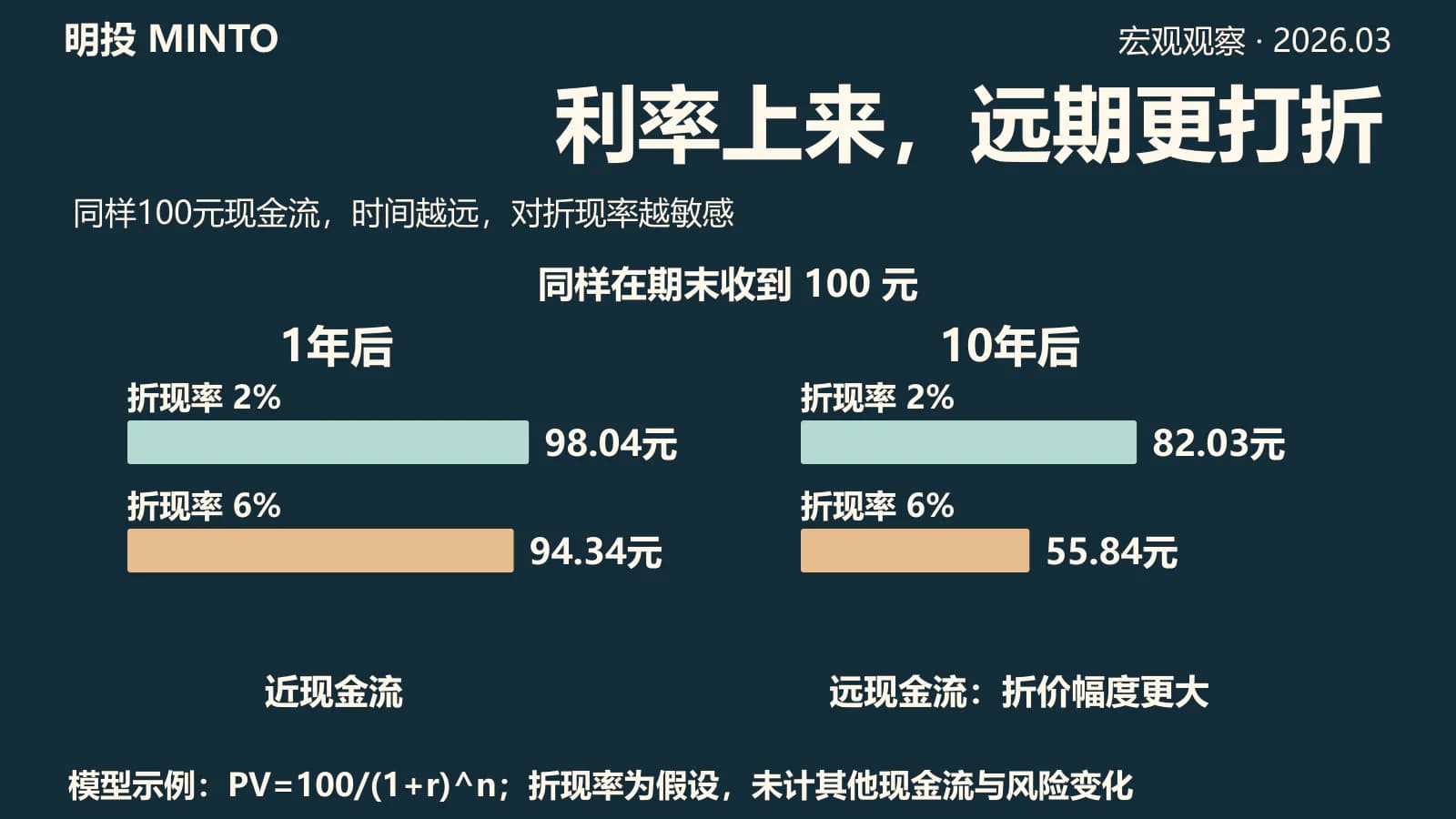
The mechanism is "discounting." An asset's value is essentially the sum of all future cash flows it can generate, discounted back to today. The discount rate—the core of which is the interest rate—is what does that work. Low rates mean future cash flows aren't "discounted much" when brought back to today, so assets are worth more. High rates mean future cash flows get heavily discounted, so assets are worth less. The same company, the same future earnings, can be worth dramatically different amounts today simply because the interest rate is different. This isn't emotion; it's math.

So rates are never just "the cost of borrowing." They are the yardstick that prices the entire market. When that yardstick's scale changes, all asset prices have to be remeasured. And in 2022, that yardstick made its most violent move in fifteen years.

II. 2022: A Regime Change, Not a Routine Hike

To understand the peculiarity of 2022, you have to understand the world before it.

From the 2008 financial crisis through 2021—roughly fifteen years—we lived in a deeply abnormal world that many had come to see as normalzero interest rate policy (ZIRP). Rates were pinned to the floor; money was nearly free. In that world, gravity all but disappeared:

  • Companies with no profits, only stories, could survive on funding for ages and see their valuations soar (because money was free, investors were willing to pay for distant futures).
  • Borrowing had almost no cost, leverage was abused, asset prices were repeatedly pushed higher by liquidity.
  • Cash and bonds yielded almost nothing, forcing everyone into stocks and risk assets—the famous TINA (There Is No Alternative).

This "free money" world lasted so long that an entire generation of investors took it for granted as the natural order. But it was an anomaly in financial history, not the norm.

In 2022, that anomaly ended abruptly. To fight the worst inflation in 40 years, the Fed jacked rates from near zero to high levels at a stunning pace. This wasn't a normal hiking cycle. It was a regime change—from the abnormal old regime of ZIRP back to a world where rates carry real weight. Gravity returned overnight.

And when gravity came back, the things that had flown highest in the "no gravity" era fell hardest.

III. Why Growth Stocks Got Crushed First

The 2022 selloff had a sharp signature: the higher the valuation, the more growth-dependent, the more distant the profits—the worse the crash. The lower the valuation, the more current earnings, the more real cash flow—the more they held up. This wasn't random; it's the inevitable consequence of the rates yardstick.

The key concept is duration—how much of an asset's value depends on the distant future.

  • Growth stocks / concept stocks are "long-duration" assets: They may not earn much today; their value is almost entirely bet on a distant future where they'll make a lot of money.
  • Value stocks / mature companies are "short-duration" assets: Their value comes mainly from real cash generated now and in the near term.

And when rates rise, the more distant the cash flow, the harder it gets discounted. So—rising rates hit long-duration assets (growth stocks) far harder than short-duration assets (value stocks). When gravity (rates) increases, the stocks that flew highest and depended most on the distant future get yanked down hardest; the ones with their feet on the ground, earning cash today, stand firm.

This gives us an extremely useful positioning tool—by understanding the rate environment, you can get a broad sense of which market style (growth vs. value) will have the wind at its back. An environment of rising or persistently high rates is headwind for growth and tailwind for value and cash flow; a falling rate environment flips that. This isn't a prediction; it's understanding "under current gravity, which assets struggle more and which struggle less."

IV. What Gets Repriced After 'Free Money' Ends

The significance of a regime change goes far beyond style rotation. Many things built on the "free money" era must now be repriced under the new regime:

First, 'growth at all costs' gives way to 'real profitability.' In the ZIRP era, the market rewarded "burn cash for growth"—money was free, so grab market share first, don't worry about profits. But in a world with real interest rates, capital has a cost, and the market starts asking a simple question again: do you actually make money? Business models with nothing but growth stories and never any profits lose their cheap funding lifeline and are forced to face reality. Profitability becomes hard currency again.

Second, leverage goes from 'free accelerator' to 'dangerous fuse.' In zero rates, borrowing had almost no cost; leverage was a free amplifier. After rates return, debt service becomes a real, heavy burden. Highly leveraged companies and 'zombie firms' that survive only by rolling over debt get slowly squeezed to death by rates in the new regime. This echoes what I wrote in the asset allocation piece on leverage—the cost of leverage can be especially deadly when rates are high.

Third, TINA becomes TARA. When cash and bonds start yielding decent returns again, "There Is No Alternative" (TINA) becomes "There Are Reasonable Alternatives" (TARA). Cash is no longer "must-avoid garbage"; it's an asset that generates a respectable yield and preserves optionality (remember my piece on cash = optionality). Bonds also become a valid allocation again (remember the piece on bonds). That means stocks are no longer the only game in town; they have to compete for capital with cash and bonds that have regained their appeal—and that itself puts downward pressure on equity valuations.

V. Will the New Regime Last? Positioning, Not Predicting

So how long will this new interest rate regime last? Could we ever go back to ZIRP again?

This is a critical question, but I have to answer it with the discipline of the framework: I don't predict the specific path of rates (nobody can), but I can make a structural assessment of the 'nature of the regime.'

My assessment: Most likely, we won't return to the extreme of sustained ZIRP from the 2010s, but we also shouldn't assume rates will stay high forever. Reasons:

  • Several structural reasons we won't return to long-term ZIRP (to be expanded in later pieces): deglobalization pushes costs higher (inflation floor rises), large fiscal deficits (government needs higher nominal growth to dilute debt), and the structural cost pressures from energy transition and AI power consumption. All these factors make the inflation floor higher than the 2010s, and therefore the rate floor higher too. 'Free money' was a product of specific historical conditions; those conditions are fading.
  • But "higher floor" does not mean "always high." Economies have cycles; recessions will force central banks to cut. Rates will oscillate around this new, higher floor. So the right stance is not to bet 'rates go back to zero' or 'rates stay high forever.' It's to recognize: We have likely entered a new normal where the rate floor is higher than the past fifteen years and rates carry real weight again.

This assessment gives clear guidance for decisions: Don't invest using the ZIRP-era playbook—don't assume money will always be free, don't pay infinite multiples for unprofitable stories, don't ignore the cost of leverage, don't ignore the renewed appeal of cash and bonds. The most dangerous thing is to carry the muscle memory of the old regime into the new one. The biggest risk for the last generation of investors is applying 2010s experience to a world that has already changed.

VI. In Closing

2022 was a watershed. It wasn't a routine rate hike; it was a regime change—gravity, after disappearing for fifteen years, returned to the financial world.

The moment gravity returned, many "common sense" rules of the old world broke down: the growth stocks that flew highest crashed hardest; burn-cash-for-growth models became unsustainable; leverage flipped from accelerator to fuse; cash and bonds went from garbage to viable options. These aren't cyclical fluctuations; they're regime-level shifts—marking the end of one era and the beginning of another.

And for us, the most important thing is not to predict where rates go next (that's another prediction trap). It's to recognize: We've already changed regimes. The rules of the game have changed. In the new regime, capital has a cost again, profitability is the hard currency again, discipline is valuable again. Carrying the old regime's playbook into the new regime is the biggest risk of this era.

If I leave only one line—

Interest rates are the gravity of asset prices. In 2022, after fifteen years, gravity came back—and we're unlikely to return to that old world of free money. Don't invest in a new regime where rates carry weight with the muscle memory of the zero-rate era.

Next, we'll look at the hub through which this rate regime radiates globally—the dollar. It's the axis of this world, and its strength or weakness moves everything from emerging markets to commodities.

Risk disclaimer: This article is a macro framework study and does not constitute any investment advice. Markets carry risk. Invest with caution.

Minto
明投 Minto
投资分析 · 长期主义者

专注投资分析、市场洞察与资产配置。不追短期波动,只理解真正驱动长期回报的东西。
你读完了 · Colophon

The New Interest Rate Regime: Gravity Returns

8
分钟
2026/03
期号
2026
年份
真正稀缺的,是一个不慌不忙的人。
明投 · MintoInvest Wisely
— From This Series
喜欢这篇?这类 宏观观察 的深度拆解会持续发到你邮箱。
无广告 · 随时退订
— Enjoyed the read?
如果这篇文章对你有用,把它分享给一个朋友,就是对我最好的支持。

口碑是独立创作者最稀缺的燃料。

— Discussion

说说你的想法

评论基于 GitHub Discussions(Giscus)。登录后即可留言、点赞、互相讨论。

评论还在准备中。

想说什么可以直接发我邮件,比在评论区更容易认真回复。

mingtaohuang617@gmail.com →
支持沉浸式阅读