跳到正文 · Skip to content
内容
关于与合作
订阅与会员
★ 查看会员权益
外观与设置
外观
主题色
版本 · 深色 / 减动搜索⌘K
草稿预览·这篇还没发布,不会出现在列表和 RSS 里。review 完后把 frontmatter 的 draft: true 改为 false 即可。

Macro: Not a Crystal Ball, But a Compass for Your Position

Almost no one can consistently predict the macro. But that doesn't mean it's useless — its value was never about telling you what the future holds. It's about showing you where you stand right now, so you can check: does your current decision deserve this environment?

2026.03.178 min原创
Macro: Not a Crystal Ball, But a Compass for Your Position
宏观观察MINTOVIEW2026.03.17

Macro Observations Series · Manifesto. I've written plenty of macro-event notes (FOMC, NFP, tariffs), but I've always lacked a piece that clearly explains how I actually use macro. This fills that gap. It's the framework for all the macro pieces to come, and the very top layer of my entire research system.

1. First, Let's Admit Something Uncomfortable: Macro Forecasting Is Basically Unreliable

To talk macro, we have to first admit something that embarrasses the entire industry: consistently forecasting the macro is virtually impossible.

This isn't my being harsh. It's documented fact. Look at the people who should be best at it: the Fed — with the most data and the strongest economics team — its own rate path projections (the famous dot plot) are often wildly wrong in hindsight. Wall Street banks' annual GDP, rate, and oil forecasts, when checked against year-end reality, have abysmal accuracy. Even something as big as a 'recession' has almost never been successfully predicted by the economics profession before it arrives.

Why is it so hard? Because macro is a classic complex system (remember my notes on Kevin Kelly's Out of Control and complexity science) — it's made of countless interacting, feedback-heavy variables: growth, inflation, rates, employment, policy, geopolitics, sentiment... each affects all others, and is laced with unknowable shocks (pandemic, war, sudden policy changes). In such a system, 'linear extrapolation' inevitably fails, and 'precise prediction' is an illusion. Anyone who claims they can forecast where the market will be next year is either lying to you, or lying to themselves.

So here's the question: if we can't predict, what's the point of macro research? Why am I even writing this entire series?

Because — the use of macro was never about prediction.

2. The Real Use of Macro: It's a Map, Not a Crystal Ball

My core positioning of macro, distilled into one sentence (the spine of this series): Macro is not for predicting the future; it's for positioning yourself in the present.

Use an analogy. You're hiking in heavy fog. You can't see the path ahead. What you need is not a fortune-teller who tells you 'will it rain in three hours' (no one can do that accurately), but rather a map + a location fix — telling you 'you're on the eastern side of the mountain, halfway up, near a steep slope.' Knowing your position, you can judge: should I speed up now? Should I pack rain gear? Is my next step stable?

Macro is that map. Its value isn't in prophesying the weather at the summit. It's in helping you understand what kind of environment you're standing in right now, so you can answer a simple but crucial question — does the decision I'm making (my positions, my allocation, my risk exposure) deserve this environment?

This is a fundamental shift in perspective:

  • Wrong use (fortune-teller): 'Will the Fed cut next time? So should I go all-in now?' — using macro as a trading signal, betting on a future you can't predict.
  • Correct use (location device): 'We're in a 'growth slowing + inflation still high + rates staying elevated' environment. In this environment, am I fully loaded with high-valuation growth stocks — am I exposing myself to too much risk?' — using macro as a background check, examining whether your decisions match the environment.

The former is betting with macro; the latter is guarding with macro. The former inevitably has low win rates (because it relies on prediction); the latter is highly feasible (because it only requires you to honestly recognize the present and check yourself against it). I do macro only as the latter.

3. The Map I Use for Positioning: The Growth × Inflation Four-Quadrant

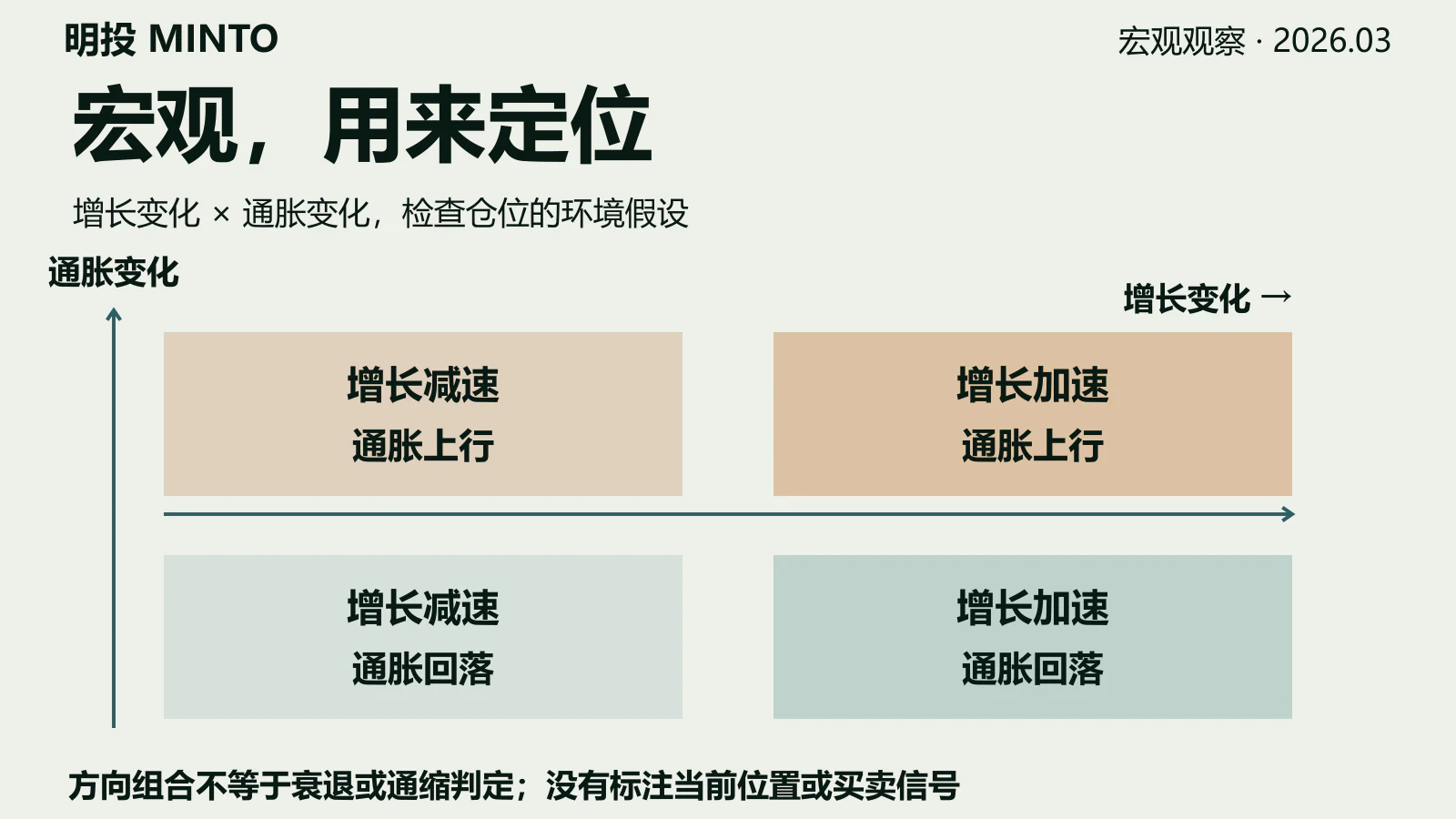
So how exactly do we 'position'? The map I use is an extremely simple but extremely useful framework — the four-quadrant of growth and inflation.

Macro has a thousand threads, but if I can only grab the two most important variables, they are economic growth (accelerating or decelerating) and inflation (rising or falling). The four combinations of these two variables roughly outline four kinds of 'macro weather':

Inflation FallingInflation Rising
Growth RisingRecovery (Goldilocks)Overheat
Growth FallingRecession (Deflation)Stagflation

Each kind of weather has its roughly preferred asset character (a summary of historical patterns, not a law):

  • Recovery (Growth ↑, Inflation ↓): The most comfortable environment. A golden period for equities, especially growth stocks.
  • Overheat (Growth ↑, Inflation ↑): Commodities, real assets, companies with pricing power dominate.
  • Stagflation (Growth ↓, Inflation ↑): The most painful environment. Cash, gold, inflation-hedging assets hold up relatively well; growth stocks get hit hardest.
  • Recession (Growth ↓, Inflation ↓): Bonds (especially long-duration), defensive assets rule.

This chart is my 'map' for macro positioning. Note — its use is not to predict 'which quadrant is next' (that falls back into the prediction trap), but to judge 'which quadrant am I roughly in right now,' then check whether my allocation matches that quadrant.

The piece I wrote earlier on the 'inflation, growth, policy triangle' (remember that one) is actually a simplified version of this four-quadrant chart — policy (interest rates) is essentially a reaction to these two variables. Add that reaction variable, and the map is more complete: growth and inflation determine which quadrant you're in, while policy (central bank tightness/ease) determines how deep the water (liquidity) is in that quadrant, and whether the quadrant might be artificially pushed to shift. In the next few pieces, I'll unpack 'key landmarks on the map' — liquidity, rates, the dollar, inflation, and fiscal policy — one by one.

4. Why 'Positioning' Is More Valuable Than 'Predicting'

You might think 'positioning' sounds too conservative — it doesn't tell me what to buy, or when. It just asks me to 'check.' How is that useful?

It's far more useful than you think. Because the vast majority of investment disasters don't come from 'failing to predict the future'; they come from 'being severely mismatched between decision and environment without realizing it.'

A few examples:

  • In 2021, in an environment of extreme liquidity flooding and valuations pushed to extremes, countless people loaded up on the most expensive growth stocks and concept stocks. Their mistake wasn't failing to predict the 2022 crash (no one could pinpoint it). It was failing to realize they were standing in an 'extremely fragile' environment and had maxed out their risk exposure. A simple positioning map would have told them: the water level is absurdly high; now is the time to reduce risk, not add.
  • Conversely, at the end of 2022, in an environment where everyone was panicking and valuations were beaten down, many people dumped all holdings out of fear. Their mistake wasn't failing to predict the 2023 rebound, either. It was failing to realize they were standing in an environment where 'valuations are cheap and pessimism is fully priced in,' and instead of taking risk, they withdrew.

See the pattern? Both disasters could be avoided without 'predicting the future.' They could be avoided simply by 'positioning the present.' Positioning tells you 'the water is high/low, the environment is fragile/cheap.' You then adjust your risk exposure accordingly. You don't need to know when the wave will come; you only need to know 'right now, am I standing firmly?'

This is precisely the interface between macro and asset allocation (remember the core of my entire asset allocation series — not predicting the future, but preparing for all futures). Macro positioning is the top-level manifestation of 'preparing for all futures': I don't bet on the next quadrant, but I figure out the current quadrant, make sure my allocation won't be destroyed in the current environment, and leave room for any quadrant switch.

5. Placing It at the Top of the Entire Research System

Finally, let's talk about where this macro series sits in my entire research system.

My research is roughly a four-layer stack from top to bottom:

Macro (weather) → Industry (track) → Company (individual) → Allocation (how to hold).

  • Macro positions you in what kind of weather (this series).
  • Industry tells you which tracks have good industry structures, where the bottlenecks are, how value is distributed (the industry research series I just finished).
  • Company dives into a specific target's moat and financials (company teardowns).
  • Allocation decides what structure you use to hold all this, ensuring you're not destroyed by any single outcome (the asset allocation series).

These four layers interlock. For example, the 'master switch' I keep returning to in my industry research — the sustainability of AI capex — appears to be an industry issue, but at its core it's a macro issue (it touches liquidity, rates, corporate earnings, the overall economy's capital allocation). The macro layer is what gives that master switch its context: are we in a macro environment that can sustain this kind of astronomical capex? How might this environment change?

Macro is the top-level weather. It doesn't directly tell you what to buy, but it determines the background against which all decisions in the three layers below should be made. If you set sail without understanding the weather, no matter how good the ship (allocation) or how good the cargo (targets), you could capsize in a storm whose danger you could have anticipated (even if you couldn't predict its timing).

6. In Closing

Macro is the most misused tool in investing.

It's misused because people always demand from it something it cannot give — a prophecy of the future. Hence the endless forecasts, targets, calls, and the ensuing embarrassment of being repeatedly wrong. Treating macro as a crystal ball is a path with inherently low win rates.

But the real value of macro lies in a humbler, more useful application — positioning. It doesn't tell you what the future holds (no one can). It tells you where you stand now, so you can check: does your decision deserve this environment? Is your risk exposure too full or too empty at the current water level? This usage doesn't require prediction; it only requires honest recognition of the present. And it can help you avoid the vast majority of investment disasters.

So if this manifesto could leave only one line, I hope it's this:

Don't ask macro 'what will the future be' — it doesn't know, and no one does. Ask it 'where am I right now' — then honestly check if the hand you're holding deserves the weather under your feet.

In the next few pieces, I'll unpack the most critical landmarks on this map, one by one — liquidity, rates, the dollar, inflation, and fiscal policy. They are the coordinates you must learn to read when positioning. Next up: we start with the tide that drives all asset prices: liquidity.

Risk Disclosure: This article is a macro-framework study and does not constitute any investment advice. Markets carry risks; invest with caution.

Minto
明投 Minto
投资分析 · 长期主义者

专注投资分析、市场洞察与资产配置。不追短期波动,只理解真正驱动长期回报的东西。

你读完了 · Colophon

Macro: Not a Crystal Ball, But a Compass for Your Position

8
分钟
2026/03
期号
2026
年份
真正稀缺的,是一个不慌不忙的人。
明投 · MintoInvest Wisely
— From This Series
喜欢这篇?这类 宏观观察 的深度拆解会持续发到你邮箱。
无广告 · 随时退订
— Enjoyed the read?
如果这篇文章对你有用,把它分享给一个朋友,就是对我最好的支持。

口碑是独立创作者最稀缺的燃料。

— Discussion

说说你的想法

评论基于 GitHub Discussions(Giscus)。登录后即可留言、点赞、互相讨论。

评论还在准备中。

想说什么可以直接发我邮件,比在评论区更容易认真回复。

mingtaohuang617@gmail.com →
支持沉浸式阅读