跳到正文 · Skip to content
内容
关于与合作
订阅与会员
★ 查看会员权益
外观与设置
外观
主题色
版本 · 深色 / 减动搜索⌘K
草稿预览·这篇还没发布,不会出现在列表和 RSS 里。review 完后把 frontmatter 的 draft: true 改为 false 即可。

Three Machiavelli Rules for Judging CEOs: A Different Reading of *The Prince*

Machiavelli says a prince must learn to be "not good"—but the real insight of the book is that he admits what most people won't: the logic of power is not the same as the logic of morality.

2024.04.2211 min原创
Three Machiavelli Rules for Judging CEOs: A Different Reading of *The Prince*
读书笔记MINTOVIEW2024.04.22

1. A book that has been condemned for 500 years

In 1513, Niccolò Machiavelli, after being dismissed by the Florentine government and exiled to the countryside, wrote this slim volume The Prince (Il Principe).

His motivation was brutally practical—he wanted to be rehired. So the book was a letter of introduction to the ruling Medici family of Florence. The book is essentially a job application—he was telling the Medici: Look, I understand how power works. Hire me.

But the Medici didn't hire him. Machiavelli lived on in the countryside for another 14 years and died quietly. Almost no one read the book during his lifetime.

It wasn't until 5 years after his death, in 1532, that the book was formally published. Then it got condemned for 500 years. The term "Machiavellian" became almost synonymous with "unscrupulous," "ruthless," and "manipulative."

But here's the strange thing—the most condemned book of the last 500 years is also the most widely read. Every politician, every CEO, every leader reads it in private and denies it in public.

Why? Because it admits what most people refuse to admit—that the logic of power is not the same as the logic of morality.

2. The most anti-ethical sentence: When necessary, a prince must learn to be "not good"

There's a sentence in The Prince that has been quoted and criticized for 500 years—"A prince must learn to be not good, and to use that ability when necessary."

That sounds malicious. But Machiavelli's argument is intensely practical—

If a prince is completely good, he can't handle evil enemies. He will be devoured. Once he is devoured, his state falls into greater chaos, and his people suffer more. So a prince who truly loves his people must instead dare to be "not good" when the time calls for it.

This is a form of "dark utilitarianism"—to maximize the overall good, the prince must personally bear the cost of being "not good."

When I read this passage, I kept thinking about corporate CEOs.

The best CEOs are the ones who dare to lay off when they need to, kill off businesses when they need to, and fire executives when they need to. These CEOs are often called "cold," "ruthless," and "inhumane" when they execute. But what they do is right for the long-term survival of the company as a whole.

The classic counterexample is GE's Jeff Immelt—from 2001 to 2017, he made almost no truly ruthless decisions. He kept losing businesses, protected entrenched executives, and avoided any painful restructuring that would make headlines. The result: GE's stock fell 30% on his watch, then collapsed by -70% after he left. He was "too good," but ended up costing GE's employees and shareholders a much bigger price.

Compare that to Steve Jobs returning to Apple in 1997—his first move was to cut 70% of product lines, fire vast numbers of employees, and settle the lawsuit with Microsoft (which he personally hated). All these decisions were "not good" from a personal moral standpoint, but they saved Apple.

Machiavelli told you 500 years ago—A leader's responsibility is not to "be a good person" but to "make outcomes better." These two things often conflict.

3. The second insight: Being feared is more stable than being loved

Machiavelli directly tackles the classic leadership question—should a leader seek to be loved or to be feared?

His answer is brutally cold—If you can't have both, being feared is safer than being loved.

His reasoning: love is an active emotion that people can withdraw at any time. Once a crisis hits, interests conflict, or personal convenience arises, people will stop loving you instantly. Fear, by contrast, is a passive emotion—as long as you have real coercive power, people will keep fearing you.

This pattern plays out repeatedly in corporate governance. A CEO who is "loved" by employees and a CEO who is "feared" by employees look similar in good times, but diverge drastically in bad times.

A CEO loved by employees gets the highest morale when business is smooth. But the moment a crisis hits (layoffs, pay cuts, restructuring), centrifugal forces explode—because "my love for you was contingent on you being good to me; now you're not, so I don't love you anymore."

A CEO feared by employees may not have a great atmosphere in good times, but in a crisis, that CEO gets the strongest execution—because the team knows: "this CEO says he'll do something, and he will." That certainty itself is stability.

The classic example is Jeff Bezos. He was known inside Amazon as harsh, demanding, and unsentimental. But every insane transformation Amazon pulled off over the past 25 years—from selling books to cloud, from consumer to enterprise, from software to hardware, from US to global—required that kind of "fear-based leadership" to get executed.

This has a direct implication for investors evaluating management—a CEO's "likeability" and the company's long-term return are negatively correlated. Of course, it's not absolute, but as a prior, it's closer to reality than the opposite.

4. The third insight: Incumbent interests are the biggest enemy of reform

Machiavelli repeatedly emphasizes—The greatest political danger is not from external enemies, but from internal incumbents whose interests you have disturbed.

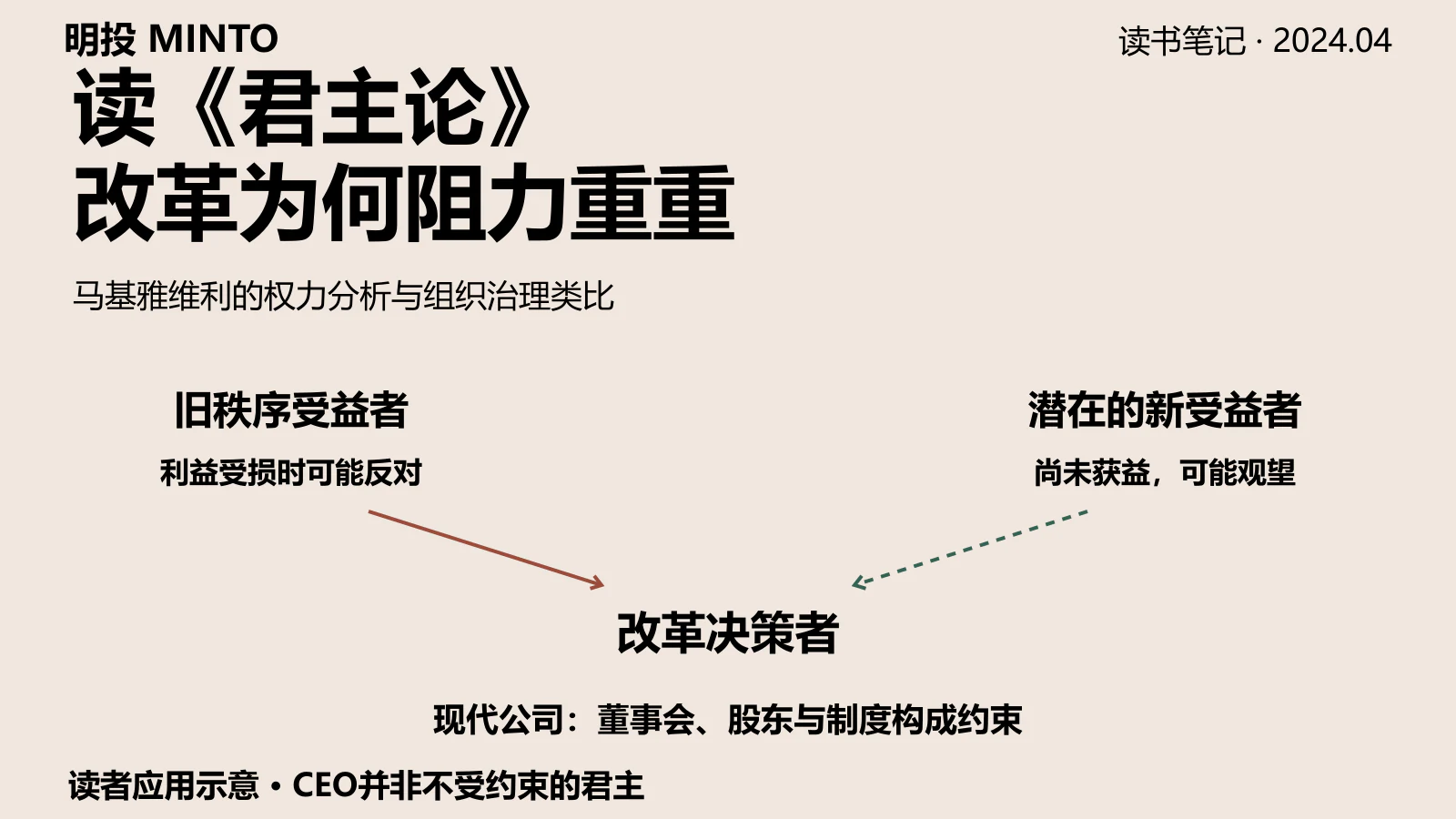
His original words (paraphrased)—"Reformers have the hardest path, because they face opposition from all the beneficiaries of the old order (who will fight them), while the potential beneficiaries of the new order (who won't support them yet because they haven't tasted the benefits)."

This is a universal truth in both political science and corporate management.

The vast majority of failed corporate transformations fail not because the strategy was wrong, but because the incumbents in the old business successfully resisted.

Nokia failed to produce an iPhone-level product—it had top-tier hardware teams, top-tier software engineers, and a global distribution network. But Nokia's feature phone division was the profit center; any transformation that threatened it would be resisted by internal incumbents. Nokia died of "wanting to transform but unable to."

Kodak invented the digital camera in 1975. But the engineer who invented it was suppressed by the film division—film profits made up 90% of the company; anyone who touched it was out. The digital camera patent sat in Kodak's drawer for 30 years, and then Kodak went bankrupt.

Blockbuster had a chance to buy Netflix in 2000 for USD 50 million. They declined—because Blockbuster's store business was wildly profitable, and internally no one wanted to admit that the future was in streaming. 20 years later, Netflix is worth USD 200 billion; Blockbuster doesn't exist.

These aren't failures of "not seeing the trend"—they are failures of "incumbents resisting change." Machiavelli told you 500 years ago—this resistance is structural, almost inevitable.

For an investor, this means—when evaluating a company in transition, don't look at its "strategic PPT." Look at whether it "dares to truly piss off the people in the old business." If a company says it's transforming but still protects old-business executives and profits, its transformation is probably fake.

5. My reservations about [object Object]

By the second reading, I started to have some reservations.

First, it assumes a "prince-to-many" power structure that doesn't fully apply in modern companies.

Machiavelli wrote about a world where a prince rules over subjects. But modern corporate power structures are far more complex—the CEO has a board above, the board has shareholders above, and among shareholders there are large institutions, Soros-style hedge funds, ESG investors, and index funds. The CEO isn't a true "prince"; he is an agent constrained by multiple parties.

Under this structure, some of The Prince's advice becomes ineffective. For example, "display cruelty to establish authority"—if a CEO does that, he'll be fired by the board immediately, his ESG rating downgraded, and hit with employee class-action lawsuits. Machiavelli's methods work best in eras of concentrated power; in an era of dispersed power, they must be heavily discounted.

Second, it treats "short-term" and "long-term" too coarsely.

Many of Machiavelli's suggestions ("establish authority with cruelty first, then bestow favors"; "do all bad things at once, then slowly do good things") are optimal in short-term game theory. But in a corporate setting, the time horizon for "short" and "long" is much longer than Machiavelli imagined.

A CEO who uses Machiavelli's methods to establish authority may be very effective in Year One. But the accumulated resentment over 5-10 years can backfire—mass employee departures, internal information blackouts, cultural decay. Uber under Travis Kalanick is the textbook example—he used brute force to grow the company, but eventually the internal hostility he created pushed him out.

Machiavelli's methods work in the short term but backfire in the long term. He didn't see this himself—because he lived in an era where princes had short life spans.

Third, it barely discusses the importance of "cultural capital."

Machiavelli focuses on hard power—armies, finances, control over allies. But the core assets of modern companies are increasingly cultural capital—brand, trust, talent attraction, employee reputation.

Companies like Patagonia, Costco, and Berkshire Hathaway have outperformed the market for long stretches not because they played "power games" well, but because they built a certain cultural capital—employees want to work for them, customers pay a premium for them, society gives them goodwill. Once built, this capital self-reinforces.

Machiavelli almost never discusses this kind of capital. In his world, cultural capital is "soft, flimsy, unreliable." But the reality of 2024 tells us that cultural capital is actually the most durable moat.

Fourth, its implicit view of human nature is too pessimistic.

Machiavelli assumes almost everyone is selfish, ruthless, and opportunistic. He advises the prince to "always assume the worst in human nature."

This is accurate at some level—many decisions require the worst-case assumption for risk management. But always assuming the worst makes you blind to the possibility of cooperation and trust.

The most profitable long-term business relationships are almost all results of "assuming goodwill." Warren Buffett buys companies without due diligence—he trusts the seller. Costco's relationship with its employees is almost anti-Machiavellian—high pay, good benefits, low turnover. These companies built long-term success by assuming goodwill.

Machiavelli saw half of human nature—the bad half. He missed the half that long-term cooperation can create.

6. [object Object] vs. [object Object] itself: an internal contradiction

The most interesting thing about The Prince is that it contains a deep internal contradiction—Machiavelli's method could not be used by Machiavelli himself.

Machiavelli himself never held real power. He was a mid-level bureaucrat who never recovered after being dismissed. All the things he wrote about "what a prince should do," he himself was never a prince.

This is widely discussed in Western academia. A common interpretation is that Machiavelli wrote the book not as a genuine guide for princes, but as a revelation of how princes actually operate. It is essentially a book that "exposes the mechanisms of power" rather than teaching "how to be a prince."

Under this interpretation, the real readers of the book are not princes but ordinary people—it lets them see how power works so they are not deceived, suppressed, or tamed.

I lean toward this interpretation. For an investor, the greatest value of the book is not "how to manipulate power" but "how to recognize the operating patterns of power."

When you see a CEO make a certain decision, you can use Machiavelli's framework to analyze—why is he doing this? What are the real constraints he faces? What is he guarding against? What is he pursuing? This ability to "decode power" is more valuable than any technical analysis for judging management.

7. Concrete takeaways for investors evaluating management

If I could take only three rules from The Prince for evaluating public company management, they would be:

First, watch whether the CEO dares to be "not good" when the moment calls for it. Look back at the company over the last 10 years—are there genuinely difficult decisions: big layoffs, killing a core business, firing a top executive, walking away from an acquisition? Did the CEO push through despite external criticism? A CEO without these traces probably doesn't have real power.

Second, watch the CEO's relationship with incumbents. Is the old business being protected? Are there "sacred" business divisions that can't be touched? Did the company miss a transformation because of internal resistance when a new trend emerged? A CEO who protects incumbents will likely lose at the next industry inflection point.

Third, watch if the CEO's "likeability" is too high. If a CEO in all internal communications tries to be loved, avoids conflict, and is unwilling to make people uncomfortable—that's a red flag. The best CEOs have internal reputations of "tough but fair," not "everyone likes him."

8. Closing thoughts

Machiavelli died in 1527 at age 58. He knew he would be condemned—he wrote in a private letter that he knew the book would make him "a devil in the eyes of the world," but he still wrote it because he believed "truth is more important than decorum."

500 years later, he is still heavily condemned. But at the same time, he is still one of the most cited figures in political philosophy and corporate management.

This itself is the deepest footnote to the book—the cost of telling truth is condemnation, but the reward of telling truth is being remembered.

For me, the biggest takeaway from reading the book is not the "tactics" it teaches, but the attitude of daring to face the truth about power.

Most management books, leadership courses, and business bestsellers tell you that "leadership is about goodness, about mission, about vision." Those words aren't wrong, but they tell only half the story. The other half—that leadership is also about ruthlessness, about trade-offs, about daring to make people uncomfortable—few people are willing to say out loud.

Machiavelli dared to say it 500 years ago. That honesty is more valuable than any specific advice in the book.

It's also why this book, 500 years later, is still worth rereading every year.

Minto
明投 Minto
投资分析 · 长期主义者

专注投资分析、市场洞察与资产配置。不追短期波动,只理解真正驱动长期回报的东西。

你读完了 · Colophon

Three Machiavelli Rules for Judging CEOs: A Different Reading of *The Prince*

11
分钟
2024/04
期号
2024
年份
真正稀缺的,是一个不慌不忙的人。
明投 · MintoInvest Wisely
— From This Series
喜欢这篇?这类 读书笔记 的深度拆解会持续发到你邮箱。
无广告 · 随时退订
— Enjoyed the read?
如果这篇文章对你有用,把它分享给一个朋友,就是对我最好的支持。

口碑是独立创作者最稀缺的燃料。

— Discussion

说说你的想法

评论基于 GitHub Discussions(Giscus)。登录后即可留言、点赞、互相讨论。

评论还在准备中。

想说什么可以直接发我邮件,比在评论区更容易认真回复。

mingtaohuang617@gmail.com →
支持沉浸式阅读