跳到正文 · Skip to content
内容
关于与合作
订阅与会员
★ 查看会员权益
外观与设置
外观
主题色
版本 · 深色 / 减动搜索⌘K
草稿预览·这篇还没发布,不会出现在列表和 RSS 里。review 完后把 frontmatter 的 draft: true 改为 false 即可。

Wu Wei: The Daoist Cure for Overtrading

Laozi's concept of 'wu wei,' uttered 2,500 years ago, might be the earliest and deepest diagnosis of how overtrading destroys returns.

2022.10.187 min原创
Wu Wei: The Daoist Cure for Overtrading

1. A 5,000-Character Book That Shaped 2,500 Years

The Dao De Jing is only 5,000 characters long, left by Laozi (circa 6th century BCE). It is one of the most translated books in the world, after the Bible.

This book is extremely difficult to interpret — its language is poetic, paradoxical, and ambiguous. "The Dao that can be spoken is not the eternal Dao." This deliberate vagueness has allowed countless interpretations over 2,500 years.

I read the Dao De Jing not as mysticism, but as a kind of practical wisdom about how to act in an uncertain world. And its core concept — wu wei — is perhaps the most important and counterintuitive lesson for investors.

Because one of the biggest traps in investing is precisely "overaction" — frequent trading, chasing gains, selling in panic, the compulsion to do something. Laozi diagnosed this disease 2,500 years ago.

2. Wu Wei: Not Inaction, But Non-Conscious Action

"Wu wei" is the most misunderstood concept in the Dao De Jing. Many think it means "do nothing, be passive and lie flat." But that's not what Laozi meant.

The real meaning of wu wei is "non-conscious action" — not doing things that go against the grain, that are futile, that stem from anxiety and desire. It emphasizes "going with the flow," not "forcing things."

Laozi says — "Learning accumulates day by day, but the Way diminishes day by day. Diminish and diminish again, until you reach wu wei. Non-action, yet nothing is left undone." Meaning: learning is about adding knowledge, but understanding the Way is about reducing unnecessary actions and attachments, until you reach wu wei, and through wu wei, everything is accomplished.

For investors, this is a revelation.

One of the biggest killers of investment returns is "overaction." Countless studies show that the more frequently an investor trades, the worse their long-term returns. Every "I can't help it" move (chasing highs, selling lows, taking profits early, switching stocks) on average destroys value. Buffett's "the best thing to do is nothing," Bogle's "buy and hold," Lynch's "stay invested" — they are all modern versions of Laozi's wu wei.

Truly superior investing is not about "doing more," but about "doing less, but doing it right." Most trades are "non-conscious action" — driven by anxiety, greed, boredom, the urge to "do something." Laozi would say — restrain these urges, and your returns will naturally improve. Non-action, yet nothing is left undone.

3. Two More Concepts Useful for Investing

First, "fan zhe dao zhi dong" (reversal is the movement of the Dao). Laozi says that when things develop to an extreme, they turn into their opposite — "when things peak, they reverse." Booms lead to busts, despair gives way to hope. This is the oldest expression of "cycles" and "mean reversion" (think of Marks's pendulum, Bogle's mean reversion). For investors, this means — when an asset is so loved that everyone is bullish, be wary of reversal; when something is so hated that everyone is despairing, an opportunity may be brewing. "Reversal is the movement of the Dao" is the ancient philosophical foundation of contrarian investing.

Second, "zhi zhi bu dai" (know when to stop, and you won't be in danger). Laozi says — "Knowing contentment avoids disgrace; knowing when to stop avoids danger; thus one can endure long." For investors, this is the deepest warning about greed — those who don't know when to stop add the most leverage at the top, only to be wiped out by a single drawdown. How many people made a fortune, only to give it all back because they couldn't stop (adding more, leveraging up, chasing even more)? "Zhi zhi" — knowing when to be satisfied, when to stop, when to reduce risk — is key to surviving cycles and living to fight another day.

4. My Reservations About the Dao De Jing

First, its ambiguity is both depth and a problem.

The language of the Dao De Jing is extremely vague, paradoxical, and open to multiple interpretations. This ambiguity gives it unlimited interpretive space (an advantage), but it also means it can be used to prove almost any point (a disadvantage). If you want to argue for aggressiveness, you can find support in the Dao De Jing; if you want to argue for conservatism, you can find it too. A text that can support any position of questionable guidance. Readers easily project their own biases onto "Laozi's wisdom." This is a common problem with overly vague classics.

Second, wu wei is dangerous in situations that require initiative.

Wu wei is golden advice for curbing overtrading. But investing also has moments that demand active decisiveness — cutting positions decisively in a crisis, going heavy when an opportunity arises, stopping out when you're wrong. These moments require you to act, not to wu wei. Treating wu wei as a universal principle risks paralysis when action is needed. Laozi's wisdom needs to be paired with judgment about "when to act"; otherwise, wu wei becomes an excuse for not pulling the trigger when you should.

Third, it lacks concrete operability.

The Dao De Jing gives a worldview and posture (going with the flow, wu wei, knowing when to stop), but it hardly gives any specific method. "Go with the flow" — but how do you determine what the flow is? "Know when to stop" — but where exactly do you stop? These critical judgments are not provided. It is a "mental method," not a "technique." Readers often feel wise after reading it, but when they return to a specific decision, they find it offers no concrete guidance whatsoever.

Fourth, its passive/retreating tendency needs balance.

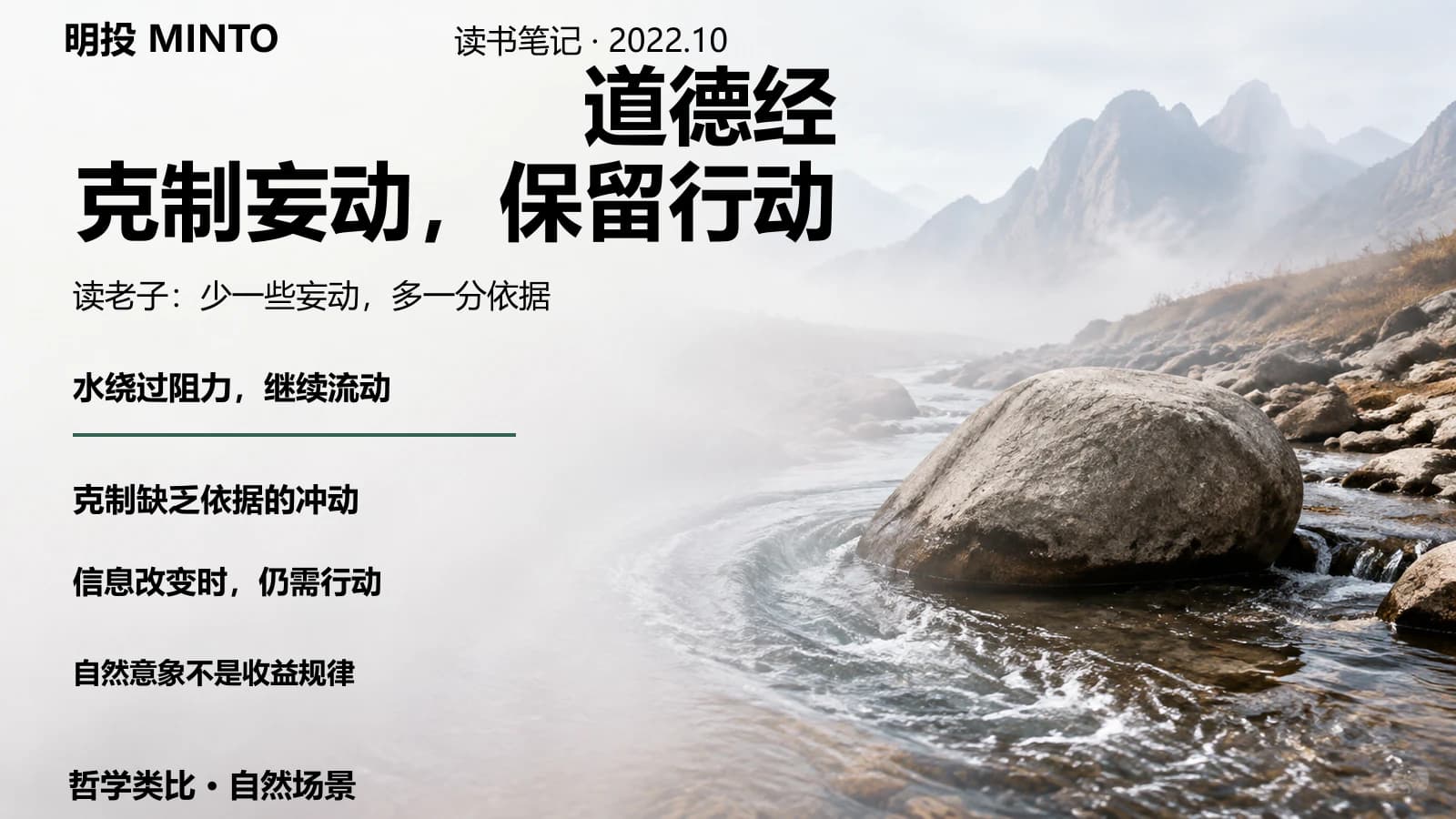
The entire Dao De Jing leans toward "softness, retreat, non-contention" — "the highest good is like water," "because he does not contend, no one can contend with him." This wisdom is invaluable in countering excessive aggression and keeping humility. But it is negative toward aggressive initiative and active creation. A pure Daoist might become too defensive, losing the drive to "actively seize opportunities and create value." Investing requires a balance of "Daoist restraint" and "ambitious initiative"; pure Daoism leans too passive.

5. The Dao De Jing vs. Buffett: An Eastern Wisdom and Western Practice Converge

Interestingly, Laozi's wisdom from 2,500 years ago has a striking resonance with Buffett's investment philosophy.

Laozi says "non-action, yet nothing is left undone" — Buffett says "our favorite holding period is forever" and "the best thing to do is nothing."

Laozi says "reversal is the movement of the Dao" — Buffett says "be fearful when others are greedy, and greedy when others are fearful" (contrarian).

Laozi says "know when to stop to avoid danger" — Buffett says "only act within your circle of competence" and "always leave a margin of safety" (knowing when to stop).

Laozi says "the highest good is like water, which benefits all things without contending" — Buffett stays for a long time in corners that others overlook, that are unsexy, that are undervalued.

This is not a coincidence. The highest wisdom in investing and the highest wisdom in Daoism point in the same direction — restraint, going with the flow, contrarianism, knowing when to stop, the long term, non-conscious action. Over 2,500 years and the gap between East and West, these two worlds have arrived at a deep convergence on investing.

The takeaway for investors is — the highest level of investing is not about being "smarter, harder-working, more active," but about a nearly Daoist "restraint and going with the flow." Most people lose not because they do too little, but because they do too much, too fast, too eager to "beat the market." The real winners are those who learn wu wei, learn zhi zhi, and learn to ride cycles rather than fight them.

6. In Closing

My biggest takeaway from reading the Dao De Jing is not any specific wisdom, but an alertness to overaction.

We live in an age that worships "action" — being harder working, more diligent, more proactive, doing more — all treated as virtues. In investing, this translates into watching the screen, frequent trading, constant rebalancing, chasing every hot trend, the fear of missing out.

But Laozi saw through it 2,500 years ago — many "actions" are actually "non-conscious actions" — superfluous moves born of anxiety and desire. They are not only useless; they are harmful.

True wisdom often consists of "doing less" — curbing those non-conscious actions, going with the grain of reality, waiting when waiting is called for, stopping when stopping is needed. This may be a more important skill than any technique in investing. Because the market loves to punish precisely those who "can't help but do something."

There is a line from Laozi that I keep as my investing mantra — "Empty your mind to the extreme, maintain stillness to the utmost. All things arise together, and I observe their return."

Let the heart-mind reach extreme emptiness and stillness, then observe the cycles of all things.

Isn't that the best investing posture? — Don't be led by the market's noise. Keep your mind still and empty, then calmly observe the cycles (all things arise together, and I observe their return), and at the right position, make restrained and precise actions.

Laozi from 2,500 years ago and the best investors today are saying the same thing.

A classic is a classic because it speaks not of techniques of a particular era, but of the Dao that transcends all eras.

And investing, in the end, is not about technique — it is about the Dao.

Minto
明投 Minto
投资分析 · 长期主义者
你读完了 · Colophon

Wu Wei: The Daoist Cure for Overtrading

7
分钟
2022/10
期号
2022
年份
真正稀缺的,是一个不慌不忙的人。
明投 · MintoInvest Wisely
— From This Series
喜欢这篇?这类 读书笔记 的深度拆解会持续发到你邮箱。
无广告 · 随时退订
— Enjoyed the read?
如果这篇文章对你有用,把它分享给一个朋友,就是对我最好的支持。

口碑是独立创作者最稀缺的燃料。

— Discussion

说说你的想法

评论基于 GitHub Discussions(Giscus)。登录后即可留言、点赞、互相讨论。

评论还在准备中。

想说什么可以直接发我邮件,比在评论区更容易认真回复。

mingtaohuang617@gmail.com →
支持沉浸式阅读