1. A Historical Masterpiece on Collective Panic
Philip Kuhn is a leading Harvard historian of China. In 1990, he published Soulstealers: The Chinese Sorcery Scare of 1768 – a study of a collective panic that swept across much of China during the heyday of the Qianlong Emperor.
Here's the story – in 1768, a rumor spread among the people: sorcerers were cutting people's queues (braids) and reciting spells to "steal" their souls (soulstealing). Those whose souls were stolen would fall ill or even die. This absurd rumor started in a corner of Jiangnan and spread like wildfire across the country, triggering mass panic, persecution, and wrongful imprisonment. Innocent beggars, monks, and strangers were arrested, tortured, and executed as "sorcerers."
The most absurd part – even the Qianlong Emperor and the entire bureaucracy got drawn in. The emperor believed the rumor and ordered a nationwide crackdown, leading to a state-driven hunt for a threat that didn't exist.
Why should an investor read a book about a rumor from 250 years ago? Because – the transmission mechanism, self-reinforcing logic, and collective irrationality of the "Soulstealing" panic are almost identical to those of market panics (and frenzies) today.
2. Insight #1: How Panic Reinforces Itself
Kuhn brilliantly shows the self-reinforcing mechanism of the Soulstealing panic:
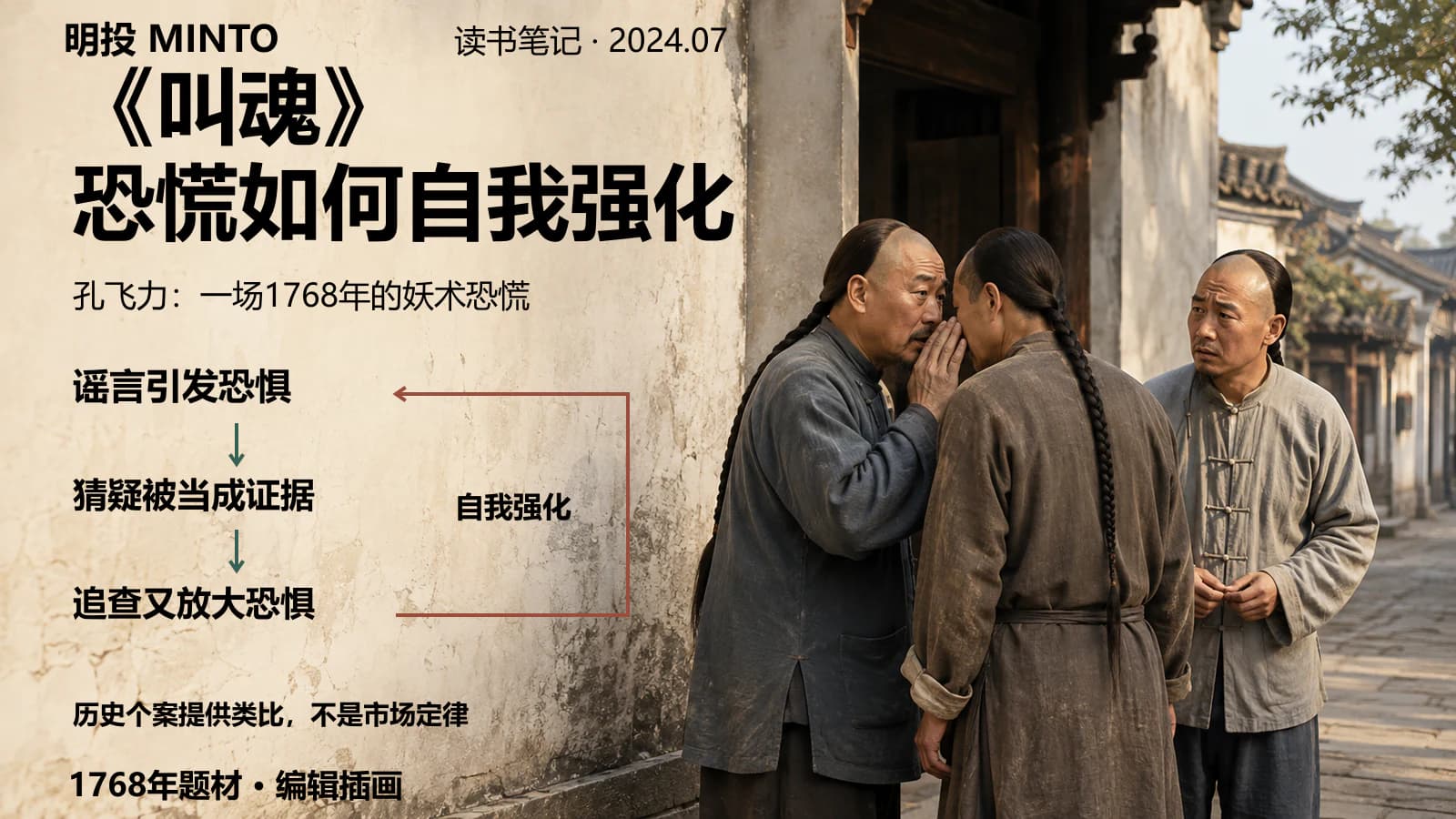
Rumor appears → people become afraid → fear makes them interpret everything suspicious (strangers, haircuts, chanting) as "evidence of sorcery" → this "evidence" confirms the rumor → fear intensifies → more "evidence" is discovered…
This is a positive feedback loop – fear creates evidence, evidence intensifies fear (think Soros's reflexivity, feedback loops in complex systems). Once started, it self-reinforces, spinning faster and faster until it engulfs everything.
For investors, this is a direct mirror – the mechanism of market panics is exactly the same.
Stock prices start falling → investors become afraid → fear makes them interpret any information as negative (the same news is read as bearish in panic, bullish in optimism) → these "bearish interpretations" accelerate selling → prices fall further → fear intensifies…
The stampede during a market crash is, in essence, a Soulstealing-style collective panic – fear creates bearishness, bearishness intensifies fear, a positive feedback loop drives prices far below value. Understanding this mechanism means understanding why market bottoms are often irrational, and why "being greedy when others are fearful" is so hard yet so valuable. In a panic's positive feedback loop, staying clear-headed and acting in the opposite direction is counter-intuitive – but it's precisely where excess returns come from.
3. Insight #2: Even the Highest Authority Can Get Sucked In
The deepest part of Soulstealers is that it shows – even the Qianlong Emperor and the entire elite bureaucracy got sucked into this absurd panic.
You might think panic only sweeps the ignorant masses, while elites, power holders, and professionals stay clear-headed. But Kuhn proves – no. Qianlong – a brilliant emperor – believed the rumor and used the entire state machinery to hunt a non-existent threat.
This is an extremely important warning for investors – don't assume that "professionals" and "elites" are immune to collective panic (think Le Bon, think of the Wall Street elites in 2008 who were using the most sophisticated models).
In market panics (or frenzies), institutional investors, fund managers, and professional analysts also get swept up. The dot-com bubble of 2000, the 2008 crisis, the mania of 2021 – participants weren't just retail investors; plenty of "professionals" were in there too. Collective emotional contagion doesn't distinguish between professional and amateur, elite and masses.
This means – you can't rely on "following the professionals/institutions" to avoid panic, because they're panicking too. You can only rely on your own framework and discipline, built independently of herd emotion (think Wang Xiaobo on independent thinking, Le Bon on admitting you're also in the crowd). In a Soulstealing-style market panic, those who stay clear-headed are never the "most professional" – they're the most independent, most disciplined, and least infected by crowd emotion.
4. Where I Differ from Kuhn
First, its historical case is hard to generalize.
Kuhn studies a very specific historical event. His analysis is brilliant, but how far can an 18th-century case be generalized into a "universal law of collective panic"? That's debatable. Each panic has its unique historical, cultural, and social conditions. Applying the Soulstealing mechanism directly to modern markets requires caution – it provides an "analogical inspiration," not a "reliable law." This aligns with my general wariness of deriving laws from single cases.
Second, it's stronger on "description" than on "prediction and response."
Kuhn brilliantly describes how the panic happened, but he hardly discusses how to predict when it will happen or how to respond in it. This is a feature (and limitation) of history – it explains the past, not the future. For an investor, you can get an understanding of the panic mechanism (why irrational panics occur), but you don't get operational tools (how to judge when the panic has bottomed, how to act in the panic). You need to supplement this with Marks (cycle positioning), Taleb (keeping dry powder), etc.
Third, it may over-attribute the panic to "power anxiety."
One of Kuhn's core reads is that the panic was amplified partly because of the Qianlong regime's deep "ruling anxiety" (fear of the Han majority, fear of losing control). This political interpretation is insightful, but it may over-politicize a more general "crowd psychology" phenomenon. Collective panic doesn't necessarily require "power anxiety" – it can be purely a product of crowd psychology (Le Bon). Kuhn, pursuing his political history argument, may have attached too much political interpretation to the Soulstealing case.
Fourth, it doesn't cover enough how panics end.
Kuhn details how the panic arose and spread, but he spends little ink on how it subsided. For an investor, "how the panic ends" is exactly the most critical part – Where is the bottom of the market panic? What signals suggest the panic is about to subside? This book shows the horror of panic, but it doesn't provide the perspective that "every panic eventually passes, and when it does, opportunities arise." A complete understanding needs to add this – every Soulstealing-style panic eventually ends (the 1768 one did too), and the deepest point before the end is often the best opportunity.
5. [object Object] vs. Le Bon's [object Object]: Two Takes on Group Irrationality
Soulstealers and Le Bon's The Crowd both address "collective irrationality of groups," but in different ways.
Le Bon is theoretical and general – he directly proposes a general theory that "groups lose rationality" (though full of bias and lacking rigor). Kuhn is empirical and case-based – through a detailed historical case, he solidly demonstrates how collective panic specifically happens, spreads, and self-reinforces.
Le Bon gives you the theoretical assertion of "group irrationality"; Kuhn gives you a complete, rigorous, flesh-and-blood empirical case of that theory.
Together – use Le Bon to understand the general mechanism of group irrationality (emotional contagion, lowered intelligence, susceptibility to simple narratives); use Kuhn to see how that mechanism unfolds in a real historical event (fear creates evidence, positive feedback self-reinforces, even elites get swept in).
For investors, both point to the most important and hardest-to-achieve ability – staying independent, clear-headed, and uncorrupted during a collective panic (or frenzy) that engulfs everything. Whether it's the 1768 Soulstealing, the 2008 crash, or the 2021 mania, those who can stand firm in the vortex of herd emotion are always the few. And it is these few who take the money that everyone else loses due to panic and mania.
6. Final Thoughts
My biggest takeaway from this book is a deep reverence and vigilance towards "collective irrationality."
The Soulstealing panic seems absurd in hindsight – how could an entire nation, including the emperor, believe that "cutting queues to steal souls" was real? But Kuhn makes you understand – those inside it can't see its absurdity. Inside the positive feedback vortex of panic, the most ridiculous rumor feels totally real, and the most rational people get pulled in.
This is an eternal reminder for investors – today we think the people of 1768 were foolish, but how will people 250 years from now view some of our current collective frenzies and panics?
The asset manias of 2021, the panics of certain moments – when you're in them, participants all think they're rational. But stretched over time, they might look as absurd as Soulstealing. And those of us inside them, like the people of 1768, can't see it.
This vigilance is one of the most valuable moats an investor can have. It makes you ask, in every collective market frenzy or panic, one more question – Is this a real judgment, or a Soulstealing-style collective irrationality? Am I clear-headed, or have I already been infected without knowing?
With a story from 250 years ago, Kuhn reveals an eternal truth – human collective irrationality is timeless, transcends elite and mass, transcends East and West. In 1768 it made an empire hunt for non-existent sorcerers; today it makes markets push prices to crazy highs or desperate lows.
The mechanism is exactly the same. Only the carrier has changed – from "rumors about cutting queues" to "social media trending topics" and "red and green numbers on screens."
Understanding this eternal mechanism, and admitting that you too might be caught in it –
This is the deepest lesson Soulstealers gives to an investor who wants to stay sane amidst collective madness.