跳到正文 · Skip to content
内容
关于与合作
订阅与会员
★ 查看会员权益
外观与设置
外观
主题色
版本 · 深色 / 减动搜索⌘K
草稿预览·这篇还没发布,不会出现在列表和 RSS 里。review 完后把 frontmatter 的 draft: true 改为 false 即可。

Ten Years Later: The Verbs Kevin Kelly Got Right and Wrong

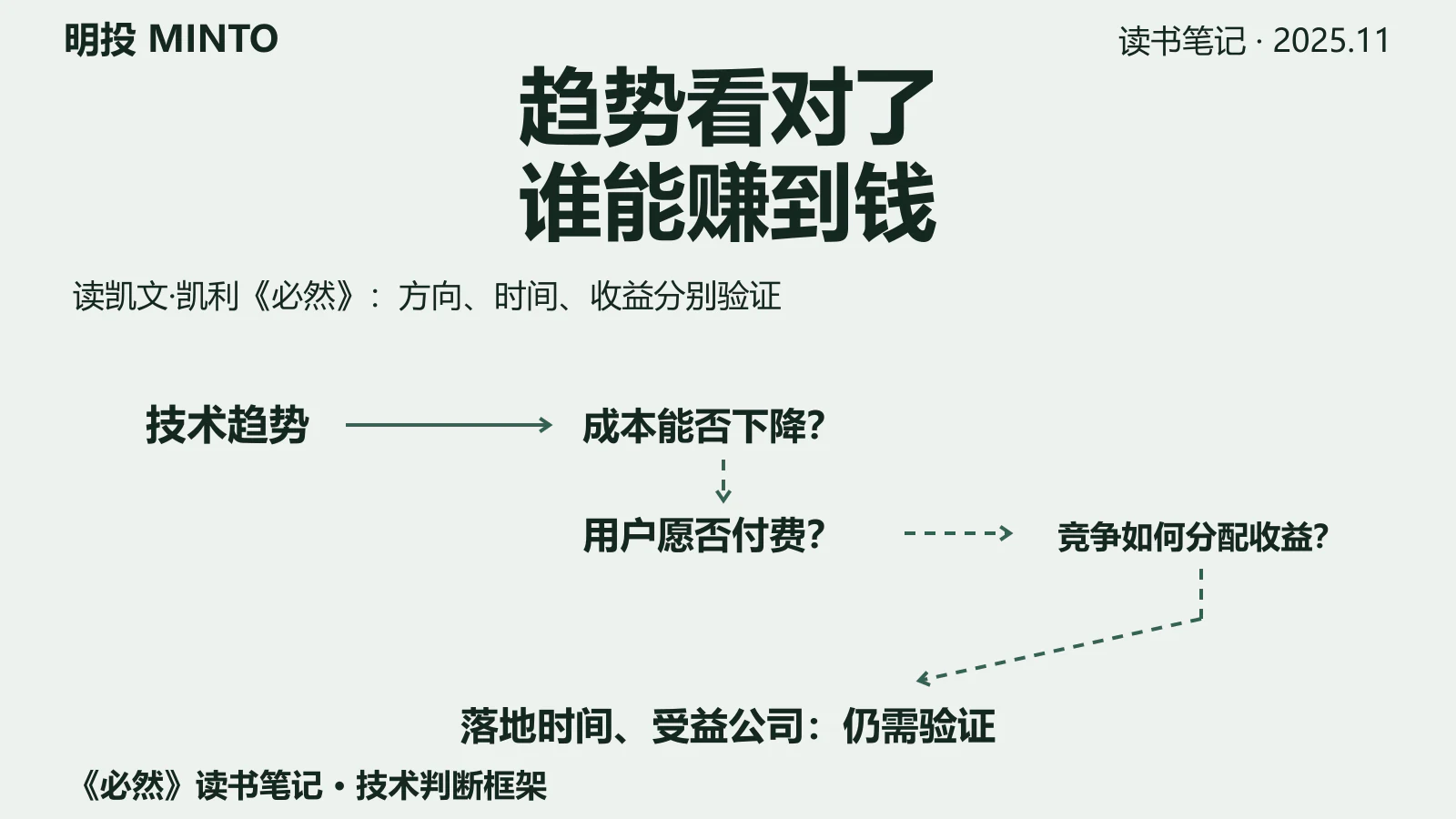
Kevin Kelly’s book isn’t about predictions, it’s about the direction of trends – but direction doesn’t equal path.

2025.11.2010 min原创
Ten Years Later: The Verbs Kevin Kelly Got Right and Wrong
读书笔记MINTOVIEW2025.11.20

1. A Book That Tried to Predict the Future with Twelve Verbs

In 2016, Kevin Kelly published The Inevitable, using twelve English present-progressive verbs to describe what he saw as the tech trends for the next 30 years – becoming, cognifying, flowing, screening, accessing, sharing, filtering, remixing, interacting, tracking, questioning, beginning.

The Chinese translation turned these verbs into nouns, losing half the flavor. KK used the progressive tense because he believed these trends were not static states but ongoing processes – they wouldn't stop at an endpoint, they would keep moving.

What makes the book remarkable is its timing: published in 2016 – when OpenAI was just a year old, the Transformer paper hadn't been released, and Stable Diffusion was still six years away. At that point, KK had already used the word “cognifying” to predict that everything would become intelligent.

A decade has passed. Now is the best time to reread it – you can go line by line and check which trends he got right, which he got wrong, and which were right but in a different way than he imagined.

2. The Two He Nailed Best: Cognifying and Flowing

The first trend KK got right is cognifying – injecting intelligence into everything.

He wrote in the book: “We are taking cheap, powerful, ubiquitous artificial intelligence and embedding it into objects that were previously unintelligent.” That was written in 2016.

Looking back from 2026, that sentence is unsettlingly precise. ChatGPT, Claude, and Gemini have been plugged into nearly every workflow; Cursor and Copilot have reshaped programming; Notion AI, Gamma, and Perplexity have redefined knowledge work; Midjourney and Sora have transformed content production.

With a single verb in 2016, KK summed up everything that happened between 2023 and 2025.

The second trend he nailed is flowing – moving from static files to fluid streams.

KK predicted: “We are moving from owning to accessing, from copies to streams.” A decade ago, that was hard to see clearly; now it's the process of Netflix replacing DVDs, Spotify replacing albums, Substack replacing email newsletters, ChatGPT replacing search result lists. Everything with “stock” qualities is being replaced by things with “flow” qualities.

This has enormous investment implications – the valuation premium for static assets is being steadily eroded by liquid streaming assets. The same IP, once monetized statically through copyright, is now monetized continuously through subscription streams. The fair valuations for these two models are vastly different.

3. The Ones That Were Right but Went Off Course: Tracking, Screening

Some trends KK predicted were directionally correct, but the way they played out was completely different from what he imagined.

The most typical is tracking – “record everything.” In 2016, KK predicted that everyone would be comprehensively quantified and tracked in the future – health data, location data, behavioral data. That did happen. But the way it happened was not what he envisioned – it wasn't individuals proactively tracking themselves, but platforms passively tracking everyone.

KK imagined a victory for the Quantified Self movement – people actively wearing various sensors and using data to optimize themselves. The result? Quantified Self barely took off. The real winners were platforms like Facebook, Google, and TikTok – the ones that “don't tell you they're tracking you.”

KK got the “data explosion” right, but he got the “power allocation” wrong. The data didn't go to individuals; it went to platforms. That difference is massive – it directly determined which business models were the most profitable over the past decade.

The second is screening – the era of “screen reading.” KK predicted screens would be everywhere and books would die. Screens are indeed everywhere, but books didn’t die. Kindle sales declined after 2015; physical book sales grew between 2020 and 2024. Audiobooks from Audible/Spotify are a big trend, but “visual screen reading” didn’t eat all reading the way KK thought.

People still have a need for a “focused, slow, bounded” reading experience. Screens offer a “fragmented, fast, unbounded” experience. These two aren’t replacements; they coexist.

4. The Two He Got Wrong: Sharing and Remixing

Among the trends KK got wrong, the most obvious is sharing.

In 2016, he wrote: “The future society will be more shared – shared bikes, shared housing, shared offices, shared everything.” This wave peaked in 2015-2019, then collapsed halfway.

WeWork’s valuation went from $47 billion to $800 million. Uber went from “disrupting transportation” to a “squeezed traditional taxi company.” Airbnb was regulated and squeezed in many cities. Shared bikes were almost completely wiped out. The sharing economy didn’t vanish, but it came nowhere near the level KK described – people’s desire to “own” is more stubborn than he thought.

The second one he got wrong is remixing.

KK predicted that all future content would be remixed – existing content would be endlessly recombined to create new works. Before AI, this barely happened. TikTok’s mashup culture is a form of remix, but it’s not the “layered blending of cultural works” KK described. The thing that actually made remixing work turned out to be AI – LLMs are essentially remixes of all existing human text. But in 2016, KK didn’t foresee that it would happen through LLMs rather than community creation.

5. Where I Differ from KK

After reading The Inevitable and KK’s other works (Out of Control, New Rules for the New Economy), I started to have some real disagreements.

First, his view of technology is too optimistic, almost naive.

KK is a technological determinist – he believes technology’s direction is “toward good” and that technology will make the world better. Every trend in this book is described as exciting – as if cognifying, tracking, and accessing were all wins with no losers.

But the past decade’s reality is – these trends created winners and losers simultaneously, and the number of losers far exceeded the winners. Algorithmic recommendations cause addiction, social media polarizes society, remote work destroyed many people's sense of purpose, AI replaced a lot of white-collar jobs.

KK’s book almost never discusses these costs. His hymn to technology is so pure that it doesn’t read like a serious trend book; it reads more like a tech-optimist pamphlet.

My own correction is – for any trend, you must ask both “who benefits” and “who is harmed.” KK only asks the former, and that’s the biggest blind spot in this book.

Second, he underestimated the power of “what doesn’t change in humans.”

KK assumes humans will adapt to technological change. But looking back a decade, humans have adapted much more slowly than he thought – and some deep “human nature” simply doesn’t change.

People’s preference for physical books hasn’t changed. People’s need for face-to-face interaction hasn’t changed (everyone flocked back to the office after the pandemic). People’s desire for deep focus hasn’t changed (the more the attention economy thrives, the more “focus” becomes a luxury). People’s need for belonging to small groups hasn’t changed (big platforms fail, while small communities on Discord and Telegram groups thrive).

KK describes a world where “humans are completely reshaped by technology.” But in the real world, there is massive friction between humans and technology, and that friction in turn limits technology’s direction.

Third, his judgment of time scales is too compressed.

KK repeatedly says “the next 30 years.” But reading from 2026, many of the trends he describes are more like “the next 100 years” – full AI-driven medicine, fully autonomous cities, completely dissolved national borders.

These things aren’t not going to happen; they’re just happening much slower than KK thought. The gap between technology’s possibility curve and its deployment curve is 10 to 30 years. If an investor bets on KK’s timeline, they’ll likely lose money for being “too early” – and “too early” in investing is the same as being wrong.

The classic example is self-driving cars from Uber and others. In 2016, KK predicted “large-scale deployment of autonomous driving within five years.” Ten years later, Waymo can operate in a few cities, but “large-scale” has not arrived. Most of the early capital invested in autonomous driving has gone to zero.

Fourth, he barely discusses China.

KK’s perspective is thoroughly American. The book rarely mentions China – yet the biggest technological variables of the past decade are precisely from China (payments, mobile internet, EVs, open-source AI). When someone talks about the next 30 years and doesn’t discuss this variable, the book’s predictive accuracy is naturally limited.

6. KK vs. Taleb: A Clash of Two “Uncertainty” Philosophies

The more you read, the more you see that KK and Taleb are silently opposed.

KK believes that “uncertainty can be managed with a sense of direction” – you don’t know the specifics, but you know the direction of trends, so you can bet on the big trends.

Taleb believes that “uncertainty is unknowable” – you think you know the direction, but black swans will upend all predictions. So the response is not “bet on direction” but “build convexity.”

These two methods, when applied to tech trends, correspond to two completely different ways of placing bets.

A KK-style person would have bet on AI, EVs, and cloud computing in 2016 – some bets paid off (NVDA), some didn’t (many AI unicorns went to zero). A Taleb-style person would build a barbell portfolio of “90% conservative + 10% bets on convex outcomes like AI, quantum, biology, nuclear fusion” – the single-bet returns wouldn’t be as concentrated as KK’s, but the probability of bankruptcy is extremely low.

My own posture is to use KK for big directions and Taleb for position sizing. KK helps you identify the track; Taleb helps you avoid getting killed by a single wrong bet on that track.

7. Why This Book Is Still Worth Reading in 2026

Many people read The Inevitable the wrong way – they treat it as a “prediction book,” then score it against the reality of a decade later, concluding that it was “half wrong.”

This reading wastes the book.

The book’s real value isn’t its specific predictions; it’s its way of thinking – using verbs instead of nouns, processes instead of states, direction instead of prediction.

KK teaches you how to see trends, not what the trends themselves are. Specific trends become outdated, but the posture of “seeing the future with verbs” does not.

When I look at AI application-layer investing in 2026, I use KK’s method – instead of predicting “which company will win,” I ask “in which verb’s direction is this company?” Companies on the cognifying direction have long-term tailwinds; companies on the remixing direction may explode short-term but get internalized by LLMs long-term; companies on the tracking direction need to be wary of regulation and privacy backlash.

This “verb perspective” is far more cross-cycle than the “specific company perspective.”

8. On the Over-Deification of Futurism

In this final section, I want to say something against KK’s readership – the label “futurism” has been deified to the point of losing its original meaning.

Whenever I see someone, after reading KK, daring to go all-in on some emerging track in the next five years, I get wary. Because KK himself never said his predictions were certain – he repeatedly stressed in the book that “the direction is inevitable, but the specific path is unpredictable.”

But readers often translate “direction is inevitable” into “path is inevitable,” then use that overconfidence to bet on specific companies, specific timings, specific technologies – and end up with big losses in the 2017-2019 blockchain hype, the 2020-2022 metaverse hype, and some AI speculations in 2023-2025.

KK’s method is excellent at “describing the big direction” but almost useless at “guiding specific trades.” Confusing these two is the most common mistake KK’s readers make.

9. Final Thoughts

Kevin Kelly is over 70 now. Starting as an editor at Whole Earth Review in the 1980s, he has experienced four complete tech revolutions: the PC era, the internet era, the mobile era, and the AI era.

Having lived through so many cycles, he naturally has a kind of intuition about trends that others lack. That intuition is the book’s most valuable asset – not the specific prophecies, but the posture for seeing trends.

I reread The Inevitable every two years. Each time I read it differently – not because the book has changed, but because new reality has made some of its prophecies come true and others fail. This experience of “checking the book against time” is itself the message KK most wanted to convey – the future is not a point, but an ever-unfolding process.

Read this book as a map, and you’ll be disappointed. Read it as a compass, and you’ll benefit.

The difference between these two is far greater than most readers imagine.

Minto
明投 Minto
投资分析 · 长期主义者

专注投资分析、市场洞察与资产配置。不追短期波动,只理解真正驱动长期回报的东西。

你读完了 · Colophon

Ten Years Later: The Verbs Kevin Kelly Got Right and Wrong

10
分钟
2025/11
期号
2025
年份
真正稀缺的,是一个不慌不忙的人。
明投 · MintoInvest Wisely
— From This Series
喜欢这篇?这类 读书笔记 的深度拆解会持续发到你邮箱。
无广告 · 随时退订
— Enjoyed the read?
如果这篇文章对你有用,把它分享给一个朋友,就是对我最好的支持。

口碑是独立创作者最稀缺的燃料。

— Discussion

说说你的想法

评论基于 GitHub Discussions(Giscus)。登录后即可留言、点赞、互相讨论。

评论还在准备中。

想说什么可以直接发我邮件,比在评论区更容易认真回复。

mingtaohuang617@gmail.com →
支持沉浸式阅读