跳到正文 · Skip to content
内容
关于与合作
订阅与会员
★ 查看会员权益
外观与设置
外观
主题色
版本 · 深色 / 减动搜索⌘K
草稿预览·这篇还没发布,不会出现在列表和 RSS 里。review 完后把 frontmatter 的 draft: true 改为 false 即可。

9 Laws of God: Why Kevin Kelly's 1994 'Out of Control' Is the Bible for the AI Age

Kevin Kelly told us back in 1994: complexity isn't designed, it's emerged. It took us 30 years to finally hear him.

2025.09.158 min原创
9 Laws of God: Why Kevin Kelly's 1994 'Out of Control' Is the Bible for the AI Age
读书笔记MINTOVIEW2025.09.15

1. An 'Internet Bible' Written Before the Internet

In 1994, Kevin Kelly published Out of Control. A 700-page brick of a book.

It was written in an era with no Google, no Amazon, no Facebook, no iPhone, barely even an 'internet.' Netscape hadn't gone public yet. The Web had maybe 10,000 sites.

Yet KK's book from that year foresaw nearly every tech, business, and social form of the next 30 years. Distributed computing, cryptocurrency, social networks, swarm intelligence, biological evolution, machine learning—every concept we talk about in 2024, KK described in 1994.

The most mind-blowing thing about reading this book isn't what KK predicted—it's how the hell he could see it in 1994. The answer lies in its structure: he wasn't predicting technology; he was describing a mental paradigm. In 1994 that paradigm belonged to a few outliers. By 2025, it's common sense.

2. Nine Laws of God: KK's Core Legacy

In the final chapter of Out of Control, KK distilled what he called the 'Nine Laws of God'—the fundamental rules for creating any complex system:

  1. Distribute being — function is not concentrated in one point but distributed across the whole
  2. Control from the bottom up — complex order is not designed; it emerges
  3. Cultivate increasing returns — success breeds more success (Matthew effect)
  4. Grow by chunking — large systems are built module by module, not all at once
  5. Maximize the fringes — diversity comes from the edges, not the center
  6. Honor your errors — mistakes are not to be avoided but exploited
  7. Pursue no optima; have multiple goals — systems should not chase a single optimum
  8. Seek persistent disequilibrium — steady state is the beginning of death
  9. Change changes itself — the rules of change themselves evolve

Apply these nine laws to any complex system—an ecosystem, a tech company, an AI model, a market—they hold.

KK told us in 1994: complexity isn't designed; it's emerged. It took us 30 years to finally hear him.

3. The Predictions That Hit Me Hardest: Neural Networks and Swarm Intelligence

One chapter in Out of Control focuses on the 'hive mind'—a bee colony has no center yet demonstrates high intelligence as a whole.

KK wrote: 'The intelligent systems of the future will not be single brains, but collections of countless small units that interact to produce emergent global intelligence.' That was 1994.

That sentence precisely predicted two things 30 years later:

First, the structure of LLMs. GPT-4, Claude, Gemini—these large models are essentially collections of countless neurons. A single neuron has no 'intelligence,' but collectively they emerge reasoning ability. That's KK's swarm intelligence.

Second, decentralized protocols. Bitcoin's proof-of-work, Ethereum's smart contracts, the whole Web3 mechanism—they're all 'centerless' swarm systems.

The 'swarm' KK saw in 1994 is now the dominant organizing principle of our world.

When I first read this passage, I felt a mild dread—this book is 30 years old, yet its description of the future is more accurate than many new books in 2025. It means true insight may have little to do with era and everything to do with how you think.

4. Direct Lessons for the AI Age: Don't Try to 'Control' LLMs

Perhaps the most direct investment insight from Out of Control for 2025 AI is its title—Out of Control.

KK argues repeatedly: once you create a complex system, you must relinquish full control. It will evolve by its own logic, producing behaviors you never anticipated. This 'out-of-control' isn't a bug; it's a feature—without it, no true intelligence emerges.

That statement directly foreshadowed the AI alignment problem starting in 2023. When GPT-4 showed certain 'emergent abilities,' even OpenAI researchers couldn't fully explain why. LLM intelligence is itself a product of being out of control—you train it, but you don't fully understand what it does.

The implications for AI investing are profound:

  • If you think you can 'control' AI, you're likely to make bad bets (over-indexing on 'explainable AI,' over-indexing on 'proprietary data moats')
  • The winning companies are those that embrace out-of-control and build ecosystems (OpenAI, Anthropic, Google are all building ecosystems, not restricting AI capabilities)
  • The future of AI regulation likely cannot go the 'central control' route—it will be forced to adopt the 'bottom-up governance' KK described in 1994

5. Where I Disagree with KK

On my third read of Out of Control, I started forming a few real disagreements.

First, his glorification of 'bottom-up' goes too far.

KK nearly always frames top-down design as inferior. He believes complex systems should be emergent, that top-down systems are fragile.

This holds for ecosystems, neural networks, and crypto protocols. But in many other systems—pharmaceuticals, semiconductor manufacturing, aerospace engineering—top-down precision design is still the winner. TSMC's 3nm process wasn't 'emerged'; it was meticulously designed by a group of people over a decade.

KK's methodology is extremely strong for 'soft systems' but can be misleading for 'hard systems.' Treating it as universal truth can lead to serious misjudgment in certain industries.

Second, his attitude toward 'failure' is too romantic.

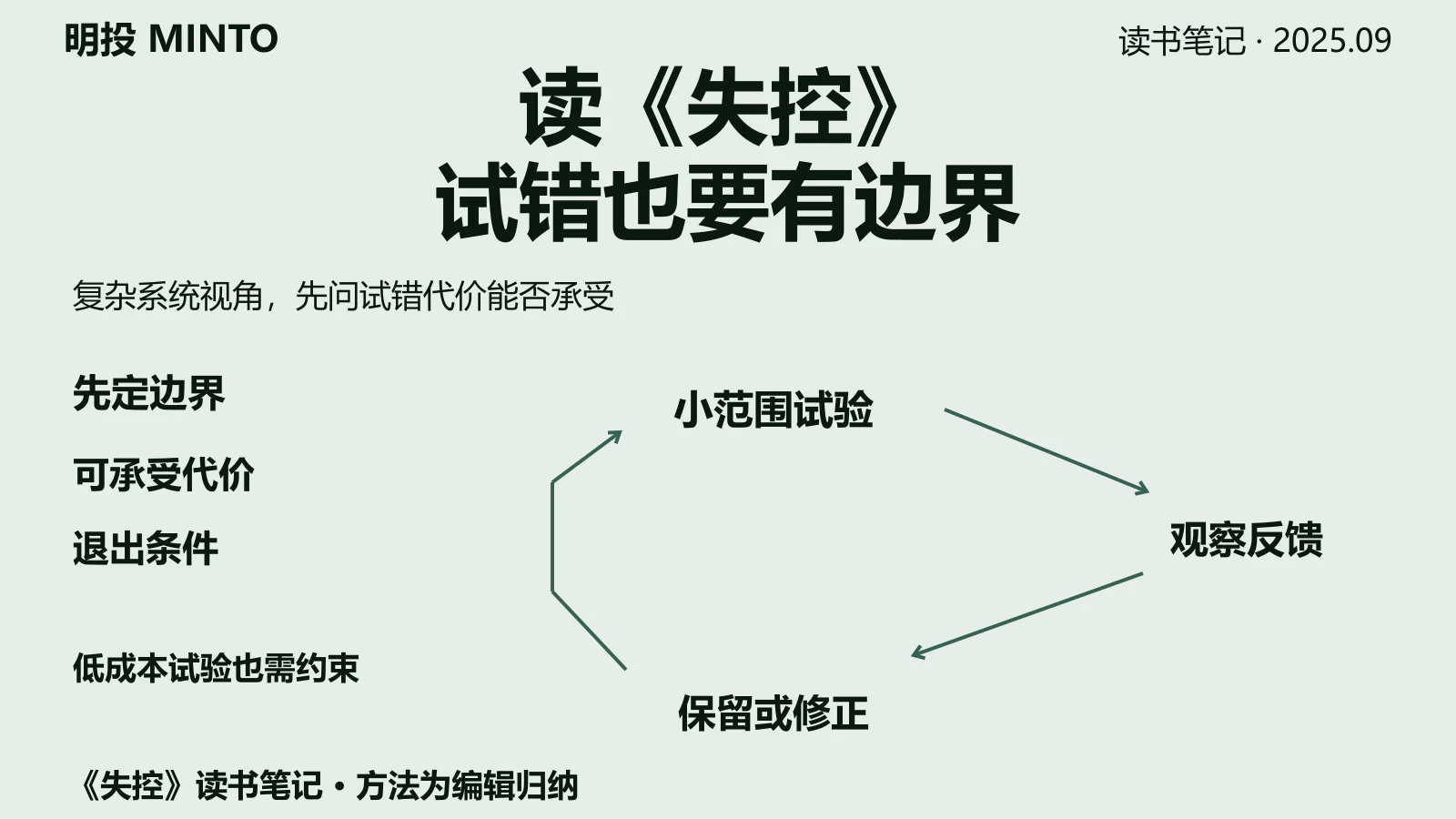
KK frequently says 'error is the wellspring of creation' and 'failure is necessary.' This holds in ecosystem evolution and iterative product development. But he barely discusses the cost of failure—in some domains, one failure means you're out of the game with no second chance.

The clearest examples are nuclear power, biopharma, and commercial space—sectors where the 'cost of failure' is so high that trial-and-error can't be tolerated. KK's 'embrace failure' philosophy in these domains directly translates to 'bankruptcy.'

For investors, this means KK's method works in low-cost-trial-error arenas (SaaS, consumer apps) but is a trap in high-cost-trial-error arenas (deep tech, infrastructure).

Third, his time scale is still too fast.

Like The Inevitable, many trends described in Out of Control were predicted by KK to land in the 'next 10–20 years.' Thirty years later, some still haven't fully landed—fully distributed cities, fully decentralized finance, stateless digital currencies.

That doesn't mean KK was wrong. It means genuine paradigm shifts take 30–50 years, not 10–20. An investor who bets on KK's timeline will almost certainly exit too early.

Fourth, he barely discusses power.

KK's entire book rarely talks about power—who controls the technology, who sets the rules, who profits from emergence. He describes technological evolution as a 'natural process,' as if no one is shaping its direction.

But reality from 1994 to 2025 is that behind technological evolution there are always specific people, specific companies, and specific capital shaping the direction. Google's search algorithm wasn't 'emerged' —it was designed by a group of engineers reflecting their values and business goals. Facebook's algorithmic feed wasn't 'natural'—it was designed to maximize ad revenue.

By stripping away the question of power, KK's methodology becomes elegant but also dangerous—it makes people forget that technology is never neutral.

6. Out of Control vs Sapiens: Two Opposing 'Big Histories'

Reading KK inevitably leads to another 'big history' book—Yuval Noah Harari's Sapiens. Both try to give a long-scale explanation of humanity, but from opposite angles.

KK believes in 'technological determinism'—technological evolution drives everything, and humans are merely vectors for technology.

Harari believes in 'story determinism'—the stories humans believe (myths, religions, money, nations) drive everything, and technology is just a tool for those stories.

These two perspectives yield completely opposite conclusions when judging the future.

KK's view: AI will naturally emerge intelligence beyond human, that's the inevitable direction of technological evolution, and our job is to align with it.

Harari's view: Whether AI has 'intelligence' depends on what stories humans believe. If humans believe AI is conscious, it will be treated as conscious; if they believe AI is just a tool, it will be treated as a tool. Human beliefs determine AI's future, not AI's capabilities.

My own stance: KK is more accurate for the short term (5–10 years), Harari for the long term (20–50 years). KK's methodology is better for judging 'where the next technology inflection point appears'; Harari's is better for judging 'how that inflection point will be digested by human society.' They complement each other on different time scales.

7. The Over-Mythologizing of 'Complex Systems'

For my last section, I want to push back against a common tendency among KK's readers—the term 'complex system' has been mythologized to the point of losing its meaning.

Many people, after reading Out of Control, see everything and say 'that's a complex system, so it's unpredictable' or 'that's emergence, so it can't be designed.' This usage is wrong—it uses KK's terminology to avoid making specific judgments.

True complex systems thinking is not about 'refusing to judge' but about 'making judgments in the face of uncertainty.' KK himself spent his entire life making judgments—he judged in 1994 that the future would be distributed; he judged in 2016 that 'cognifying' was the big direction. He didn't escape with 'too complex, can't judge.'

People who use 'complexity' as an excuse have misread KK. I've seen this happen at least a hundred times, and it always bothers me.

8. In Closing

Out of Control is a book from 1994, but like the Bible or the Tao Te Ching, its predictive accuracy is inversely proportional to its age. The older it gets, the more you appreciate how deep its insight runs.

I've read this book three times, each time with a completely different takeaway. The first time, I thought KK was a tech prophet. The second time, I felt he was describing life itself. The third time, I realized he was really saying that anything sufficiently complex cannot be 'designed'; it can only be 'nurtured.'

The implications for investing are profound. You can't 'design' a great company; you can only create the conditions for it to emerge. You can't 'design' a perfect portfolio; you can only give it enough diversity and fault tolerance. You can't 'design' the perfect judgment; you can only keep multiple options alive in uncertainty.

This is KK's method, and three decades later it still holds.

Reading Out of Control will permanently change the way you see the world.

But remember—KK only gives half the map. The other half (power, story, human nature) lies with Harari, Arendt, and Foucault. Read both books for a complete view.

KK himself argued most against 'people who only read one book'—he emphasized this repeatedly in Out of Control, but his readers often forget.

Minto
明投 Minto
投资分析 · 长期主义者

专注投资分析、市场洞察与资产配置。不追短期波动,只理解真正驱动长期回报的东西。

你读完了 · Colophon

9 Laws of God: Why Kevin Kelly's 1994 'Out of Control' Is the Bible for the AI Age

8
分钟
2025/09
期号
2025
年份
真正稀缺的,是一个不慌不忙的人。
明投 · MintoInvest Wisely
— From This Series
喜欢这篇?这类 读书笔记 的深度拆解会持续发到你邮箱。
无广告 · 随时退订
— Enjoyed the read?
如果这篇文章对你有用,把它分享给一个朋友,就是对我最好的支持。

口碑是独立创作者最稀缺的燃料。

— Discussion

说说你的想法

评论基于 GitHub Discussions(Giscus)。登录后即可留言、点赞、互相讨论。

评论还在准备中。

想说什么可以直接发我邮件,比在评论区更容易认真回复。

mingtaohuang617@gmail.com →
支持沉浸式阅读