一个心理学家拿了诺贝尔经济学奖
Daniel Kahneman is a psychologist, but he won the Nobel Prize in Economics in 2002. That alone tells you something — his research with Amos Tversky fundamentally shook the core assumption of economics: that humans are rational.
In 2011, Kahneman distilled a lifetime of work into Thinking, Fast and Slow. This book is the bible of behavioral economics and the most fundamental text for understanding why investors make mistakes.
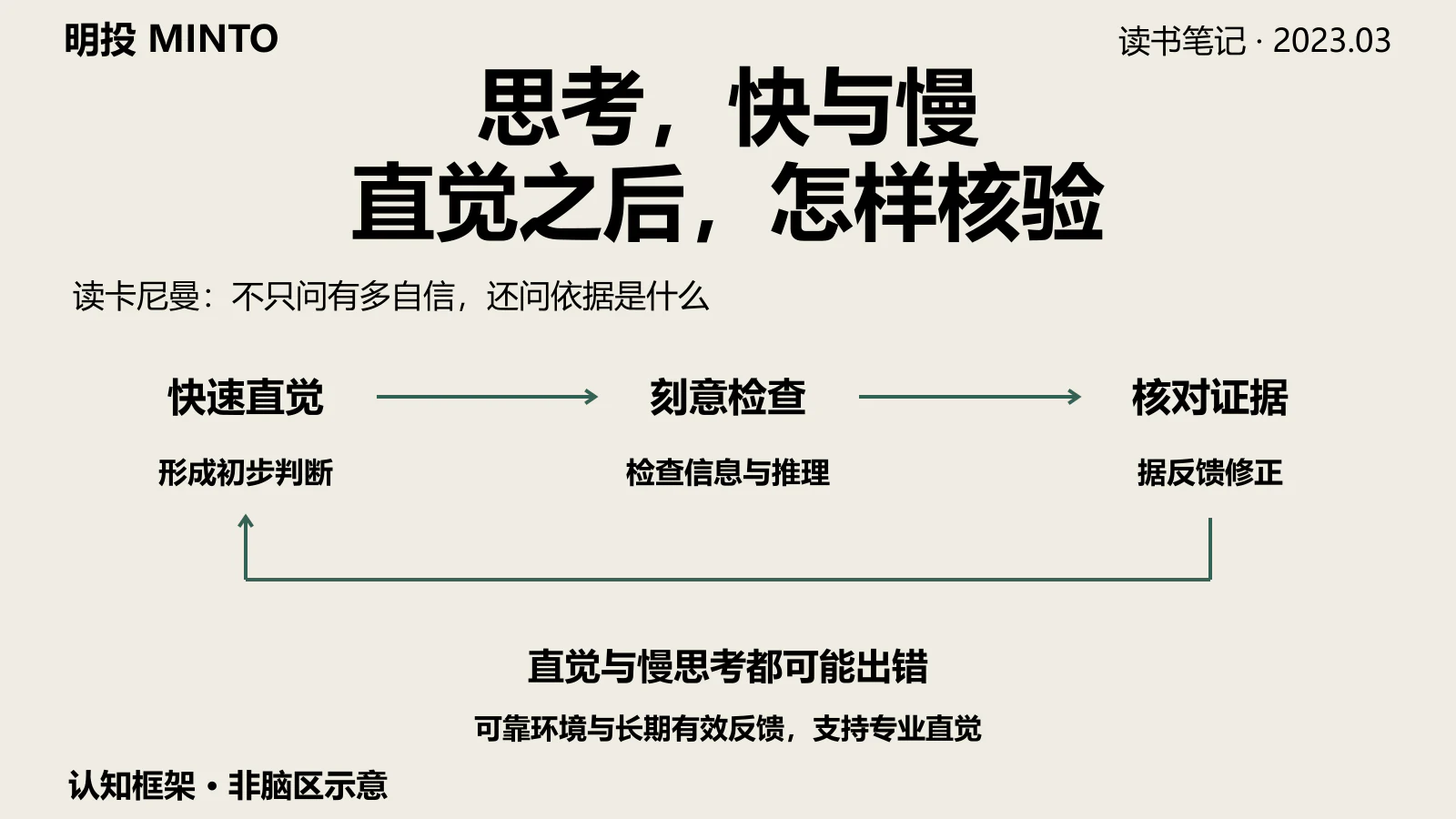
Its core model is brutally simple — the human brain has two systems:
System 1: fast, automatic, intuitive, effortless. You see 2+2 and instantly know it's 4. You see an angry face and feel threatened immediately. System 2: slow, deliberate, analytical, effortful. Calculating 17×24, planning a trip, weighing a complex decision.
Kahneman's biggest discovery is this — we think we're using System 2, but 95% of our decisions are actually made by System 1. System 2 just shows up afterward to rationalize what System 1 did.
对投资者最致命的几个偏误
The book lists dozens of cognitive biases. I'll pick the three most lethal for investors.
First, anchoring. People get 'anchored' by an irrelevant number. Your purchase price of a stock becomes your anchor for judging whether it's cheap or expensive — even when the company's fundamentals have deteriorated, you refuse to sell because 'my cost was 100, now it's 80, I haven't broken even.' Your cost basis is a past number, irrelevant to the future, but it hijacks your decision.
Second, loss aversion. Losing $100 hurts about twice as much as gaining $100 feels good. This makes investors 'take profits early and hold losers forever' — because realizing a gain is pleasure (you want it now), while realizing a loss is pain (you delay it). The result is cutting winners that would keep rising, and holding losers that keep falling — the exact opposite of what you should do.
Third, overconfidence. Kahneman showed that your confidence in a judgment barely correlates with its accuracy. Your most confident predictions are usually your worst. After a streak of wins, investors become overconfident, place bigger bets, and get schooled by the market.
These three biases explain most of the losses individual investors rack up. The scariest part? Knowing about these biases doesn't immunize you. Kahneman admitted that after a lifetime studying biases, he still fell for them himself.
最深刻的一句:你不知道你不知道
One concept from this book that I keep coming back to is WYSIATI (What You See Is All There Is).
Meaning — System 1 builds a coherent story using only the information it has at hand, and then convinces you that story is true, completely ignoring what it's missing.
This is incredibly important for investing. When you research a company, you see 'available information' — earnings reports, news, analyst notes. System 1 weaves these into a coherent judgment, then makes you overconfident about that judgment, entirely blind to how important the missing information might be.
Lehman investors in 2008, people who bought meme stocks in 2021, anyone who ever stepped on a landmine — most didn't 'analyze the visible information wrong.' They failed to be alert to what they couldn't see. WYSIATI made them think 'what I see is all there is.'
Now any time I make a judgment, I force myself to ask a WYSIATI question — 'What information is my judgment based on? And what don't I see that might be even more important?' This doesn't eliminate blind spots, but it keeps me appropriately skeptical of my own conclusions.
我跟卡尼曼不同的地方
First, 'knowing a bias' and 'avoiding it' are separated by a chasm — and this book doesn't build a bridge.
Kahneman spends 500 pages cataloging biases but is almost defeatist about overcoming them — he seems to believe System 1's biases can't be corrected by willpower alone. This leaves the reader feeling helpless: I know I'm biased, but I can't do anything. The real solution is institutional fixes — checklists, rules, mandatory cooling-off periods, external reviews — mechanisms that wrest judgment away from System 1. Kahneman is a brilliant diagnostician but a weak prescriber.
Second, some of his classic experiments later suffered a 'replication crisis'.
After 2011, psychology went through a severe replication crisis — many famous experiments couldn't be repeated. Some studies cited in the book (especially on priming effects) were later found to have inflated effect sizes or couldn't be replicated at all. Kahneman himself publicly acknowledged this in 2017, admirably. But it means some conclusions in this book need to be taken with a grain of salt. Readers shouldn't treat every experiment as gospel.
Third, System 1 isn't all bad — he doesn't emphasize this enough.
Kahneman's tone implies System 1 (intuition) is a troublemaker. But experts' intuition is often right — an experienced doctor, firefighter, or investor has rapid-fire intuitions honed by tens of thousands of hours of practice. They're incredibly reliable. System 1 works brilliantly in 'stable environments with lots of feedback.' Kahneman says too little about 'good intuition,' risking readers dismissing intuition entirely.
Fourth, he barely discusses how individual biases cancel out or amplify each other at the market level.
This book is about individual psychology. But the market is the sum of millions of individuals. Sometimes individual biases cancel each other out (so the market is roughly efficient), sometimes they amplify each other (so you get bubbles and panics). The jump from 'individual bias' to 'market behavior' is something Kahneman almost entirely skips. To understand investing, you need not just individual psychology but also how these biases aggregate in crowds — that's where Shiller and Soros fill in the gaps.
卡尼曼 vs 塞勒:两种行为经济学的姿态
Reading Kahneman inevitably leads to his 'academic successor' Richard Thaler (author of Misbehaving). Both are giants of behavioral economics but with different postures.
Kahneman is a pessimistic diagnostician — he proves that biases are everywhere, nearly impossible to overcome, and that human irrationality is deeply ingrained.
Thaler is an optimistic engineer — he acknowledges biases exist but believes we can design environments that 'nudge' people into making better decisions without their even noticing.
Kahneman makes you despair at how irrational you are; Thaler shows you how to get things done despite that irrationality.
For investors, you need both postures — use Kahneman to stay skeptical of your own judgments, and use Thaler to design systems that fight your biases (automatic investing, mandatory checklists, emotion-isolating decision processes). Kahneman alone leaves you paralyzed; Thaler alone leaves you glib.
关于「认知偏误」的滥用
One final section — 'That's a cognitive bias' is becoming a cheap weapon.
After reading Kahneman, people learn to slap bias labels on others — 'That's confirmation bias!' 'That's anchoring!' 'That's survivorship bias!' But labeling someone else's thinking as a bias is often itself a bias (you're using System 1 to quickly judge that 'he's wrong').
The real way to use this book isn't to attack others with bias names — it's to turn that lens on yourself. Kahneman wrote this book to make you doubt your own judgments, not other people's. Turning it into a debate weapon is the most thorough misuse of it.
写在最后
Kahneman died in 2024 at 90. Reports say he chose to end his life actively (Swiss euthanasia), which itself embodies a rationalist's posture toward the ultimate question — he spent a lifetime studying how humans make decisions, and at the end made one clear-eyed choice about his own death.
What strikes me most about this book is Kahneman's self-doubt. A man who won the Nobel Prize, hailed globally as a giant of thought, repeatedly says in the book — 'I studied biases my whole life, and I still commit them' 'Even I can't be immunized by knowledge alone.'
That honesty is extremely rare. Most people who write a book about 'how humans make mistakes' subtly imply 'but I see through it, so I don't make them.' Kahneman never does. He always puts himself in the category of 'fallible people' .
My biggest takeaway from this book isn't the dozens of bias names — you don't need to memorize them all. The real takeaway is a lasting humility: My most confident judgments are precisely the ones I should doubt most; what I see is never the full picture; I think I'm reasoning, but most of the time my intuition decides and I just come up with an excuse later.
This humility is the most valuable moat an investor can have. Because the market's favorite punishment is for overconfident people.
And Kahneman, in one book, repeatedly teaches you to doubt your own confidence. That's the book's timeless value.
专注投资分析、市场洞察与资产配置。不追短期波动,只理解真正驱动长期回报的东西。