Section 1: Kahneman's 'Second Book' Tackles a Neglected Problem
In 2021, Kahneman and two co-authors published Noise. The book addresses a problem ignored in Thinking, Fast and Slow.
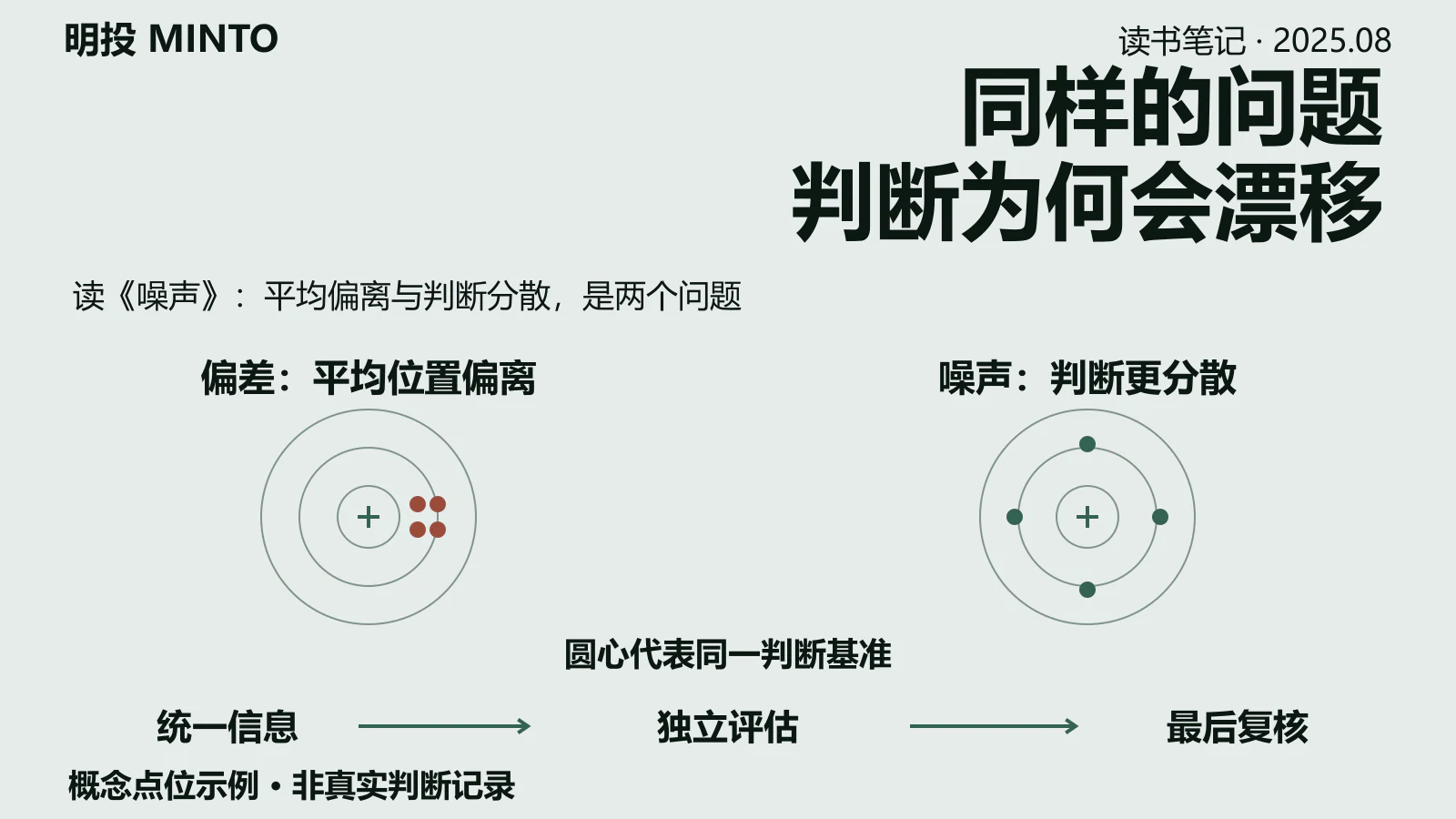
Thinking, Fast and Slow is about bias — systematic, directional errors in judgment. For example, everyone tends to be overconfident; that's bias.
Noise is about noise — random, directionless fluctuations in judgment. The same judge, before and after lunch, gives different sentences for the same case; the same doctor, looking at the same scan, gives different diagnoses; the same underwriter, reviewing the same policy, can quote prices that differ by 50%.
Kahneman uses an analogy: Bias is all arrows consistently landing left of the target; noise is arrows scattered everywhere. People have spent decades studying how to eliminate bias, yet almost no one studies noise — even though the errors caused by noise can be as large as those caused by bias.
Section 2: The Most Counterintuitive Finding — Expert Disagreement Is Startlingly Large
The most shocking data in this book concerns 'expert consistency'.
We assume professional judgments are relatively consistent — two experienced underwriters should give similar quotes for the same policy, right? The median gap is 55%. Two senior doctors often give completely different diagnoses for the same patient. Two judges can differ by several years in sentencing for the same criminal.
The same holds true in investing — two top analysts looking at the same stock can have target prices that differ by a factor of two. Not because one is right and the other wrong, but because judgment itself is full of random noise.
Even scarier is 'occasion noise' — the same expert, at different times, in different moods, or after different sequences of events, makes different judgments about the same thing. You might reach a different conclusion looking at the same stock in the morning versus the afternoon; your risk appetite changes when you're hungry versus full.
This means — you think your investment judgment is a product of 'your cognition', but a large part of it is really a product of 'the state you happen to be in right now'. The same person, at a different time, could make the opposite decision.
Section 3: Direct Implications for Investors — 'De-Noise' Your Judgment
The biggest takeaway from noise theory for investors is — you need to actively 'de-noise' your decisions.
Kahneman's tool is called 'decision hygiene' — like washing hands to prevent germs, use processes to prevent noise:
First, decompose the judgment. Don't judge a company by 'overall feel'; break it into independent dimensions (moat, valuation, management, industry), score each separately, then aggregate. This reduces noise from one salient impression contaminating the whole judgment.
Second, delay the overall judgment. Gather all information first, evaluate each piece separately, and only then form a composite judgment. Forming a conclusion too early distorts all subsequent information (confirmation bias).
Third, use the 'outside view'. Ask 'what is the average historical outcome for similar companies?' rather than focusing only on 'this company's unique story.' Statistical baselines contain much less noise than case-by-case intuition.
Fourth, fix your decision 'environment'. Make major decisions in a fixed state — don't place big bets when you're emotionally charged, extremely tired, or immediately after a big win or loss. Your state itself is a source of noise.
One concrete thing I do — all major trading decisions must be overnighted. If I want to buy today, I write down the reasons and look again tomorrow. Only if it still holds after a night's sleep do I execute. This rule specifically combats 'occasion noise' — preventing a momentary impulsive state from dominating the decision.
Section 4: Where I Disagree with Kahneman
First, there's a tension between 'de-noising' and 'preserving judgment' — he leans too far toward the former.
Kahneman's remedies (algorithms, rules, processes) reduce noise, but they also suppress genuine insight. The biggest excess returns in investing often come from 'non-standard judgments that differ from consensus' — and those are exactly the kind that a 'de-noising' process might filter out as noise. If you standardize all judgments, you also kill the source of alpha. Kahneman doesn't discuss this cost enough.
Second, algorithm-based de-noising creates 'homogenization risk' in finance.
Kahneman advocates replacing human judgment with algorithms/rules to eliminate noise. But if all investors use similar algorithms, noise decreases, but systemic risk increases — everyone does the same thing at the same time (e.g., quant funds simultaneously deleveraging in August 2007). Reducing individual noise might amplify collective collapse. This is a finance-specific paradox.
Third, he underestimates that 'some noise is information.'
Not all judgment disagreements are noise. Sometimes two analysts reach different conclusions because they truly see different things — one sees risk, the other opportunity. Treating all divergence as noise to be eliminated could remove valuable diversity of perspective. Diversity and noise are sometimes hard to distinguish, and Kahneman's framework handles this boundary too crudely.
Fourth, this book is thinner than Thinking, Fast and Slow; its core insight is diluted.
The central insight of Noise (noise is neglected; we need to de-noise) could be explained in a long essay, but it's stretched into a book. The latter half is full of repetition and case padding. It's an important 'one idea', but not a '400-page book'. Readers who grasp the core distinction (bias vs. noise) and the four decision hygiene rules are essentially done.
Section 5: [object Object] vs. [object Object] — Two Errors, Two Antidotes
Reading these two books together gives you a complete 'map of judgment errors'.
Bias (Thinking, Fast and Slow) — systematic, directional errors. Antidote: 'become aware of the direction and correct in the opposite direction.' For example, knowing you're overconfident, you deliberately discount.
Noise (Noise) — random, non-directional fluctuations. Antidote: 'process and rules.' For example, fixing your decision environment, decomposing judgments, overnight cooling-off.
Key difference: Bias can be partially corrected through 'self-awareness,' but noise almost cannot — you cannot eliminate noise by realizing 'I have noise,' because noise is random and has no fixed direction to correct. Noise can only be fought with institutions, not awareness.
This is the most important lesson from the two books combined — for bias, train yourself; for noise, design a system. Two different errors require two completely different responses. It's not enough to just cultivate your mindset (against bias); you also need to install a process that fights noise.
Section 6: A Final Word
Noise is a work from Kahneman's later years, in a sense a completion of Thinking, Fast and Slow — he realized he had only told half the story of 'judgment error' (bias), and missed the other half (noise).
An 80-year-old Nobel laureate willing to turn back and say 'I missed something important,' then write another book to fill the gap — that attitude alone deserves respect. Most people at that status would rather defend their existing conclusions than revise or supplement them.
The biggest takeaway for me from this book is not the concept of 'noise' itself, but the uncomfortable recognition — many of my investment judgments may have less to do with my 'cognitive ability' than with 'the state I was in when I made them.'
The same person: well-rested vs. sleep-deprived → different decisions; just made money vs. just lost money → different risk appetite; morning vs. late night → different view on the same thing.
This realization humbles you — I thought I was investing with 'my judgment,' but I was actually investing with 'the state I happened to be in.'
Understanding this makes clear why 'decision hygiene' is so important. Not because you're dumb, but because you're human — and human judgment is inherently full of random noise.
The only way to fight it is not to think harder, but to design your thinking environment more intelligently.
That's the most practical sentence Noise leaves for investors.
专注投资分析、市场洞察与资产配置。不追短期波动,只理解真正驱动长期回报的东西。