1. Why I Start with "Mr. Market" Instead of "Margin of Safety"
Most Chinese readers first encounter The Intelligent Investor and latch onto "margin of safety" as the key concept. I think the book's most valuable invention is "Mr. Market."
Graham personifies the market as a neighbor—emotional, manic-depressive, knocking on your door every day with a bid and an ask. Some days he's euphoric and quotes absurdly high; other days he's despondent and quotes absurdly low.
The metaphor is simple, but it accomplishes something critical: it turns "the market" from an abstract god into a concrete, flawed person you can say no to.
Once you internalize this, the way you look at price charts changes. A decline is no longer "the market is telling me this company is bad" but "Mr. Market is in a foul mood today; he's quoting a low price." You can take it, you can pass, or you can ask him for an even lower price.
I practiced this repeatedly when Meta fell to $88 in 2022. Every sell-side note was about the "Metaverse black hole," "Reels monetization failure," "ATT permanently cratering $10 billion in ad revenue." That month, Mr. Market was pricing the company like it was going bankrupt. Every day I opened the screen and felt the pain of paper losses. But simply swapping "the market" for "Mr. Market" instantly calmed me by half—it was the quote of an emotional neighbor, not the truth of the universe.
You know what happened next. Meta went from $88 to $500+ in 18 months.
The market is not a referee; it's your counterparty—that's the single most important line I took from Graham's book.
2. Margin of Safety Is a Valuation Method, but More a Disposition
"Margin of safety" is the book's signature concept, but it's also the most misunderstood.
Many people think margin of safety simply means "cheap"—buying below intrinsic value. That's just the surface.
What Graham really meant is that margin of safety is the buffer you build for your own potential error. It's not for when the market makes a mistake; it's for when you make a mistake.
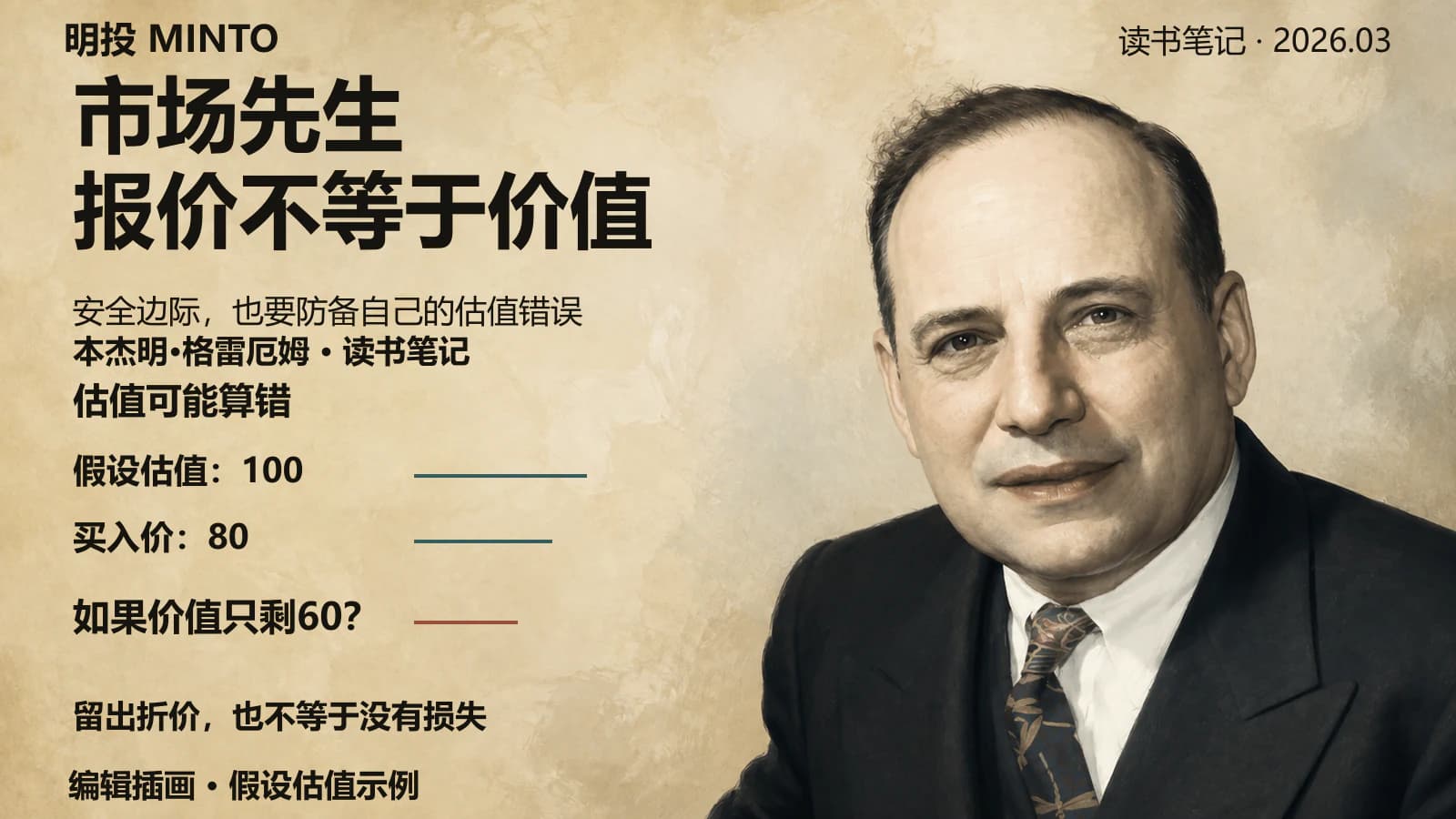
You estimate a company is worth $100. You say, let's buy at $80, leaving a 20% margin of safety.
Sounds reasonable. But in practice, you'll find that your estimate of "100" itself might be wrong. You misread the cycle, the competitive landscape, or management's capital allocation. Any one of those errors turns your "100" into "60." Buying at $80 then becomes a loss.
So the true measure of margin of safety isn't "how cheap" but "how likely am I to be wrong, and how much do I lose when I am wrong?"
This is a disposition. It forces you to admit two things: first, I could be wrong; second, even if I'm right, it's only probabilistic, not certain.
Every time I'm about to place a big bet, I force myself to write an "error journal" — I reverse all my valuation assumptions: what if gross margins drop 3 points? What if one more competitor enters? What if management changes?
After writing it, I sometimes dial down my position size. That's what margin of safety looks like as a character trait.
3. The Defensive Investor: Graham's Real Audience
One of the most overlooked aspects of this book: Graham explicitly divides readers into two types—defensive investors and enterprising investors.
He makes it very clear: most people should be defensive investors.
Being defensive isn't about being so conservative you do nothing; it's about being clear on what you're opting out of.
Graham's prescription for the defensive investor is remarkably specific—choose large companies, long earnings records, consistent dividends, valuation caps (he suggests PE < 15, PB < 1.5), and diversify across 10–30 stocks.
If you apply that prescription to US stocks in 2026, the numbers need recalibrating, but the skeleton is unchanged. My personal approach: core positions in large companies with >15% ROE over 10 years, stable free cash flow, and consistent buybacks—these I hold long-term. Only the peripheral 20% of my portfolio goes into active judgment calls, where getting it right adds alpha and getting it wrong doesn't break me.
That's what Graham means: you don't win on a single trade; you win on structure.
4. Where I Differ from Graham
By the fourth reading, I found myself genuinely disagreeing with Graham on several points. These aren't about him being wrong, but about how the world has changed.
First, his "PB < 1.5" rule is nearly unusable today.
Graham's valuation framework is essentially industrial-era: tangible assets on the balance sheet are the core. But today's largest US companies have their most valuable assets off the balance sheet. Microsoft's real assets are the Azure ecosystem and Office 365 stickiness; Alphabet's are search-intent data; Apple's are the 2.2 billion active device installed base. None of this shows up in PB.
Screening for PB < 1.5 in US stocks today gives you a pile of banks, insurers, and dying traditional retailers. That's not what Graham intended; the metric itself is obsolete. My own replacement metric is "cumulative free cash flow over the past 10 years / current enterprise value." That ratio is far more honest than PB.
Second, his "diversify across 10–30 stocks" is too broad.
In Graham's era, information costs were enormous; an ordinary investor could not research any company deeply. So he recommended diversification to spread risk.
Today, information is nearly free. What's truly scarce is attention. Holding 30 stocks means you spend only 1/30th of your effort on each—meaning you know none of them deeply enough. When they fall, you can't hold; when they rise, you sell too early.
Buffett later revised Graham's rule: for truly high-conviction bets, concentration works better than diversification. My own core portfolio holds just 8–12 stocks, not 30. Depth matters more than breadth.
Third, he assumes the market can "wait."
Graham's method basically assumes that if you buy cheap enough, time is on your side. But that assumption breaks down in a rapidly changing industrial landscape.
Sears in the 1990s looked like a cheap good company; Kodak in the 2000s looked like a cheap asset with cash flow; GE was bottom-fished by countless value investors in the 2010s. All three were classic value traps. Cheapness alone is not enough. You must verify that the reason for cheapness isn't "dying."
Fourth, he almost never discusses management.
Graham believed "the numbers speak for themselves" and barely studied management. That was correct in his era—most companies had stable management with sensible incentives.
Today it's different. Tesla's story is 60% Musk; Berkshire's story will be rewritten after Greg Abel takes over; Meta's entire AI capex rhythm is determined by Zuckerberg personally. In many companies, management is half the value.
Graham taught you how to read financial statements, but not how to read people. That's the blind spot in this book, and it's the part I supplement by reading Buffett's shareholder letters.
5. Graham vs. Buffett: The Internal Value-Schism
When you study value investing, you can't avoid a hidden conflict: Graham and Buffett are not the same.
Graham is a "quantitative value" investor. He trusts numbers, diversification, and "cheap enough to buy." Many of his picks were cigar butts—companies worth little, but worth more than the current price, so you pick them up for one last puff.
Buffett (especially after being influenced by Munger) is a "quality value" investor. He trusts moats, concentration, and "a slightly expensive great company is worth more than a cheap mediocre one."
These two approaches have completely different win rates under different market environments.
In low-valuation, high retail participation, and high information asymmetry markets, Graham's method wins more often because cheapness itself is protective.
In high-valuation, highly efficient pricing, and institution-dominated markets, Buffett's method wins more often because cheap things are cheap for a reason; real excess returns come from identifying quality.
US stocks in 2026 are the latter. So in US stocks, I almost exclusively use Buffett's method, not Graham's. But I read Graham not to use his specific formulas, but to absorb his deeper attitudes—Mr. Market, margin of safety, defensive discipline. Formulas become obsolete; attitudes don't.
6. The Over-Glorification of "Value Investing"
One final section that might make some people uncomfortable: the term "value investing" has been so deified it's become useless.
Whenever someone says, "I'm a value investor," I get wary. Because the phrase today means too many things—it could be Graham's cigar butts, Buffett's moats, Howard Marks's contrarianism, or Joel Greenblatt's special situations. The differences among these approaches are greater than the differences between any one of them and "growth investing."
Packaging all these under "value investing" and defending it like a religion is fundamentally anti-Graham: Graham spent his whole life opposing dogma.
True value investing isn't a specific method; it's a discipline—the discipline of leaving room for your own mistakes.
As long as you have that discipline, what formula, what valuation method, what style you use are just tool choices.
Graham wanted you to be a "value investor" in that sense, not a follower of a particular formula.
7. Why This Book Is Still Read 70 Years Later
Graham first wrote this book in 1949. Munger called it one of the most important investing books he'd ever read; Buffett said reading it at age 19 changed his life.
Over 70 years, price charts changed, indices changed, interest rates changed, valuation multiples changed. But Mr. Market is still Mr. Market. Human nature is still human nature. Emotions are still emotions.
That's why.
A good investing book isn't about the market; it's about yourself—and yourself barely changes.
Afterword
The Intelligent Investor is not an easy read. It was written in the mid-20th century, with outdated examples and figures. First-time readers often get stuck.
My advice: don't bother with his specific valuation formulas; those numbers are mostly outdated. The only three things to take away are these—see the market as a concrete, emotional person; admit you might be wrong; prepare a buffer for possible errors.
None of these come with formulas.
But they determine whether you're still at the table 20 years from now.
Graham died in 1976. He didn't live to see the decline of the PB ratio, the collapse of information costs, or Apple and Microsoft—companies built on intangible assets—dominating the market.
But the metaphor he left behind, Mr. Market, transcends all those changes.
That's the mark of a classic: specific methods become obsolete; the underlying attitude never does.
专注投资分析、市场洞察与资产配置。不追短期波动,只理解真正驱动长期回报的东西。