跳到正文 · Skip to content
内容
关于与合作
订阅与会员
★ 查看会员权益
外观与设置
外观
主题色
版本 · 深色 / 减动搜索⌘K
草稿预览·这篇还没发布,不会出现在列表和 RSS 里。review 完后把 frontmatter 的 draft: true 改为 false 即可。

Physical AI: The Biggest Market, the Deepest Trap

AI is already omnicompetent inside the screen, but the moment it tries to reach out and pick up a cup from the table, it stumbles like a toddler. The things that are easiest for humans are hardest for machines – that gap is both the biggest market for robotics and its deepest trap.

2026.04.158 min原创
Physical AI: The Biggest Market, the Deepest Trap
行业研究MINTOVIEW2026.04.15

Final installment of the "Industry Research" series. The previous eleven articles, covering storage to compute to applications, mostly lived in the digital world. This final piece examines AI as it tries to step out of the screen and into the physical world – embodied intelligence. It's the category with the most imagination, and the easiest one to overpay for a cool demo.

Why Everyone Is Suddenly Talking About Robots

First, understand why "robots," an old topic, has suddenly become a focal point again.

Robots are not new – factory robotic arms have been used for decades. But the old robots were "brainless": they could only execute pre-programmed, precisely repetitive motions; change the scene or throw in an unexpected event, and they'd be lost. They could screw bolts on a structured assembly line, but couldn't pick up a cup from a table in a cluttered room.

The difference this time is that AI may give robots a "brain." Large language models and vision models have demonstrated general understanding capabilities, raising the possibility that robots might, for the first time, "understand" the physical world they face, rather than just mechanically executing: seeing a scene they've never seen, understanding a vague command, handling an unexpected situation. That's the core proposition of "embodied intelligence" or "Physical AI" – putting that omnipotent AI brain from the digital world into a body that can act in the physical world.

And the temptation lies in a market logic that is stunningly simple – the market for physical labor is much larger than the market for mental labor. If LLMs are revolutionizing knowledge work, embodied intelligence targets the labor of the entire physical world: manufacturing, logistics, caregiving, housework... a market capped by "global labor." That's why Tesla's Optimus and various humanoid robot companies spark such enormous imagination – the total addressable market (TAM) it corresponds to may be the largest among all AI applications.

But precisely next to this biggest temptation lies the category's deepest trap.

The Deepest Trap: Moravec's Paradox

To pour cold water on the robotics frenzy, we need to revisit an insight proposed decades ago that still holds today – Moravec's paradox.

It describes a deeply counterintuitive truth: The things hardest for humans (chess, advanced math, coding) are comparatively easy for AI; the things easiest for humans (walking, grasping, keeping balance, moving flexibly in cluttered environments) are the hardest for AI.

Why? Because chess, math, and other "higher intelligence" are abilities that humans evolved late and can be described by symbols and rules – exactly what computers are good at. But walking, grasping, picking up an egg with just the right force without crushing it – these are abilities honed by hundreds of millions of years of evolution, deeply embedded in our bodily instincts, yet extremely hard to describe with rules. They seem simple, but are incredibly complex, real-time, continuous physical control problems.

The implication of Moravec's paradox for robot investing is deadly – it means the difficulty of "making AI act reliably in the physical world" is systematically underestimated. The AI inside the screen can already write poetry and code, but having a robot reliably fold a pile of clothes in a real, cluttered, unpredictable environment – a task trivial for a three-year-old – may be far harder and slower than we imagine.

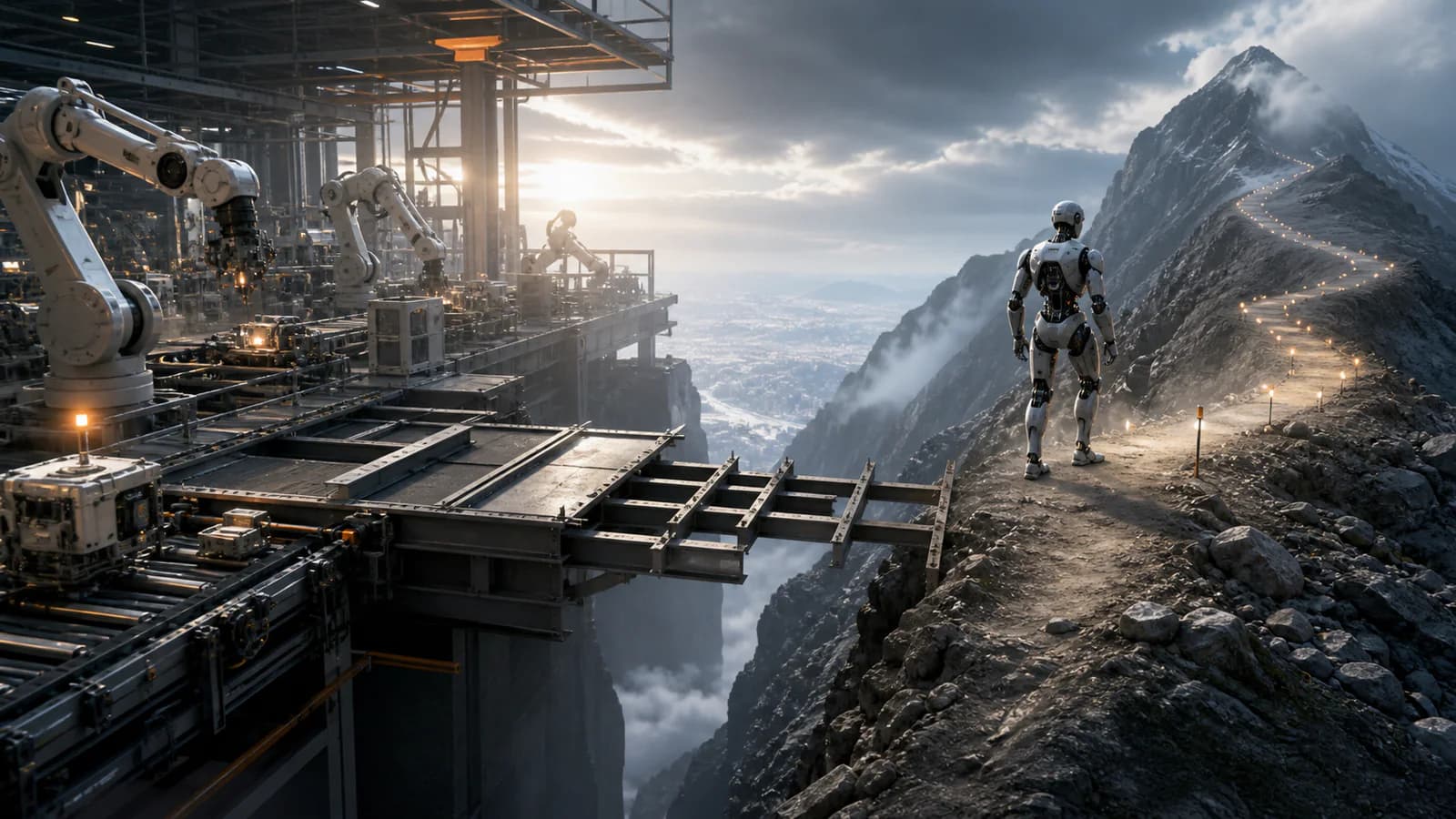
This leads to the biggest cognitive trap in robotics: the chasm between demo and reality. The humanoid robot you see at a product launch moves smoothly and looks stunning – but between a carefully staged demo and "7×24 reliable operation in any real environment" lies the abyss of Moravec's paradox. The former may already be achievable; the latter may take another decade. Countless robot companies have died in that gap between "beautiful demo" and "massacre in mass production."

Splitting "Robots": Those That Have Landed, and Those Still Far Away

Because of this chasm, you cannot talk about "robots" as a generalization when looking at the category. You must split it – which parts have already landed and are making money, and which are still in the distant future. Their investment logics are completely different.

Already landed: Industrial automation and specific-use robots. In structured, controllable environments (factories, warehouses), robots have been deployed at scale for a long time, creating real value – robotic arms, AGVs (automated guided vehicles), warehouse robots. This is a real business with real cash flow, and AI is making them smarter and capable of handling more complex tasks. This is the "certain" end of the robotics category – not sexy, but real.

Struggling forward: Autonomous driving. Autonomous driving is essentially a specific form of embodied intelligence – getting AI to be reliable at the single physical task of "driving." Its progress tells the whole story: even a relatively constrained task (on the road) has taken more than a decade and enormous amounts of money, and is still making the final hard climb toward reliability. Autonomous driving is the best empirical lesson in Moravec's paradox – if even this seemingly much simpler embodied task than a general-purpose humanoid is so hard, what about the rest?

Still far away: General-purpose humanoid robots. This is the end with the most imagination and the most uncertainty. A general-purpose humanoid that can flexibly work in any unstructured environment (your home, any place) must face the full difficulty of Moravec's paradox. It could be the greatest thing of the next decade or even decades, or it could be far slower than anyone expects. This end is "still far away" – it's a bet, not a reality.

When looking at robotics, the first thing is to distinguish which end you're talking about: automation that's already working in warehouses with cash flow (certain), or the stunning humanoid at the launch event (a distant bet). Confusing the two is the most common cognitive mistake in this category, and the easiest way to pay the wrong price.

My Framework: Participating via "Selling Shovels + Ultra-Long-Term Options"

So for individual investors, how to participate in Physical AI? My framework is the same logic that runs through this whole series – selling shovels + barbell options.

First, prioritize "selling shovels" rather than betting on "whose robot will win." No matter which robot company ultimately wins, they will all need compute (to train the embodied brain), sensors (for the robot to perceive the world), chips, actuators, simulation platforms. Nvidia is building Physical AI platforms (for training and simulating robots) – this is another "selling shovels" logic: don't bet on which robot company wins; bet on "the underlying tools that all robot companies need." In a category with highly uncertain outcomes, selling shovels is always safer than betting on the gold miners.

Second, treat humanoid/general-purpose robots as "ultra-long-dated options." General-purpose humanoids are a bet with enormous potential TAM but extremely long time horizon and high uncertainty. They have all the features of a convex option: limited downside (if you use a small position), huge upside (if it works, it's world-changing), very long time to maturity. So the correct posture is exactly the same as for space or early biotech – small position, can afford to lose it, betting on an extreme upside a decade out, not heavy betting because of a cool demo. And be clear: the strongest player in this category (Tesla's humanoid) is hidden inside a giant doing many other things; pure public market humanoid targets are mostly immature.

Third, beware of "demo-driven valuations." This category is the most vulnerable to emotion and valuation spikes driven by "cool demos." A video of a robot dancing or folding clothes can send related stocks soaring. But Moravec's paradox reminds us: the gap between a stunning demo and reliable mass production is a decade-wide abyss. Paying a price that implies "mass production is just around the corner" for a demo is the biggest way to lose money in this category.

Behind this framework is a long-termist patience I've drawn from reading Kevin Kelly's The Inevitable and Out of Controlthe long-term direction (intelligence will eventually enter the physical world) may be "inevitable," but its pace of arrival is usually much slower than the boosters claim and more thorough than the skeptics imagine. For a trend that is "certain in direction but highly uncertain in timing," the correct posture is always: share the certain parts by selling shovels, use small option positions to bet on extreme upside, and then wait patiently.

Epilogue: The Ending of the Entire Industry Research Series

Physical AI is a perfect ending – because it brings together several threads running through the whole series.

It re-validates the wisdom of "selling shovels" (Nvidia's Physical AI platform is again in that position of not betting on gold miners, just selling tools). It once again demands the discipline of "convex options" (humanoids, like space and early biotech, are small-position bets on extreme upside). It reminds us again that "direction ≠ timing" (intelligence entering the physical world may be inevitable, but the pace is extremely hard to predict). And Moravec's paradox gives us a simple yet profound amulet – the things easiest for humans are hardest for machines; therefore, the most stunning demo may still be separated from the most reliable mass production by the deepest chasm.

Looking back over this entire industry research series – from the storage super-cycle, to value migration in the AI compute stack, to the debate on application-layer moats, to space, optical communications, innovative drugs, and robotics – what I've been trying to express is the same thing:

Understanding an industry is not about predicting who will win (which is often futile), but about seeing the underlying structure – where is the bottleneck, how value is distributed, where moats come from, what probability distribution it follows – and then participating in it with a framework that ensures "no matter who wins, I won't be destroyed and can still share in the upside." This is the same philosophy as my asset allocation approach, just applied from "across assets" down to "within an industry."

If the entire series leaves only one sentence, I hope it's this –

The end goal of industry research is not to predict which sector or company the future belongs to; it is to understand the underlying structure of each sector, and then always participate in that future you believe in but cannot foresee in detail, using the framework of "selling picks and shovels + convex options + never being knocked out by any single outcome."

Don't predict the future – prepare for all possible futures. This sentence that runs through my asset allocation series still holds at the end of industry research.

The Industry Research series (all twelve articles) is now complete. From storage to robots, may this industry map be useful to you.

Risk Disclaimer: This article is an industry chain study. The sectors and companies mentioned are for analytical illustration only and do not constitute any investment advice. Markets can be risky; invest with caution.

Minto
明投 Minto
投资分析 · 长期主义者

专注投资分析、市场洞察与资产配置。不追短期波动,只理解真正驱动长期回报的东西。

你读完了 · Colophon

Physical AI: The Biggest Market, the Deepest Trap

8
分钟
2026/04
期号
2026
年份
真正稀缺的,是一个不慌不忙的人。
明投 · MintoInvest Wisely
— From This Series
喜欢这篇?这类 行业研究 的深度拆解会持续发到你邮箱。
无广告 · 随时退订
— Enjoyed the read?
如果这篇文章对你有用,把它分享给一个朋友,就是对我最好的支持。

口碑是独立创作者最稀缺的燃料。

— Discussion

说说你的想法

评论基于 GitHub Discussions(Giscus)。登录后即可留言、点赞、互相讨论。

评论还在准备中。

想说什么可以直接发我邮件,比在评论区更容易认真回复。

mingtaohuang617@gmail.com →
支持沉浸式阅读