Industry Research #10. In the piece on the AI compute stack, I mentioned that value is shifting from chips to networking. This article zooms in on that network link alone — optical communication, the most unassuming yet increasingly bottlenecked blood vessel in AI data centers.
1. Why AI Turned 'Connectivity' into a Major Problem
First, understand a counterintuitive fact: buying 10,000 GPUs and piling them together doesn't automatically turn them into a supercomputer.
Training a large model requires thousands of GPUs to collaborate — they must constantly exchange data and synchronize parameters. If the 'communication' between GPUs can't keep up, no matter how many GPUs you add, they won't work efficiently — a lot of compute is wasted just waiting for data. What turns that mass of GPUs into a single cohesive system is the high-speed network in between.
And as AI clusters grow — from thousands, to tens of thousands, to hundreds of thousands — the importance of that network skyrockets. The reason: the larger the cluster, the more data must be exchanged between GPUs, and the pressure on the interconnect grows non-linearly. For a 100,000- cluster, just getting those GPUs to 'talk' to each other is an enormous engineering challenge. The cost and power consumed by the interconnect take up an ever-larger share of the entire data center.
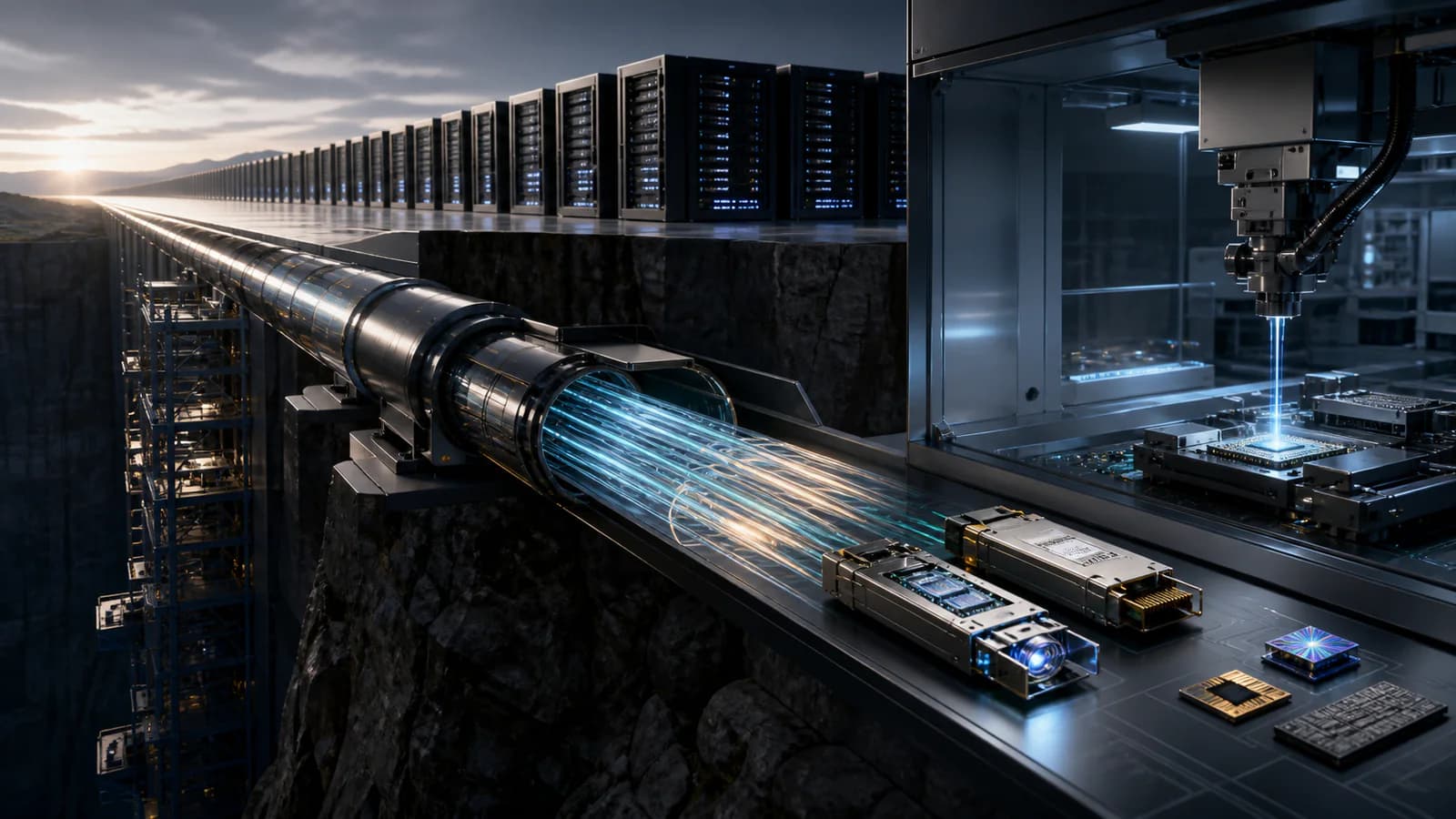
That's why AI has turned 'connectivity' into a major problem. In traditional computing, the network is a supporting player; in massive AI clusters, the network determines whether the entire system can run efficiently. And the technology that handles this high-speed, high-capacity, longer-distance connectivity is primarily light — optical modules, fiber, optical switches. Compute is muscle; light is the blood vessel. No matter how strong the muscle, if the blood vessels can't supply, it's useless.
2. Optical Communication's 'Repetitive Demand': A Better Business Model Than One-Time Sales
Optical communication has one particularly noteworthy characteristic for investors: its demand is 'repetitive' rather than 'one-time'. This makes its business model better than many hardware plays.
The logic lies in the upgrade cadence of optical modules. AI data center optical interconnects follow a clear speed upgrade path: 400G → 800G → 1.6T → 3.2T… Each new generation of GPUs pushes cluster size and bandwidth requirements higher, demanding faster optical modules to match.
The key point: this is not a one-time purchase; it's a continuous, GPU-iteration-driven upgrade cycle. Nvidia iterates roughly once a year (remember the Nvidia piece), and each new platform requires the optical interconnect to keep up. That means optical module makers face a replacement demand that repeats with every GPU generation — before 800G is even old, 1.6T demand arrives.
'Repetitive demand' is a far better business model than 'one-time sales' — it makes revenue more predictable and sustainable, unlike hardware that sells once and is done. As long as AI clusters keep upgrading and GPUs keep iterating, optical interconnects must follow. This is why optical communication, as a 'pick-and-shovel' play, has an edge over typical picks and shovels: customers have to come back again and again for that shovel.
3. CPO: An Architectural Shift Underway
The biggest variable in optical communication right now is an architectural shift called CPO (Co-Packaged Optics). Understanding it is key to judging how the winners and losers in this space will be reshuffled.
The starting point, once again, is electricity (remember the value migration piece — electricity is AI's hardest constraint). Traditional optical modules are 'pluggable' — the optical-electrical conversion happens in modules plugged into ports outside the switch. This approach is flexible, but it has a fatal flaw: as data rates climb, the power consumption of these pluggable modules skyrockets, becoming an ever-larger chunk of the data center's electricity bill. In the AI era where 'electricity is scarce', this is unacceptable.
CPO's solution is to move the optical-electrical conversion right next to the switch ASIC, packaging them together — shortening the electrical signal transmission distance and dramatically reducing power. Simply put: CPO trades 'moving optical components closer to the chip' for 'saving electricity.' In an environment where power is the bottleneck, the value of this power saving is enormous.
The significance of this shift: it will redistribute value along the chain:
- It pushes optical communication from 'making pluggable modules' toward 'advanced packaging + chip-level integration' — raising the technological barrier.
- It favors players who understand switch chips, optical components, and advanced packaging — typical giants like Broadcom that also make switch ASICs occupy a strong position.
- It may marginalize some vendors that only make standard pluggable modules.
CPO is to optical communication what HBM4's 'base die using logic process' was to memory (remember the piece) — it pushes a previously standardized segment toward higher integration and higher barriers, raising the moat and solidifying leaders. Judging the long-term winners in optical communication largely comes down to: who can secure a position in this CPO architectural migration.
4. Key Distinction: Price-War-Prone 'Modules' vs. Moat-Protected 'Optical Chips'
This, I believe, is the single most important distinction when looking at optical communication investments — optical communication is not monolithic; it breaks down into 'low-barrier, price-war-prone segments' and 'high-moat, defensible segments', and value is concentrating in the latter.
Low-barrier, easy-to-price-war segment: standard optical module assembly. Making standardized pluggable optical modules is essentially assembly — putting together optical chips, electrical chips, and packaging. Competition here is fierce (a large number of global vendors, especially Chinese vendors with extreme cost advantages), making it prone to price wars and margin erosion. When looking at US-listed stocks, the pure module assembly thesis requires caution: 'high demand but profits eaten by price wars' is a real trap.
High-barrier, moated segment: Real value is in the hardest components inside the module:
- Optical chips / lasers: The core devices that emit and receive light; high technology barriers, few players.
- DSP / electrical chips: The chips handling high-speed signal processing; dominated by Broadcom, Marvell, and similar.
- Switch ASICs: The brain of the entire network; Broadcom is one of the dominant leaders.
- CPO-related packaging and integration IP: The core of the next-generation architecture described above.
For US-listed equities, the right way to approach optical communication is to look 'up the barrier' — don't stare at the price-war-prone module assemblers; focus on lasers, DSPs, switch ASICs, CPO — the hard segments with real moats. Value is highly unevenly distributed along this chain, and AI's dividends will flow first and persistently to the irreplaceable hard components, not to the assembly anyone can do. This goes back to my repeated point: in an industry chain, find the 'bottleneck' link — that's where the profit lives.
5. Final Thoughts
Optical communication is an easy-to-overlook but genuinely bottlenecked blood vessel in the AI story.
Its logic chain is clear: the larger the AI cluster, the more critical the GPU interconnect; the more critical the interconnect, the higher the value of light; and as GPUs iterate every year, light must be upgraded generation after generation — this creates a rare 'repetitive demand.' In the 'pick-and-shovel' narrative, optical communication sells the kind of shovel that customers must come back to buy again and again, making its business model superior to one-time hardware sales.
But it's not a sector to blindly buy into. It's highly differentiated internally: standard module assembly will face price wars and margin erosion; the real moats lie in the hard components — lasers, DSPs, switch chips, CPO. And CPO, an architecture shift driven by 'saving electricity', is redistributing value across the entire sector — pushing it toward higher barriers and higher integration.
So I see optical communication with two rules: First, recognize its 'repetitive demand' as a real dividend; second, strictly distinguish price-war-prone modules from moated optical chips, and look for value only in the latter. Combine these two, and you can enjoy AI's sustained pull on optical interconnects while avoiding the 'high demand, thin margin' assembly trap.
If I had to leave one sentence —
In AI data centers, light is the blood vessel connecting compute, and it's a blood vessel that must be replaced every time the GPU iterates — that's its best feature. But blood vessels come in different grades: don't buy the pipe wall anyone can make (module assembly); buy the hardest connector that no one else can produce (optical chips and CPO).
Next time, we leave the world of compute and look at a completely different sector undergoing its own paradigm shift — innovative drugs.
——
Risk Disclosure: This article is an industry chain analysis. Companies mentioned are for illustrative purposes only and do not constitute any investment advice. Market risks exist; invest carefully.
专注投资分析、市场洞察与资产配置。不追短期波动,只理解真正驱动长期回报的东西。