跳到正文 · Skip to content
内容
关于与合作
订阅与会员
★ 查看会员权益
外观与设置
外观
主题色
版本 · 深色 / 减动搜索⌘K
草稿预览·这篇还没发布,不会出现在列表和 RSS 里。review 完后把 frontmatter 的 draft: true 改为 false 即可。

The AI Stack: Money Is Flowing from Chips to Power

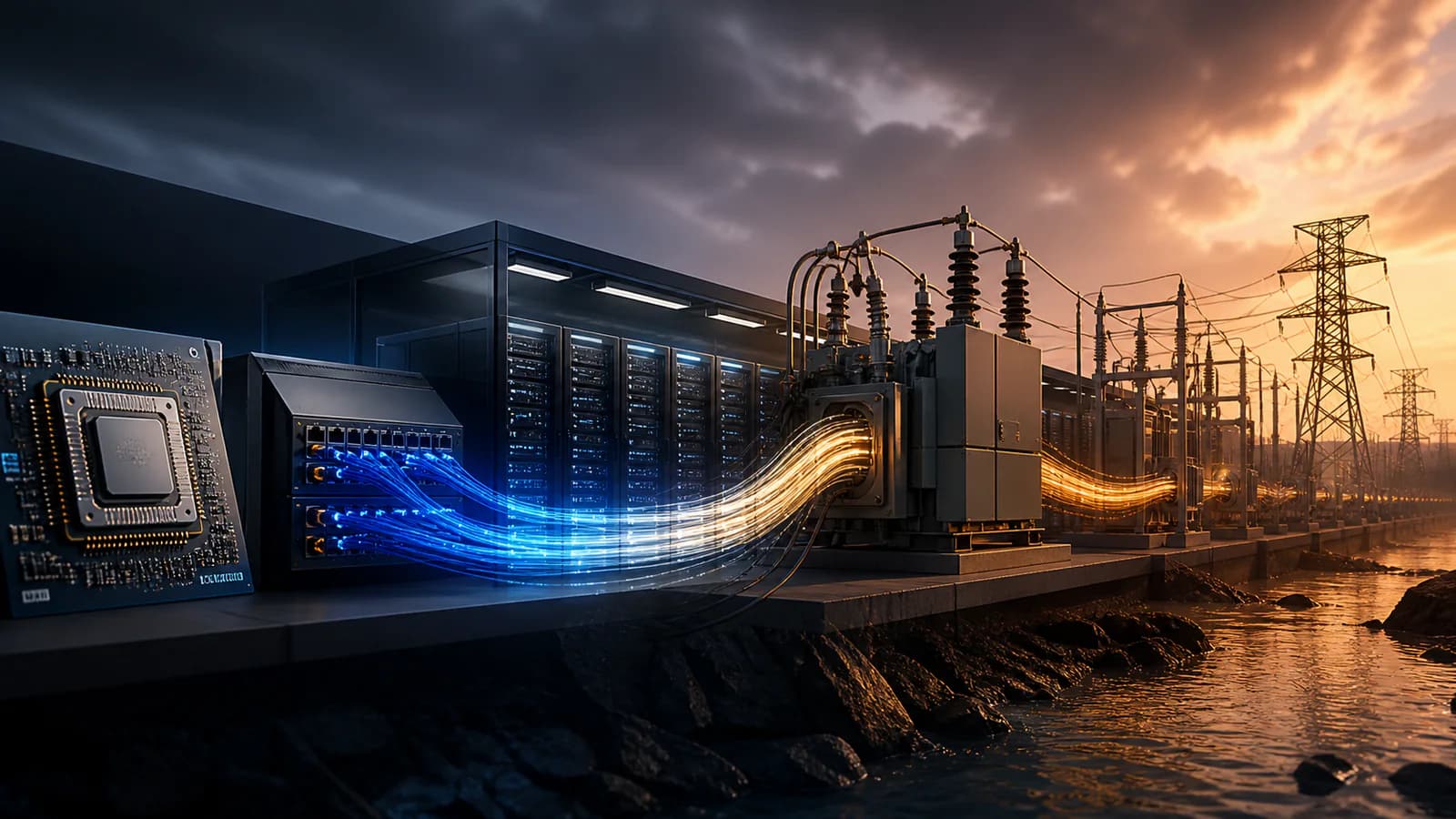
Two years ago, the scarce resource in AI investing was the GPU. Now, people who can get GPUs are discovering they’re stuck without electricity, without data center space, without cooling. The bottleneck is moving—and profits always follow the bottleneck.

2026.04.068 min原创
The AI Stack: Money Is Flowing from Chips to Power
行业研究MINTOVIEW2026.04.06

「Industry Research」AI Compute Stack Series · Part 1. In the memory chain, we looked from bottom up (how bottlenecks the ). This series flips the perspective—let’s lay out the entire compute stack and see where the money is flowing along it.

1. First, Unfold the “Compute Stack”

When people talk AI investing, most have only one word in mind: Nvidia. But Nvidia is just the tip of an iceberg. To see where the money is flowing this cycle, you have to unfold the entire compute stack.

From bottom to top, an AI data center roughly looks like this:

LayerContentExamples
Chip LayerGPU, HBM, CPUNvidia, AMD, Micron, SK Hynix
System/Network LayerServers, Interconnects, Optical Modules, SwitchesNvidia (NVLink), Broadcom, Optical Communication Vendors
Data Center LayerFacilities, Racks, Liquid Cooling, LandData Center REITs, Neocloud
Energy LayerPower, Substations, Cooling, Grid AccessUtilities, Independent Power Producers, Nuclear, Gas Turbines

These four layers together form the complete chain that turns electricity into AI compute. No matter how powerful the chip, it has to be plugged into a server; servers need high-speed interconnects to form a cluster; clusters need to be housed in data centers; and data centers need to gulp enormous amounts of electricity.

Key to understanding this stack is one sentence: Scarcity moves along this chain over time. And every move is a redistribution of profits.

2. The First Move: From Compute to Bandwidth

The first bottleneck is one everyone knows: GPU.

In 2023-2024, the scarcest thing in AI investing was Nvidia’s GPU. Whoever could get H100s and GB200s owned compute. Profits were heavily concentrated at the chip layer—Nvidia captured the vast majority of the money on this chain.

But the bottleneck started moving quickly. The first move was from compute to bandwidth—exactly the rise of HBM I covered in my earlier memory series. When the GPU is no longer the only scarce item and data feeding into the GPU becomes the new constraint, value flows from pure compute to HBM. That was the first downward shift; SK Hynix and Micron captured that wave.

Soon after, the bottleneck shifted to network interconnects. When AI training requires tens of thousands of GPUs to work together as a cluster, the speed of communication between GPUs becomes the new bottleneck. A GPU may compute fast, but if data exchange with its neighbor is slow, the whole cluster’s efficiency plummets. Value then flowed to high-speed interconnects and optical communications—precisely the core logic of my earlier fiber article: in an AI data center, optical modules, switches, and future CPO (co-packaged optics) are the “blood vessels” connecting millions of GPUs. And when cluster sizes explode, those vessels become the choke point.

See the pattern? The bottleneck moves down the stack like a cursor: GPU → HBM → Network Interconnects → … Each step turns a new set of companies from supporting actors to lead roles.

And now, the cursor has landed at the bottom layer—the most counterintuitive bottleneck of this cycle: electricity.

3. The Latest Bottleneck: Electricity Becomes AI’s Hardest Constraint

This is the point I want to drive home in this piece—AI’s current expansion is slamming into a wall nobody expected to be so hard: not enough electricity.

Sounds absurd: the world’s most cutting-edge, high-tech industry is being choked by something as “basic” as electricity. But that’s the reality unfolding.

The logic chain goes like this:

First, AI data centers are “power hogs.” A large AI data center can consume as much electricity as a medium-sized city. Training and running large models is fundamentally converting massive amounts of electricity—through GPUs—into compute. The bigger the model and the cluster, the more power it devours.

Second, the grid can’t keep up. America’s power grid has grown slowly over the past two decades—because prior electricity demand was roughly flat (efficiency gains offset growth). As a result, when AI data centers suddenly demand a massive, concentrated amount of power, the grid isn’t ready: not enough generation, not enough transmission lines, not enough substations, and interconnection approvals take years to queue. In some data center-heavy regions, “whether you can get power” has replaced “whether you can get GPUs” as the primary constraint on building.

Third, this contradiction has forced a set of unprecedented moves. When the public grid can’t feed AI, tech giants start solving electricity themselves—buying power plants directly, signing long-term nuclear deals, even investing in small modular reactors (SMR). Microsoft signed a deal to restart the Three Mile Island nuclear plant; Amazon and Google invested in SMRs; everyone is scrambling for gas turbines… When the richest tech companies in the world start personally buying power stations and building power infrastructure, you know electricity as a bottleneck is real.

That’s the latest landing point of the moving bottleneck. The value cursor has traveled from chips all the way down to the bottom of the stack—the electron itself. In the AI era, electricity has become a strategic scarce resource for the first time.

4. Why “Electricity” Might Be One of the Most Certain Stories of the Next Decade

I’ve always been cautious about AI investing (more on risks later). But within the entire AI narrative, the “electricity” thread is the one I find relatively highest in certainty. Three reasons:

First, its demand is “derived” and lags. Electricity demand derives from data center construction—and data center construction is a locked-in CapEx for years to come. That means even if the AI application layer story is still vague (who will win, whether it will make money), the fact that “these data centers under construction need power” is certain. Electricity demand is, to some extent, the part of AI CapEx least dependent on whether AI ultimately makes money—because once the facility is built, it has to drink power.

Second, supply is extremely rigid, so pricing power is high. Power plants, transmission lines, and grid equipment take years or even decades to build; supply can’t ramp quickly. When demand surges suddenly while supply is rigid, the result is: revaluation of generation assets, rising electricity prices, and order backlogs for power equipment (transformers, cables, gas turbines). This is a classic “demand shock + rigid supply” setup—the same logic as storage HBM—the scarcer the link, the stronger the pricing power.

Third, it benefits from “cross-narrative” demand. Electricity doesn’t just serve AI. EVs, reshoring manufacturing, and overall electrification are all lifting power demand (remember my energy transition piece). AI is just the most aggressive, concentrated wave within that broader rising tide. So even if the pure AI story cools down, the larger electrification trend still underpins power demand. That gives electricity plays an extra safety cushion compared to pure AI names.

In US equities, the positioning along this line roughly is: independent power producers / utilities (especially those with nuclear assets that can sign long-term data center deals), power equipment (transformers, grid gear—the real “shovel sellers”), gas turbine manufacturers, and nuclear / SMR as a high-beta, high-uncertainty frontier. These are the positions that “don’t bet on which AI model wins, only that AI needs power.”

5. My Caution: Don’t Mist the “Shovel Seller” as Risk-Free

After all this talk about electricity’s certainty, I have to throw cold water—the “selling picks and shovels to gold miners” logic carries a trap that gets overused.

“Selling shovels in a gold rush is safest” is an overused investing cliché. Its problem: when everyone knows “shovels are safest,” shovels get expensive. Today the market has fully priced in the “AI needs power” story; many power, grid equipment, and nuclear names already have a lot of optimistic expectations baked in. A correct logic plus a high price still makes a bad investment (remember my repeated point in “Market Mr.” and valuation notes: even the best company, bought at too high a price, will lose you money).

A deeper risk: the “certainty” of electricity demand is ultimately still built on the assumption of continued AI CapEx. Earlier I said electricity is “least dependent on whether AI makes money”—that’s relative. If overall AI CapEx slows sharply and data centers under construction get canceled, that “certain electricity demand” will be discounted too. Already-signed long-term contracts can hold for a while, but new demand will dry up. Electricity has a thicker safety cushion than pure AI, but it’s not insulated.

There’s also a specific risk: cycles and overbuild. Historically, every “demand shock → frantic capacity build” story ends in overcapacity (storage industry is a textbook case). If electricity and data centers are overbuilt, local oversupply may appear in a few years. Today’s bottleneck sows tomorrow’s surplus—that’s the inescapable fate of capacity industries.

So my stance is: electricity is the relatively highest-certainty thread in the AI compute stack—worth serious study. But “high certainty” does not mean “buy now.” Correct logic, expensive price, and still tied to the master switch of AI CapEx—these three must be considered together.

6. Closing Thoughts

Unfold the entire AI compute stack and you see a clear picture moving: value travels like a cursor down the stack—from GPU to HBM to network to data center to electricity. Each step turns a new set of companies from supporting to leading roles, and dilutes the excess profits of the old stars.

This “moving bottleneck” perspective lets you see a much more complete opportunity map than staring at Nvidia alone. It tells you: the AI bonanza was never just at the chip layer. It distributes along the entire chain, and the center of gravity keeps shifting downward. Today it lands on the most “basic” yet hardest constraint: electricity.

But this perspective also reminds me: bottlenecks move, meaning no layer’s excess profits are permanent. Today’s choke point—electricity—will attract massive investment to solve it, and solving it sows the seeds of the next glut. Understanding a chain isn’t just about seeing where the bottleneck is now, but how it will be filled, and where the next one will appear.

So if I had to leave one sentence:

On this AI compute chain, don’t just fixate on the brightest link (chips). Watch the bottleneck, because profits follow it. But also remember: once a bottleneck is seen, it starts being filled—today’s scarcity is manufacturing tomorrow’s surplus.

Next piece, we go back to the brightest link—Nvidia—and ask a question everyone asks but few seriously answer: how long can its moat hold?

——

Risk disclaimer: This is an industry chain analysis. Companies mentioned are for analytical illustration only and do not constitute investment advice. Markets carry risks; invest with caution.

Minto
明投 Minto
投资分析 · 长期主义者

专注投资分析、市场洞察与资产配置。不追短期波动,只理解真正驱动长期回报的东西。
你读完了 · Colophon

The AI Stack: Money Is Flowing from Chips to Power

8
分钟
2026/04
期号
2026
年份
真正稀缺的,是一个不慌不忙的人。
明投 · MintoInvest Wisely
— From This Series
喜欢这篇?这类 行业研究 的深度拆解会持续发到你邮箱。
无广告 · 随时退订
— Enjoyed the read?
如果这篇文章对你有用,把它分享给一个朋友,就是对我最好的支持。

口碑是独立创作者最稀缺的燃料。

— Discussion

说说你的想法

评论基于 GitHub Discussions(Giscus)。登录后即可留言、点赞、互相讨论。

评论还在准备中。

想说什么可以直接发我邮件,比在评论区更容易认真回复。

mingtaohuang617@gmail.com →
支持沉浸式阅读