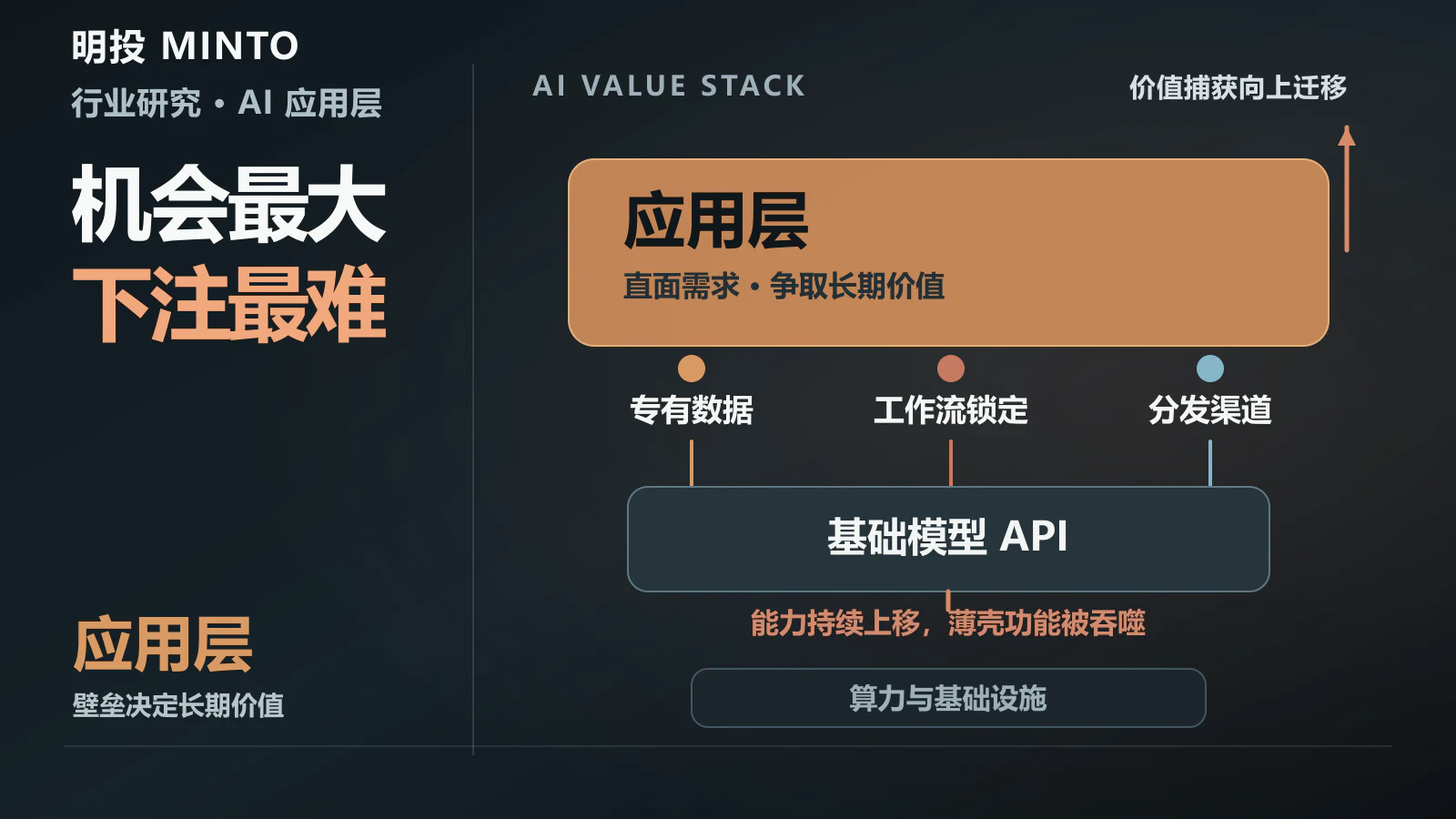
Industry Research AI Applications Series, Part 1. The earlier pieces on the compute stack were in the 'hard' world (chips, power, leverage). This one enters the 'soft' layer — applications. The layer with the most imagination, but also the hardest to bet on.
1. A Historical Pattern: The Biggest Money Is in the Application Layer
In my piece 'After AI Compute,' I laid out the three-phase structure of tech cycles: infrastructure → platform → application. Let me elaborate, because it determines where the biggest AI money will be.
Look back at the last internet cycle:
- Infrastructure winners: Cisco (selling network gear), Intel (selling chips). They made a fortune early.
- Platform winners: operating systems, browsers, cloud.
- Application winners: Google, Amazon, Facebook, Netflix — and these became the companies that created the most value in the entire internet cycle.
Notice the pattern: Infrastructure winners make money early and fast, but application winners ultimately make the most and longest. Cisco is a great company, but its market cap is far below the app-layer giants. The reason: infrastructure is a 'pipe' — pipes eventually become commoditized and margins compress; applications directly serve end users and demand, allowing sustained and deep value extraction.
Apply this to AI: today we're still in the tail of the infrastructure phase (Nvidia, , power). The platform phase is arriving (foundation model APIs). The application phase — the one that will eventually birth AI's 'Google and Amazon' — likely hasn't truly begun. This means AI's biggest value creation may still lie ahead.
But that exact insight creates the hardest question.
2. The Hardest Question: The App-Layer Winners Are Still Unclear Today
'The application layer will produce the biggest winners' — I believe that. But it's almost useless for investing, because there's a second sentence: The winners in the application layer are nearly impossible to identify early.
In 2000, you knew 'internet applications will be huge,' but could you have bought Google early? It wasn't even public. Could you have bought Amazon early? Yes, but you'd have to survive its 90% drawdown after the 2000 crash. 'Knowing the app layer will be huge' and 'being able to pick the winners early' are two vastly different things.
AI's application layer today looks strikingly like the internet's in 2000 — a cacophony of startups, but the true winners are blurred, and many may not even be public yet. That's why 'biggest money' and 'hardest bet' are two sides of the same coin.
To make matters worse, AI's application layer has a unique curse the internet didn't have — the wrapper trap.
3. The Wrapper Trap: Why Most 'AI Apps' Have No Moat
This is the single most important concept for understanding AI app-layer investing.
Today, the vast majority of 'AI applications' are essentially a thin interface or workflow on top of OpenAI, Anthropic, or other foundation model APIs. Users interact with your product, but the heavy lifting is done by the underlying model. These 'wrapper' apps face two nearly fatal problems:
First, they are trivially easy to replicate. If your product is just 'call GPT/Claude + a nice UI,' anyone can build the same thing in weeks — because the core capability (the model) isn't yours; it's publicly accessible. No proprietary core capability means no moat, and you're left competing on price in a sea of sameness.
Second, they get 'eaten from above' by the foundation models. This is the crueler blow. Every time the underlying model upgrades, it can internalize an entire layer of wrapper functionality — your painstakingly built feature becomes a default in the next model version. As a Silicon Valley dark joke goes: 'Every OpenAI release kills a dozen startups.' When your product is built on someone else's rapidly evolving capability — and that someone has an incentive to move up the stack — your room to survive keeps shrinking.
Combined, these two problems explain a counterintuitive reality: AI app startups are booming, but those with durable moats are extremely rare. Most 'AI apps' are no-moat thin shells, hot for a moment but unsustainable. For investors, this is the most dangerous trap — paying a high price for an 'AI app' story that is really just a thin shell waiting to be copied or swallowed by a model.
4. So Where Does a Real Moat in Applications Come From?
Wrappers have no moat — so what kind of AI applications have a real moat? From my observation, durable moats come from three things, none of which is 'the model itself' — they are outside the model:
First, proprietary data (data the model cannot access). If your application is built on exclusive data that no one else has and that the model hasn't been trained on, you have a moat. Feed the same model your proprietary data, and the output is irreplaceable. Companies in healthcare, finance, industrials, and government that own deep proprietary data will be far more resilient than pure wrappers. Data is one of the hardest moats in the AI app layer.
Second, workflow lock-in (embedded in the customer's business process). If your product is deeply embedded in your customer's daily workflow — becoming the 'system of record' they depend on for recording, decision-making, and collaboration — the switching cost is extremely high. Customers won't tear down their entire process just because a new tool appears. The moat isn't the AI feature itself; it's the fact that you are already part of the customer's business. This is exactly what I wrote about in my moat piece — the highest level of moat is embedding and habit.
Third, distribution (you already reach millions of users). If you already have a massive user base and distribution capability, adding AI as a new feature 'bundled' in comes with near-zero acquisition cost, while pure startups have to win each user from scratch. In a world where AI features are increasingly commoditized, 'who can put this feature in front of the most users' matters more than 'whose feature is slightly better.'
These three moats — proprietary data, workflow lock-in, distribution — share one thing: they are not natural endowments for AI startups; rather, they are already in the hands of today's incumbent software giants. Which leads to my core thesis on AI app-layer winners.
5. My Thesis: This Cycle's Winners May Be 'Old Money'
The mainstream narrative loves to say 'AI will disrupt everything and startups will replace incumbents.' I'm deeply skeptical. My view is the opposite — in the AI application layer, this cycle's winners are likely to be today's incumbent software giants, not startups.
Why? Because the three moats I just described — proprietary data, workflow lock-in, distribution — Microsoft, Adobe, Salesforce, ServiceNow already have them. They don't need to build a moat from scratch; they need to 'bundle' AI as a new capability into their already unassailable moats:
- Microsoft has Office, Windows, and hundreds of millions of enterprise users for distribution — bundling Copilot gives them near-zero acquisition cost.
- Adobe has creative workflow lock-in plus massive creative data.
- Salesforce and ServiceNow have core enterprise workflows and data.
For these incumbents, AI is not a disruptor; it's new ammunition to thicken their moats. For pure AI startups, they face a pincer attack — 'eating from below' by foundation models and 'bundling from above' by incumbents. Survival is extremely tough.
Of course, I'm not saying startups have no chance. In entirely new scenarios that incumbents don't cover (like how Google and Amazon created new categories), new AI-era giants may still emerge. But those winners are likely not public today, or are still very early — it's nearly impossible to pick them in advance on public markets.
So my practical conclusion for AI app-layer investing is:
First, beware of 'wrapper' stories — most touted 'AI apps' have no real moat. Don't pay a premium for a thin shell.
Second, on public markets, the safest way to capture AI app-layer upside is through those incumbents with distribution, data, and workflow lock-in — they add AI as incremental ammunition rather than betting their entire existence on it. This is a stable 'hitch a ride on incumbents' moats' play.
Third, truly disruptive AI app winners may require waiting until they go public or the picture clears — miss the early super-profits in exchange for certainty once the moat is visible. That's my consistent trade-off: I'd rather buy when I can see clearly than gamble on high-odds-but-blurry bets.
6. A Final Thought
The AI application layer is a place of both immense temptation and hidden traps.
Temptation: history tells us this layer will ultimately birth AI's biggest winners, just as the internet's biggest winners weren't Cisco but Google and Amazon. Traps: in today's cacophony, most offerings are moatless wrappers, and the true winners are blurred, or not even here yet.
The tension between these two forces demands a simple but hard-to-follow discipline — resist the FOMO of 'if I don't bet now, I'll miss the next Google.' That anxiety is precisely what makes people overpay for wrappers with no moat. Seeing 'the app layer will be huge' is easy; the hard part is admitting 'I can't yet see who will win' and staying patient and disciplined.
So my approach to the AI app layer rests on three rules: don't pay for wrappers, prioritize riding incumbents' moats, and leave the disruptive winners for when the picture is clear. This strategy will inevitably cause me to miss some early lottery-ticket gains. But it also avoids the biggest pitfall — paying a perfection price for a no-moat story.
If I had to leave just one line:
The AI application layer will create the most value — that's almost certain. But 'most value' and 'you can pick it early' are two different things. Until the winners are clear, real moats aren't in wrapper startups; they're in incumbents' distribution, data, and workflow lock-in — and in companies that aren't public yet.
Next piece: an exception — a company already on public markets that has actually built an app-layer moat: Palantir. Whether its 'AI operating system' is a template for app-layer moats.
—
Risk Disclaimer: This is industry research. Companies mentioned are for analysis only and do not constitute investment advice. Markets are risky; invest with caution.
专注投资分析、市场洞察与资产配置。不追短期波动,只理解真正驱动长期回报的东西。