一个 CEO 写的、关于「生死时刻」的书
Andy Grove, Intel's legendary CEO, took the company from a near-dead memory chip maker to the microprocessor empire that defined the PC era. In 1996, he distilled his core experience into Only the Paranoid Survive.
This book is different from most management books—it's not about running a successful company, but about how a company survives its 'moment of truth'.
Grove introduced a central concept: the Strategic Inflection Point. This is a moment when the fundamental basis of a company's success shifts, the old playbook stops working, and the company either transforms or declines.
The title Only the Paranoid Survive captures this state—at a strategic inflection point, you must be paranoid, constantly alert to the change that could upend you. Because that change often arrives quietly, from a corner you're not watching, exactly when you're most successful.
英特尔的生死时刻:放弃存储芯片
The most powerful part of the book is Grove's account of Intel's own strategic inflection point.
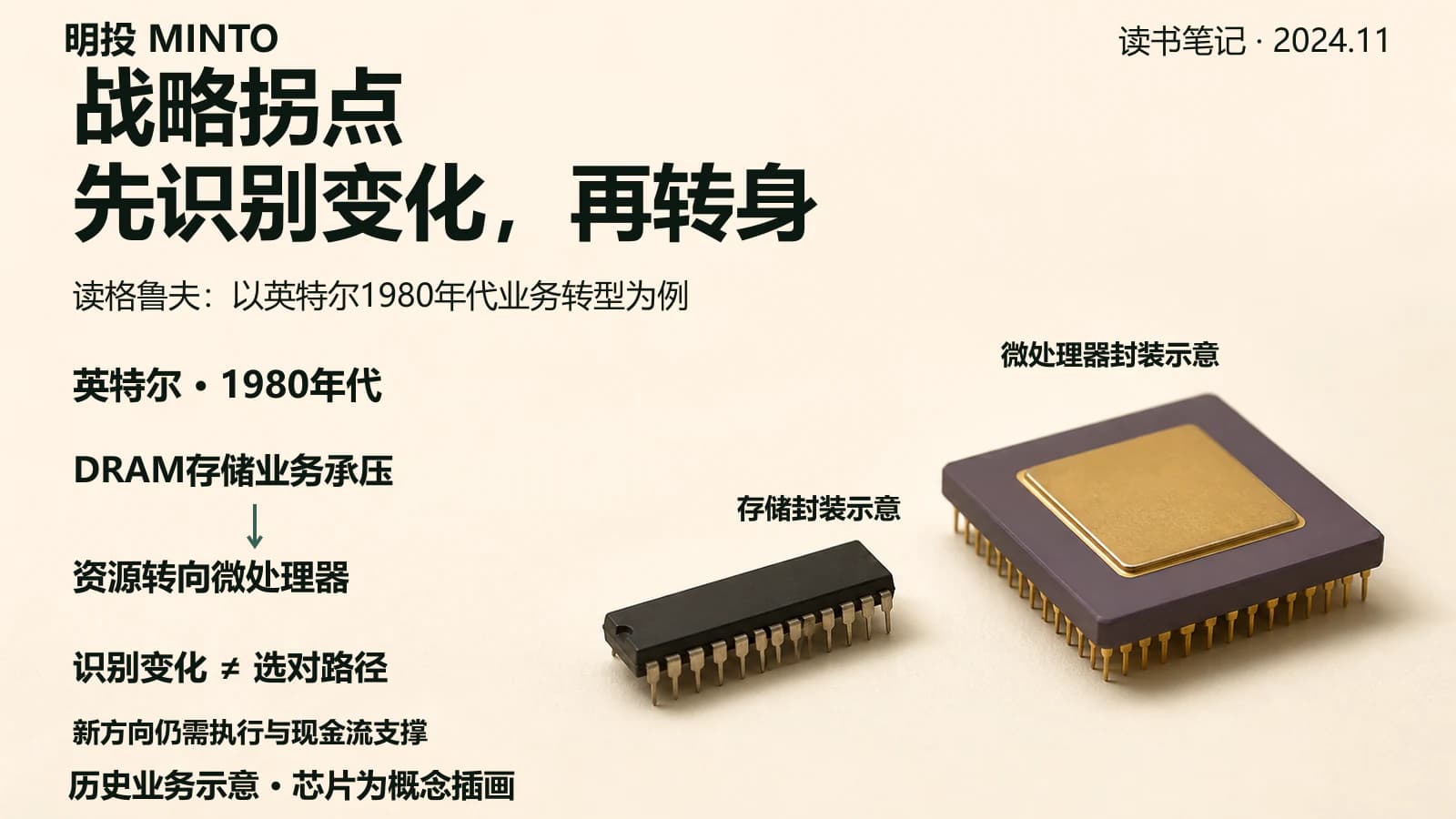
In the 1980s, Intel was built on memory chips (DRAM)—its roots, its identity, its core business. But Japanese companies (NEC, Toshiba, Hitachi) turned memory chips into a price war bloodbath with lower costs and higher yields. Intel was losing badly on memory chips, bleeding money.
Grove describes a famous moment—he asked co-founder Gordon Moore (of Moore's Law): "If we were kicked out and the board brought in a new CEO, what would that CEO do?" Moore said: "He would give up memory chips." Grove replied: "Then why don't we walk out the door, come back in, and do it ourselves?"
So Intel made an excruciating decision—abandon its founding business, the one that defined its identity, and go all-in on microprocessors.
At the time, that decision was nearly unimaginable—it was like a company giving up its own roots. But that decision saved Intel and made it the king of the PC era.
The essence of a strategic inflection point is: you must give up what made you successful, because it no longer makes you successful. That's the most anti-human decision, because it demands you betray your own past.
对投资者的实用工具:识别一家公司的战略拐点
Grove's most practical gift to investors is a set of signals that indicate whether a company is facing a strategic inflection point.
First, the power of a '10x change'. Grove said that when one of the forces affecting a company (technology, competition, customers, suppliers, regulation) undergoes a '10x' change, a strategic inflection point has arrived. Not a 10% change (that's normal fluctuation), but a 10x change (that's a paradigm shift). AI for the software industry is a 10x change.
Second, 'the disconnect between what is said and what is done.' Grove said an early signal of a strategic inflection point is when the 'strategy the top talks about' and 'what frontline employees actually do' start to diverge. Frontline people sense the change first (they face customers and competition directly), while top management is still living in an old map. When management is still telling the old story, but the front line is quietly doing something else, the inflection point may already be here.
Third, 'the most dangerous time is when you are most successful.' Strategic inflection points often arrive when a company's books look best—because success makes management complacent and blinds the company to threats. A company's best quarter, when its stock is at its peak, may be the eve of its strategic inflection point.
When I look at any giant company, I always ask Grove-style questions: Is there a 10x change happening in its environment? Is management facing it head-on, or hiding behind old narratives? In 2025, for every software, media, and consumer company, the answer to this question basically determines how AI, as a 10x change, will reshape them.
我跟格鲁夫不同的地方
First, he underplays the cost of 'paranoia.'
'Only the paranoid survive' is a powerful slogan, but permanent paranoia has a huge cost—it makes you overreact, see ghosts, and treat every normal fluctuation as a strategic inflection point. Grove himself was an extremely anxious man (a Holocaust survivor; that shaped his paranoia). But not every company or every investor should live in that constant state of anxiety. Real wisdom is distinguishing 'true inflection points' from 'false alarms,' and Grove's 'always paranoid' doesn't provide that tool—it risks burning you out on endless false alarms.
Second, ironically, Intel itself missed its next strategic inflection points.
Here's the bitter irony—the company that wrote the book on strategic inflection points, missed several of its own later inflection points: it missed mobile chips (disrupted by ARM and Qualcomm), it missed /AI chips (left far behind by Nvidia), and it lost the process lead to TSMC. The company that wrote the definitive work on strategic inflection points lost badly at the next turn. This shows that knowing the concept of a strategic inflection point in no way guarantees you'll get your own inflection point right. There's a chasm between theory and execution. That's the most important warning for readers.
Third, it assumes there is always a right answer for the transformation.
In Grove's story, Intel's decision to abandon memory chips and pivot to microprocessors was a clear, correct move. But in reality, strategic inflection points often have no clear right answer—you know the old path is dead, but you don't know which new path is right. Kodak knew digital was the future, but it had countless choices for 'how to pivot,' and most were wrong. Recognizing the inflection point (knowing you must change) is relatively easy; picking the right direction (knowing where to go) is extremely hard. Grove's book leans heavily on the first and doesn't do justice to the difficulty of the second.
Fourth, it's a CEO's perspective, not fully applicable to investors.
Grove wrote from the perspective of 'a CEO leading a company through an inflection point.' But an investor's position is different—an investor doesn't need to help a company transform; an investor only needs to judge whether the company can survive the inflection point, then decide to buy or sell. These are completely different skill sets. The more useful question for investors is not 'how to transform' but 'does this company's management, culture, and capital structure have the ability to survive the inflection point?' Grove's CEO perspective needs to be translated into an investor's lens to be useful.
格鲁夫 vs 克里斯坦森:从两边看同一件事
Grove's 'strategic inflection point' and Clayton Christensen's 'disruptive innovation' are two sides of the same coin.
Christensen looks from the outside—how disruption comes from below, eating incumbents from the low end. It's the perspective of the 'disruptor' and the 'mechanism.'
Grove looks from the inside—how the incumbent CEO, caught in the middle, senses and responds to this inflection point. It's the perspective of the 'disrupted' and the 'response.'
Christensen tells you how disruption happens; Grove tells you what to do when you're in it.
Together, they give investors a complete framework for judgment—use Christensen to identify 'who is likely to be disrupted' (external mechanism), and use Grove to judge 'does it have the capacity to save itself' (internal response).
A company faces disruption (Christensen), but it has leadership and culture willing to 'give up its roots' like Grove—then it might save itself (like Netflix, Microsoft). Another company faces the same disruption, but its management consoles itself with old narratives and protects vested interests—then it will probably die (like Kodak, Nokia, and later Intel itself).
写在最后
Grove died in 2016. He was a legend—a Hungarian Holocaust survivor who escaped to America, started from the bottom, and became the CEO who defined an era. His paranoia was rooted in his life—someone who had seen the world collapse overnight would naturally stay perpetually alert that 'everything could suddenly change.'
My biggest takeaway from this book is not the concept of 'strategic inflection point,' but the underlying life posture—at your peak success, stay alert to the possibility that 'success is becoming a trap.'
This is extremely important for investors. Because in investing, the biggest risk is often not the company you misjudged, but the company you correctly judged, made a lot of money on, and then, because you were too successful, refused to sell—a company that quietly rots at a strategic inflection point, and you refuse to believe it because 'it has always been good to me.'
Intel's own story is the ultimate irony—the company that wrote 'only the paranoid survive' later declined because it wasn't paranoid enough.
That tells us a brutal truth—'knowing you should be paranoid' and 'actually being paranoid' are two different things. At your peak of success and comfort, when you have every reason to believe 'my method works,' staying paranoid is nearly anti-human.
But precisely this anti-human ability determines whether a company, or an investor, survives its next strategic inflection point.
Grove wrote an entire book about this. Then his company proved, with its own decline, how hard it really is.
Two lessons, equally important.
专注投资分析、市场洞察与资产配置。不追短期波动,只理解真正驱动长期回报的东西。