跳到正文 · Skip to content
内容
关于与合作
订阅与会员
★ 查看会员权益
外观与设置
外观
主题色
版本 · 深色 / 减动搜索⌘K
草稿预览·这篇还没发布,不会出现在列表和 RSS 里。review 完后把 frontmatter 的 draft: true 改为 false 即可。

A Book That Decodes the Chinese Mind: Feng Youlan

Feng Youlan summed up two millennia of Chinese philosophy in one book—and reading it makes you realize which ancient logic is silently running your every investment decision.

2024.01.107 min原创
A Book That Decodes the Chinese Mind: Feng Youlan

One: A Book Written for Westerners That Made Chinese People Rediscover Themselves

A Short History of Chinese Philosophy was compiled from lectures Feng Youlan gave at the University of Pennsylvania in 1947, originally in English. Its explicit goal was to introduce Chinese philosophy to the West.

But here’s the irony—this “foreigner-oriented” book became the best introduction for many Chinese to rethink their own way of thinking. Because it steps outside the Chinese context and presents Confucianism, Daoism, Mohism, Legalism, and Buddhism as a clear, systematic, and comparative whole.

Why should a US equity investor read this? Because every time you make an investment decision, the logic deep in your bones has been shaped by these two-thousand-year-old philosophies, and you might not even know it. Your risk appetite, your sense of “balance,” your patience, your herd instinct or independence, your attitude toward loss—these deep “decision operating systems” are largely coded by your cultural DNA.

Understanding Chinese philosophy is, in a way, understanding the invisible “underlying code” that runs your decisions.

Two: Several Frameworks That Shaped the Chinese Way of Thinking

Among the schools Feng systematizes, a few frameworks have the deepest impact on “how to decide.”

First, Confucian “The Mean” (zhong yong). The Mean is not “muddy compromise” but “the precisely right degree”—neither leaning too far, neither exceeding nor falling short. This way of thinking has deeply ingrained in Chinese people a feel for “degree.” In investing, it shows up as an instinctive avoidance of extremes—never fully long or fully short, never extremely optimistic or extremely pessimistic, seeking balance rather than betting the farm. This has its upside (avoiding tail risks) but also its downside (missing the big moves that require extreme conviction). Understanding your own “Mean bias” helps you ask: Should I stick with balance now, or break through the Mean and place a decisive bet?

Second, Daoist “Wu Wei” and “Going with the Flow”. I touched on Laozi earlier; here Feng places it in a broader picture. Daoism gives the Chinese a wisdom of “following nature, not forcing, knowing when to advance and when to retreat.” In investing, it manifests as sensitivity to cycles and wariness of forcing—go with the flow, take profits when the time is right, don’t fight the tape.

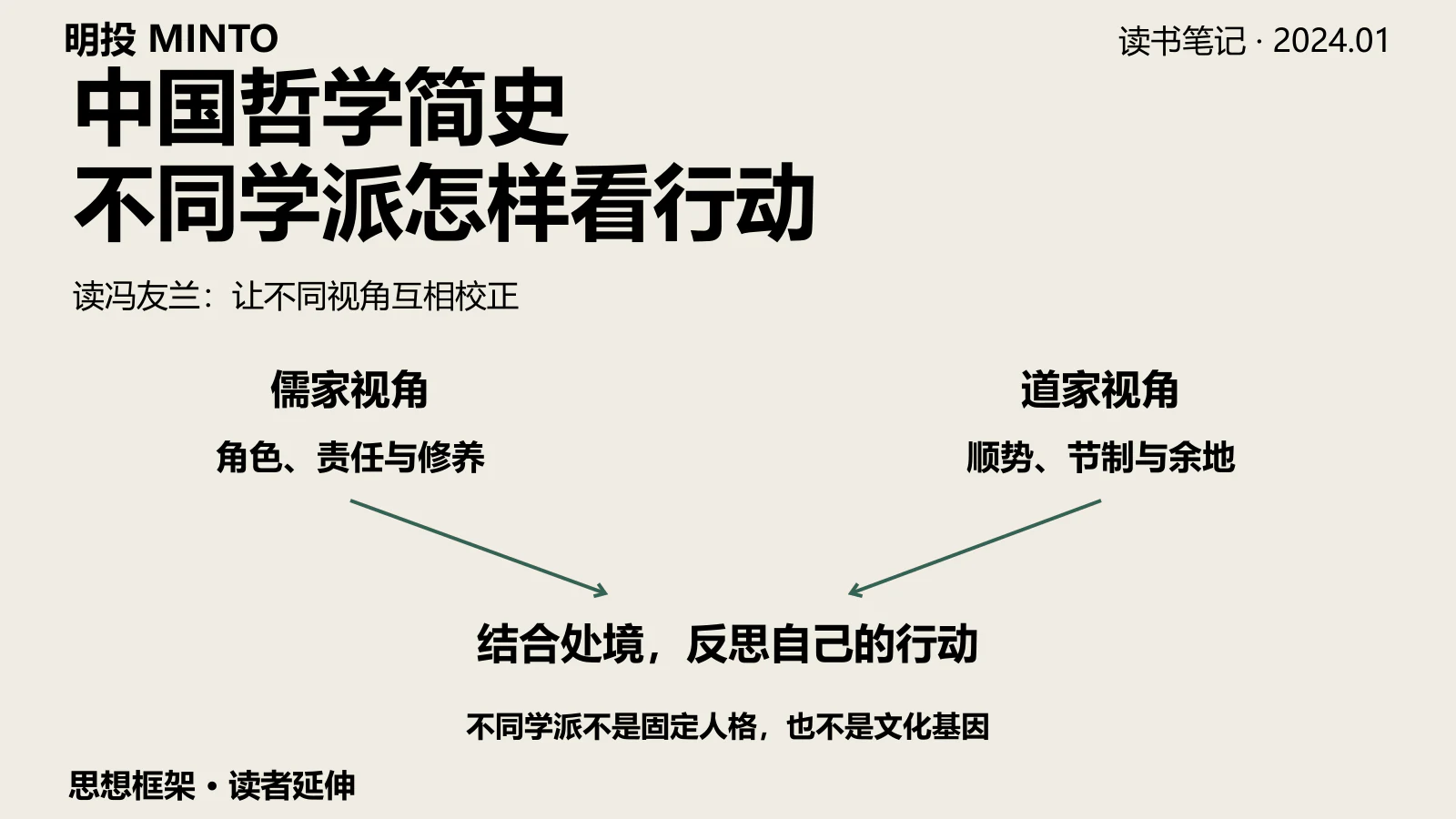
Third, the Confucian-Daoist complement— “When in the world, serve the world; when out of it, cultivate yourself.” Feng points out a profound phenomenon—the Chinese intellectual is inherently “Confucian-Daoist complementary”: use Confucianism when things go well (active, engaged, responsible) and Daoism when things go badly (retreat, preserve oneself, transcend). This dual operating system is extremely flexible—it lets one advance in good times and preserve in bad. In investing, this corresponds to a healthy mindset—bullish Confucian, bearish Daoist, neither missing the boom nor collapsing in the bust.

Three: The Deepest Insight—Chinese Philosophy Is “Worldly” Wisdom

Feng offers a key framework for understanding Chinese philosophy—the mainstream of Chinese philosophy pursues “sageliness within and kingliness without” (neisheng waiwang)—the highest spiritual realm within, yet effective action in the real world.

This is quite different from Western philosophy (especially its religious traditions). Many Western wisdom traditions are “otherworldly”—transcending the mundane, seeking the beyond. The mainstream of Chinese philosophy (Confucianism) is “this-worldly”—achieving the highest realm right here in everyday life, in concrete affairs.

Feng captures it with a phrase: “Being supremely lofty yet following the middle way” (ji gaoming er dao zhongyong): pursue the loftiest realm, but that realm is realized precisely in the most ordinary daily activities.

This has a profound implication for investors (and anyone working in the real world)—true wisdom is not escaping reality and transcending it, but showing your cultivation and realm in the most concrete, pragmatic, mundane decisions.

Wang Yangming’s “practice on things” (shi shang molian), Inamori Kazuo’s “cultivation through management”—these are all manifestations of the same “worldly wisdom.” Investing itself is a form of “practice on things”—your greed, fear, patience, discipline are all tested and tempered in every real, consequential trade. Chinese philosophy tells you—do not separate the “art of investing” from the “way of being human.” How you invest is how you live; your cultivation in investing is your cultivation in life.

Four: Where I Disagree with Feng Youlan

First, he may be too harmonizing a portrait of different schools.

Feng tends to synthesize Confucianism, Daoism, Buddhism, etc., into a complementary whole (“Confucian-Daoist complementarity”). But the actual history of Chinese thought has intense conflicts and tensions among schools, not all harmony. Feng’s “harmony narrative” may downplay these real tensions in favor of system-building. This echoes my general wariness toward all “grand unifying narratives”—oversimplification of complexity is itself suspect.

Second, the book was written in 1947, with the perspective of that era.

Written in the twilight of the Republic of China, Feng’s generation had a strong desire to “legitimize Chinese philosophy in dialogue with the West.” This gives the book a defensive undertone—it tends to present Chinese philosophy in its best, most systematic light. A more critical angle (what are the fundamental limitations of Chinese philosophy, why didn’t it develop science and modernity?) is relatively weak here.

Third, it underplays Chinese philosophy’s weakness: “heavy on morality, light on logic”.

The mainstream of Chinese philosophy places extreme emphasis on “moral cultivation” and “practical wisdom,” but relatively neglects “logical reasoning” and “systematic argumentation.” This is both its strength and its limitation—it excels at “mind techniques” and “realm talk,” but not at “analysis” and “proof.” For an investor, this means—Chinese philosophy gives you excellent “mind cultivation” (wu wei, the Mean, knowing when to stop), but it provides no “analytical frameworks” or “quantitative tools” (for those, you rely on the Western logical tradition—Porter, Kahneman, Shannon). A complete investor needs “a Chinese philosophy heart + a Western science brain.” Feng does not dwell enough on this limitation.

Fourth, the ideal of “sageliness within and kingliness without” often fails in reality.

Feng exalts neisheng waiwang—the person who has the highest inner realm and also achieves worldly success. But historically, very few have truly achieved both. More common are either those with inner realm but worldly failure (many upright literati) or those with worldly success but no inner realm (many pragmatic power holders). Neisheng waiwang is a beautiful ideal, but its assumption that “moral cultivation” and “worldly success” are linked is often falsified in practice (remember Machiavelli—the logic of power and the logic of morality often conflict). Feng’s idealism needs a Machiavellian dose of realism to stay grounded.

Five: Feng Youlan vs. Western Philosophy—The Division of Labor Between Heart and Brain

After reading this book and putting it alongside Western thought I’ve studied, a clear division of labor emerges.

Chinese philosophy (as arranged by Feng)—good at “heart” (xin): how to cultivate your mind, how to face gain and loss, how to grasp degree, how to maintain your realm in the midst of action. It gives you “wisdom for living and working.”

Western philosophy and science—good at “brain”: how to analyze logically, how to quantify, how to build falsifiable frameworks, how to argue systematically. It gives you “tools for analysis and decision-making.”

Chinese philosophy governs the heart; Western science governs the brain.

For an investor, both are indispensable—use the Western “brain” for analysis (Porter’s five forces, Kahneman’s biases, Shannon’s information, probabilistic thinking), and the Chinese “heart” for cultivation (wu wei’s restraint, the Mean’s balance, the wisdom of knowing when to stop, the honesty of “practice on things”).

The failure of most investors is not that their “brain” is inadequate (analytical ability), but that their “heart” is weak (emotionally dominated). The best analysis collapses in the face of fear and greed. This is precisely the greatest value of Chinese philosophy (and Stoicism, Wang Yangming)—it cultivates that “heart” which renders all analysis useless when it breaks down.

Six: Final Thoughts

My biggest takeaway from this book is a kind of self-awarenessit made me see clearly which set of logic I’m using deep down when I make decisions.

My risk appetite has Confucian “Mean” (instinctive avoidance of extremes). My patience has Daoist “going with the flow” and “knowing when to stop.” My attitude toward losses has the retreat of “when out of the world, cultivate yourself.” My conviction in “cultivating through concrete work” comes from neisheng waiwang and “practice on things.”

These two-thousand-year-old philosophies, without my knowing, have shaped every investment decision I make.

Understanding them gives two benefits:

First, play to strengths—the “heart methods” Chinese philosophy gives me (restraint, balance, going with the flow, knowing when to stop, treating investing as cultivation) are precious. They let me stay steady in volatility. I should consciously use them.

Second, shore up weaknesses—the “heart-heavy, brain-light” limitation of Chinese philosophy needs to be supplemented with Western analytical tools. A pure Daoist “wu wei” and Confucian “Mean” without Porter’s framework, Kahneman’s clarity, and probabilistic thinking would turn me into an investor with “great attitude but poor judgment.”

Feng Youlan has a phrase that sums up the highest pursuit of Chinese philosophy. I take it as my goal for investing and life—“Being supremely lofty yet following the middle way.”

Pursue the loftiest realm, but that realm is realized in the most ordinary daily actions.

For an investor, that means—the highest investment wisdom is not in some secret manual, but in every single mundane order you place—whether you can stay clear, restrained, honest, going with the flow, and knowing when to stop.

Investing is cultivation. How you invest is how you live.

This is the deepest lesson that Feng Youlan’s two thousand years of Chinese philosophy offers to a modern investor.

Minto
明投 Minto
投资分析 · 长期主义者
你读完了 · Colophon

A Book That Decodes the Chinese Mind: Feng Youlan

7
分钟
2024/01
期号
2024
年份
真正稀缺的,是一个不慌不忙的人。
明投 · MintoInvest Wisely
— From This Series
喜欢这篇?这类 读书笔记 的深度拆解会持续发到你邮箱。
无广告 · 随时退订
— Enjoyed the read?
如果这篇文章对你有用,把它分享给一个朋友,就是对我最好的支持。

口碑是独立创作者最稀缺的燃料。

— Discussion

说说你的想法

评论基于 GitHub Discussions(Giscus)。登录后即可留言、点赞、互相讨论。

评论还在准备中。

想说什么可以直接发我邮件,比在评论区更容易认真回复。

mingtaohuang617@gmail.com →
支持沉浸式阅读