跳到正文 · Skip to content
内容
关于与合作
订阅与会员
★ 查看会员权益
外观与设置
外观
主题色
版本 · 深色 / 减动搜索⌘K
草稿预览·这篇还没发布,不会出现在列表和 RSS 里。review 完后把 frontmatter 的 draft: true 改为 false 即可。

Effectiveness Is a Habit, Not a Talent: Drucker

Drucker argued that effectiveness isn't the privilege of the brilliant – he saw plenty of smart people accomplish nothing, and plenty of ordinary people deliver extraordinary results.

2024.08.227 min原创
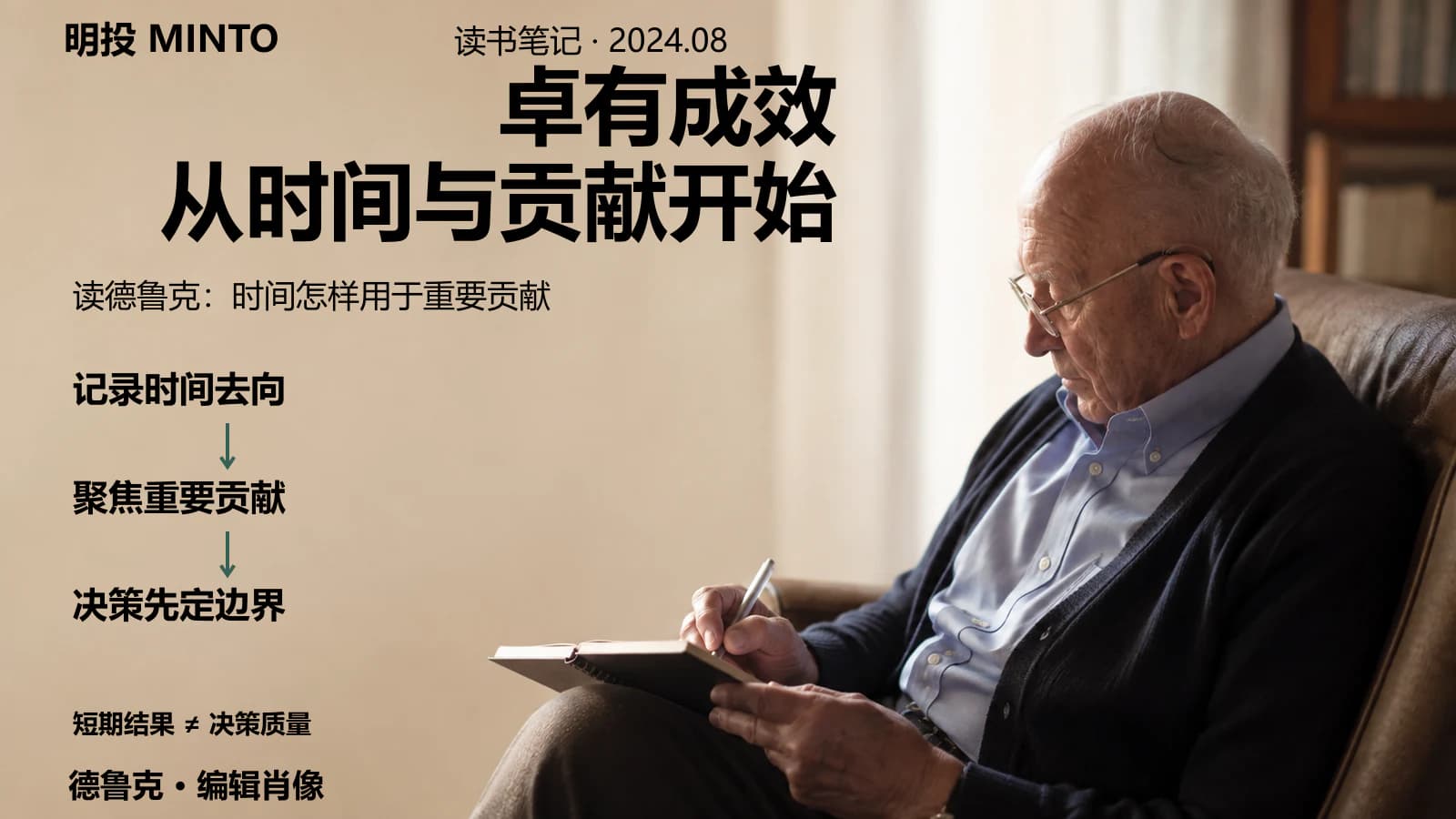
Effectiveness Is a Habit, Not a Talent: Drucker
读书笔记MINTOVIEW2024.08.22

现代管理学之父最实用的一本小书

Peter Drucker is known as the 'father of modern management.' He wrote 39 books over his lifetime, influencing everyone from GE to Intel. But the most practical, thinnest, and most personally relevant one is 'The Effective Executive,' published in 1966.

It has a counterintuitive premise – Drucker says 'effectiveness' is not a talent, but a learnable habit.

He saw plenty of brilliant, well-read, idea-rich people end up with nothing to show for it; and plenty of seemingly ordinary people who quietly produced remarkable results. The difference isn't intelligence – it's the habit of effectiveness.

The book is written for 'executives,' but Drucker's definition is broad – anyone who relies on their own judgment and decisions to contribute results is an 'executive.' An independent investor is, in essence, a one-person company's executive. So this book is really for anyone who makes decisions with their mind.

三个对投资者也成立的原则

First, focus on contribution, not effort. Drucker says ineffective people ask 'how much did I do, how hard did I try?' Effective people ask 'what results did I contribute?' Busy is not the same as effective. You can work 14 hours a day, read 100 research reports, watch the screen for 8 hours – if none of that translates into better decisions, it's just busywork.

For investors, this is a gut punch – most investors' 'hard work' is ineffective. Constant screen-watching, news-scrolling, chasing every rumor – it feels diligent but mostly degrades decisions, introducing noise and impulsive trades. Drucker would ask: Does what you're doing actually improve your investment outcomes, or does it just make you feel like you're doing something?

Second, prioritize the few important things, and do one at a time. Drucker says effective people concentrate on the few truly important tasks, one at a time. They don't do more – they do less, but better.

For investors, this echoes Buffett's '20-punch-card' idea – if you only had 20 investment decisions in your lifetime, you'd be extremely careful. An effective investor doesn't catch every opportunity; they catch the right ones. Channel energy into a handful of high-conviction decisions and pass on the rest.

Third, start every decision with 'boundary conditions.' Drucker's decision method isn't 'make up your mind fast' – it's first clarifying: What conditions must this decision meet to succeed? What's the worst case? Am I willing to accept it? He emphasizes that most bad decisions aren't because the answer was wrong – it's because the wrong question was asked.

For investors, this means – before placing a trade, think clearly: 'What's my core logic, what would prove me wrong, and how much could I lose at worst?' This is exactly what Dalio's 'trade journal,' Munger's 'inversion' both stress – define the boundaries of success and failure first, then decide.

最深刻的一句:管理你的时间,而非任务

One point from Drucker I keep coming back to is 'Know thy time.'

He says almost everyone overestimates their control over time. If you don't actively track it, you have no idea where it goes. Drucker advises – log your time honestly for a few weeks, and you'll be shocked to see how much is wasted on unproductive, non-result-generating activities.

This is extremely applicable to investors. If you are honest about tracking, you'll find – the time you spend on 'research and decision-making' is likely far less than the time spent on 'watching screens, scanning news, worrying, discussing market moves with others.' The first creates value; the second mostly consumes it.

Drucker's prescription – first identify and eliminate time-wasters, then protect large, uninterrupted blocks for deep thinking that really matters. The most important investment decisions require quiet deep thought, not fragmented screen-watching.

From this I developed a rule – Major investment decisions must be made in 'uninterrupted, screen-free, quiet' time. The trading day is the noisiest, most emotional, worst time for big decisions. Separating decision-making from screen-watching is Drucker's 'time management' most practical application in investing.

我跟德鲁克不同的地方

First, his 'rational decision' framework underestimates emotion and bias.

Drucker's method assumes people are reasonably rational – with the right process, you can make good decisions. But Kahneman and Thaler show human decisions are driven by unconscious biases and emotions – good 'method' alone isn't enough. Drucker wrote before the rise of behavioral economics; he didn't fully account for how systematically irrational we are. A complete decision framework needs, on top of Drucker's 'method,' defenses against your own biases (where Kahneman and Thaler fill in).

Second, 'focus on contribution' can be a trap in investing.

Drucker emphasizes focusing on results. But investing has a quirk – results (returns) in the short term are full of luck and don't accurately reflect decision quality (remember Marks and Taleb). If you 'focus on results' as Drucker says, you might reinforce a bad method because of a good short-term outcome, or abandon a good method because of a bad short-term outcome. In investing, you should focus not on 'results' but on 'decision quality' – this is where Drucker's framework needs adaptation for investing.

Third, his era was the 'organization man' era.

Drucker wrote when most people worked inside large organizations. 'Effectiveness' mainly meant 'contributing efficiently inside a hierarchy.' Today, more and more people are independent workers, creators, individual investors – they face not 'collaborating inside an organization' but 'fighting alone against their own procrastination, emotions, isolation' (remember Handy's 'fleas'). Drucker's 'organizational effectiveness' framework doesn't fully address this 'personal effectiveness.' A solo worker's biggest obstacle isn't inefficient methods – it's the breakdown of self-management.

Fourth, 'first things first' is easy to say, hard to judge.

Drucker says focus on the most important things. But the hard part is precisely 'judging what is most important.' In investing, how do you know which opportunity is one of those '20 punch cards' vs. a temptation to reject? Drucker gives the principle of 'focus' but not the tool for 'how to prioritize.' And that's the real difficulty – it requires judgment, and judgment is the hardest thing to teach.

德鲁克 vs Handy:组织人与独立人

Drucker and Charles Handy ('The Elephant and the Flea') represent two eras' 'philosophies of work.'

Drucker is the sage of the organization era – he teaches you how to be an effective contributor inside a large organization. His core question is 'how to make both organization and individual effective.'

Handy is the prophet of the post-organization era – he predicted the dissolution of large organizations and the rise of independent work. His core question is 'when you leave the organization, how do you survive alone?'

Drucker teaches you how to be an effective screw on an elephant; Handy teaches you how to be a flea that can survive independently.

For an independent investor (a 'flea' by nature), you need both perspectives – use Drucker's methods to manage your own 'work effectiveness' (focus, first things first, manage time), and Handy's wisdom to handle the 'structural lack' of independent work (create your own discipline, rhythm, and external feedback).

Drucker gives you the methodology for efficient work; Handy reminds you – when no organization imposes structure, you have to enforce these methods yourself – and that's the hardest part.

写在最后

Drucker died in 2005 at age 95. He maintained astonishing productivity and clarity all his life, still writing and consulting until the very end. He himself was a living example of 'effectiveness' – not by talent but by a lifetime of habit.

My biggest takeaway from this book is that it demystifies and de-geniuses 'effectiveness.'

Most people think achieving results requires intelligence, talent, inspiration. Drucker says – No. It requires a few learnable habits: focus on results, not busyness; do one important thing at a time; manage your time, not your tasks; before deciding, think through boundary conditions.

Anyone can learn these habits. They aren't sexy, they don't require genius, but they accumulate day after day to create the vast gap between people who are effective and people who are just busy.

For investors, this is both deeply reassuring and a sharp spur – you don't need to be a genius to invest well, but you need to develop the habits of effectiveness: focus on a small number of high-conviction decisions, think deeply in quiet time, don't waste energy on ineffective busyness (screen-watching, news-grazing), and before every decision, think through the worst case.

One Drucker quote I keep coming back to – 'Efficiency is doing things right; Effectiveness is doing the right things.'

Most investors are busy 'doing things right' (more detailed analysis, more diligent screen-watching) but rarely ask themselves 'Am I doing the right things?'

And that's the lesson Drucker spent his whole life really teaching. And the one most overlooked – yet most important – in investing.

Minto
明投 Minto
投资分析 · 长期主义者

专注投资分析、市场洞察与资产配置。不追短期波动,只理解真正驱动长期回报的东西。

你读完了 · Colophon

Effectiveness Is a Habit, Not a Talent: Drucker

7
分钟
2024/08
期号
2024
年份
真正稀缺的,是一个不慌不忙的人。
明投 · MintoInvest Wisely
— From This Series
喜欢这篇?这类 读书笔记 的深度拆解会持续发到你邮箱。
无广告 · 随时退订
— Enjoyed the read?
如果这篇文章对你有用,把它分享给一个朋友,就是对我最好的支持。

口碑是独立创作者最稀缺的燃料。

— Discussion

说说你的想法

评论基于 GitHub Discussions(Giscus)。登录后即可留言、点赞、互相讨论。

评论还在准备中。

想说什么可以直接发我邮件,比在评论区更容易认真回复。

mingtaohuang617@gmail.com →
支持沉浸式阅读