一本回答"终极问题"的书
In 1997, biogeographer Jared Diamond published Guns, Germs, and Steel. It won the Pulitzer Prize and became one of the most influential "big history" works of the past few decades.
It sets out to answer an extremely broad and sensitive question: Why did Europeans conquer the Americas, Africa, and Australia, rather than the other way around? Why has the development of civilizations been so uneven across continents?
The danger of this question: a racist answer ("because Europeans are smarter/superior") has been repeatedly used to justify colonization and oppression. Diamond wrote the book precisely to demolish that racist answer and offer a completely different explanation.
His answer: Geography. Diamond argues that differences in civilizational development can be almost entirely explained by differences in geography and environment, with nothing to do with race, intelligence, or cultural "superiority." The rise of Europe was not because Europeans were superior, but because Eurasia happened to have better geographic conditions.
地理如何决定命运
Diamond's chain of argument is extraordinarily elegant:
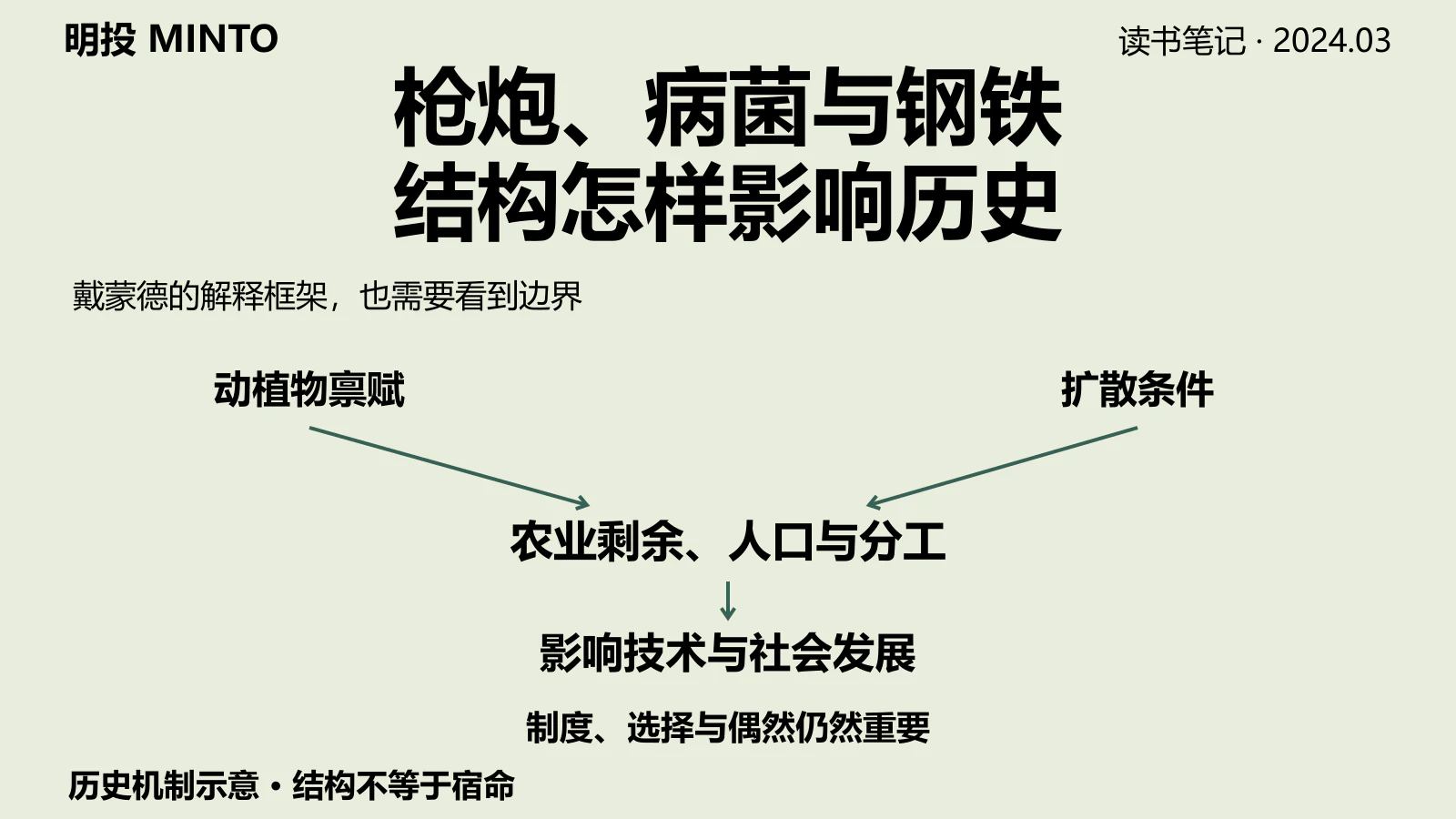
First, the uneven distribution of domesticable plants and animals. Eurasia happened to have the most domesticable large animals (cows, horses, sheep, pigs) and high-yield crops (wheat, barley). The Americas and Africa mostly had species that could not be domesticated (zebras can't be tamed; the Americas had no large domesticable draft animals). Only with domesticable plants and animals can you generate agricultural surplus, support non-food-producing specialists (craftsmen, soldiers, bureaucrats), and develop complex civilizations.
Second, the "axial orientation" of continents determined the speed of diffusion. Eurasia is east-west — at similar latitudes with similar climates, so agricultural techniques, crops, and livestock could spread quickly along the east-west axis. The Americas and Africa are north-south — crossing different climate zones, making diffusion extremely difficult. This simple geographic fact (whether a continent is horizontal or vertical) profoundly affected the speed of civilizational spread.
Third, germs were the invisible conquerors. Eurasians lived alongside domesticated animals for a long time, evolving immunity to various germs. When they reached the Americas, smallpox and other germs killed over 90% of the indigenous population — the conquest of the Americas was less about guns than about germs. And this difference in immunity was also determined by geography (whether domesticable animals existed).
So — guns, germs, and steel, the three things that allowed Europe to conquer the world, all trace back to differences in geography and environment, not to racial superiority.
对投资者的启示:长期格局由"结构"决定
This book offers investors a profound lesson in long-cycle, structural thinking — many outcomes that appear determined by "effort" or "ability" are actually, at a deeper level, determined by "structural conditions."
This mindset can be transferred to many investment judgments:
First, the long-term competitiveness of a country/region has deep structural roots. Why is America the innovation center? Not just because Americans work hard, but because of its "geography + institutional structure" — vast territory and resources, ability to absorb immigrants, deep capital markets, rule of law tradition, distance from major war zones. These "structural endowments," like Diamond's geography, profoundly shape its long-term destiny. Understanding these structures is more important for judging long-term trends than chasing short-term news.
Second, the long-term profitability of an industry has structural roots. Whether an industry is inherently profitable or not (remember Porter's five forces) is often determined by its "structure," not by the efforts of the firms within it. The airline industry works hard but struggles to make money (bad structure), while software platforms earn almost passively (good structure). Look at structure first, then effort — this is Diamond-style thinking applied to investing.
Third, beware of the "effort narrative" and emphasize "structural analysis." Our culture loves stories where "effort changes fate" (they're inspiring, easy to spread). But Diamond reminds us — for many outcomes, the role of effort is actually limited, while the role of structure is underestimated. A company's success may owe more to the good structure it sits in (good industry, good era, good geography) than to its "superior management" (remember the failure of Good to Great). Investment judgment must be wary of being seduced by the "effort/excellence" narrative, and instead look more at "structural conditions."
我跟戴蒙德不同的地方
First, geographic determinism is strong at explaining "long-term" but weak at explaining "recent."
Diamond's geographic determinism does a great job explaining ultra-long-term trends like "why Eurasia led for ten thousand years." But it can barely explain the dramatic changes of the last few centuries — why did Britain, not equally geographically advantaged China, lead the Industrial Revolution? Why did Japan, South Korea, and Singapore rise after WWII (geography didn't change, but outcomes did)? These recent upheavals cannot be explained by geography; they require institutions (Acemoglu), culture, policy, and contingency. Geographic determinism is an "ultra-long-term" explanation; its explanatory power is limited for the "decades-scale" that concerns investors.
Second, it has an overreach tendency toward geographic determinism.
To oppose the racist explanation, Diamond attributes almost all differences to geography. But that is overreach — he underestimates the roles of institutions, culture, individual choices, and contingent events. Acemoglu directly challenges Diamond — North and South Korea share identical geography, but due to different institutions, their outcomes are worlds apart. Geography is an important initial condition, not destiny. Attributing everything to geography is the same single-variable oversimplification as attributing everything to race (just in the opposite direction).
Third, it underestimates human agency.
A dangerous side effect of geographic determinism is that it can make people think "everything is predetermined, effort is useless." But history repeatedly shows — within given geographic conditions, human choices (institutions, policies, culture) can make enormous differences. Singapore's geography is not special, but Lee Kuan Yew's choices made it rise. Diamond's framework can easily make people overlook that "within structural constraints, agency still matters." For investors, this means — structure matters, but don't fall into the fatalism of "structure determines everything." Specific companies, management, choices can still make a difference within the structure.
Fourth, its "scientific narrative" may be too neat.
Diamond's argument is extraordinarily elegant, coherent, and persuasive. But real history is far messier than any single theory. A theory that can explain ten thousand years of history consistently with "geography" should itself be a warning — it may sacrifice historical complexity and contingency for narrative neatness. This aligns with my general wariness of all grand unifying theories (Siegel, Acemoglu, Arthur all have this problem) — beautiful theories often oversimplify messy reality.
戴蒙德 vs Acemoglu:地理 vs 制度
Diamond and Acemoglu (Why Nations Fail) represent two major competing schools explaining "rise and fall of nations," and they have publicly debated.
Diamond says — Geography determines destiny. A region's long-term development is mainly determined by its geographic and environmental endowments.
Acemoglu says — Institutions determine destiny. Geography is secondary; what really determines a nation's rise or fall is its political and economic institutions (inclusive vs. extractive).
Diamond explains "ultra-long-term initial differences," Acemoglu explains "recent divergences."
Who is right? My judgment: they are answering questions at different time scales. On the ten-thousand-year scale, Diamond is right — geography determined which regions could first develop agriculture and civilization. But on the last few centuries' scale, Acemoglu is right — given geographic conditions, institutional choices caused huge divergences (North vs. South Korea, East vs. West Germany, Singapore vs. its neighbors).
For investors, the combined lesson is — to judge a country/market's long-term prospects, look at both its "structural endowments" (geography, resources, population — Diamond) and its "institutional quality" (property rights, rule of law, innovation incentives — Acemoglu). The United States is the preferred long-term market precisely because of the rare combination of "excellent structural endowments (Diamond) + very high institutional quality (Acemoglu)."
写在最后
My biggest takeaway from this book is a humble long-cycle perspective — many successes we attribute to "effort" and "superiority" are, in the final analysis, products of structure and luck.
This perspective is extremely important for investors because it cures a dangerous mindset — simplistically attributing success to ability.
Diamond tells you that Europe conquered the world not because Europeans were smarter, but because they happened to stand on a better geographic structure. The same logic can be transferred — a successful company may be less about its excellent management and more about happening to be in a good industry, good era, good structure (remember the failure of Good to Great, remember Porter's "industry structure determines profitability"). A successful investor may be less about skill and more about happening to be born in a long bull market, a rising era (remember Taleb's "lucky fool," Buffett's demographic tailwind).
This is not to deny effort and ability. It is to remind — when attributing success, leave enough room for "structure" and "luck," and don't put everything on "ability."
This humility keeps you from arrogance when you succeed (knowing there were structural and lucky components), from blindly following others' success (knowing it might be structurally driven), and makes you focus more on "structural conditions" than "effort narratives" when making long-term investment judgments.
Diamond uses ten thousand years of history to provide a grand footnote to this humility — destiny, to a large extent, is determined by structures that existed before we were born. What we can do is make the wisest choices possible within those structures.
For investors, this means — choosing the right structure (good market, good industry, good era) is far more important than working hard within a bad structure.
This is the most unexpected and profound lesson geographic determinism has to offer a modern investor.