# Why This Book Isn't About Investing
Many people pick up Principles because of the "Bridgewater founder" label, hoping for a hedge fund's trading playbook. They finish disappointed—the book barely talks about how to trade.
But that's exactly what makes it powerful. Dalio isn't writing about investing at all. He's writing about how to turn yourself into a system that keeps getting better for 30 years.
Investing is just a byproduct of that system.
His own summary is a formula: Pain + Reflection = Progress.
It's so simple anyone can understand it. Yet when it comes to action, almost no one follows through—because they bail at the "pain" step.
Losses are painful. Being wrong in public is painful. Admitting mistakes is painful. So most people's first reaction to pain is to escape—"It was a black swan," "The market was irrational," "I was unlucky."
Once you escape, reflection disappears. Without reflection, progress stops. True compounding doesn't happen in your account—it happens in your reflection.
In the most painful moments of the 2022 rate-hiking cycle, I read this book over and over. That year I made a big mistake—in August, before Powell's Jackson Hole speech, I levered up to a level that made me uncomfortable. Two months after the speech, U.S. stocks gave back 12% across the board. If not for the word "reflection" in that book—forcing me to write down my entire judgment chain—I would have blamed the loss on "Powell being too hawkish" and made the same mistake again next time.
Writing it down made me see clearly: in my July analysis, I hadn't seriously assigned any probability to a "hawkish surprise." I just assumed risk was gone because my account had bounced from the June low. Pain isn't the problem; avoiding reflection is.
# What Dalio Is Really Selling Isn't Principles—It's Recording
The most quoted concept in this book is "principles." But after three re-reads, I realized the real tool is something else—writing it down.
Dalio insists that every major decision, every mistake, every emotional swing must be recorded. Not vaguely—structurally.
Why? Because the human brain naturally edits the past. Six months later, you won't remember the exact reasoning behind today's judgment. You'll remember "I was right that time" or "I was so unfairly treated."
Both are rearview-mirror fictions. They won't help you do better next time.
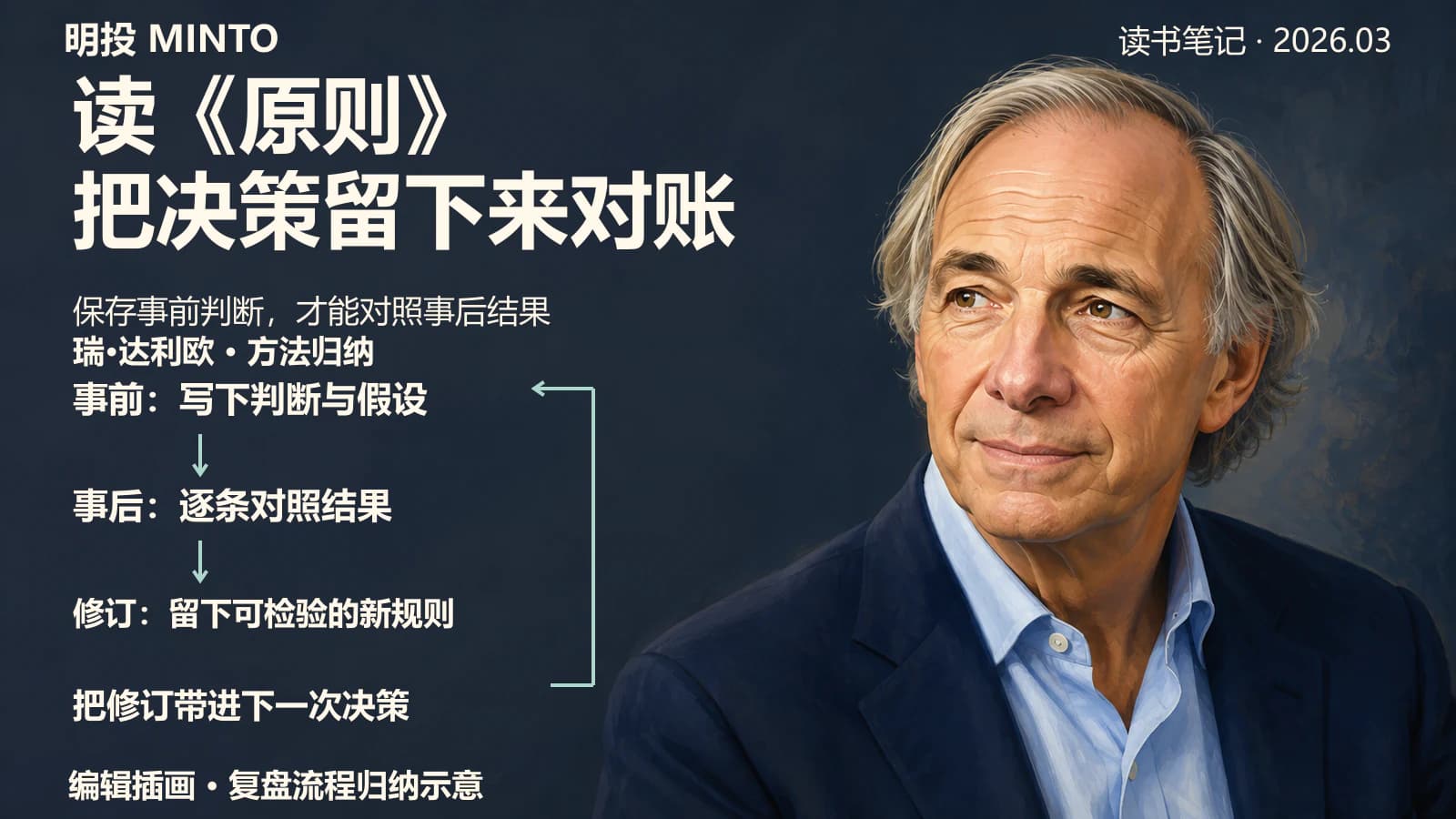
So Dalio's core method isn't "set principles"; it's "write down your real decision logic, then check it against outcomes."
I started doing this myself in 2023. A Notion doc called "Trade Diary." Before every concentrated bet, I must write four things:
- My core thesis for buying this company (one sentence)
- The valuation I'm paying, and what assumptions that valuation implies
- How I will be wrong if I am wrong
- How long before I review this decision
After three years, this diary has taught me more than any investment book. Because it forces me to face not the market, but the past version of myself.
The most interesting finding: most of my losing trades had a vague "core thesis" line; most winning trades had a clear, sharp sentence. If you can't write a clear thesis, you're gambling—the diary doesn't lie.
# On Radical Transparency: The Overhyped Part
Another overused concept from Principles is radical transparency—all Bridgewater meeting recordings, all decision logs, all ratings are accessible to every employee.
It got wildly praised in Silicon Valley, with startups claiming they would build a "radically transparent culture."
My take: just because it works at Bridgewater doesn't mean it works for you.
Radical transparency at Bridgewater presupposes 1,500 highly educated, highly homogeneous employees, all bound by strict NDAs. It works because the organization has already been filtered.
Drop that into a typical small company—20 people, mixed backgrounds, high turnover—and radical transparency probably won't create culture; it'll create infighting.
That's not Dalio's fault. It's readers automatically translating "works at Bridgewater" into "works everywhere." That translation is the disaster source of most management books.
Bridgewater's methods only work in Bridgewater's context. That's the sentence from this book I least wanted to admit—and the one I most need to.
In fact, Bridgewater itself quietly dialed back this system after 2017. Many former employees complained the rating system became a pressure tool, and the messy succession fight around Dalio partly stemmed from the system's failure. Any methodology that claims to be universal on its own is suspicious—Dalio should know that better than anyone, yet he got stuck here himself.
# Where I Differ from Dalio
By my third reading, I found several genuine disagreements with Dalio.
First, his All Weather portfolio broke in 2022.
Dalio's most famous asset allocation uses risk parity to build a portfolio stable across all macro environments—roughly 30% stocks + 55% long-duration bonds + 15% commodities/gold. From 1981 to 2020's secular bond bull, it worked beautifully: steady annualized returns with low drawdowns.
But 2022 produced its ugliest failure ever—stocks and bonds fell together, commodities surged then dropped, and All Weather suffered a drawdown of around -20%, its worst year since inception.
The reason isn't complicated: All Weather assumes stocks and bonds are negatively correlated. That assumption held in the low-inflation environment since 1981, broke in the high-inflation 1970s, and broke again in 2022's "inflation return + rate hikes."
My view on All Weather has therefore changed—it's not an "all-weather" portfolio; it's a "low inflation + low interest rate" portfolio. If they renamed it the "Low-Inflation Portfolio," I wouldn't object. Calling it "all-weather" is marketing.
Second, his "Bridgewater model" is really a set of macro bets dressed up as a system.
Dalio often talks about "the machine"—he believes the economy, markets, people are all pattern-driven machines. It's a beautiful metaphor. But look at Bridgewater's actual trades: they're essentially bets on a few core macro judgments—the dollar cycle, long-bond yields, commodity cycles. When those judgments are right, the machine looks brilliant; when they're wrong, the machine collapses.
In 2022 he bet wrong on inflation persistence. In 2023 he bet wrong on the Fed pivot speed. The machine gives you a story; the bad part is it makes you forget you're guessing.
This isn't to say Bridgewater is bad. It's to say all "systematic investing" is still judgment—just engineered judgment. Mistaking it for an "objective system" is a misreading.
Third, his "culture as a filter" thesis is useless for individual investors.
Dalio often says Bridgewater's culture is its moat—a group of homogeneous, self-correcting people who rate each other. That narrative is completely useless for a solo investor, because a solo investor is just one person.
My own substitute: find two or three people with different styles but intellectual honesty, and review each other's positions quarterly. It's not "Bridgewater culture," but it forces me to reconcile, to admit blind spots I can't see. For an individual investor, three real critics are worth more than 30 books.
Fourth, his calls on cycles are frequently wrong, and he's reluctant to acknowledge that directly.
Dalio has repeatedly predicted a "century debt crisis" since 2018, and the timing has been off every time. He called China the next hegemon, and China's GDP growth has systematically stepped down since 2022. His long-cycle direction sense isn't bad, but on timing, his public record is not high-conviction.
In this book, he presents the stance "I have principles so I can keep correcting"—but in his public forecasts, he often behaves less like someone constantly correcting and more like someone simply saying the same thing in different words.
What I learn from this isn't "don't trust Dalio"—it's when someone starts sanctifying their own method, even they find it hard to correct honestly. That's the inner tension of Principles: it preaches constant revision while crafting the author as a wise man who needs no revision.
# Dalio vs. Soros: Two Macro Investors
Macro investing requires looking at two figures: Dalio and Soros. Both spent their lives on macro, both made fortunes, but their methodologies are nearly opposites.
Dalio believes "the world is a machine." His method is essentially modeling—digitizing macro variables, finding patterns, betting with the pattern.
Soros believes "the world is a reflection." His method is essentially observing how humans misinterpret the world, then betting before that misinterpretation corrects. His famous "reflexivity" theory is exactly this—market participants' judgments change the market itself, so there's no objective truth, only evolving consensus.
My own judgment on these two approaches: Dalio suits slow bull markets; Soros suits turning points.
During a slow bull, macro variables are smooth and machine models work. During a turning point, macro variables jump, machine models collapse, and "people readers" can make money.
2022 was a turning point. Dalio had a rough year; Soros-style investors generally performed better.
2024 was a slow bull. Dalio should be more comfortable—though specific results aren't publicly visible.
My own stance: use Dalio's discipline most of the time, but switch to Soros's observation near turning points. These aren't binary choices; they have different windows of applicability.
# The Most Useful Paragraph for Individual Investors
If I could take one passage out of this book, it would be this (my own summary):
Don't trust your gut; trust your data. Don't trust "this time is different"; trust that history rhymes. Don't trust "I was right"; trust that you could still be wrong even when you're right.
These three lines don't feel like quotes—they feel like three rulers for reconciliation.
Once you internalize them, you stop chasing being right every time. You chase knowing which link broke when you were wrong—and fixing it.
# Conclusion: Principles Aren't Answers, They're Revision Logs
This book is over 600 pages with hundreds of principles. You don't need to remember all.
You just need to build your own version—based on your experiences, mistakes, lessons—write, revise, discard what's useless, keep what's proven.
That document might start with three entries. After three years it grows to thirty. After thirty years, to three hundred.
And then you have your "principles." They weren't borrowed—they were bought with your own mistakes.
Final Note
I recommend this book to anyone making investment decisions who feels they should be more systematic.
But read it right. Don't read it as an investing guide—it isn't. Read it as a methodology on how to get along with yourself, and it will be ten times more useful.
The one key line, I'll re-copy: Pain + Reflection = Progress.
Only "pain" without "reflection" makes you someone who repeats the same mistakes.
And I think that's where most investors get stuck.
The step Dalio himself got stuck on is another matter—after writing this book, he stopped practicing what it teaches.
That's another story. But for the reader, the best way to read this book is to take the method and drop the worship.
专注投资分析、市场洞察与资产配置。不追短期波动,只理解真正驱动长期回报的东西。