1. A Crisis Manual Given Away for Free
In 2018, Ray Dalio published The Big Debt Crises (also titled Principles for Navigating Big Debt Crises). This book has a peculiar feature — he released the digital version for free, because he said he had made enough money from debt crises in his lifetime and now wanted to give back his approach to the world.
This book is completely different from Principles. Principles is about life and decision-making methodology; this book is hardcore macroeconomic analysis — it unpacks 48 major debt crises over the past 100 years, identifies their common structure, and builds a "debt supercycle" model.
Dalio's core belief is that the economy is essentially a machine. Debt crises are not random disasters; they are the result of the machine operating according to predictable laws. All debt crises are fundamentally the same movie, just with different actors and sets.
Understand this machine, and you can see its shape before a crisis arrives — that is the entire value of this book.
2. The Debt Supercycle: How Prosperity Breeds Collapse
Dalio's core model is the "debt supercycle," which roughly has several phases:
Phase 1: Healthy early phase. Debt grows, but it is used for income-producing investments; the debt-to-income ratio is healthy. The economy booms.
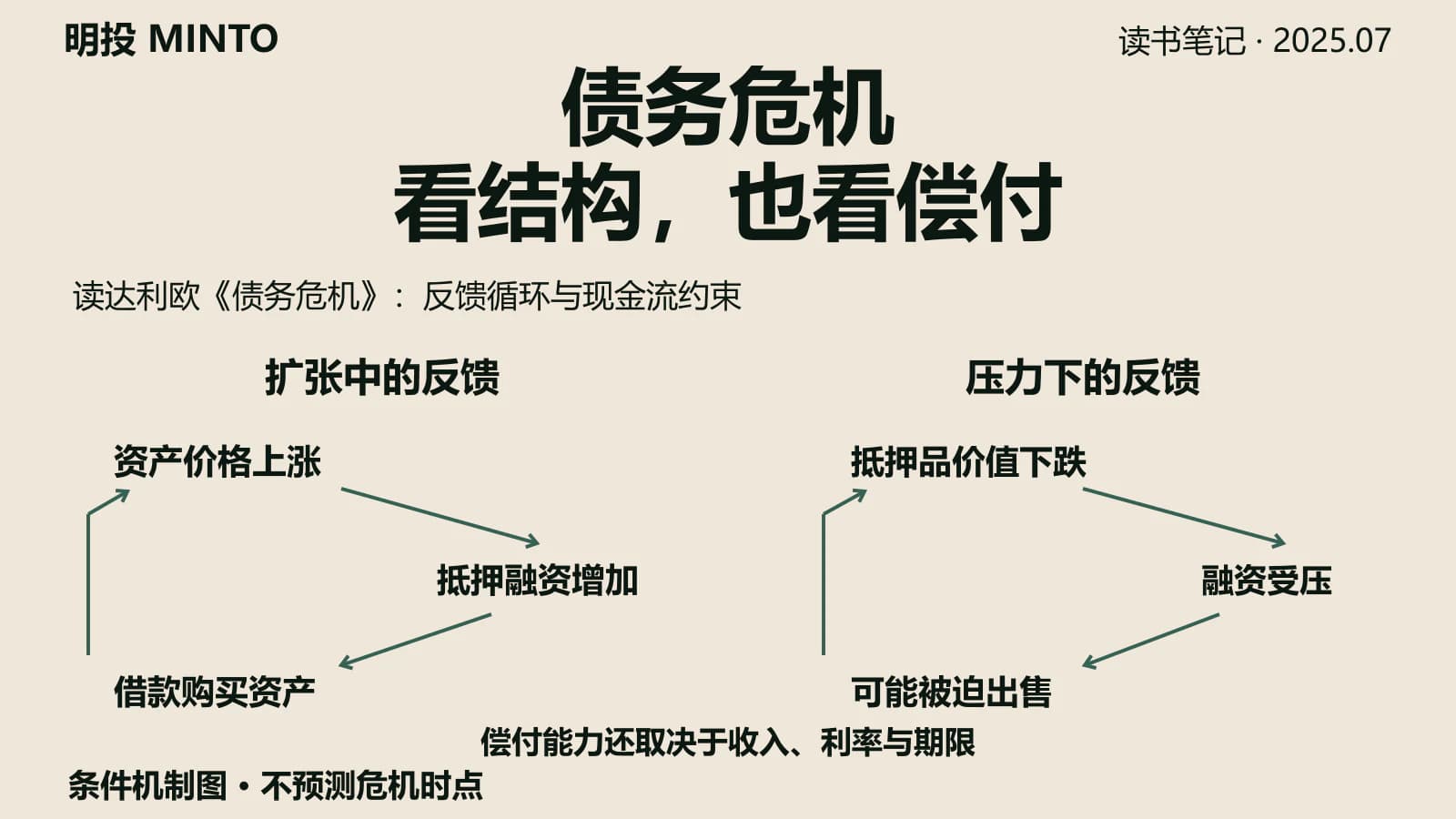
Phase 2: Bubble. Debt growth starts to outpace income. People borrow not for production, but for speculation (buying assets that are already rising). "Borrowing to buy up" becomes self-reinforcing — assets go up → collateral appreciates → ability to borrow more → buy more → assets keep rising. This is exactly Soros's reflexivity.
Phase 3: Top. The debt-to-income ratio reaches unsustainable levels. Interest rates rise, or asset prices stop increasing, and the "borrow to buy" logic breaks suddenly.
Phase 4: Depression. Deleveraging begins. Asset prices collapse → collateral shrinks → forced selling → prices fall further. This is what happened in 2008.
Phase 5: Deleveraging and recovery. Central banks print money, debt is restructured, fiscal stimulus is deployed — various ways to reduce the debt burden.
Dalio's most valuable insight is that Phase 5 can be "beautiful deleveraging" or "ugly deleveraging." The key is whether the central bank can find a balance between "deflationary pressure (deleveraging)" and "inflationary pressure (money printing)." If balanced well (the US post-2008), the recovery is mild; if balanced poorly (Germany in the 1920s), hyperinflation.
3. A Practical Tool for Investors: Look at Debt, Not Just GDP
The most useful tool this book gives investors is determining where you are in the debt cycle.
Dalio's key indicators:
First, the rate of change of the debt-to-GDP ratio. Don't look at the absolute level, look at the rate of change. When debt growth persistently outpaces income growth, a bubble is accumulating.
Second, the ratio of debt service costs to income. When more and more income goes to debt repayment (rather than consumption and investment), the cycle is near its top.
Third, whether new debt is used for "production" or "speculation." Healthy debt goes into investments that generate returns; dangerous debt goes into buying already-rising assets.
Applied to the US in 2025 — federal debt-to-GDP has exceeded 120%, near post-WWII historical highs; interest payments are becoming one of the largest single items in the federal budget. By Dalio's framework, this is a position worthy of high vigilance. It doesn't mean collapse tomorrow (cycles can last a long time), but it means future policy space is narrowing, and the next time a crisis hits, central bank ammunition will be less than in 2008.
When I look at macro, the most practical lesson I learned from this book is — don't just look at GDP growth; look at how much debt was incurred to generate that growth. Growth bought with massive debt is fragile; it must be paid back at some point in the future.
4. Where I Differ from Dalio
First, the metaphor "the economy is a machine" is both a strength and a trap.
Treating the economy as a predictable machine allowed Dalio to build a beautiful model. But the machine metaphor underestimates the reflexivity and unpredictability of the economy — the economy is not just a machine; it consists of people who change their behavior. In every crisis, the actors "think it's different this time," and this very thinking alters how the machine operates. Dalio's model is good on "structure" but almost always wrong on "timing" (he has been warning of a major debt crisis since 2018, and it hasn't arrived on his schedule).
Second, his own track record does not match the confidence of this book.
Dalio demonstrates a deep understanding of the debt cycle in this book. But Bridgewater's actual performance in recent years has been unimpressive, and Dalio's personal public macro forecasts have repeatedly missed — he was bearish on US stocks, bullish on China, and warned of debt crises; most of these calls didn't pay off in 2019-2024. Understanding the structure of a cycle is not the same as predicting its timing. The biggest limitation of this book is that it leads readers to believe "understanding the model means you can predict," but Dalio himself has shown these two things are separate.
Third, his sample may overstate "regularity."
Dalio extracted a common structure from 48 crises. But historical samples are limited, and the background of each crisis is vastly different. Forcing them into one model may be a kind of "ex-post neatening" — real crises are far messier. Especially with new variables like AI, cryptocurrencies, and central bank digital currencies, the next crisis may take a shape never seen before. Using 100 years of old scripts to predict a structurally changing future is risky.
Fourth, he underestimates how "politics" can disrupt deleveraging.
Dalio's "beautiful deleveraging" assumes that central banks and governments can rationally coordinate and make optimal decisions. But in reality, deleveraging is highly politicized — who bears the losses (savers, taxpayers, creditors, or everyone via money printing) is a political struggle, not a technical decision. In a politically polarized environment (the US in 2025), the political coordination required for "beautiful deleveraging" may be impossible. Dalio's model is too "technocratic" and underestimates the destructive force of politics.
5. Dalio vs. Minsky: Who Saw the Debt Cycle First
Dalio's debt supercycle actually stands on the shoulders of the economist Hyman Minsky. Minsky proposed the "Financial Instability Hypothesis" decades ago — stability itself breeds instability.
Minsky's core insight is that a long period of prosperity and stability causes people to gradually relax their guard against risk, taking on more and more debt until the system becomes extremely fragile, and then a small shock triggers a collapse (this collapse moment is called a "Minsky moment").
Dalio essentially datafied, modeled, and operationalized Minsky's insight. Minsky gave the idea; Dalio gave the tool.
The combined lesson is: the seeds of crisis are planted precisely during the most prosperous, stable, and reassuring times. When everyone feels that "this time is different, risk has been tamed," that is precisely when the system is most fragile.
The market in 2025, after an AI-driven long bull run, is seeing a mood of "risk is tamed" spreading. This is exactly the state Minsky and Dalio would both warn about.
6. Closing Thoughts
The writing style of this book is extremely plain — lots of charts, data, and case studies, almost no literary flair. Dalio is not a great writer, but he is an honest researcher. He unreservedly wrote down his method of betting on macro cycles over decades and gave it away for free.
The biggest takeaway for me from this book is not the ability to "predict the next crisis" — this book precisely proves that predicting the timing is nearly impossible. What I gained is a sense of structure:
Debt crises are not natural disasters; they are the inevitable byproduct of prosperity. They have identifiable phases. You cannot predict when they will come, but you can judge whether they are accumulating or releasing. Most importantly, the moment everyone feels safe is precisely the most dangerous.
This sense of structure does not allow me to time the market, but it allows me to adjust my posture at different points in the cycle — preserve ammunition and reduce leverage during debt-fueled mania; prepare to buy in the rubble of deleveraging.
A quote from Dalio keeps coming back to me: "Pain is inevitable, but learning from pain is optional."
The pain of a debt crisis repeats every generation. Because each new generation forgets the lessons of the previous one, always believing "this time is different."
And this book is for those willing to remember.
Those who remember will not avoid the crisis — no one can. But they will survive it, and then pick up in the rubble what others were forced to discard.
That is the whole point of understanding cycles.