One: A Book About When People Are Happiest
Mihaly Csikszentmihalyi is one of the founders of positive psychology. In 1990, he published Flow—a psychology book about human "optimal experience."
His decades of research centered on one core question: When are people happiest, most fulfilled, and most productive?
His answer upends most people's intuition: not when they're relaxed, enjoying themselves, or doing nothing. On the contrary, optimal experience happens in a state called "flow"—when you are fully absorbed in a challenging task, so focused that you forget time, forget yourself, forget everything around you.
A climber on a cliff, a chess player in a game, a writer at work, a surgeon in an operating room—in that moment, they enter a state of "self-forgetfulness," deep concentration, unity of self and action. That's flow, and it's the highest form of happiness a person can experience.
Why should investors read this book? Because the kind of deep focus, independent judgment, and emotional control that investing requires is essentially flow—and the market is the environment most likely to destroy that state.
Two: The Conditions of Flow: Balance of Challenge and Skill
Csikszentmihalyi found that flow has several key conditions, the most central being: balance of challenge and skill.
When the challenge level of a task just matches your skill level, flow arises—
Challenge far exceeds skill → anxiety (too hard, can't do it). Challenge far below skill → boredom (too easy, uninteresting). Challenge and skill just match → flow (just within reach, total focus).
This has a profound parallel for investors: The "flow state" in investing happens when you do research and make judgments that match your competency with a moderate challenge (remember Buffett and Munger's circle of competence).
Within your circle of competence, with a moderate challenge—understanding a company you can grasp, analyzing an industry you've accumulated knowledge in—you enter flow: focused, engaged, enjoying the thinking itself.
But straying too far outside your circle (gambling on a sector you know nothing about) leads to anxiety (because you lack the skill to match the challenge, so you're just speculating). And having no challenge at all (mindlessly chasing hot stocks, following the herd) leads to boredom, which you try to escape by overtrading for stimulation.
The best state in investing is deep, moderately challenging research and judgment within your circle of competence—that's the flow of investing. It's both effective (focus leads to good decisions) and happy (immersed engagement is itself enjoyable).
Three: The Deepest Insight: Flow Requires Autonomous Attention
Csikszentmihalyi's deepest insight is that flow requires the ability to control your attention autonomously.
Flow is a state of deep concentration. And concentration means you can decide where to place your attention and block out all distractions. Someone who cannot control their attention (constantly interrupted by notifications, emotions, external stimuli) can never enter flow.
In 2025, this is a hundred times more severe than in 1990—because we live in an era of systematic attention掠夺 (remember Gleick—attention has become the new scarcity). Social media, push notifications, endless newsfeeds, flickering prices—they all compete to slice up and destroy your attention.
For investors, this is a fatal problem: the market environment is the greatest killer of attention.
Real-time price movements, constant financial news, social media hype and panic, instant account P&L stimulation—they continuously hijack your attention, preventing you from entering the flow state needed for deep research and independent judgment. The result: your investment decisions are increasingly made by "fragmented, emotion- and noise-driven, shallow reactions," not "deeply focused, independent judgment."
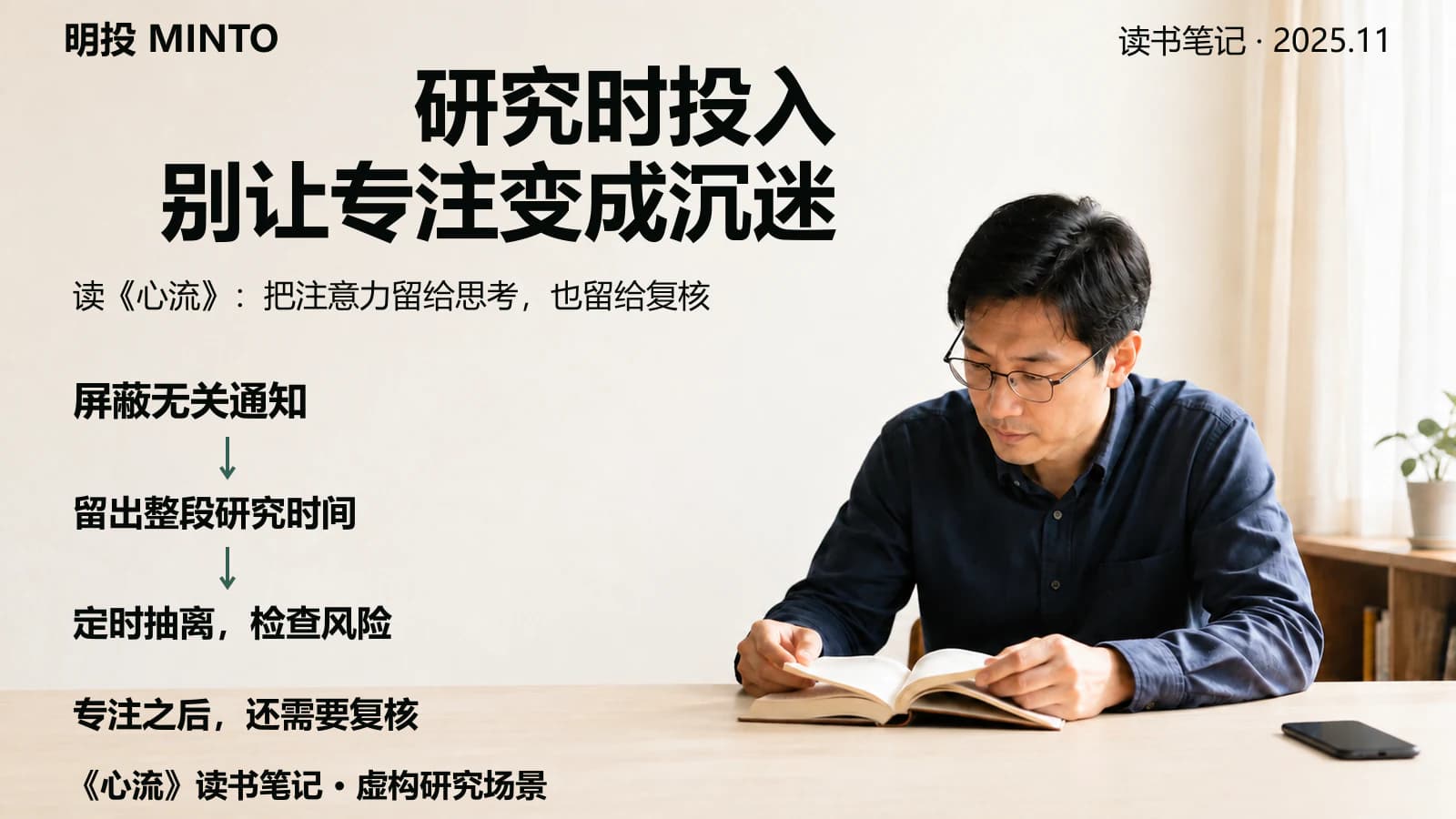
Csikszentmihalyi would say: Reclaiming the autonomy of your attention is the prerequisite for entering investment flow. That means actively isolating market noise: not staring at screens, turning off push notifications, staying away from hype communities, doing deep research in quiet, uninterrupted blocks of time (remember Drucker—major decisions should be made in quiet deep time). Protecting your attention is protecting your most important investment skill.
Four: Where I Disagree with Csikszentmihalyi
First: Flow in investing can have a dangerous side.
Flow is a state of deep immersion and self-forgetfulness. But in investing, this immersion can be dangerous—it can make you overly engrossed and lose a detached perspective. A person in "trading flow" (especially high-frequency trading or staring at charts) may focus so much that they forget risk, forget the big picture, forget to step back. Some flow is healthy (deep research), some is dangerous (addiction to screen-watching and trading adrenaline). Csikszentmihalyi doesn't discuss enough the "dark side of flow" (addiction, dependency)—yet gambling, gaming, and high-frequency trading can all produce a dangerous, addictive "pseudo-flow." Investors must distinguish "research flow" (good) from "trading thrill" (dangerous pseudo-flow).
Second: It underestimates the value of doing nothing.
Csikszentmihalyi champions "full-engagement optimal experience" and relatively disparages "passive relaxation." But investing (and creation) also needs empty space for doing nothing—many of the best insights come during relaxation, walks, daydreaming, moments of "sudden illumination," not during high-intensity focus (remember Laozi's "Empty the mind to the utmost, abide in stillness"). Overemphasizing "flow-style high-intensity engagement" may cause people to neglect the value of "blank space and rest" for deep thinking. The best state alternates between "deep focus" and "relaxed emptiness," not a single-minded pursuit of flow.
Third: The "challenge-skill balance" is hard to judge in investing.
Csikszentmihalyi says flow comes from "challenge matching skill." But in investing, judging whether a challenge matches your skill is itself extremely difficult—we often overestimate our own skill (overconfidence, remember Kahneman), thereby mistaking "gambling far outside one's circle" for "a matched challenge." A person betting on a sector they know nothing about may feel they're in "flow," but in reality they are "anxious gambling" without knowing it. Flow theory assumes you can accurately assess your skill level, but that's exactly the hardest thing (the boundary of your circle of competence is hardest to recognize).
Fourth: It's a psychology of "individual experience," lacking a "system and environment" dimension.
Csikszentmihalyi focuses on how individuals can achieve optimal experience. But he relatively neglects that the modern environment—especially digital environments designed to hijack attention—is systematically at war with flow. If you can't enter flow today, it's often not because you lack self-discipline, but because the whole environment (algorithms, notifications, tickers) is meticulously engineered to destroy your focus. This is not something individual willpower can easily overcome (remember Thaler—rely on mechanisms, not willpower). Csikszentmihalyi treats "achieving flow" mainly as personal cultivation, underestimating the necessity of "systematically redesigning your environment" (physically isolating noise, using mechanisms to block distractions).
Five: Flow vs. Stoicism/Daoism: Two Inner States of Focus and Detachment
Flow (Csikszentmihalyi) and the Stoicism (Marcus Aurelius) and Daoism (Laozi) I've read both describe an "ideal inner state," but from different angles.
Flow is about highly engaged concentration—total absorption to the point of self-forgetfulness, unity of self and action. Stoicism/Daoism is about detachment and calm—not being disturbed by external things, controlling what you can, detaching from what you can't.
Flow is 'immersed engagement'; Stoicism/Daoism is 'calm detachment.'
They seem opposite, but for investors, they are complementary states, corresponding to two different phases of investing:
During research and judgment: flow — fully absorbed, deeply understanding a company, an industry, a decision. This is the engaged, focused state.
When facing results and volatility: Stoicism/Daoism — toward the outcomes of decisions already made, toward market ups and downs, maintain a detached calm, not disturbed by them (remember Marcus Aurelius' "control dichotomy," Camus' "detachment from results").
The best investors can switch between these two states freely: during research, flow-like immersion (deep focus leads to good decisions); during holding, Daoist detachment (not emotional about fluctuations). Immersed without addiction, focused without anxiety, detached without passivity. This balance of engagement and detachment is a high form of cultivation.
Six: Closing Thoughts
Ending this series of fifty books with Flow feels fitting—because the process of reading these fifty books itself was a sustained flow.
In the months of writing these fifty reading notes, I repeatedly experienced that state—when I deeply immersed myself in a book, conversed with a great mind, tried to understand and then question it, and then organized those thoughts into words, I forgot time, forgot myself, and entered a pure, focused, happy state.
That is flow. And it was the greatest reward of this long reading and writing journey—not the outcome of 'having read fifty books,' but the happiness of the process itself—being immersed in thought (remember Camus, Sisyphus—meaning is in the process, not the end).
This holds a profound lesson for investors (and everyone): True happiness and effectiveness don't come from results (how much you earned), but from the process (doing what you love with deep focus and challenge).
An investor who pins happiness on "account numbers" will always be anxious (numbers are uncontrollable and never enough). But an investor who can experience flow in the process of research, thinking, and judgment has a self-sufficient happiness: regardless of outcomes, the process of deep immersion and focused effort is itself the reward.
And in 2025, an era of systematic attention predation, being able to enter flow—to block out market noise, turn off endless notifications, and think with full concentration in quiet deep time—is itself a rare skill that must be deliberately protected.
It is both the prerequisite for good investing (deep focus leads to good judgment) and the core of a good life (immersed engagement brings real happiness).
Csikszentmihalyi has a line I take as a guideline for work and investing: "The best moments usually occur when a person's body or mind is stretched to its limits in a voluntary effort to accomplish something difficult and worthwhile."
Not when relaxed, not when enjoying, not when doing nothing.
It's when you are fully absorbed, stretching yourself to your limits for a challenging goal.
Reading these fifty books and writing these fifty notes—for me, that was such a time.
And investing, done at its best, should also be such a time: not anxiously staring at your account, but flow-like, deeply, self-forgetfully understanding the world, and then making your independent judgment.
That is what these fifty books, and this last one Flow, have taught me together—
About how to invest, and about how to live.

On investment analysis, market insight, and asset allocation — not chasing short-term noise, but understanding what truly drives long-term returns.