1. A Book Underrated Because It's Seen as a 'Moral Textbook'
The Analects is a record of the words and deeds of Confucius (551–479 BCE) by his disciples. For 2,500 years, it has been the 'Bible' of Chinese civilization—but also dismissed and resented by many moderns as a mere manual of moral preaching.
I reread the Analects not as a moral textbook, but as a practical guide to 'how to perceive, how to decide, and how to get the measure right.'
Because if you look carefully, you'll see—many of the most famous lines in the Analects aren't about vague morality at all. They are about extremely precise 'cognitive discipline' and 'behavioral calibration.' And that's exactly what investors most lack and most need to cultivate.
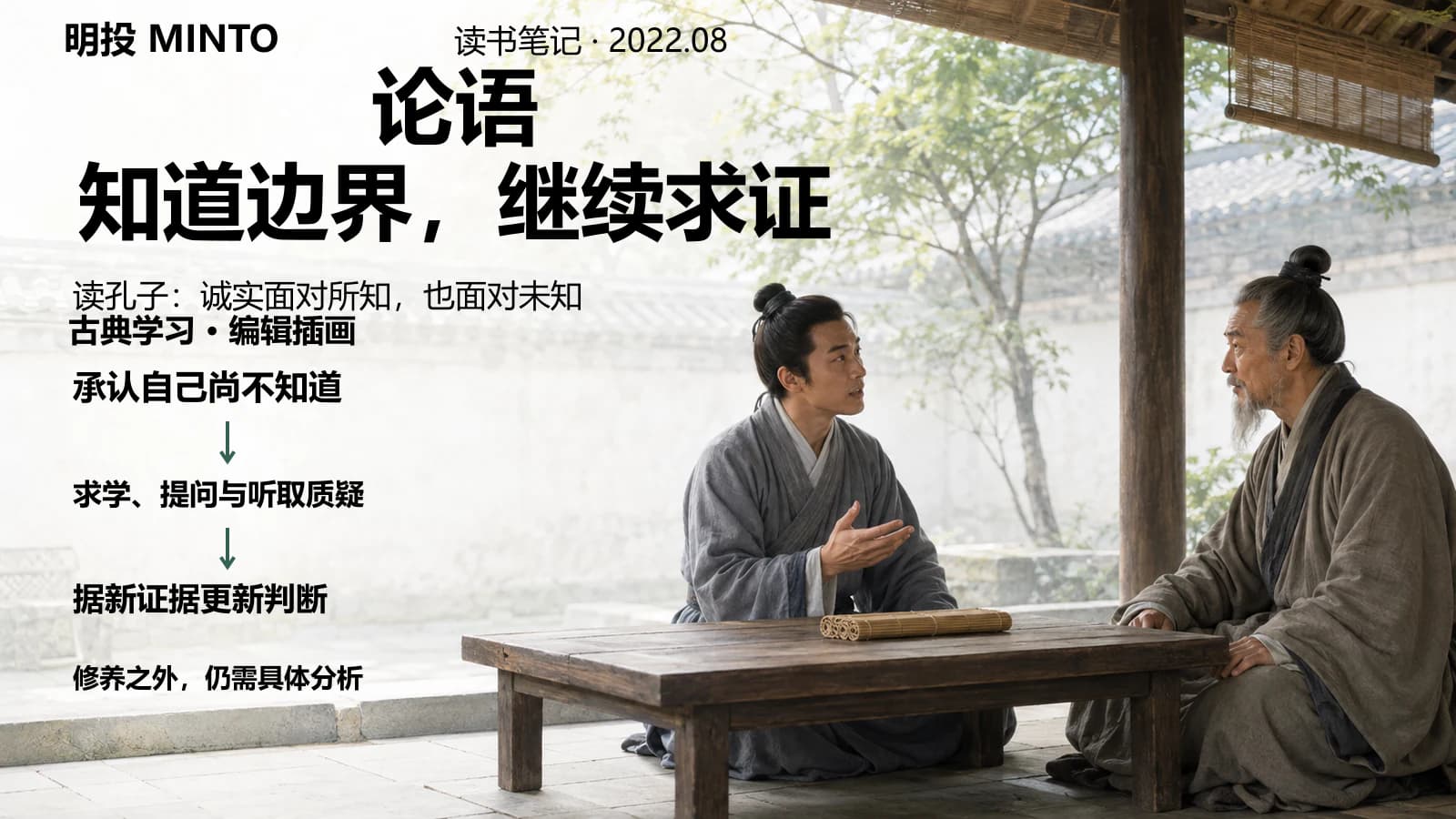
"To know that you know, and to know that you don't know—that is wisdom." — This is the most distilled expression of 'cognitive boundaries.'
"Too much is as bad as too little." — This is the wisdom of 'the right degree.'
"A gentleman is not a vessel." — This is about 'specialization versus breadth.'
"No arbitrary guessing, no absolute certainty, no stubbornness, no ego." — This is almost the earliest diagnosis of cognitive biases.
Confucius wasn't teaching you to be a 'good person.' He was teaching you how to perceive and act clearly, honestly, and with measure. And that is the best possible training for investing.
2. Three Lines That Directly Map to Investment Discipline
First: "To know that you know, and to know that you don't know—that is wisdom."
This is essentially Buffett's 'circle of competence' 2,500 years earlier. The biggest danger in investing isn't 'not knowing'—it's 'not knowing that you don't know' (recall Kahneman's WYSIATI, Taleb's black swans). An investor who honestly says 'I don't understand this, so I stay away' is a hundred times safer than one who thinks they understand everything. Confucius, in nine Chinese characters, nailed the essence of circle of competence: true wisdom is knowing the boundaries of your own knowledge.
Second: "Too much is as bad as too little."
This is the ultimate wisdom of 'degree.' Investing is full of 'too much vs. too little'—overweight (too much) vs. missing out (too little), overtrading (too much) vs. failure to sell when you should (too little), overoptimism (too much) vs. overpessimism (too little). Most mistakes aren't about the wrong direction—they are about the wrong degree: a correct judgment executed with the wrong force. Confucius's 'too much is as bad as too little' reminds you—finding the 'just right' degree is harder and more important than finding the 'right direction.'
Third: "No arbitrary guessing, no absolute certainty, no stubbornness, no ego." Confucius said there were four things he absolutely avoided: making assumptions without evidence, being dogmatic, being obstinate, and being self-righteous.
These four phrases are arguably the earliest and most distilled diagnosis of cognitive biases:
- No arbitrary guessing — Don't bet on speculation; base decisions on evidence
- No absolute certainty — Think in probabilities; never say 'definitely'
- No stubbornness — Update your judgment when new information arrives; don't cling to yesterday's view (remember the 'superforecasters' frequent updating)
- No ego — Don't let your self-image or pride hijack your decisions; admit mistakes, don't refuse to admit error just to protect 'being right'
Confucius, in eight Chinese characters, summarized the four psychological traps every rational decision-maker must avoid. 2,500 years later, Kahneman and Thaler proved the same four things with a whole body of behavioral economics.
3. The Deepest Line: 'A Gentleman Is Not a Vessel'
The line I keep returning to in the Analects is—"A gentleman is not a vessel."
'Vessel' means a container or tool with a single purpose. 'A gentleman is not a vessel' means—a truly cultivated person should not limit themselves to being a single-function tool. They should have broad, cross-domain, holistic wisdom.
This has a profound dual implication for investors.
On one hand, it supports 'interdisciplinarity' — exactly Munger's 'latticework of mental models.' An investor who only knows financial statements but not psychology, history, technology, or human nature is a 'vessel' (a single tool). A truly great investor is 'not a vessel'—they can draw on psychology (understanding market sentiment), history (understanding cycles), technology (understanding innovation), and philosophy (understanding human nature). The Analects's ideal of 'a gentleman is not a vessel' is the same thing as Munger's interdisciplinary approach. That's exactly why I'm reading these fifty books across fields—to become a 'non-vessel' investor.
On the other hand, it seems to contradict 'circle of competence'—but it's actually complementary. Circle of competence says 'focus narrowly on what you know'; 'a gentleman is not a vessel' says 'be broadly learned.' Apparent contradiction, but actually complementary: in making investment decisions, have the focus of a circle of competence (only bet heavily where you truly understand); in understanding the world, have the breadth of 'not a vessel' (see problems with cross-disciplinary wisdom). Specialize in decisions; broaden in cognition. That is the mark of the best investors.
4. My Reservations About the Analects
First: Its 'morality first' bias can suppress independent thinking.
The Analects (and later Confucianism) places extreme emphasis on morality, hierarchy, and respect for authority (ruler, father, teacher). This has good aspects (stability, responsibility), but also a repressive side—it doesn't encourage 'challenging authority and independent questioning.' Yet investing requires exactly that: independent thinking, willingness to go against consensus (contrarian investing). Excessive Confucian deference can make you afraid to question the mainstream or go against the crowd. Take the Analects's 'honesty and measure,' but be wary of its 'conformity and herd' tendency.
Second: It values morality over analysis (a common flaw in Chinese philosophy).
Like all Chinese philosophy, the Analects offers 'cultivation and mindset' rather than 'analytical frameworks.' It can make you an honest, measured, not-stubborn person (extremely valuable), but it won't give you valuation models, probability tools, or industry analysis frameworks. Investing needs 'the heart of the Analects + the brain of Western science.' Only the Analects, and you'll be a virtuous investor who can't do the math.
Third: Its 'doctrine of the mean' may cause you to miss extreme opportunities.
The Analects extols the middle way, balance, 'too much is as bad as too little.' That's wisdom most of the time. But the biggest returns in investing history sometimes come precisely from 'non-mean' extreme decisions—heavily loading up when everyone is terrified, concentrating bets on an overlooked opportunity. Buffett's decisiveness in the financial crisis, Munger's 'you only need a few big decisions'—these are 'non-mean.' Excessive leaning toward the middle way can make you forever make mediocre, balanced decisions, missing the big opportunities that require being 'extremely right.'
Fourth: It has been 'over-sacralized,' which undermines its usefulness.
The Analects has been enshrined for 2,500 years. That sacralization has ironically stripped it of its 'practical tool' quality—people treat it as a scripture to be worshiped, not as wisdom to be critiqued, selected, and used for one's own purposes. The true way to respect the Analects is not to worship it, but to use it like a tool—take its essence (honesty, measure, non-stubbornness, 'not a vessel'), discard its limits (excessive deference, disdain for analysis, excessive moderation). Treat it as sparring partner and friend, not as god—this is how I approach all classics.
5. The Analects vs. the Tao Te Ching: The Confucian-Taoist Divide in Investing
The Analects (Confucian) and the Tao Te Ching (Taoist) are the two poles of Chinese thought. Their wisdom for investing differs.
Confucian (Analects) — active engagement in the world, refinement of measure, emphasis on honesty and responsibility. It maps to 'active, diligent, disciplined, honest about the limits of one's knowledge' in investing.
Taoist (Tao Te Ching) — going with the flow, non-action, knowing when to stop. It maps to 'restraint, going with the trend, not forcing things, taking profit when the time is right.'
Confucianism teaches you 'how to act actively and with measure'; Taoism teaches you 'how to restrain yourself and not act, going with the flow.'
The best investor is exactly 'Confucian-Taoist complementary'—use Confucian proactivity and discipline when it's time to research, decide, and confront your cognitive boundaries honestly; use Taoist non-action and knowing when to stop when it's time to wait, restrain, and go with the cycle.
Be aggressive in bull markets (Confucian), retreat in bear markets (Taoist); act decisively and honestly when it's time (Confucian), wait non-actively when it's time (Taoist). This 'Confucian-Taoist dual operating system' may be the most complete wisdom Chinese philosophy offers investors.
6. Final Thoughts
My biggest takeaway from reading the Analects is discovering that this book, dismissed as a moral textbook, is actually a practical manual on 'how to perceive and act clearly.'
"Know that you know, know that you don't know" — honest boundaries (circle of competence).
"Too much is as bad as too little" — calibrate your actions (position size, timing).
"No arbitrary guessing, no absolute certainty, no stubbornness, no ego" — avoid four cognitive traps (biases).
"A gentleman is not a vessel" — maintain cross-disciplinary breadth (latticework of mental models).
Which of these is not a discipline every investor should carve into bone?
Confucius never dreamed of investing, but what he taught—'how to be honest, how to have measure, how not to be hijacked by ego, how to be broad rather than narrow'—these are the common lessons for anyone who must make judgments under uncertainty.
I am increasingly convinced that investing, at the end of the day, is not about technique—it's about 'the person.' Whether you are honest (know that you know), have measure (too much is as bad as too little), are stubborn (no stubbornness), or are hijacked by ego (no ego). These 'being a person' lessons determine your success or failure in 'doing investing.'
There is one line of Confucius I take as the guiding principle for both investing and life: "The gentleman seeks the cause in himself; the petty man seeks it in others."
When you lose money in investing, the petty man blames the market, the manipulators, the news; the gentleman turns inward—was my cognition insufficient, my discipline broken, or was I driven by emotion?
This 'seeking the cause in yourself' honesty is the lifelong cultivation of an investor. It's not sexy. It's not a get-rich-quick secret. But it is the only path that turns a person from 'a bag holder who repeats the same mistakes' into 'an investor who continuously improves.'
Twenty-five hundred years ago, Confucius laid out this path clearly.
Most of us just read it as a textbook, not as a mirror.
专注投资分析、市场洞察与资产配置。不追短期波动,只理解真正驱动长期回报的东西。