"Company Dissection" Series · Part 2, the first of six lenses. The overview said we start from the nature of the business and leave price for last. This piece unpacks that most fundamental lens: How to tell if a business is truly a good business.
One: The Sharpest Test — Can You Raise Prices?
There are countless metrics for judging a business. But if I could ask only one question, I'd use Buffett's sharpest test —
"The single most important decision in evaluating a business is pricing power. If you can raise prices without losing customers to competitors, you have a very good business. If you have to have a prayer session before raising prices, you have a terrible business."
The sharpness of this test? It cuts straight to the essence of good vs. bad businesses — pricing power.
A business with pricing power: when costs rise, it can pass them on to customers (raise prices). When inflation hits, it protects its margins. It has the initiative over how much it earns. Customers can't do without it, so its word is law.
A business without pricing power: it's a "price taker" — it sells at whatever price the market sets. When costs rise, it dares not raise prices (customers would immediately switch to competitors), so it takes the hit and margins get squeezed. It has zero initiative over how much it earns — its fate is in the hands of the market and competitors.
Whether you have pricing power almost determines if a business earns "easy money" or "hard money." This is exactly what I explained in my storage industry research — storage was a textbook "no pricing power" commodity business for thirty years (one DRAM from SK Hynix is indistinguishable from one from Samsung, so pricing is dictated by the market), so it earned hard money and got crushed by cycles. Now, with , it has pricing power for the first time (tech barriers + customer lock-in), and it is finally earning easy money. Pricing power is the first litmus test of business quality.
Two: The Ultimate Arbiter — ROIC
Pricing power is a qualitative intuition. To quantify it into a number that passes judgment on business quality, you use ROIC (Return on Invested Capital).
ROIC answers the most straightforward yet most important question — For every dollar of capital you pour into this business, how much does it earn back?
- A good business: Invest 1 dollar, consistently earn, say, 20 or 30 cents back (ROIC 20%, 30%), and sustain that high return. It's an efficient "money printer."
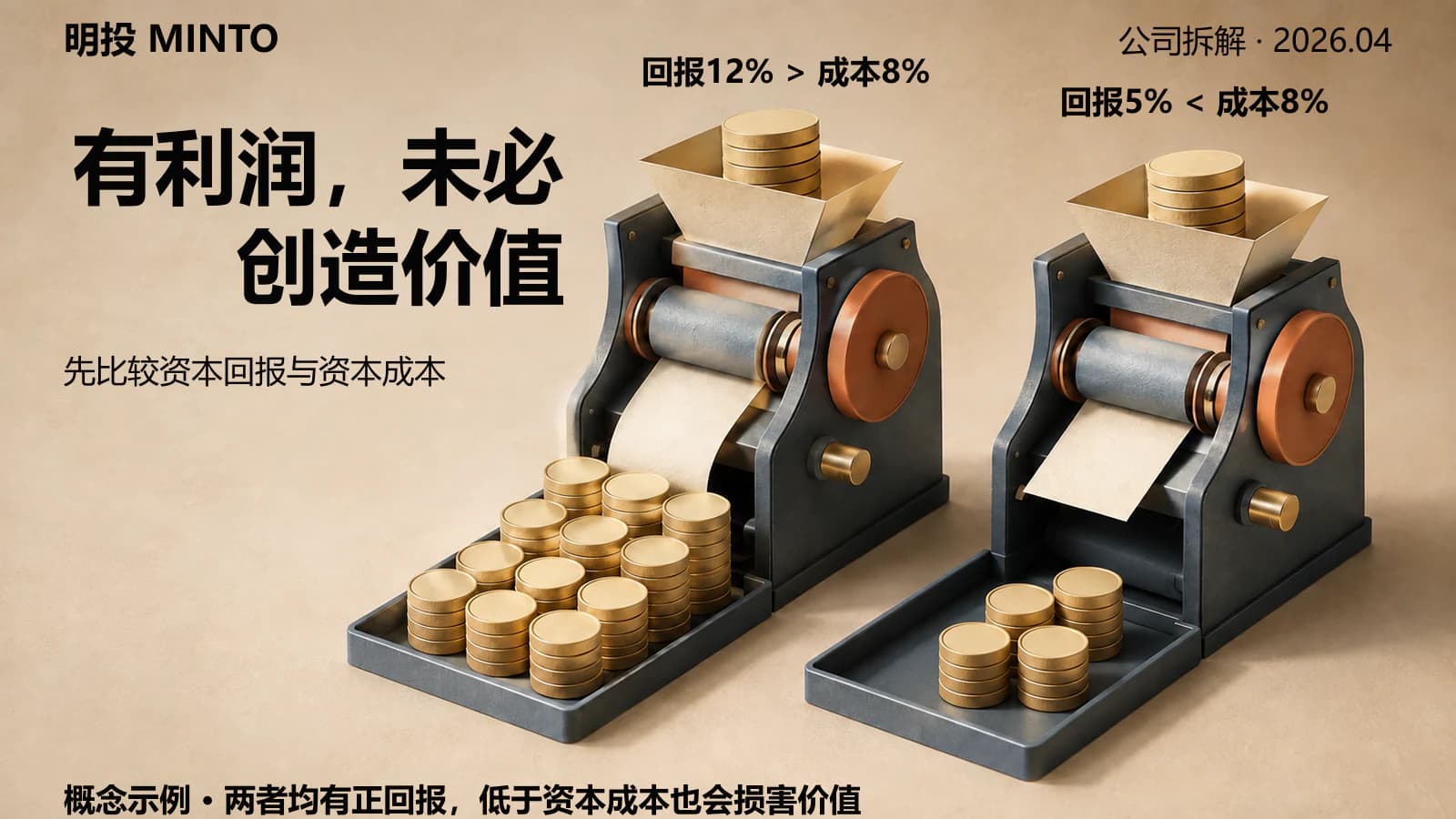
- A bad business: Invest 1 dollar, earn only, say, 5 cents back, or not even cover the cost of capital (ROIC below the cost of borrowing). It's a "money shredder" — the more you pour in, the more value you destroy.
Why is ROIC the ultimate arbiter? Because it cuts through all the surface noise and directly measures "how efficiently this business turns capital into profit." A company can have huge revenue, lots of profit, fast growth — but if it achieves all that by continually pouring in massive capital (low ROIC), it's fundamentally an inefficient business. Its size and growth come at the price of destroying shareholder value.
And high ROIC and pricing power are often two sides of the same coin: a business with pricing power doesn't need to fight price wars or subsidize to grab market share, so it can earn more profit with less capital — naturally high ROIC. Conversely, a business without pricing power needs constant capital injection (capacity expansion, subsidies, price wars) just to maintain itself, so ROIC is inevitably low.
So when I look at a business, I focus on just two things: Does it have pricing power (qualitative)? Is its ROIC high and stable (quantitative)? If both pass, it's probably a good business. If not, no matter how compelling the story, it's probably a tough business. This is exactly the core of my post on "The Boring Company" — a company with a stable 20% ROIC that quietly compounds for 20 years far outperforms a sexy story with fast growth but low ROIC.
Three: The Most Counterintuitive Trap — Growth Itself Does Not Create Value
Now we come to the most counterintuitive and important insight in this lens — Growth itself does not create value. Low-return growth actually destroys value.
This statement defies almost everyone's intuition. We've been taught "growth stocks are best" and "growth is everything." But the truth is — Whether growth is good depends entirely on whether the ROIC of that growth is above the cost of capital.
Let me explain the logic clearly:
- If a business has an ROIC above its cost of capital (say ROIC 20%, cost of capital 8%), then every extra dollar it invests in growth creates value (it earns back more than the cost). This kind of growth is good — the more, the better.
- If a business has an ROIC below its cost of capital (say ROIC 5%, cost of capital 8%), then every extra dollar it invests in growth destroys value (it doesn't earn enough to pay for the capital). This kind of growth is bad — the more it grows, the poorer shareholders get.
The destructive power of this insight? It means a high-growth company can be a value-destruction machine. Those companies that burn cash on subsidies, expand without discipline, double revenue but have extremely low or even negative ROIC — their "high growth" isn't value, it's accelerating the destruction of shareholders' money. The market often assigns high valuations to such growth (because the story is sexy), but from the nature of the business, this growth is negative.
So when I see "high growth," my first reaction isn't excitement — it's to ask: What is the ROIC of this growth? Is it good growth that creates value, or bad growth that destroys value? This single question filters out a huge number of businesses that are actually terrible but wrapped in a "growth narrative." This also echoes my post on interest rates — in a zero-rate era, bad growth can survive on free money, but when rates come back, bad growth gets mercilessly exposed by the cost of capital.
Four: The Two Portraits — Good Business vs. Bad Business
Combining the criteria above gives us two classic portraits of good and bad businesses.
Portrait of a Good Business:
- Has pricing power: can raise prices without losing customers.
- High ROIC: high and stable return on invested capital.
- Asset-light or heavy asset with high return: either it doesn't need much capital to make money (asset-light, e.g., software, brands, platforms), or it's heavy asset but with exceptional returns.
- Growth doesn't require proportional capital: it can "use very little incremental capital to generate a lot of incremental profit."
- Sticky/recurring revenue: customers keep buying and find it hard to switch (remember switching costs and network effects from the moat piece).
Typical examples: businesses with strong brands or network effects that earn by "collecting tolls" (payment networks, rating agencies, exchanges, strong branded consumer goods, work-flow-embedded software). Their common traits: low capital intensity, strong pricing power, high ROIC, sticky customers.
Portrait of a Bad Business:
- No pricing power: price taker, follows the market.
- Low ROIC: huge capital invested, thin returns.
- Asset-heavy, high CapEx: constantly needs to pour money into building capacity and buying equipment, just to stay in place (running just to stand still burns cash).
- Commoditized/easily replaced: product is a commodity; everyone's is the same.
- Highly cyclical, fate not its own: earnings swing wildly with the cycle, and the business has no control.
Typical examples: Airlines, which Buffett repeatedly disdains (extremely capital-intensive, brutal price wars, no pricing power, highly cyclical), and historical commodity manufacturing businesses (including storage in its cyclical days). Their common traits: endless cash burn, no pricing power, chronically low ROIC, fate dictated by market and cycle.
The biggest difference between these two portraits isn't "whether they make money" (bad businesses can make money in good times). It's the quality and sustainability of earnings. Good businesses make money structurally, sustainably, and easily. Bad businesses make money cyclically, by luck, and painfully — and they can easily give back all the good-year earnings in bad years.
Five: A Necessary Caution — Good Business ≠ Good Investment
Finally, I must add a discipline that runs through the entire series, otherwise this lens will be misused — Identifying "this is a good business" is only the first step. It absolutely does not mean "this is a good investment."
This lens (nature of the business) and the later valuation lens are strictly separate. A top-tier good business (strong pricing power, high ROIC) can still be a terrible investment if you buy at an extremely overvalued price (remember NVIDIA, Palantir — great companies at perfect prices leave no room for error). The "goodness" of the business can be canceled out by the "expensiveness" of the price.
So the correct function of this lens is: It's a "quality filter" that helps you narrow down the universe — from all companies, pick out those "worth deeper research on whether to buy" because they are good businesses. It tells you "this company deserves your time to study further (because the business is good)," but it does not tell you "you should buy it now" (that's the valuation lens).
Screen for good businesses, then patiently wait for a good price — that's the complete logic. Looking only at good businesses and ignoring price leads to overpaying. Looking only at price and ignoring the business leads to buying cheap, bad businesses (value traps). The two lenses are indispensable, but the order is: first confirm a good business, then talk about price.
Six: Final Thoughts
Judging the nature of a business is the foundation of company dissection. If the foundation is crooked, nothing built on top is stable.
And the core of that judgment is distilled by Buffett into one sharp test — pricing power: Can you raise prices without losing customers? If yes, you have a good business that earns easy money. If no, you're in a tough business whose fate is dictated by the market. Quantify this qualitative intuition into ROIC — the ultimate arbiter that measures "how much each dollar of capital earns back."
And the most valuable insight in this lens is that counterintuitive truth: Growth itself does not create value. Only growth above the cost of capital creates value. Low-return growth destroys value. It urges you, when tempted by "high growth," to ask one more question: "What is the ROIC of this growth?" — thereby filtering out a large batch of bad businesses wrapped in growth narratives.
But remember, this is only the first lens. It screens for good businesses, but good businesses are not the same as good investments — the price test still awaits.
If only one line stays —
To judge a business, first ask: Can it raise prices without losing customers? If yes, it's a good business. If no, it's a tough business. Then look at one number: Is ROIC high and stable? And always be wary of 'high growth' — growth creates value only when returns are high; low-return growth is value destruction in a growth costume.
Next up, the second lens (moat) I've already written as a standalone piece, so we'll jump straight to the third lens — Financial Quality: How to see through the profit on a company's financial statements and gauge its real cash content.
—
Risk Disclaimer: This article is a framework for company analysis. Companies mentioned are for analytical illustration only and do not constitute investment advice. Markets carry risks; invest with caution.

On investment analysis, market insight, and asset allocation — not chasing short-term noise, but understanding what truly drives long-term returns.