A Book That Was Canonized — Then Reality Intervened
In 2001, Jim Collins published Good to Great. It sold millions of copies and became a business bible.
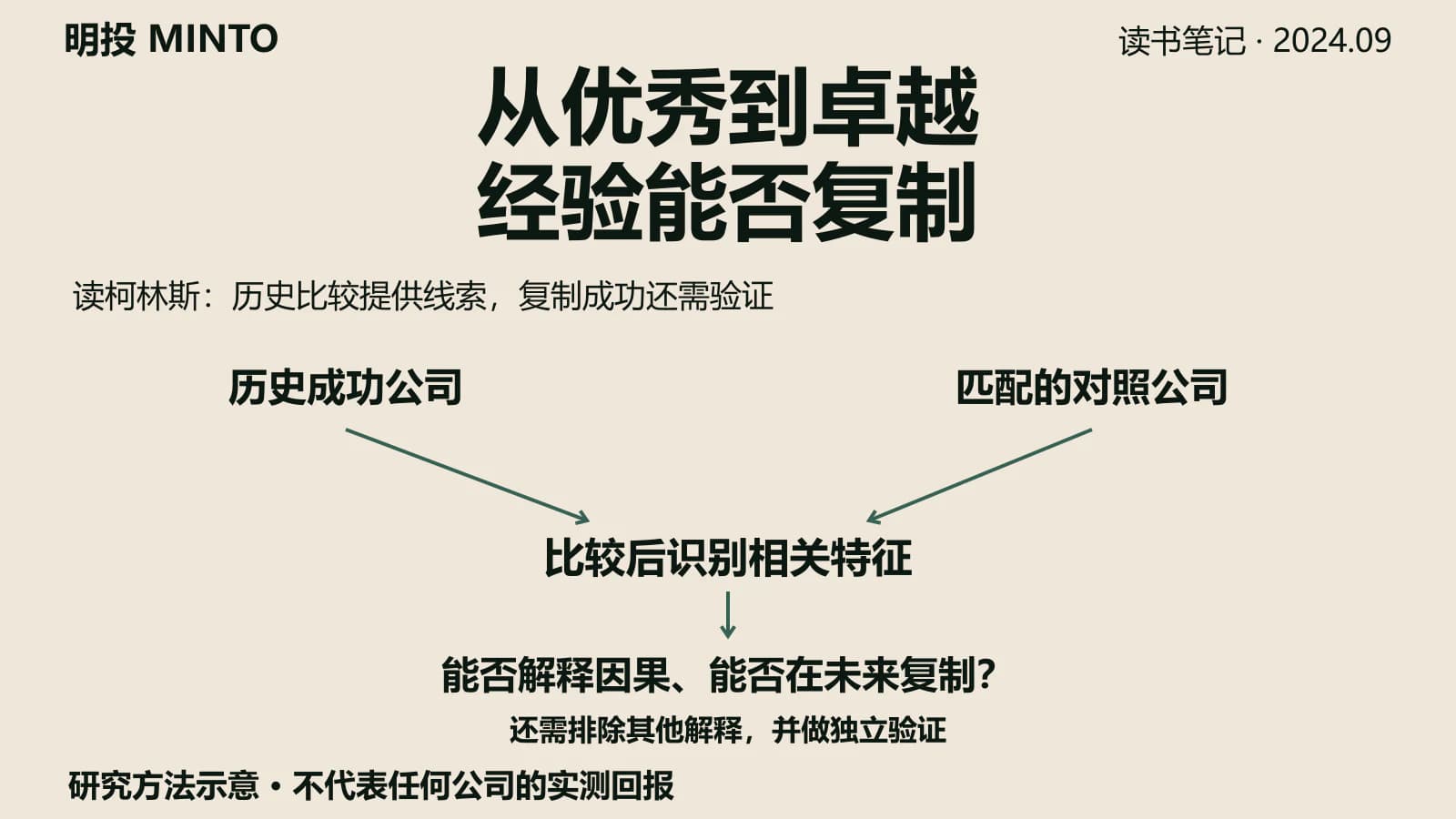
Collins's method looked rigorous. He and his team spent five years sifting through 1,435 companies to pick 11 that had "made the leap from good to great" (definition: after a turning point, cumulative stock returns 3x the market over 15 years). Then they studied what those 11 had in common, distilling "the genes of greatness."
But there's a huge, unavoidable problem: most of the 11 "great" companies it chose didn't stay great.
Circuit City (electronics retailer) went bankrupt. Fannie Mae was taken over by the government during the 2008 crisis, nearly collapsing. Wells Fargo got mired in scandals. Most of the others reverted to mediocrity.
A book that tells you "how to be great" — and its own sample of greatness mostly couldn't sustain it. That fact alone is the book's deepest lesson, just not the one Collins intended.
Insights That Still Hold
Despite the sample blowup, a few insights remain valuable. I'll pick three.
First, Level 5 Leadership. Collins found that the leaders who took their companies from good to great were rarely the charismatic, magazine-cover CEOs. Instead, they were a paradoxical mix of humility + fierce resolve — personally modest, but almost obsessively determined about their mission. This insight runs counter to the "celebrity CEO" cult and has anti-intuitive value. It echoes the temperament of people like Buffett and Bogle — not flashy, but relentlessly steady.
Second, First Who, Then What. Collins argued that great companies "get the right people on the bus, then figure out where to drive it." The right people will figure out the right direction. This flips the traditional order of "strategy first, then people." For an investor, it means the quality of a management team might matter more than the current strategy — because a good team will correct its own strategy.
Third, the Hedgehog Concept. Borrowing from Isaiah Berlin's "fox and hedgehog" (remember Tetlock used it too), Collins said great companies focus on the intersection of three circles — what you can be best at, what drives your economic engine, and what you're passionate about. Stay in that intersection; reject temptation outside it. For investors (and individuals), it's a useful focusing principle: don't do everything, only do what you can be world-class at, make money at, and genuinely love.
Why the Sample Blowup Is the Real Lesson
The book's greatest value, ironically, lies in its failure.
Why did most of Collins's carefully chosen "great" companies fail to stay great?
The answer reveals a deep problem: the "find commonalities after the fact" method has a fundamental flaw.
Collins's approach: find companies that already succeeded, then reverse-engineer their common traits. This commits the twin errors Taleb keeps warning about — survivorship bias and hindsight narrative:
First, maybe the "failed" companies had the same traits. Collins didn't adequately test whether there were companies with Level 5 leaders, First Who Then What, and Hedgehog Concepts that failed. If so, those traits aren't the cause of greatness.
Second, 15 years of good performance could largely be luck (remember the lucky fool). Picking 11 companies out of 1,435 that outperformed for 15 straight years — pure chance would produce some. Collins mistook luck for "genes of greatness."
This is a crucial warning for investors: any book that "studies successful people and distills their success formula" (including many bestselling business and investment books) likely makes the same mistake. The "formula for success" you see may just be a survivor's hindsight narrative, not real causation.
My Fundamental Challenges to the Book
First, it's a textbook case of survivorship bias.
As above — Collins studied only successes, with no control group of companies that had the same traits but failed. Methodologically, that's fatal. If a trait appears in both successful and failed companies, it cannot explain success. Collins made exactly the error that Thaler, Taleb, and Kahneman all warn against — reverse-engineering from outcomes, fooled by narrative coherence.
Second, it confuses correlation with causation.
Even if those 11 companies really all had Level 5 leaders, that's correlation, not causation. Maybe "the company succeeded, so the leader seems humble and determined" — not "the leader was humble and determined, so the company succeeded." The causal direction could be reversed. After a company succeeds, we retroactively glorify every trait of its CEO as a "cause of greatness" — that's the rearview mirror filter.
Third, it gives a false sense of replicability.
The book's biggest harm is making readers (and countless CEOs) believe "just follow these steps and you'll be great." But business success involves massive non-replicable factors: timing, luck, industry cycles, competitor mistakes. Packaging success into "a few actionable principles" is a dangerously oversimplified view of complex reality. That's why countless companies studied Good to Great and very few became great — because success isn't made by following a formula.
Fourth, its definition of "greatness" is itself problematic.
Collins defined greatness as "stock returns 3x the market for 15 years." But stock returns are heavily influenced by industry cycles, valuation starting points, and macro environment — a company might outperform for 15 years simply because it happened to be in a rising industry at a low valuation. Equating "stock price performance" with "great company" confuses company quality with investment returns (they're related but not equal — a great company bought at a high price can still deliver lousy returns).
[object Object] vs [object Object]: Same Method, Repeated Failure
Collins had an earlier book, Built to Last, with nearly identical methodology — study companies that supposedly "endured," identify common traits.
Both books make the same methodological error (survivorship bias), and — many of the "enduring" companies chosen in Built to Last also later declined (Motorola, Sony, etc.).
Together, the two books form a perfect negative case study — they show how unreliable the "study winners, extract formula" approach is, because both times, the chosen model companies largely blew up afterward.
The implication for investors is profound: Be suspicious of all "success formulas." Whether it's a business book's "genes of greatness," a investing book's "stock-picking secrets," or a finance blogger's "can't-lose method" — if it's reverse-engineered from success stories, it's almost certainly contaminated with survivorship bias, hindsight narrative, and correlation-for-causation.
Real knowledge more often comes from studying failure — understanding how companies die (Christensen, Grove) is more reliable and more useful than understanding how companies succeed. Because failure reasons are relatively deterministic; success reasons are saturated with luck and non-replicable factors.
Final Thoughts
I'm conflicted about this book. It has genuine insights (Level 5, First Who, Hedgehog). But its methodology is fundamentally flawed, and its chosen sample got demolished by reality.
Yet precisely this contradiction makes it an extremely educational book — not because it taught the right things, but because how it was wrong is itself a lesson in how not to be fooled by success porn.
My biggest takeaway isn't those "greatness principles." It's a lasting skepticism — when someone tells me "I studied all successful X and found they all share these traits," my alarm bells go off. I ask: Did you study the failed X? Did they share the same traits? How did you rule out luck? How did you determine causal direction?
That skepticism is what Taleb, Kahneman, and Thaler have taught me. Good to Great — through its own crash — made that lesson vivid.
Collins wanted to teach you "how to be great." But what he actually taught (through his failure) is: nobody really knows how to be great, including the people who write books telling you how.
Success involves too much luck and too many non-replicable factors for any "success formula" to be taken seriously.
This isn't pessimism. It's clarity.
And clarity, far more than any fake "greatness formula," will help you survive longer in investing and in your career.