1. A Book That Explains Why Good Companies Die
In 1997, Harvard Business School professor Clayton Christensen published The Innovator's Dilemma. The theory of disruptive innovation it proposed may be the most influential business theory of the past 30 years.
The question it tackles is deeply counterintuitive — why do good companies that manage well, listen to customers, invest in R&D, and do everything right get disrupted by rough, low-end, unimpressive new products?
The conventional explanation is "big companies got lazy, bureaucratic, and stopped innovating." But Christensen found — the truth is the opposite. These companies died because they were too rational, too obedient to customers, too focused on high-margin businesses.
In other words — what killed them wasn't their mistakes, but their strengths. This is the book's most profound and unsettling insight.
2. The Mechanism of Disruption: Enter from the Low End, Eat Upward
Christensen's core mechanism works like this:
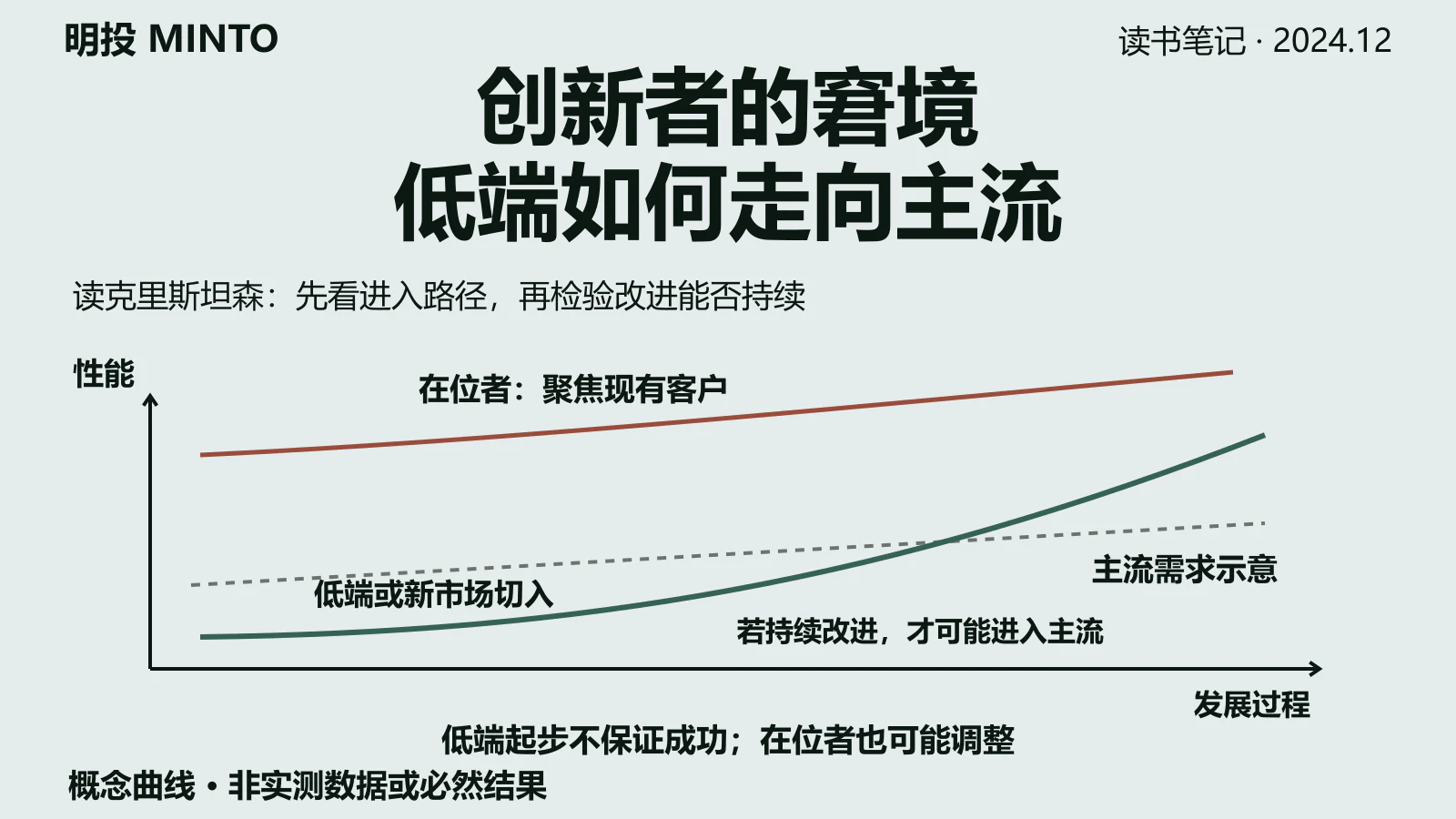
When a new technology emerges, it is often low-performance, low-margin, and can only serve the lowest-end customers that mainstream companies ignore.
Mainstream companies (incumbents) take one look and make a completely rational decision — don't invest in this new technology. Because: their customers (high-end) don't need it; its margins are too low to bother; its market is too small to move the needle for a large company.
Every single reason is correct in the moment. A rational, customer-listening, profit-seeking good company will inevitably decide "no."
But the new technology improves rapidly along its performance curve. It starts at the low end, gradually meets higher-end needs, until one day — it becomes good enough for mainstream customers, and it's cheaper. By then, incumbents suddenly find themselves disrupted, with no time to react.
This is the dilemma — every step the incumbent takes is rational, but the sum of rationality is death.
Classic examples: steel industry (minimills started from low-end rebar and ate upward against integrated mills), hard drives, digital cameras disrupting Kodak, smartphones disrupting Nokia, streaming disrupting Blockbuster.
3. A Practical Tool for Investors: Who Will Be Disrupted
This theory gives investors an extremely practical tool — judging whether an incumbent giant is vulnerable to disruption.
Christensen's warning signals:
First, is there a new technology entering from the low end that is improving rapidly? The key is not how good the new technology is now (it's always not good enough now), but its rate of improvement. If a crude new thing is improving much faster than the mainstream product, the warning light flashes.
Second, are the incumbent's best customers precisely what blinds it to the threat? The more a company serves high-end, high-margin customers, the easier it is to ignore low-end disruption — because its customers don't need that new thing. The most premium customers are the source of the blind spot.
Third, does the incumbent's profit structure make it unable to respond? A high-margin company cannot disrupt itself with a low-margin new business — that would drag down overall margins, and shareholders and management won't allow it. High margins themselves become a shackle that prevents turning.
Applied in 2025 — this framework is a weapon for judging who will be disrupted in the AI era. Which SaaS giants will be disrupted by AI-native applications? Which traditional software companies cannot pivot? Which "high-end customer, high-margin" companies, precisely because of their strengths, cannot see AI's low-end entry? These are the most important investment judgments of 2025, and Christensen gave us the tools.
4. Where I Disagree with Christensen
First, the theory is strong ex post but weak ex ante.
Disruption theory perfectly explains every disruption that has already happened. But ex ante, it rarely tells you "which new technology will succeed as a disruptor and which will fail." The vast majority of low-end new products that "look like disruptors" ultimately fail — they don't improve along the performance curve. Christensen's theory lets you see the possibility of disruption, but cannot tell you whether it will actually happen this time. It's useful for assessing risk, but often wrong for predicting specific winners.
Second, some incumbents have successfully disrupted themselves.
Christensen's theory implicitly assumes incumbents can hardly save themselves. But real-world counterexamples are mounting — Netflix disrupted itself from DVD-by-mail to streaming; Amazon disrupted itself from e-commerce to cloud; Microsoft disrupted itself from software licensing to cloud subscriptions; Apple constantly disrupts its own products. These companies prove — incumbents can self-disrupt with the right mechanisms and leadership. Christensen underestimated this possibility; his theory fails against great self-disruptors.
Third, the word 'disruption' has been overused and turned into a marketing term.
Christensen himself later lamented — every startup calls itself a 'disruptor,' every new product claims to be 'disruptive.' But in the strict sense, 'disruptive innovation' has a precise definition (entering from the low end or a new market), while most so-called 'disruptions' are really just 'better products' (the iPhone, strictly speaking, is not Christensen's kind of disruption — it was a high-end innovation). The abuse of the theory dilutes its precision. Investors should be wary: 99% of companies that call themselves 'disruptors' are not true disruptors.
Fourth, it underestimates the defensive power of network effects and scale.
Christensen's theory was formed in the era of hardware and manufacturing. But in the digital age dominated by network effects, scale itself is a formidable moat — a low-end entrant struggles to disrupt a platform with billions of users and network effects. The moats of Facebook, Google, Amazon are not 'product performance' but 'network scale,' and the latter is highly immune to Christensen-style low-end disruption. This is why, over the past decade, the giants haven't been disrupted — they've only grown stronger.
5. Christensen vs. Schumpeter: Two Theories of 'Destruction'
Christensen's 'disruptive innovation' and Schumpeter's 'creative destruction' are often conflated, but they differ.
Schumpeter's creative destruction is macro and broad: any new thing destroying the old. It encompasses all forms of innovative disruption.
Christensen's disruptive innovation is micro and narrow: it specifically refers to one mechanism — entering from the low end or a new market and eating upward along the performance curve.
Schumpeter tells you 'destruction happens'; Christensen tells you 'how it happens in detail.'
Christensen's contribution is to break Schumpeter's grand 'creative destruction' into a recognizable, partially predictable mechanism. He lets you not just know 'there will be disruption,' but see 'where and how disruption is brewing.'
For investors, combining both — use Schumpeter to stay alert that no moat is permanent (no safety forever), and use Christensen to identify specific disruption signals (low-end entry + rapid improvement + incumbent blind spots). The former is a worldview; the latter is a tool.
6. Final Thoughts
Christensen died of cancer in 2020. He was more than a business theorist — he was a devout religious man and a person of warmth. In his later years, he wrote How Will You Measure Your Life?, applying business theory to life choices with profound emotional resonance.
My biggest takeaway from The Innovator's Dilemma is a sustained alertness — the most dangerous moment is precisely when everything you're doing seems right.
A company, an investor, a person is most vulnerable to disruption not when they are making mistakes, but when they are too successful, too rational, too focused on existing strengths. Success itself creates blind spots — the more you excel at what you do now, the less you see the new thing quietly improving at the low end that will kill you in the future.
This applies not just to companies, but to investors themselves — your most profitable method may be precisely the blind spot that keeps you from seeing the next opportunity (or threat). An investor who made a fortune on value investing may be so good at it that they completely miss the era of growth stocks.
Christensen's dilemma is essentially the curse of strength — every strength is simultaneously a blind spot.
Understanding this gives you a healthy skepticism toward your own 'success methods.'
And that skepticism is the prerequisite for survival in a world repeatedly swept by creative destruction.