I. A Book That Tries to Answer ‘Why Not Suicide?’
In 1942, Albert Camus (1913–1960) published Le Mythe de Sisyphe (The Myth of Sisyphus). He was 29, France was under Nazi occupation, and the world was in its darkest moment of war.
Camus opened the book with what became perhaps the most famous sentence of 20th-century philosophy—“There is but one truly serious philosophical problem, and that is suicide. Judging whether life is or is not worth living amounts to answering the fundamental question of philosophy.”
It sounds heavy and uncomfortable. But Camus wasn't promoting suicide; he was using this most extreme question to press himself—if the world has no meaning, no God, no ultimate purpose, why should people go on living?
The entire 250-page book is an answer to that question.
I keep coming back to this book not as philosophy but as an existentialist guide for investors. Because the question Camus asks is the same one that haunts the deepest part of an investor—if the market is efficient in the long run, my cognition will likely be wrong, my returns are probably just luck, and the money I make will be eaten by inflation—then why do I even invest?
Camus, in 1942, gave an answer. An answer I return to again and again.
II. The Sharpest Diagnosis: ‘Absurdity’ Is What Clear-Eyed People Discover
The core concept of Camus's book is “absurdity” (absurdité).
What is absurdity? Camus says—absurdity is not a property of the world itself, nor a property of human beings. Absurdity arises from the collision between “man's need for meaning” and “the world's silence.”
Man wants meaning. The world does not provide it. This state of “I want it but the world won't give it” is absurdity.
This definition is extraordinarily precise. It explains why philosophers, artists, and thinkers feel “life is meaningless” more often than ordinary people—because their need for meaning is stronger. Someone who never thinks about meaning won't feel absurdity; someone who thinks deeply about meaning will almost inevitably run into it.
This is a direct mirror for investors.
Average investors don't ask “why do I invest”—their goals are straightforward (make money, buy a house, retire), and they don't demand much “meaning.”
But deep investors inevitably hit a moment—you earn the money you wanted, and then you ask yourself: does this really matter?
Camus would tell you: this moment is called the “awakening of the absurd.” You are not the first to reach this point, nor the last. But most people won't admit they've gotten there, because once they do, they don't know how to keep working.
III. The Most Important Refusal: Camus Rejects Two Easy Ways Out
Camus spends a large portion of the book rejecting two methods people use to escape absurdity.
The first is the “leap of faith.” Camus singles out Kierkegaard—the Danish philosopher acknowledged absurdity but chose a “leap of faith,” believing God gives meaning. Camus calls this “philosophical suicide”—you use an unproven assumption (God exists + God provides meaning) to bypass the problem rather than face it.
The second is “physical suicide.” If the world has no meaning, why not just end it? Camus says this too is escapism—suicide is not a solution to the absurd; it's a surrender to the absurd. Once you die, you no longer have the need for meaning, so the feeling of absurdity disappears—but you solved the problem by eliminating one of its terms, not by truly facing it.
Camus demands a third way—neither leaping upward into religion nor downward into suicide, but “living with the absurd.”
This is extremely useful for investors.
Most investors, when faced with the question “does investing have meaning,” choose one of the two paths Camus criticized—
The first is the “leap of faith”—they believe in some “investing bible,” assuming that by following Buffett / Munger / Howard Marks's methods, meaning is automatically resolved. They treat “having studied the masters” as meaning itself.
The second is “surrender suicide”—they decide “the market is efficient, I can't generate alpha, so I'll quit.” They use exit to eliminate the pain of not earning alpha, but they never truly face the question.
Camus would tell both: you haven't really faced the problem. You responded to absurdity with escapism, not with “living with the absurd.”
IV. The Supreme Judgment: We Must Imagine Sisyphus Happy
The last line of the book—quoted for 500 years—is “One must imagine Sisyphus happy” (Il faut imaginer Sisyphe heureux).
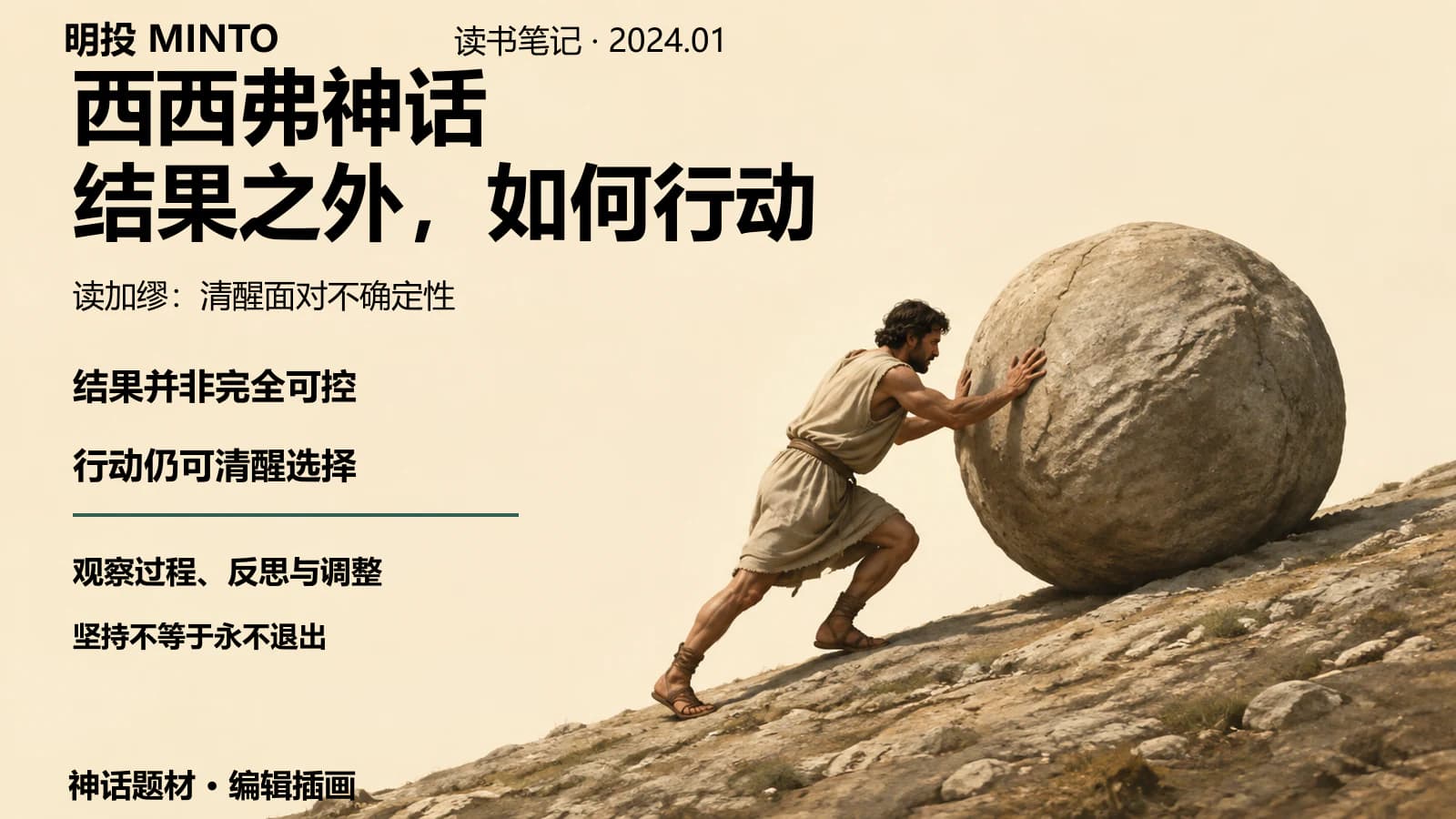
In Greek myth, Sisyphus is condemned by the gods—he must endlessly push a boulder up a hill, only for the rock to roll down each time he reaches the top, forcing him to start over. This is “eternal, meaningless, unending labor.”
Camus says—this is the human condition. We wake up, work, eat, sleep, wake up again—these cycles repeat, fundamentally no different from Sisyphus pushing his rock.
So why aren't we in despair?
Camus's answer is deeply counterintuitive—because in each act of pushing the rock, Sisyphus is lucid, free, and making a choice. He knows the rock will roll back down, but he chooses to push it anyway. This posture of “knowing it's meaningless but still choosing to act” is itself the best response to absurdity.
Meaning is not the rock reaching the top; meaning is in the act of pushing. Meaning without an endpoint is the purest meaning.
This passage directly reshaped my view of investing.
Investing is essentially Sisyphus pushing his rock—you do research, make judgments, place decisions, watch the returns, then the market pushes you back to zero, you research again, judge again, decide again… the cycle has no end. Even if you outperform for 30 years, you are only “Sisyphus for these 30 years”; your children will start pushing their own rock.
Camus, in 1942, told us—this is not terrifying. This is the human condition. The point is not “did the rock reach the top,” but “are you lucid in the act of pushing.”
The lucid rock-pusher and the confused rock-pusher look like they're doing the same thing—but their state of being is completely different. The lucid Sisyphus, in each push, is free, creative, in revolt.
V. Where I Differ from Camus
Reading the book for the fourth time, I started forming real disagreements.
First, his rejection of “meaning” is too absolute.
Camus says the world has no meaning. This has strong philosophical backing, but in practical life, “the world has no meaning” and “my personal projects have meaning” are two different things.
I can accept that the universe doesn't care about humanity—but I can still make “being with the people I love,” “the work I do affecting some people,” and “the writing I leave behind being read by certain readers” the core of my personal meaning system. This “personal meaning” doesn't need cosmic validation; it's self-justifying.
When Camus wrote this book in 1942, his own “personal meaning” was already being built through the Resistance, his writing, and love—he didn't lack meaning; he just refused to project meaning onto the external universe. But his book rarely makes this layer explicit. Readers often fall into “total nihilism” after reading, which doesn't match how Camus himself lived.
My own correction is—“external meaning” may not exist, but “internal meaning” can be constructed by oneself. These two things are not in conflict.
Second, his “revolt against the absurd” is too romanticized.
Camus describes “living with the absurd” as a heroic, free, lucid posture. It reads like a philosophical version of “burn brightly”—choosing to live despite knowing it's meaningless, how grand.
But in actual life, “living with the absurd” is more often not heroism but the mundane, ordinary, and exhausting. You don't wake up every morning heroically choosing to face the absurd—you get up because of habit, because of responsibilities, because you can't find anything better to do yet.
Camus's Sisyphus is a bit like an athlete in peak form. But the real Sisyphus, most of the time, is in a state of “tiredly getting through the day.”
This correction matters for investors—“investing lucidly” doesn't require being a hero every day. Most of the time it's plain, repetitive, undramatic. That's normal, not failure.
Third, he barely discusses “others.”
Camus's entire book is one person facing the universe. But human existence is not isolated—we live in relationships, and our meaning systems are largely derived from others.
For most people, the real experience of “life meaning” comes through “am I useful to others,” “do I have connections with others,” “will others remember me.” These “other-oriented” dimensions of meaning are almost untouched by Camus.
He writes about an isolated being facing an isolated universe—but that's not most people's reality. Most people don't need to resolve the “meaning problem” at Camus's level; they just need to find their place in relationships, and meaning is mostly settled.
Camusian existentialism applies to extreme situations where relationships are thin (war, exile, loneliness). For most people with normal relationships, it complicates the problem unnecessarily.
Fourth, his method has limited efficacy for long-term sustenance.
After reading Camus, you get a few days of “existential peak experience”—you feel you've understood the world, seen through absurdity, and are determined to push the rock heroically. Then maybe a month later, you find yourself back in daily anxiety, greed, hesitation, and self-doubt. Camus's method is not like a long-term spiritual tool; it's more like an occasional “wake-up dose.”
What can truly sustain a person over the long term is usually more prosaic—family, work, responsibility, habit. These things sound “mediocre” in Camus's language, but they are the real pillars that allow people to keep going for decades.
VI. Camus vs. Wang Yangming: Comparing Eastern and Western Ontology
Reading Camus naturally brings to mind Wang Yangming. Both tried to answer “how can a person live lucidly in this world,” but their answers are almost mirror opposites.
Camus says—the world has no meaning; man lives with dignity by revolting against absurdity. Meaning is post hoc—man creates it; the world itself provides none.
Wang Yangming says—the world inherently has meaning; man returns to this meaning through “extending innate knowledge” (zhi liangzhi). Meaning is pre-existing—it's already there, but obscured by selfish desires and attachments.
These two attitudes lead to completely different guidance for investors.
The Camusian investor—acknowledges the market has no meaning, no patterns, and is unknowable. He chooses “to live with uncertainty,” lucidly aware of what he's doing at each trade, accepting any outcome.
The Wang Yangming investor—believes that the market and investing fundamentally have a “Way” (dao) that can be followed, and if you return to your inner most lucid judgment, you can hear this “Way.” The problem isn't that the market is too complex; it's that your mind isn't bright enough yet.
My own attitude is—use Wang Yangming as the base, Camus as the surface. At the base, I believe the “Way of investing” exists—patience, discipline, honesty, inward observation—these are invariant; on the surface, I use Camus's method to accept the uncertainty of specific outcomes—the result of any single trade is uncontrollable; all I can control is the posture with which I push the rock.
VII. Three Specific Lessons for Investors
If I could take only three lessons from The Myth of Sisyphus for an investor's character, they would be:
First, accept that “investing has no finish line.” You will never “complete” investing and retire. Even at 80, your portfolio still needs managing, the market will still change. This is not terrifying—it's Sisyphus's condition. Accept it, and most of your anxiety disappears.
Second, focus on “process” rather than “outcome.” Every trade can be wrong; any 5-year return could be luck. What you truly control is your “degree of lucidity” at each decision point. Analyze carefully when deciding, execute without emotion, and honestly review afterward—these three things are always yours, independent of results.
Third, a posture of revolt is more stable than a posture of victory. Your goal is not “to beat the market” (you'll probably lose at that game); your goal is “to participate lucidly and persistently.” Imagine Sisyphus smiling as he pushes the rock, and you placing your trades with a smile—whatever the outcome, your state of being is self-consistent.
VIII. Closing Words
Camus won the Nobel Prize in Literature in 1957. On January 4, 1960, he died in a car accident at the age of 46.
In his pocket was an unused train ticket—he had planned to take the train but changed his mind at the last minute, got into a friend's car, and was killed. A death he could not even choose for himself.
This is the book's most ironic footnote—a man who spent his life writing about “how to fight absurdity” died from the most absurd accident.
But I think if Camus knew about it, he would give a wry smile. Because this is exactly what he wanted to say—absurdity is like this. You think you control your choices, but the universe still has its own rhythm.
All you can do is one thing—push the rock, seriously, while you can still push it.
The biggest takeaway for me from this book is not its specific arguments but the posture it teaches—acknowledge meaninglessness, and then still be serious.
This posture, for an investor, might be more important than any technique, any method, any model.
Because techniques become obsolete, methods fail, and models are broken by the market. But the posture of “doing things seriously with lucidity” can accompany you for a lifetime.
That is the gift Camus left in 1942, still valid over 80 years later.
May we all imagine ourselves happy—while pushing the rock.

On investment analysis, market insight, and asset allocation — not chasing short-term noise, but understanding what truly drives long-term returns.