One: A Biography Buffett Regretted Authorizing
In 2008, Alice Schroeder published The Snowball — the only authorized biography of Warren Buffett. A former Wall Street analyst, Schroeder had tracked Buffett for years and gained unprecedented access.
But the rumor is — Buffett was not happy with the final product. Because Schroeder didn't portray him as a saint. She wrote a real Buffett: pathologically stingy, emotionally clumsy with family, a man who drove his wife into separation and had an almost obsessive fixation on money.
That's precisely the value of this book. The Buffett in his shareholder letters is packaged — wise, witty, generous; the Buffett in The Snowball is real — a genius, but with enormous human costs.
Reading it, you get someone far more complex than the "Oracle of Omaha." And this complex person teaches you more about the real price of success.
Two: The Real Meaning of "Snowball" — Long Slope > Wet Snow
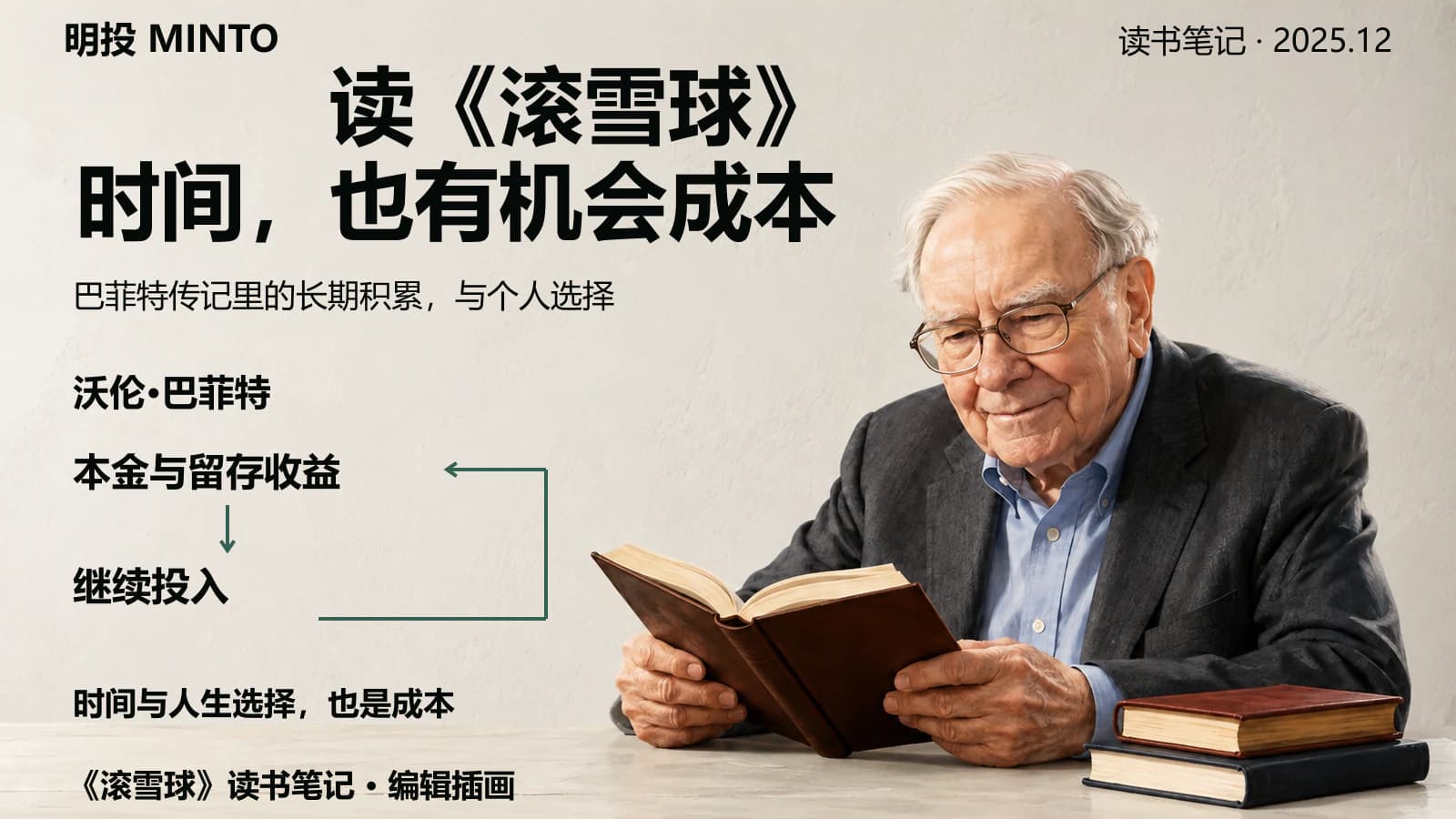
The title comes from Buffett's own metaphor — "Life is like a snowball. The important thing is finding wet snow and a really long hill."
"Wet snow" is high returns; "long hill" is time. Most people fixate on the wet snow (how to find high returns), but Buffett's real secret is the long slope (how to make time long enough).
This is severely underrated. 99% of Buffett's wealth was made after he turned 50. He was already a millionaire at 30, but the real explosion came after 60, 70, 80 — the compounding curve only steepens late.
This means — Buffett's greatest advantage is not his stock-picking ability, but that he lived long and invested continuously for 80 years. From his first stock purchase at age 11 to his 90s, he never stopped. This "long slope" itself is something most people cannot replicate.
My own lesson from this — the enemy of compounding is not insufficient returns, but a "broken slope." Selling in panic, forced liquidation due to life events, abandoning strategy midway — every interruption smashes the snowball and forces a restart. Buffett's real discipline is never letting the slope break for 80 years.
Three: The Hidden Truth — The Personal Cost of Success
The most honest part of this book is that it writes out the cost of Buffett's success.
Buffett poured almost all his attention into investing and business. The cost was extreme clumsiness in intimate relationships. His wife Susie managed the family's emotional needs for years, and eventually moved to San Francisco because she felt neglected (though they never divorced). Susie even arranged for another woman, Astrid, to take care of Buffett's daily life — an unconventional "one husband, two women" arrangement, the least known part of Buffett's private life.
Buffett was also emotionally distant from his children. He could recall financial details of any company, but not the details of his kids' lives.
The book doesn't gloss over any of this. It shows a truth — extreme focus often comes at the expense of other dimensions of life. Buffett is Buffett partly because he devoted almost all his bandwidth to investing — and that allocation had a price.
For investors, this is an important but rarely stated reminder — you want Buffett's returns, are you willing to pay Buffett's price? Most want the former without the latter. But Schroeder's book suggests they might be bundled.
Four: My Reservations About This Book
First, it's too long.
The Chinese edition alone exceeds 1,000 pages. Schroeder records every business detail, every relationship, every transaction in exhaustive depth. That's a treasure for researchers, a burden for ordinary readers. The true core insights probably account for 20% of the book; the rest is overly detailed archival material.
Second, Schroeder's "analyst lens" sometimes overpowers the "biographer's lens."
Schroeder comes from analysis. She breaks down each of Buffett's investments financially. It's professional, but sometimes she gets lost in the numbers, losing the person. A good biography should help you understand why this person lived as he did, not just what he bought and how much he made.
Third, the inherent limitations of an authorized biography.
Though the book is more honest than expected, it is ultimately authorized — Buffett and his circle cooperated. That means certain sensitive areas (controversial business decisions, accusations from opponents) are treated relatively gently. A fully independent biography would be harsher, but also possibly less accurate. That's the eternal dilemma of authorized biographies.
Fourth, it was written in 2008, missing Buffett's final "AI-era" test.
The book stops at the 2008 financial crisis. But Buffett's most controversial judgments — missing tech stocks, not buying Apple until 2016, hesitating in the face of the AI wave — mostly happened after 2008. This book lacks the final and most contradictory chapter of Buffett's career. A complete assessment of Buffett needs the last 15 years.
Five: [object Object] vs. the Shareholder Letters — Two Buffetts
The greatest value of reading The Snowball is to cross-reference it with Buffett's own shareholder letters.
The Buffett in the shareholder letters — the one he wants the world to see: rational, generous, principled, witty. This is the "public Buffett."
The Buffett in The Snowball — the one Schroeder observed: equally rational, but also stingy, focused to the point of coldness, emotionally clumsy, with a strong need for control. This is the "private Buffett."
Both are real. A person can be simultaneously a great investor and an imperfect husband, a generous philanthropist and a stingy spender.
This matters for the reader — don't deify anyone, including Buffett. Treat him as a god, and you'll blindly mimic every word; treat him as a human, and you can distinguish what's worth emulating (discipline, long slope, rationality) from what is his personal cost (emotional distance, extreme focus) and what was his era's luck (being born in 1930s America).
Six: In Closing
The detail that struck me most in this book — young Buffett went door-to-door selling gum, Coke, and newspapers, saving money from age 6. His obsession with compounding wasn't a midlife epiphany; it was a childhood instinct engraved in his bones.
This made me realize an uncomfortable truth — Buffett's "long slope" began at age 6. He has never truly left the business of "saving and rolling a snowball." This near single-dimensional life built his wealth and also defined his limitations.
My biggest takeaway from this book is not investing techniques — those are already in the shareholder letters. The real takeaway is this question: What kind of snowball do I want?
Buffett's snowball is wealth, with the cost being other dimensions of life. But a "snowball" doesn't have to be money — it can be a career, a body of work, relationships, or something else that accumulates over time. The principle of compounding applies to anything: find the hill you're genuinely willing to roll for a lifetime, and never stop.
For Buffett, that hill was money. For me, it might be writing and thinking. For you, it could be something else.
What this book truly taught me is not how to roll Buffett's snowball, but how to find my own hill.
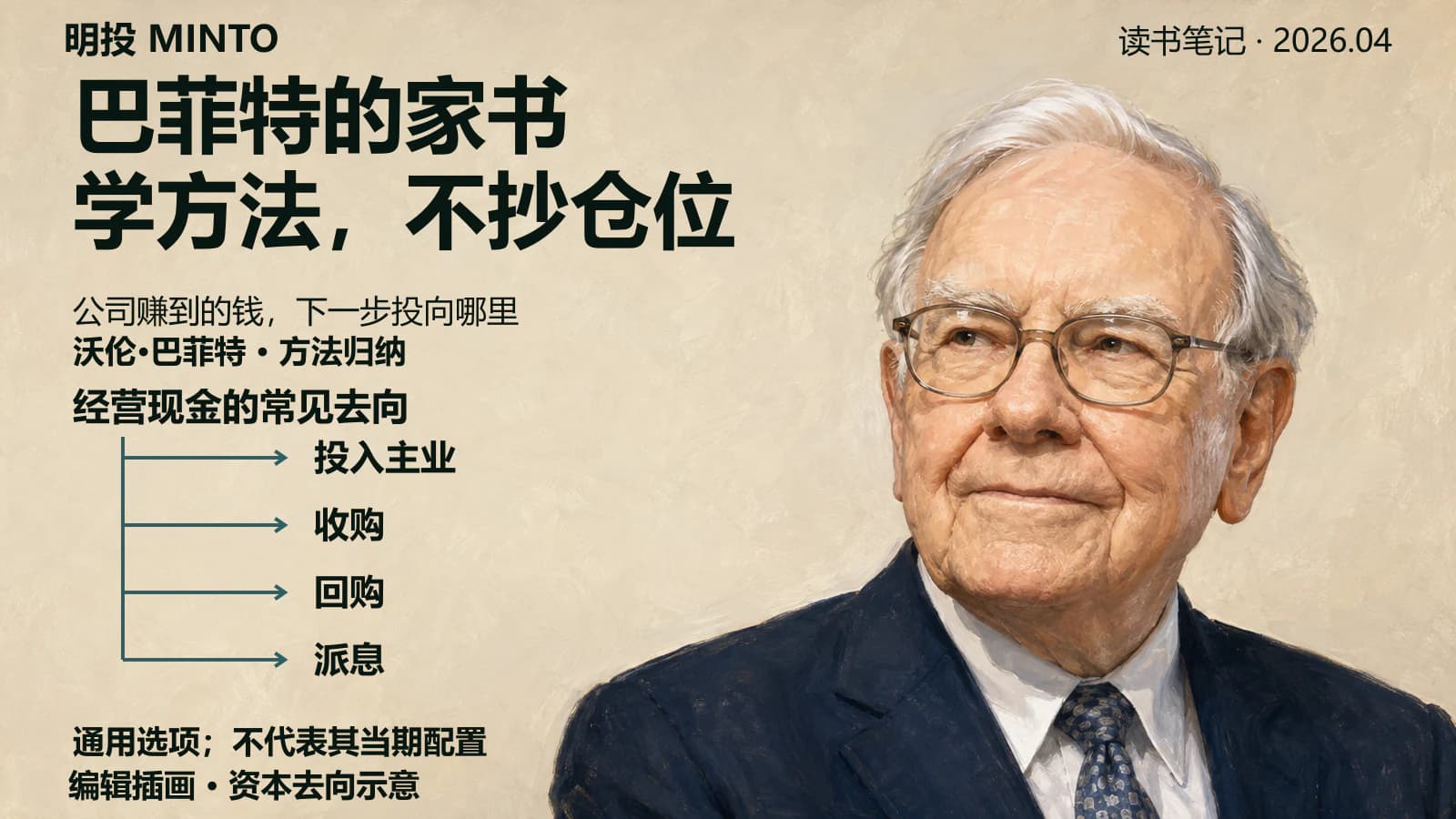
And that is far more important than copying what Buffett buys.