为什么这是世界上最该读的「企业年报」
If you could only pick one document to read for the rest of your life, I'd recommend Warren Buffett's letters to shareholders.
From 1965 to now, six decades. One letter a year, never missed. They're not a tutorial—they're a diary—an old man spending his lifetime putting down on paper how he thinks about companies, markets, and mistakes.
Many people want to read them but can't get through them because they're long—the Chinese translation alone is over 800 pages, and the English original is even thicker. My own approach: don't read from the beginning. Read by topic.
I picked five rules that appear most often and have most changed how I place orders. Here they are, one by one.
第一条:「市场是来服务你的,不是来指导你的」
One of Buffett's most classic lines: Mr. Market is there to serve you, not to instruct you.
The market quotes a price every day, but a quote is not a valuation. A quote is just a neighbor's mood—he quotes high when excited, low when terrified. You don't have to deal with him every day; you only act when his quote gets outrageous.
This sounds simple but goes against human nature.
Most people's first move when they open their phone is to check the market. Red makes them happy, green makes them feel terrible. That's the habit Buffett opposes—he emphasizes you should treat a stock as if you bought the whole company, not a piece of paper you can trade daily.
I ran an experiment: for six months, I deliberately didn't check the market every day—only on the last day of each month. Result: my trading frequency dropped 60%, and returns were above my average in similar environments.
Frequent quotes only lead to more decisions. And most decisions are wrong—this is the most counterintuitive lesson I learned from Buffett.
第二条:与其找一家便宜的好公司,不如花贵一点的钱买一家伟大的公司
Early on, Buffett was Graham's disciple, a classic value investor—looking for cigar butts, picking bargains.
But after Munger came in, his entire framework shifted. From "cheap" to "great."
Munger convinced him with one line (paraphrased): A great company, even if you pay a fair price, will still deliver astonishing long-term returns; a mediocre company, even bought at a fire-sale price, will yield limited returns over time.
That line became Berkshire Hathaway's bible.
In 2026, this rule is even more important than in the 1960s. Because information asymmetry has vanished—the "cheap" you can calculate, the market has already priced in. Real alpha comes from the ability to identify "great," not the ability to identify "cheap."
My core holdings are all in this logic: Apple, Costco, Microsoft, ASML—none of them are cheap. But they are great.
They aren't great because of today's profit, but because ten years from now they'll very likely still exist and be even bigger.
This kind of "compounding with certainty" is worth more than any single bargain hunt.
第三条:「能力圈」比「能力」重要
Buffett repeatedly emphasizes one thing: you don't need to know a lot; you just need to know what you know and what you don't.
He missed Microsoft, missed Google, missed Amazon. Mocked every time. But he never regretted it—his quote: "I didn't fail; I just didn't participate."
A bigger circle of competence isn't better; a clearer boundary is. I see the counterexample among friends all the time—they buy everything: semiconductors, AI, biotech, crypto, commercial space, every sector has a position.
Result? They're deep in none of them, so when any one drops, they can't hold.
My own circle of competence has actually been shrinking over the past two years, not expanding. Sounds counterintuitive—most people do the opposite. But the benefit of shrinking is that my understanding of every company I own is much deeper than five years ago.
When it drops, deep understanding lets you add; shallow understanding makes you cut. That's the difference.
第四条:管理层的资本配置能力,比利润本身更重要
Buffett looks at a company not just for current profit; he looks at something more subtle—how management spends the money the company earns each year.
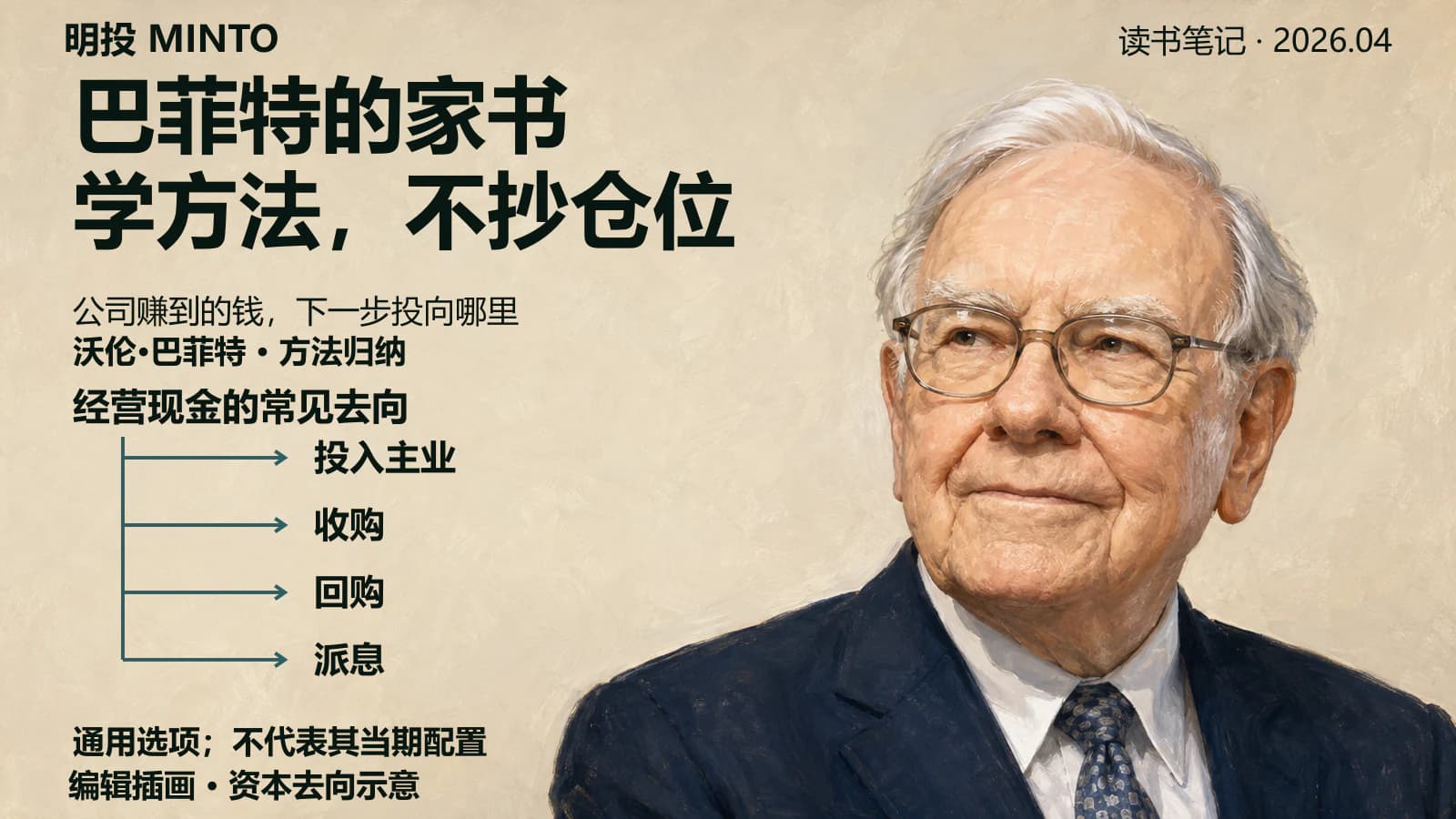
Profit can be used for four things: reinvest in the core business, acquisitions, buybacks, dividends. The choice among these four completely determines compounding speed over the next ten years.
Most management teams spend money in the wrong places—for example, increasing CapEx when returns on the core business have already declined, doing no buybacks at high share prices and stopping them at low prices, or hoarding cash instead of returning it to shareholders.
These are "capital allocation failures." They don't kill a company in a day, but they slow compounding by two gears.
Berkshire itself is a textbook on capital allocation. Buffett and Munger did essentially one thing for 60 years—deploy insurance float into the highest-return opportunities. Wherever the return is highest, they go; no mechanical lock-in.
Apple's buybacks from 2014–2024 are textbook—cumulatively repurchased about one-third of outstanding shares. Cook increased buybacks when the stock was relatively low in 2018–2020 and slowed when valuations were high in 2021–2022. That rhythm itself is alpha.
Counterexample is easy to find: GE bought back USD 25 billion at its all-time high in 2007, then in the 2008 financial crisis had to raise capital by issuing new shares, diluting shareholders—a classic case of "mistimed buyback" that destroyed decades of compounding.
When I analyze a company now, I've added a hard metric: cumulative free cash flow over the past decade vs cumulative buybacks + dividends. If the former is significantly larger than the latter, I get wary—it means management is holding on to cash, likely lacking capital allocation discipline.
第五条:复利不是速度,是耐心
One of Buffett's most underrated rules, hidden in almost every letter—Time is the friend of a good business and the enemy of a mediocre one.
The implication: once you find a good company, the longer you hold, the higher your odds of winning; but if you buy a mediocre company, the longer you hold, the more you get worn down.
This is why Buffett's turnover is extremely low. Not because he's lazy, but because he believes—the best move with the right company is to do nothing.
I've observed my own trade records: most losses don't come from the initial buy decision but from "can't resist trading during the holding period."
Up a lot? Want to take profit. Down a lot? Want to cut loss. No movement for six months? Want to switch positions—every "itch to move" is likely wrong.
Buffett summed it up with an almost anti-intellectual line: "Our favorite holding period is forever."
Sounds exaggerated. But just do the math—Berkshire's most profitable positions were held for over 20 years.
我跟巴菲特不同的地方
I respect Buffett, but after ten years of reading him, I've developed some real disagreements.
First, his "hold forever" posture has been broken by the tech era.
Buffett's most classic holdings: Coca-Cola for 35 years, GEICO nearly permanent, Apple since 2016. This "forever" posture is perfectly valid in consumer, insurance, toll-bridge-type businesses—these have moats with extremely long lives.
But he himself has been repeatedly hit by tech cycles. IBM was one of his biggest mistakes—he started buying around USD 10 billion in 2011, thinking it was "a great company in cloud transition." He exited by 2018 at roughly break-even, lagging the S&P by 70%+. In hindsight, IBM's moat was already eroded by cloud transition, but Buffett didn't admit it until 2017.
What I learned: "Hold forever" applies to sectors with moats lasting 30+ years, not to sectors with technology replacement cycles under 10 years. The AI era has compressed many original "30-year sectors" into "7-year sectors." Buffett was too slow to acknowledge this.
Second, he underestimates concentration risk.
Berkshire's Apple stake once made up 50% of its total equity portfolio. If any institutional investor had that concentration, the compliance department would flag it immediately. But Buffett believes "concentrate on what you're most sure about" is smarter.
This rule works at Buffett's level of cognitive depth. For the vast majority of individual investors, it's dangerous. Because most people's conviction in their "most sure" company far exceeds their actual understanding at depth. Concentration errors are statistically more deadly than diversification errors.
My own prescription: Learn Buffett's method, but don't copy his position sizing. Single position cap at 8-10%, no more.
Third, his no-tech posture from 1990 to 2010 cost him enormous returns.
Buffett barely touched tech from the 1990s to the 2010s. That choice made him miss several of the biggest compounding windows in human history—Microsoft, Amazon, Google, Apple (he didn't get in until 2016). If Berkshire had put just 5% into Microsoft in 1995, that single position's compounding would have added at least several hundred billion dollars to Berkshire's returns over 30 years.
Buffett's response is "I don't make money outside my circle." That posture deserves respect, but the cost is huge. "Not participating" is also a decision, with its own opportunity cost.
Fourth, he doesn't fully acknowledge the role of luck.
Buffett started managing money in 1956, right at the beginning of America's longest postwar capital market supercycle—from 1956 to 2020, the S&P 500 real annualized return was about 7.5%, far higher than most other developed markets. If he had been born in Osaka instead of Omaha in 1956, with the same skill set, the results would have been radically different—the Nikkei from 1989 to 2024 took 35 years just to get back to square one in nominal terms.
Buffett's method is right. But he lived in an era most friendly to his method. He mentions this occasionally, but not often enough. When later generations read him without realizing this, they'll think "value investing" is a universal truth, while it's actually "value investing worked in that particular era."
巴菲特 vs 塔勒布:两种老人的对立
Read enough and you'll see that Buffett and Taleb are implicitly opposed.
Buffett believes "find great companies, concentrate heavily, hold forever"—this is a maximize-expected-value posture. He believes that through research, you can identify truly good companies.
Taleb believes "find convex bets, spread your bets, allow 90% to go to zero"—this is a minimize-probability-of-ruin posture. He believes any research underestimates tail risks.
These two methods reflect fundamentally different assumptions about the knowability of the world.
Buffett believes it's knowable. Taleb believes it's unknowable.
Which is right? My answer: In stable industry structures, Buffett is right; in an accelerating world, Taleb is right. 2026 is a time when the latter proportion is growing. So my own posture: Use Buffett's method to pick stocks, use Taleb's method to manage position size. The two are not contradictory.
写在最后
A common mistake when reading Buffett's letters to shareholders is to treat them as stock recommendations.
That's a waste of the book. 80% of the specific companies he recommended are already obsolete—that was the market of the 1970s, not 2026.
What's truly valuable is that Buffett wrote down, completely, how he thinks about problems.
Not conclusions—the process.
What you should take away is not "what to buy" but "how to judge what to buy."
The distance between these two is far greater than most people imagine.
Buffett lived to 95, and he spent a lifetime proving one thing—the compound interest of slowness beats fast cleverness. But the other side of that coin is: this slow discipline only rolls into compound interest at his scale in an era friendly to such discipline.
The world for the next generation of investors may not be so generous. We must learn his discipline, but also keep going where he left things unsaid.
That's the most valuable way to read this book.
专注投资分析、市场洞察与资产配置。不追短期波动,只理解真正驱动长期回报的东西。