1. A Man Who Fought the Entire Industry
John Bogle founded Vanguard in 1974 and launched the world's first index fund for retail investors in 1976. Wall Street laughed at it—calling it "Bogle's Folly."
Why the ridicule? Because the index fund directly opposed the interests of the entire asset management industry.
How do active funds make money? By charging high management fees and convincing you "we can beat the market." Bogle argued: The vast majority of active funds don't beat the market, and the fees they charge steadily eat away your returns. So the best fund is one that doesn't pick stocks, simply replicates an index, and keeps costs as low as possible.
This cut the industry's lifeline. Even more striking: Bogle structured Vanguard as a company owned by its fund shareholders—meaning he himself could never get really rich from it. He built a trillion-dollar empire and funneled all the profits back to ordinary investors.
In 1999, Bogle distilled his philosophy into Common Sense on Mutual Funds. The core of the book is a single idea: Costs are the only certainty in investing.
2. The Most Counterintuitive Truth: Costs Determine Everything
Most investors focus on returns. Bogle tells you to focus on costs.
His logic is brutally simple: Returns are uncertain; costs are certain. You can't guarantee a fund's return next year, but you are 100% sure it charges you 1.5% every year.
And that 1.5%, compounded, is devastating.
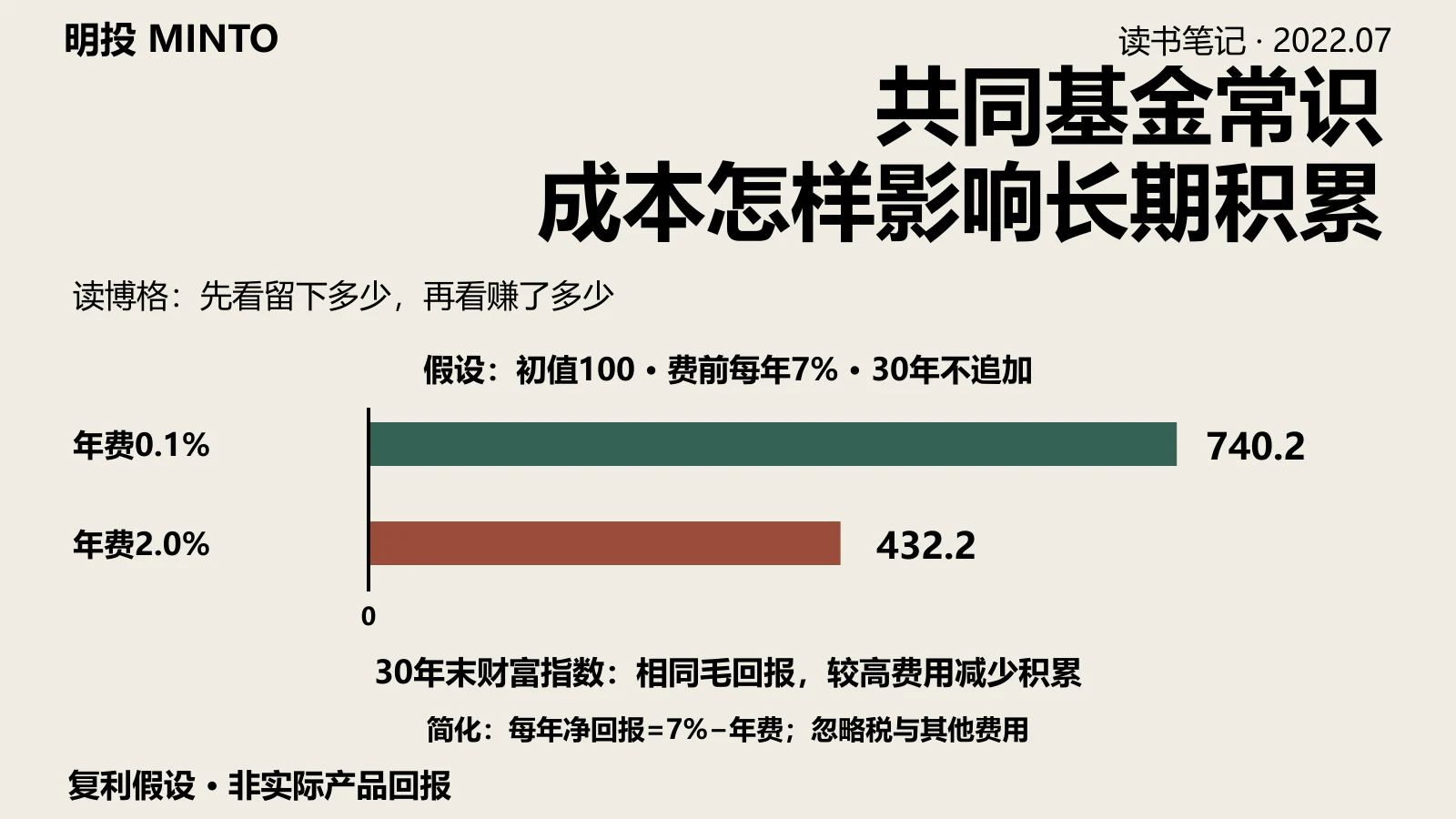
Bogle ran the numbers: Assume an annualized market return of 7%. An index fund charging 0.1% vs. an active fund charging 2%. Over 30 years, the active fund eats nearly half your final wealth. Not a little less—half.
This is the "tyranny of costs." Because costs are taken every year on your entire principal, their long-term destructive power under compounding massively exceeds most people's intuition.
When I look at any fund or investment product, the first thing I do is calculate the total cost—management fees + entry/exit fees + hidden transaction costs + taxes. Many products that look attractive end up underperforming a 0.03%-fee S&P 500 ETF once all costs are deducted. That's the most practical lesson Bogle taught me: before deciding "what to buy," first figure out "how much this thing is eating from me."
3. The Second Insight: Mean Reversion and the "Winner's Curse"
Bogle repeatedly warns: Don't chase funds with good past performance.
The data consistently shows: A fund ranked in the top 10% this year will likely revert to the middle or bottom in a few years. That's mean reversion. Past outperformance is largely luck—remember Taleb's lucky fool? Luck fades.
But investors do the exact opposite: They pile into a fund just after it has soared, then leave in disappointment when it reverts to mediocrity. This "buy high, sell low" behavior means the actual returns ordinary investors earn are far lower than the funds they hold. The gap is called the "behavior gap."
Bogle's solution is simple: Don't pick funds, don't chase performance. Buy a total-market index fund and never touch it. It sounds boring, but it systematically avoids the two biggest traps: mean reversion and the behavior gap.
4. Where I Differ From Bogle
First, his faith in indexing implicitly assumes America always goes up.
Bogle's "buy the index, hold forever, never sell" worked perfectly in U.S. stocks over the past 50 years. But it assumes the index trends upward forever. That assumption holds in the U.S., but not in Japan (35 years with no gain after 1990). Bogle almost never discussed "what if your market is Japan?" Index investing is not a universal truth; it's a truth conditioned on a long bull market in the U.S.
Second, he downplays the starting valuation.
Bogle emphasizes "don't time the market, keep buying." But Shiller's data shows: The valuation at which you enter dramatically affects your returns over the next 10-20 years. Dollar-cost averaging at a CAPE of 35 delivers returns several times lower than doing so at a CAPE of 15. Bogle's "buy regardless of valuation" works in a long bull market, but at extreme highs, it locks in poor long-term returns.
Third, the success of passive investing is creating its own problems.
Indexation, which Bogle created, now accounts for a huge and growing share of U.S. stock trading. When too much money blindly buys indexes, two things happen: constituent stocks become detached from fundamentals (passive money doesn't care about company quality), and the market's price-discovery function degrades (if nobody does research, who sets prices?). The extreme success of indexing may be eroding the market foundations that made it effective. Bogle was aware of this issue late in life but had no solution.
Fourth, he underestimated the concentration accumulating inside indexes.
Bogle said index funds are "diversified." But buying the S&P 500 today means you've effectively put 1/3 of your money into the Mag 7. "Buy the index" is no longer synonymous with "diversify"—it's becoming a hidden concentrated bet on a handful of tech giants. Bogle's index era was far more balanced than today, and his diversification argument needs reexamination.
5. Bogle vs. Buffett: Both Are Right, and They Endorsed Each Other
Intriguingly, Bogle—the father of passive investing—and Buffett—the god of active investing—admired each other.
Buffett wrote in his will that the money left to his wife should be 90% in an S&P 500 index fund. The active investment god's advice to ordinary people is to buy the index. Buffett has said publicly many times: for the vast majority of people, what Bogle did is more valuable than any investment expert.
There's no contradiction. Buffett's point: He can do active investing because he's Buffett; but you are not Buffett, so you should buy the index.
Bogle and Buffett are really describing two sides of the same coin: Active investing can win, but very few people can do it, and you probably aren't one of them; so for most people, passive index investing is the rational choice.
My own stance: Acknowledge that Bogle is right for 90% of my money (buy the index), and only make active bets on the few names I truly understand (a la Buffett). These two aren't adversaries—they're the two ends of a complete strategy.
6. Final Thoughts
John Bogle died in 2019. He built an empire worth over $7 trillion, yet his personal wealth was reportedly only tens of millions—a tiny sum compared to the hundreds of billions in costs he saved ordinary investors.
He could have structured Vanguard to make himself a billionaire, but he chose to let profits flow back to shareholders. In the greedy world of Wall Street, that's almost unbelievable.
That's what moves me most about the book: Bogle spent his life proving you can be an honest person in the financial industry, and that honesty itself creates enormous value.
My biggest takeaway from the book isn't the conclusion "buy the index"—that's common knowledge now. The real lesson is Bogle's stance: Put the investor's interest ahead of your own.
That stance, in today's finance world full of people trying to scam you, is as rare as a luxury good.
Bogle had a line I keep returning to: "In investing, you get what you don't pay for."
It means: The costs you save are the returns you earn.
That counterintuitive sentence is the essence of the book. And it's the single most important thing for ordinary investors to engrave in their minds.

On investment analysis, market insight, and asset allocation — not chasing short-term noise, but understanding what truly drives long-term returns.