1. A Name That Shares Roots with My Pen Name
Let me start with a small personal note — my pen name "Ming Tou Minto" carries the word "Minto," which shares its origin with the author of this book, Barbara Minto. This is no coincidence; it's a tribute — because her book The Minto Pyramid Principle has profoundly shaped how I "think clearly and express clearly."
Barbara Minto was McKinsey's first female consultant. While there, she noticed a problem — many brilliant consultants did excellent analysis, but their reports were unreadable. The problem wasn't the analysis; it was the expression — they couldn't organize complex thinking into a clear structure.
So she created the Pyramid Principle — a method of structured thinking and expression. This became McKinsey's internal bible and later a global standard for business writing and consulting.
But the deepest value of The Minto Pyramid Principle isn't "how to write reports" — it's that it reveals the real reason for unclear expression: you express unclearly not because you can't write, but because you haven't thought it through.
2. The Core of the Pyramid Principle: Conclusion First, Top-Down
The core structure of the Pyramid Principle is extremely simple — any complex idea should be organized into a pyramid:
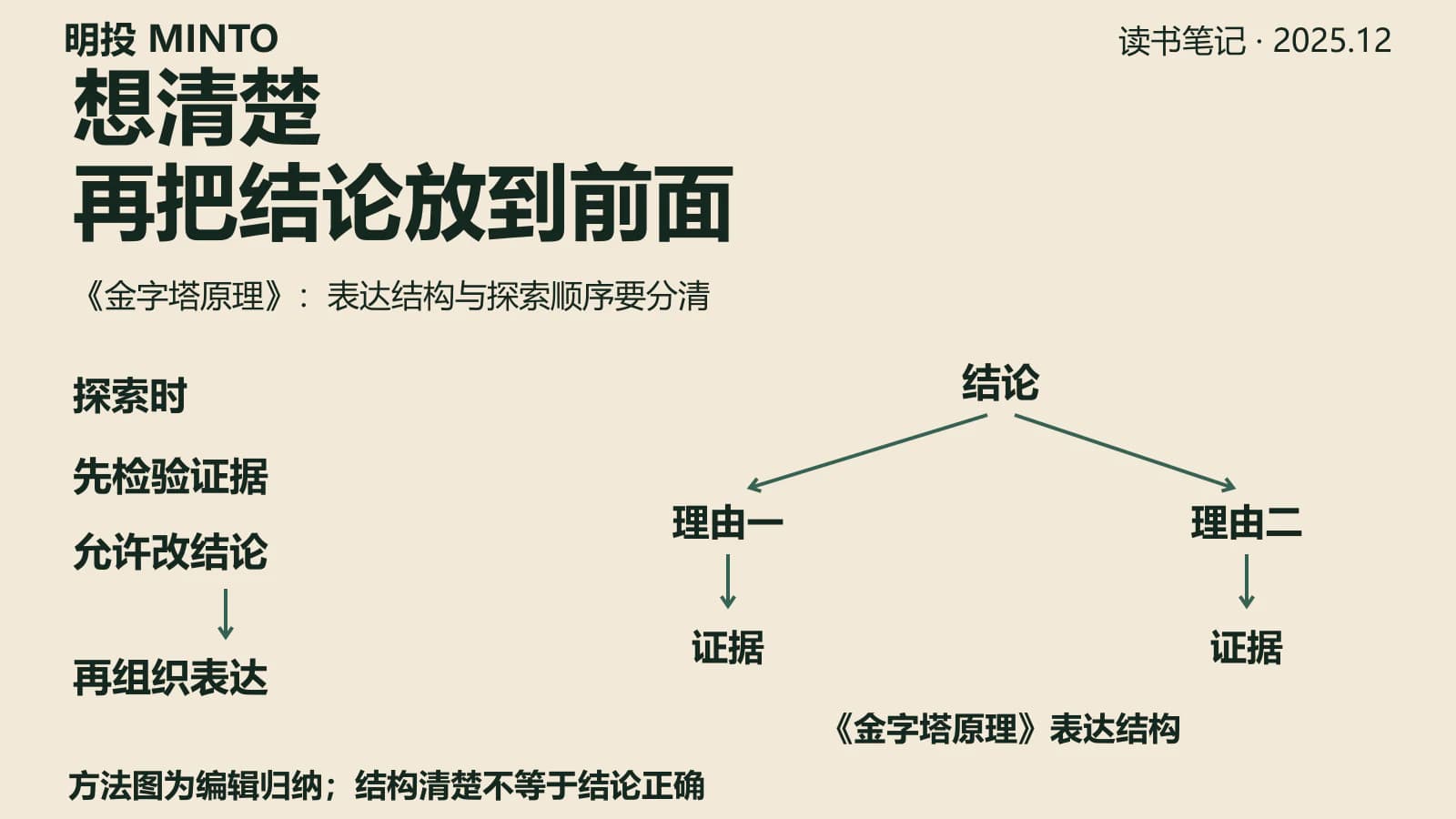
Top: a core conclusion. Below that: a few key arguments supporting the conclusion. Below that: specific evidence supporting each argument.
And the expression order is — conclusion first, top-down: start with the conclusion (the pyramid's top), then the arguments supporting it, then the evidence.
This is the opposite of most people's habit. Most people write (and think) "bottom-up" — they lay out a pile of facts and analysis and only reach a conclusion at the end. The reader has to read a lot to figure out what you're saying.
Minto says — do the reverse. Tell the reader the conclusion first, then unfold the support. This way the reader knows what you're driving at from the start, and everything that follows validates the conclusion.
This is incredibly useful for investment analysis. A good investment thesis should be pyramid-shaped:
Top — the core conclusion (I am bullish/bearish on this company). Middle — 3 or so supporting arguments (moat, valuation, catalysts). Bottom — specific evidence for each argument (data, facts, comparisons).
If you can't organize an investment thesis into a clear pyramid, it often means — you haven't actually thought it through. This is the Pyramid Principle's greatest value for investors: it's a "thinking check tool" — it forces you to test whether you really understand.
3. The Deepest Insight: Expression Problems Are Thinking Problems
On the surface, The Minto Pyramid Principle is a "writing book," but its deepest insight is about thinking —
Unclear expression stems from muddled thinking.
When you try to organize a thesis into a pyramid, you're forced to face several questions: What is my core conclusion (can I say it in one sentence)? What are the key arguments supporting it (do they really support the conclusion)? Does each argument have solid evidence (or is it just a feeling)? Are there logical gaps or overlaps between these arguments?
When you do this "structuring" work seriously, you'll discover holes in your thinking — an argument that has no evidence (just an assumption), two arguments that are essentially the same (repetition), or a conclusion that doesn't hold up (insufficient evidence).
This is the most valuable part of the Pyramid Principle — it doesn't just help you "express"; it helps you "think." The process of structured expression is itself a way to uncover thinking gaps and force yourself to think through an issue.
For investors, this means a very practical method — before making any major investment decision, force yourself to write the thesis as a pyramid (this echoes Dalio's "trade journal" and Munger's "inversion"). When you can't write a clear pyramid — when you can't articulate the core conclusion, list solid arguments, or find a shaky argument — it's telling you: you haven't thought it through yet. Don't make a big bet.
4. Where I Differ from Minto
First, "conclusion first" can be harmful in exploratory thinking.
The Pyramid Principle emphasizes "conclusion first." This works great when expressing a well-thought-out judgment. But when exploring a question you haven't figured out yet, locking down a conclusion too early is dangerous — it leads to confirmation bias, where you only look for evidence that supports your preset conclusion (remember Kahneman). Many of the best insights in investing come from open-ended exploration without preset conclusions. Minto's method suits "expression and validation" but not "exploration and discovery." These two phases require different modes of thinking, and Minto's framework mainly serves the former.
Second, the "pyramid structure" may oversimplify complex reality.
The Pyramid Principle seeks clear, hierarchical structure. But reality (especially investing) is often fuzzy, tangled, and less "structured." Forcing a complex judgment full of uncertainty and interdependencies into a neat pyramid can lose those "hard-to-articulate but important" things (intuition, fuzzy risks, interactions). A beautiful structure sometimes comes at the cost of being honest about complexity. This aligns with my general wariness of forcing complex things into neat boxes.
Third, it's "consulting thinking" with its limits.
The Pyramid Principle was born in McKinsey's consulting context — the goal was "clear persuasion of the client." But "clear persuasion" and "accurate understanding" are not the same. A pyramid that is extremely clear and persuasive can be wrong (the evidence seems solid, but the premise is flawed). Consulting thinking excels at "making an argument convincing," but that "convincingness" itself can be a trap — it makes even wrong judgments seem plausible. Investors must beware — clarity and correctness are two different things.
Fourth, it underestimates the power of narrative and emotion.
The Pyramid Principle is highly rational and logical. But humans (including markets) are driven not only by logic but also by narrative and emotion (remember Shiller, Harari). A purely logical pyramid is strong at "analysis" but has blind spots in "understanding why markets are irrational." To understand investing, you need both Minto's logical structure (to analyze companies) and sensitivity to narrative and emotion (to understand market sentiment). Minto's method is the "brain," but investing also requires a sense of "collective psychology."
5. Minto vs. Drucker: Two Meta-Skills: Expression and Decision
Minto (The Minto Pyramid Principle) and Drucker (The Effective Executive) both talk about a kind of "meta-skill" — not knowledge in a specific domain, but the underlying method of "how to think and work."
Minto's meta-skill is — structured thinking and expression (how to organize ideas clearly). Drucker's meta-skill is — effective decision-making and time management (how to focus on what truly matters and how to make good decisions).
Minto teaches you "how to think clearly and express clearly"; Drucker teaches you "how to do the right things and make good decisions."
Combined, they form the underlying operating system of an "effective thinker" — use Minto's pyramid to structure your judgments (and thereby find thinking gaps and ensure clarity), and use Drucker's methods to focus on truly important decisions and make them well in quiet, deep thought.
For investors, these two meta-skills are invaluable — investing, at its core, is about making a few clear, correct judgments amid massive information and noise. Minto helps you think through the judgment (structured), and Drucker helps you focus on the truly important judgment and do it well. They are not investment knowledge, but they are the "underlying framework" that enables all investment knowledge to be effectively used.
6. Final Thoughts
I chose "Ming Tou Minto" as my pen name in part because of this book's influence on me — it taught me that writing is thinking, and what you haven't thought through, you can't write clearly.
This is fundamental to my investment writing. Every time I want to write an analysis or express a judgment, the Pyramid Principle forces me to first answer — what is my core conclusion (can I say it in one sentence)? What are the key reasons supporting it (do they really hold)? Do I have solid evidence (or is it just a feeling)?
Many times, in this "structuring" process, I've discovered I hadn't actually thought it through — my "judgment" was just a fuzzy feeling that couldn't survive the pyramid's scrutiny. And that discovery is precisely the most valuable — it stops me from turning an unexamined judgment into a heavy investment bet.
This is the deepest gift of the Pyramid Principle to investors — it's a "honest mirror." It forces you to check: you think you've thought it through, but have you really? If you can organize it into a clear, solid, gap-free pyramid, then you've probably thought it through. If you can't — if your pyramid's top is fuzzy, arguments hollow, logic broken — then it's telling you: don't rush to bet; you haven't thought it through yet.
Minto has a phrase that I use as a benchmark for thinking and writing — "Clear writing comes from clear thinking."
The reverse is also true — muddy writing reveals muddy thinking.
For an investor (and writer), this is the simplest and most profound discipline — before you bet, before you express, before you act — write it out as a clear pyramid. If you can't write it, go back, keep thinking, until you can.
This habit is the most important thing I learned from that name that shares roots with my pen name.
It's not sexy, but it gives me one extra check before every major judgment: "Have I really thought this through?"
And that check has saved me from many mistakes I would have otherwise made.

On investment analysis, market insight, and asset allocation — not chasing short-term noise, but understanding what truly drives long-term returns.